Japanese Tower & Chinese Pavilion: Brussels's Forgotten Royal Curiosities
Commissioned by King Leopold II and completed in the early 1900s, the Japanese Tower and Chinese Pavilion in Laeken are two of Brussels's most architecturally eccentric landmarks. Currently closed for structural restoration since 2013, they remain visible from the surrounding park and are worth understanding before any visit to the Laeken royal domain.
Quick Facts
- Location
- Avenue Van Praet 44, 1020 Laeken, Brussels
- Getting There
- Tram 3 or 7 to stop 'Araucaria'; Bus 53 or 83 to stop 'Pagodes/Pagoden' on Avenue Van Praet
- Time Needed
- 20–30 minutes (exterior only; interiors closed)
- Cost
- Free to view from outside; interior closed, no tickets sold
- Best for
- Architecture lovers, history enthusiasts, Laeken royal domain walkers
- Official website
- www.kmkg-mrah.be/en/museums-far-east
What You're Actually Looking At
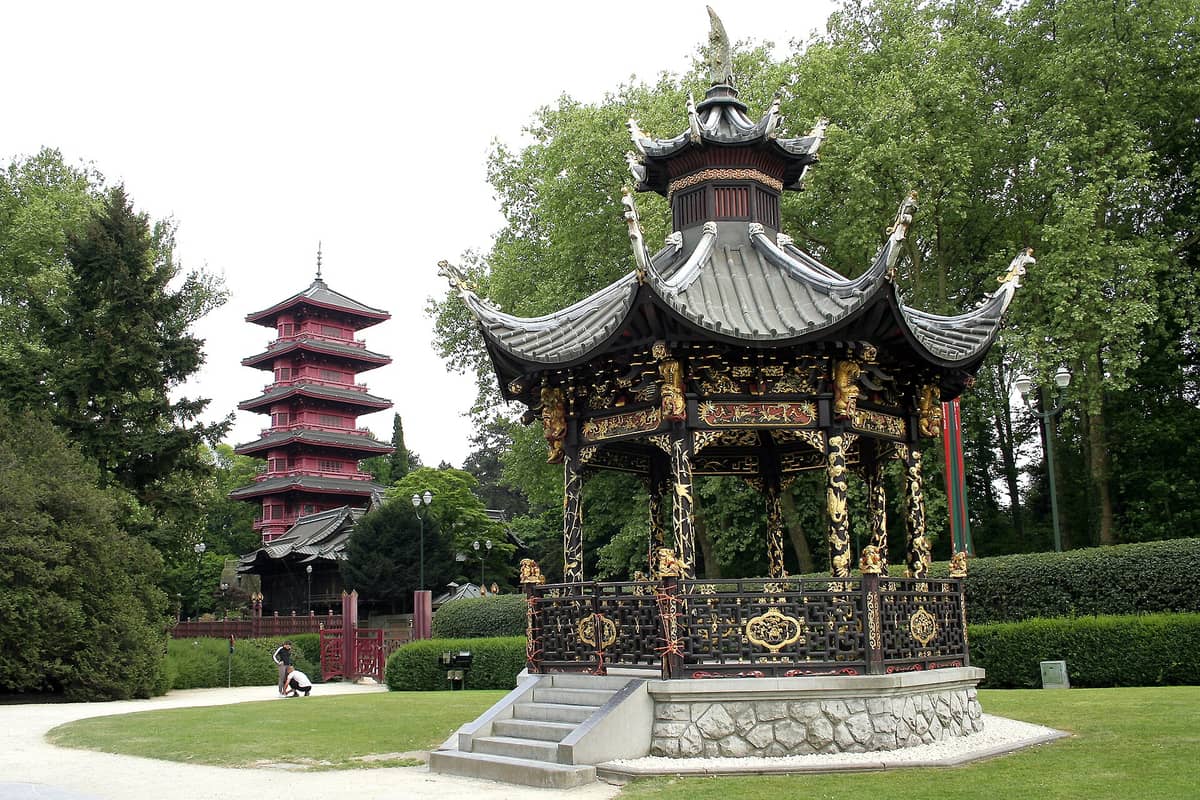
The Japanese Tower and Chinese Pavilion sit side by side on Avenue Van Praet in Laeken, a northern Brussels commune best known as the location of the Belgian royal family's primary residence. From the street and the surrounding park, the two structures are immediately disorienting: a five-storey pagoda-style tower and a richly ornamented Chinese-style pavilion rising unexpectedly above the parkland trees, with no obvious neighbors that share their architectural vocabulary. They look, in the best possible way, like props from two different continents that ended up on the same stage.
The Japanese Tower stands nearly 50 meters tall, its tiered rooflines tapering upward in the manner of a Japanese pagoda, with decorative ironwork and lacquered detailing visible even from a distance. The Chinese Pavilion is lower and wider, its facade covered in Chinese-inspired ornamentation including glazed ceramic tile work, carved woodwork imported from China and Japan, and layered eave structures that catch light differently depending on the time of day. In morning light, the pavilion's tiled roof reflects a greenish-gold tone; by afternoon the shadows emphasize the texture of the carved facades.
⚠️ What to skip
Important: The Japanese Tower and Chinese Pavilion have been closed to visitors since 2013 due to structural safety concerns. No interior access is possible. The park grounds around the buildings remain open, and the exteriors are visible from the park and street, but do not plan a visit expecting to enter. Confirm the current status before any visit, as restoration timelines have not been publicly announced.
The Story Behind the Buildings
Both structures owe their existence to King Leopold II, the Belgian monarch whose ambitions in architecture were as sprawling as his colonial projects. Leopold had visited the 1900 Paris World Exposition and become captivated by the Japanese and Chinese pavilions on display there. He acquired elements from those exhibitions and commissioned permanent versions to be built on his royal estate in Laeken. The Japanese Tower was completed in 1905; the Chinese Pavilion followed, opening in 1913.
The buildings were never straightforward museums from the start. They shifted purposes over the decades: the Chinese Pavilion eventually housed collections of Chinese and Japanese porcelain and decorative arts, while the Japanese Tower contained more architectural display than traditional museum objects. Together with a third building, the Museum of Japanese Art, they were grouped under the name Museums of the Far East, administered under the Royal Museums of Art and History network.
Leopold II's Laeken projects extended well beyond these two buildings. The nearby Royal Greenhouses of Laeken are part of the same royal domain and represent another of his large-scale architectural commissions, in that case a vast complex of glass and iron conservatories. The greenhouses open to the public for only a few weeks each spring, which makes them one of Brussels's most time-sensitive attractions. If you are visiting the Japanese Tower and Chinese Pavilion area, the greenhouses are a natural companion stop.
Tickets & tours
Hand-picked options from our booking partner. Prices are indicative; availability and final rates are confirmed when you complete your booking.
Ghent tour from Brussels
From 43 €Instant confirmationFree cancellationTablet Workshop at Choco-Story Brussels
From 45 €Instant confirmationShared tour of Delft and the Keukenhof Estate from Brussels
From 86 €Instant confirmationFree cancellationOrigins of Brussels exploration game and tour
From 10 €Instant confirmationFree cancellation
The Closure: What Happened and What It Means for Visitors
The buildings were closed to the public in 2013 after structural assessments identified safety concerns in both structures. More than a decade later, they remain closed with no confirmed reopening date. This is not unusual for historic buildings of this construction type: the combination of ornate exterior cladding, early 20th-century building techniques, and decades of deferred maintenance creates complex restoration challenges.
For most visitors, this closure changes the nature of the stop entirely. There is no interior experience to speak of, no collections to browse, and no guided tours currently operating. What remains is an architectural curiosity viewable from the park and the street. For anyone who specifically wants to see the Far Eastern decorative arts collections that were once housed here, the Art and History Museum at the Parc du Cinquantenaire holds related collections and is currently open.
If your interest is in Belgian collections of Asian and African art more broadly, the AfricaMuseum in Tervuren is worth the short journey east of Brussels. It is a far larger institution and underwent its own major restoration, reopening in 2018 with updated curatorial framing. It represents what a serious restoration of a colonial-era museum can look like when completed.
Visiting the Exterior: What You Can See and When
The park grounds surrounding the Japanese Tower and Chinese Pavilion are accessible without charge. The area is quiet on weekday mornings, with dog walkers and occasional cyclists using the paths. On weekend afternoons, particularly in good weather, the Laeken park draws more families and visitors exploring the royal domain, though this is still a far calmer environment than the tourist-heavy center of Brussels.
From the park, you can walk the perimeter of both buildings and get close enough to read the architectural detail. The Chinese Pavilion's carved wooden elements and ceramic work are visible without binoculars. Photography is straightforward from ground level, and the relative height of the Japanese Tower means it can be framed against the sky cleanly from most angles. There is no light pollution in the immediate vicinity, making early morning and late afternoon the best conditions for photography when the sun is lower.
Overcast days, which are common in Brussels given its oceanic climate, actually produce useful even light for photographing the facades, eliminating harsh shadows on the carved surfaces. Rain is possible in any season, so bring a waterproof layer regardless of the forecast. The grounds do not offer extensive shelter.
💡 Local tip
The best exterior photographs of the Japanese Tower are taken from a slight distance to capture all five tiers against the sky. Move away from the fence line rather than shooting upward from directly below.
Getting There and Fitting It Into a Laeken Visit
The complex is at Avenue Van Praet 44, 1020 Laeken. By public transport, tram lines 3 and 7 serve the stop named 'Araucaria' and bus lines 53 and 83 serve the stop named 'Pagodes/Pagoden' on Avenue Van Praet, placing you within a short walk of the entrance to the park grounds. From central Brussels, the journey takes roughly 20 to 30 minutes depending on connections.
Laeken as a whole rewards more than a single-attraction visit. The neighborhood sits within the broader Laeken district, which includes the Royal Palace of Laeken (not open to the public), the Royal Greenhouses, the Atomium, and Mini-Europe all within a walkable or short-transit radius. Combining the Japanese Tower and Chinese Pavilion exterior with the Atomium makes for a coherent half-day focused on this northern part of Brussels.
The Atomium is roughly 15 minutes on foot from the Japanese Tower and Chinese Pavilion site and is fully open to visitors. If you are making the trip north to Laeken specifically, combining the two stops makes practical sense and balances a closed exterior-only site with one that has substantial interior content.
Historical and Architectural Context
Leopold II's decision to build these structures reflected a broader European fascination with Asian aesthetics that characterized the late 19th and early 20th centuries. Japonisme and chinoiserie were fashionable across Western Europe, and World Expositions in Paris and elsewhere had exposed wealthy patrons and royalty to architectural forms from East Asia, often filtered through European interpretations rather than direct cultural exchange.
The Japanese Tower is not an accurate replica of a Japanese pagoda in strict architectural terms, but it draws clearly on pagoda design principles, with timber-framed upper sections and bracketed eaves. Elements were reportedly sourced from the 1900 Paris Exposition itself. The Chinese Pavilion was assembled using woodwork and decorative components manufactured in China and shipped to Belgium, giving it a somewhat more authentic material basis, though the overall composition remains a European royal interpretation of Chinese architecture rather than a Chinese building in any formal sense.
For context on how Brussels has approached its collections of historical and decorative arts from this era, the Art and History Museum at Parc du Cinquantenaire provides important comparative material. That museum's collections overlap thematically with what was once displayed in the Chinese Pavilion, and it is currently accessible.
Who Should and Should Not Make the Trip
If you are visiting Brussels for a short time and prioritizing interior museum experiences or major open attractions, the Japanese Tower and Chinese Pavilion should not be high on your list in their current state. The closure means the stop offers exterior architecture only, and the journey to Laeken from central Brussels requires a deliberate transit trip of 20 to 30 minutes each way.
Travelers who are already planning to visit the Atomium or the Royal Greenhouses of Laeken will find the addition of a short detour to the Japanese Tower and Chinese Pavilion worthwhile, particularly if architecture or early 20th-century royal history is a specific interest. Those focused primarily on art collections should instead prioritize open institutions such as the Royal Museums of Fine Arts or the Magritte Museum in the Royal Quarter.
Insider Tips
- Combine this stop with the Atomium and Mini-Europe on the same half-day trip north; all three are within a 15-minute walk of each other in Laeken, and the Atomium provides the substantial interior experience that the closed pavilions currently cannot.
- Check the Royal Museums of Art and History website (kmkg-mrah.be) before visiting, as this is the official managing institution and will be the first to announce any change in the reopening status of the buildings.
- The best unobstructed views of the Japanese Tower's full height are from the park path that runs roughly parallel to Avenue Van Praet; getting too close to the fence line cuts off the upper tiers.
- If you arrive by tram, use the 'Pagodes/Pagoden' stop name as a navigator: it refers directly to these buildings and confirms you are in the right place even if local signage is sparse.
- The surrounding park is calm and well-maintained, making it a reasonable spot to pause on a Laeken walk even if the buildings themselves are inaccessible. Bring water, as there are no facilities immediately adjacent to the site.
Who Is Japanese Tower & Chinese Pavilion For?
- Architecture enthusiasts interested in European interpretations of East Asian design from the early 1900s
- Travelers already visiting Laeken for the Atomium, Royal Greenhouses, or royal domain
- History researchers tracing King Leopold II's architectural projects across Brussels
- Photographers looking for unusual exterior subjects away from the central tourist circuit
- Visitors building a broader picture of Brussels's royal and colonial history
Nearby Attractions
Other things to see while in Laeken:
- Design Museum Brussels (ADAM Design Museum)
Design Museum Brussels, located steps from the Atomium in the Laeken district, turns everyday objects into cultural statements. From mid-century plastic furniture to contemporary fashion, this museum makes a compelling case for design as a serious art form — and it rarely gets the crowds its quality deserves.
- Atomium
Built for the 1958 World's Fair, the Atomium is Brussels' most recognizable landmark: a steel structure representing an iron crystal magnified 165 billion times. Here is everything you need to know to make the most of your visit.
- Mini-Europe
Mini-Europe packs over 80 scale-model landmarks from across the EU into a single walkable park in Brussels's Laeken district. It is a genuinely engaging experience for families and Europe enthusiasts, though adults visiting alone may find the novelty fades faster than the entry price suggests.
- Royal Greenhouses of Laeken
The Royal Greenhouses of Laeken are among the most extraordinary glass-and-iron structures in Europe, open to the public for only a few weeks each spring. This guide covers what you'll see inside, how to secure your tickets, and whether the visit lives up to the anticipation.