Royal Greenhouses of Laeken: The Complete Visitor Guide to Brussels's Rarest Opening
The Royal Greenhouses of Laeken are among the most extraordinary glass-and-iron structures in Europe, open to the public for only a few weeks each spring. This guide covers what you'll see inside, how to secure your tickets, and whether the visit lives up to the anticipation.
Quick Facts
- Location
- Avenue du Parc Royal 61, 1020 Brussels (Laeken)
- Getting There
- Tram 7 (Heysel stop, for Atomium); several bus lines serve Laeken
- Time Needed
- 1.5 to 2.5 hours
- Cost
- €7 per adult (13+); children under 12 enter free but still need a reserved ticket. Tickets must be booked online in advance — not available at the gate.
- Best for
- Architecture lovers, garden enthusiasts, Belgian history, spring visitors
- Official website
- www.koninklijke-serres-royales.be/en
What Makes This Place Extraordinary
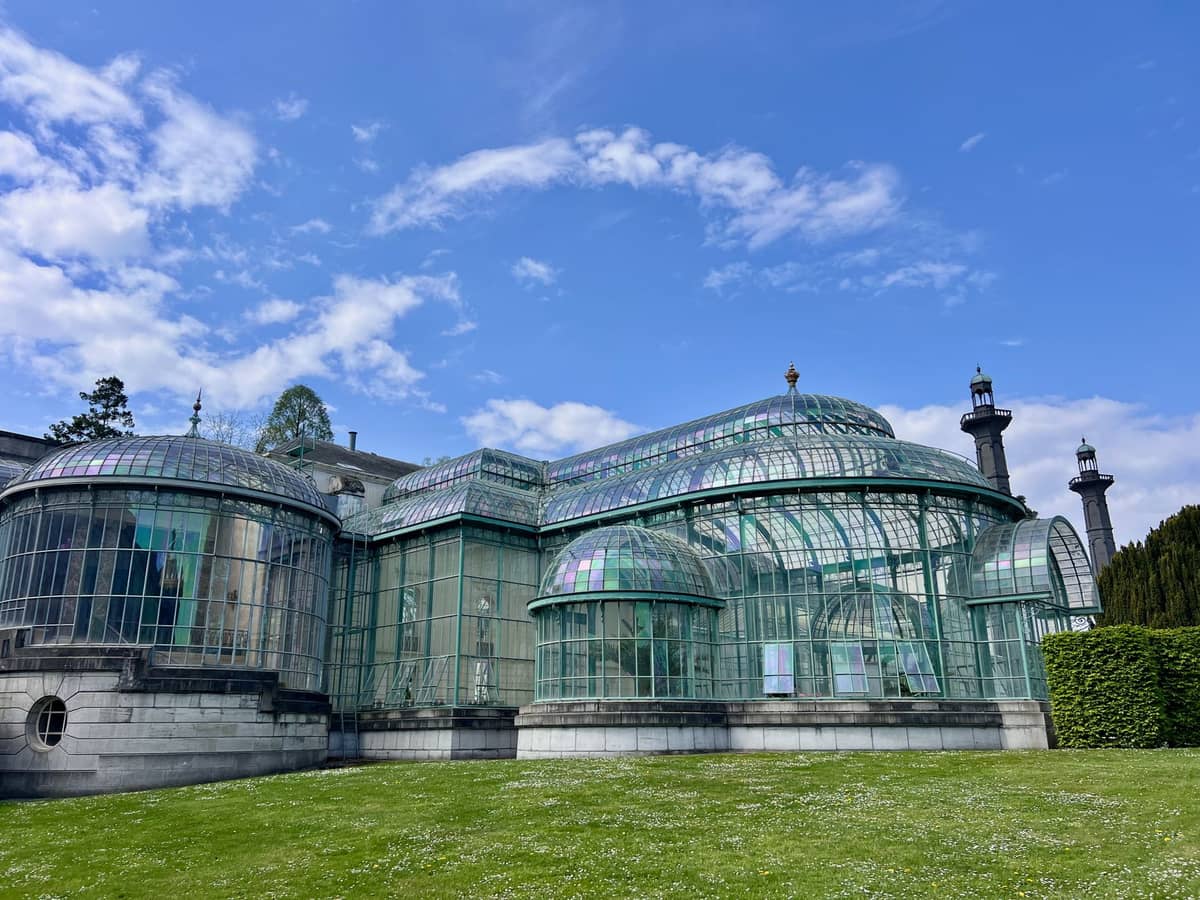
The Royal Greenhouses of Laeken (French: Serres royales de Laeken; Dutch: Koninklijke Serres van Laken) form one of the largest and most architecturally significant greenhouse complexes in Europe. Covering around three hectares of glass-and-iron structures, they sit within the Royal Domain of Laeken, the private estate of the Belgian royal family on the northern edge of Brussels. The word that keeps coming up among visitors is scale: these are not the modest municipal conservatories you find in most cities. The sequence of domes, galleries, and connecting corridors stretches far beyond what a single photograph can capture.
The catch, and it is a significant one, is access. The greenhouses open to the public for only about three weeks each spring, typically between mid-April and mid-May. Outside that window, they remain strictly closed as part of the functioning royal estate. This creates an annual ritual in Brussels: locals who have never bothered with other tourist sites queue for tickets the moment they go on sale. For visitors timing a trip to coincide with the opening, the effort is almost always rewarded.
⚠️ What to skip
Tickets cannot be purchased at the gate. You must book online in advance at koninklijke-serres-royales.be. During popular opening weekends, tickets sell out days ahead. Check the official site as soon as the season's dates are announced, usually in late winter.
History and Architectural Context
The greenhouse complex was developed primarily during the reign of King Leopold II, who also commissioned the Laeken Royal Domain's broader expansion in the late 19th century. Leopold had an obsessive interest in iron-and-glass architecture, then at its Victorian peak, and the greenhouses reflect that era's confidence in engineering ambition. The structures combine classical symmetry with the industrial grammar of cast iron: soaring cupolas, ribbed vaulting, arched galleries, and acres of glass panes held in delicate metal frames.
The complex connects multiple distinct pavilions, each designed to maintain different climatic conditions for different plant collections. The most recognizable element is the great central Winter Garden dome, whose interior volume produces a specific quality of diffuse light that no photograph accurately reproduces. The ironwork has the decorative density of the period, with foliate motifs cast into structural elements that also carry load, a characteristic of the best 19th-century greenhouse architecture.
The Laeken neighborhood itself carries considerable architectural weight. Within a short radius you have the Atomium, the Basilica of the Sacred Heart, and the Japanese Tower and Chinese Pavilion, all products of the same late 19th and early 20th century royal building programme. Visiting Laeken gives a coherent picture of how Belgium's monarchy used architecture as a statement of national ambition at a moment of rapid industrialization.
Tickets & tours
Hand-picked options from our booking partner. Prices are indicative; availability and final rates are confirmed when you complete your booking.
Ghent tour from Brussels
From 43 €Instant confirmationFree cancellationTablet Workshop at Choco-Story Brussels
From 45 €Instant confirmationShared tour of Delft and the Keukenhof Estate from Brussels
From 86 €Instant confirmationFree cancellationOrigins of Brussels exploration game and tour
From 10 €Instant confirmationFree cancellation
What You Actually See Inside
The visitor route threads through interconnected pavilions, each with its own character. The plant collections include camellias in full spring bloom, azaleas in dense banks of color, giant palms whose fronds brush the upper ironwork, tree ferns, begonias, and a range of subtropical species that have been cultivated here for well over a century. Some individual specimens are genuinely old, survivors from the original Leopold-era collections.
The scale shifts constantly as you move between spaces. Low, tunnel-like corridors of flowering azaleas open suddenly into high-domed halls where palms reach fifteen meters or more. The transition from confined passage to tall open volume is one of the recurring pleasures of the route. The smell changes too: warm mineral dampness in the older iron sections, something closer to tropical leaf and bark in the palm houses, and the distinctive sweet density of azaleas where they are planted in solid blocks.
The route is partially outdoors, crossing formal garden sections between the greenhouse buildings. On clear spring days these outdoor stretches allow you to see the dome and roof profiles from a distance, which helps you understand the complex's true footprint. On overcast days, the diffuse Belgian light softens colors inside the glasshouses in a way that can actually be more flattering than direct sun.
💡 Local tip
Wear layers. The interior is noticeably warmer and more humid than outside, particularly in the palm houses. A light jacket you can tie around your waist is ideal; wool coats become uncomfortable quickly.
Daytime Visits vs. Evening Nocturnes
On most days, the entrance gates close in the late afternoon, so the latest practical entry is early to mid-afternoon. On certain weekdays, closing time extends slightly later. The daytime experience is the standard visit: natural light through the glass, the plants in their full photosynthetic vitality, and the architectural frames clearly visible against sky.
Evening nocturne visits, offered on selected dates during the season, are a completely different proposition. The greenhouses are artificially lit from within, and the glass domes glow against a darkening sky. Inside, uplighting picks out ironwork and plant forms that are less visible in flat daylight. The crowd is typically smaller and moves more slowly. If you can choose between a daytime slot and an evening one, the nocturne is worth the slight additional planning effort, provided the weather cooperates: rain against glass panes can create its own atmosphere, but the outdoor sections between buildings become less comfortable.
ℹ️ Good to know
Evening nocturne dates are limited and announced on the official website. Entrance gates for nocturne visits close in the later evening; confirm exact times, dates and available slots when booking, as they are typically not available every day of the season.
Getting There and Practical Planning
The entrance is at the Grilles d'Honneur (Gates of Honour) on Avenue du Parc Royal 61, 1020 Brussels. Tram 7, which also serves the Atomium at Heysel, stops nearby. Several bus lines connect Laeken to the city centre and northern districts. Confirm current routes with STIB/MIVB before your visit, as service patterns can change.
The greenhouses are closed on Mondays throughout the opening season, except Easter Monday when it falls within the period. This is worth noting if you are planning around a long weekend. Arriving close to opening time on weekday mornings typically means smaller crowds than weekend afternoons. If you visit on a weekend, arrive early: the flow of visitors through the fixed route can slow noticeably once the middle of the day approaches.
For broader context on planning a spring trip to Brussels, the best time to visit Brussels guide covers how April and May balance mild temperatures with major events including the greenhouse opening. Brussels in spring averages highs of 14–18°C, which is comfortable for walking between the outdoor sections of the route.
Accessibility
The standard visitor route includes stairs and slopes and is not suitable for wheelchairs. However, one dedicated day during the opening season is reserved exclusively for visitors with reduced mobility and their companions, with an adapted route and assistance at points that would otherwise be inaccessible. Disability parking card holders can use reserved spaces at Parking Dynastie, opposite the main entrance of the Royal Domain, as long as places are available. Check the official site when booking to confirm the date of the accessibility day for the current season.
Photography and What to Bring
The greenhouses are highly photogenic, but the conditions require some adjustment. The combination of bright glass overhead and relatively darker plant masses below means auto-exposure tends to overexpose the sky or underexpose the foreground. Shooting in manual mode or using exposure compensation to protect the plants from underexposure gives better results. The ornate ironwork against backlit glass is particularly effective in black and white.
Tripods are not generally practical in the narrow passages, and the movement of other visitors makes long exposures difficult. A camera or phone capable of good high-ISO performance handles the lower-light sections of the palm houses well. The evening nocturnes present the opposite challenge: artificial lighting creates strong color temperature contrasts between warm interior light and the cooler blue of remaining dusk sky visible through the glass.
For anyone interested in Brussels's broader architectural heritage, combining the greenhouses visit with a walk through the Art Nouveau buildings of nearby neighborhoods provides a coherent half-day itinerary. The Art Nouveau Brussels guide covers the best routes and key facades in detail.
Is It Worth Your Time? Honest Assessment
For visitors with any interest in 19th-century architecture, botanical collections, or the history of European royal estates, the Royal Greenhouses of Laeken are genuinely impressive. The scale of the complex, the quality of the ironwork, and the sheer age and size of some plant specimens create an experience that is difficult to replicate elsewhere.
That said, this is not a visit for everyone. The route takes between 90 minutes and two and a half hours to walk properly, much of it on uneven surfaces and stairs. If botanical collections hold no interest for you and you are visiting primarily for the architecture, the experience may feel repetitive before you reach the end. The advance booking requirement and the strict seasonal window add friction that some travelers will find off-putting.
Families with children who enjoy outdoor spaces will generally find it works well, provided children are mobile enough for the stairs and slopes. For other family-friendly options in Brussels, see the Brussels with kids guide.
Insider Tips
- Book tickets the moment they go on sale for the current season — the official site is koninklijke-serres-royales.be. Weekend slots and evening nocturne dates disappear first, sometimes within hours of release.
- Weekday mornings in the first week of opening tend to draw the smallest crowds. Avoid the final weekend of the season, which is traditionally the busiest.
- The outdoor sections between the greenhouse buildings give the best views of the dome profiles. Pause here rather than rushing between interiors — these perspectives are underappreciated and hard to photograph from inside.
- If you are visiting Laeken anyway, be aware that the Japanese Tower and Chinese Pavilion nearby are currently closed to the public, though they still form part of the broader architectural story of Leopold II's building ambitions.
- Bring a small bag rather than a large backpack. The narrower connecting passages can feel cramped when multiple visitors are moving through simultaneously, and a compact bag makes navigation easier.
Who Is Royal Greenhouses of Laeken For?
- Architecture and design enthusiasts with an interest in 19th-century iron-and-glass construction
- Garden and botanical visitors who want to see historic plant collections in their original setting
- Photographers looking for challenging, unusual interior and structural subjects
- Travelers in Brussels specifically in April or May who want something beyond the standard city-centre circuit
- Couples looking for a distinctive and unhurried afternoon outside the tourist core
Nearby Attractions
Other things to see while in Laeken:
- Design Museum Brussels (ADAM Design Museum)
Design Museum Brussels, located steps from the Atomium in the Laeken district, turns everyday objects into cultural statements. From mid-century plastic furniture to contemporary fashion, this museum makes a compelling case for design as a serious art form — and it rarely gets the crowds its quality deserves.
- Atomium
Built for the 1958 World's Fair, the Atomium is Brussels' most recognizable landmark: a steel structure representing an iron crystal magnified 165 billion times. Here is everything you need to know to make the most of your visit.
- Japanese Tower & Chinese Pavilion
Commissioned by King Leopold II and completed in the early 1900s, the Japanese Tower and Chinese Pavilion in Laeken are two of Brussels's most architecturally eccentric landmarks. Currently closed for structural restoration since 2013, they remain visible from the surrounding park and are worth understanding before any visit to the Laeken royal domain.
- Mini-Europe
Mini-Europe packs over 80 scale-model landmarks from across the EU into a single walkable park in Brussels's Laeken district. It is a genuinely engaging experience for families and Europe enthusiasts, though adults visiting alone may find the novelty fades faster than the entry price suggests.