Atomium Brussels: What to Expect Before You Visit
Built for the 1958 World's Fair, the Atomium is Brussels' most recognizable landmark: a steel structure representing an iron crystal magnified 165 billion times. Here is everything you need to know to make the most of your visit.
Quick Facts
- Location
- Place de l'Atomium 1, 1020 Brussels (Laeken)
- Getting There
- Metro line 6 to Heysel/Heizel, then a short walk
- Time Needed
- 1.5 to 2.5 hours
- Cost
- Adults €17 / Seniors €15 / Under 17 & students €9 / Under 115 cm free
- Best for
- Architecture lovers, families, design history enthusiasts
- Official website
- atomium.be
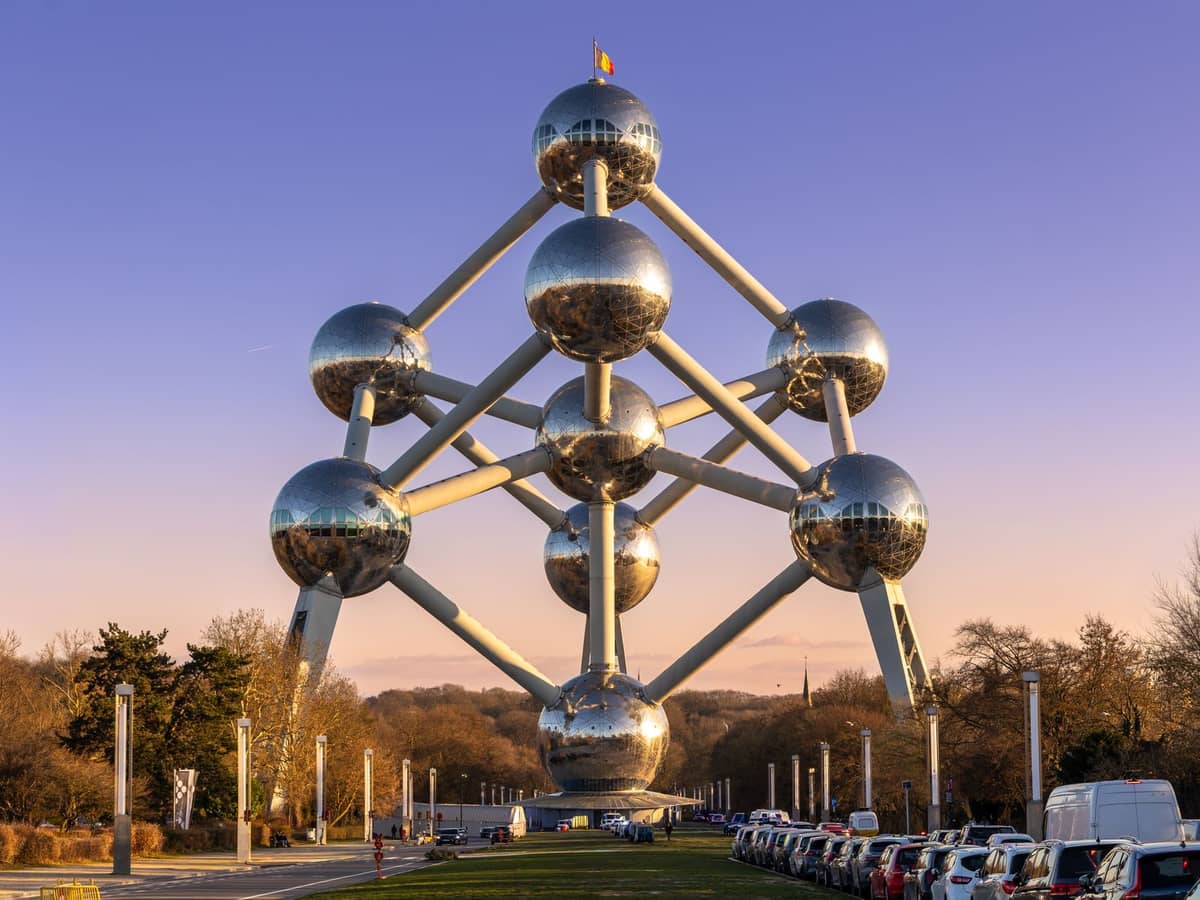
What the Atomium Actually Is
The Atomium is a 102-metre-tall structure in the Laeken district of Brussels, built as the centrepiece of the 1958 Brussels World's Fair, known as Expo 58. It represents a unit cell of an iron crystal enlarged 165 billion times, with nine steel spheres connected by tubes containing escalators, staircases, and exhibition spaces. It was designed by engineer André Waterkeyn and architects André and Jean Polak, and it was never intended to be permanent. The fact that it is still here, and still drawing crowds, says something about how thoroughly it captured the optimism of its era.
The Cold War context matters. Expo 58 was the first large-scale World's Fair after World War II, and the Atomium was a deliberate symbol: nuclear energy as a force for peace, science as humanity's path forward. That idealism is baked into every rivet. Visiting it today means standing inside a piece of postwar idealism that has somehow aged into genuine charm.
ℹ️ Good to know
The Atomium is open every day from 10:00 to 18:00 (last entry 17:30). On 24 and 31 December hours are reduced to 10:00–16:00 (last entry 15:30). On 25 December and 1 January it opens at 12:00 and closes at 18:00 (last entry 17:30). Check the official site for exceptional closures before you go.
Arriving at the Atomium: First Impressions
The walk from Heysel metro station takes roughly five minutes along a wide avenue, and the structure appears before you have rounded any corner: there is no gradual reveal. The scale is genuinely surprising even if you have seen it in photographs. In morning light the polished stainless steel panels catch the sun unevenly, so certain spheres appear to glow while others stay matte grey. In overcast weather, which is common in Brussels for much of the year, the whole structure takes on a more industrial quality.
The esplanade in front is spacious enough that early visitors (roughly 10:00 to 11:00 on weekdays) can walk the full perimeter of the base without navigating large crowds. By midday in peak season the forecourt becomes noticeably busy, with tour groups often arriving en masse between 11:00 and 13:00. Weekday mornings in spring or early autumn offer the most comfortable outdoor experience.
The Atomium sits within the wider Laeken area, which is also home to the Royal Greenhouses of Laeken and the Japanese Tower and Chinese Pavilion. Budget a full half-day if you want to combine more than one of these sites.
Tickets & tours
Hand-picked options from our booking partner. Prices are indicative; availability and final rates are confirmed when you complete your booking.
Atomium Brussels self-guided audio tour
From 10 €Instant confirmationGhent tour from Brussels
From 43 €Instant confirmationFree cancellationTablet Workshop at Choco-Story Brussels
From 45 €Instant confirmationShared tour of Delft and the Keukenhof Estate from Brussels
From 86 €Instant confirmationFree cancellation
Inside the Structure: The Escalators, Spheres, and Exhibitions
Entry is at the base sphere. From there, a central escalator runs through the connecting tubes up through the middle of the structure. The tubes are narrow and the escalators are slow, which means you are suspended at an angle, inside a steel cylinder, looking up or down through a transparent floor panel at considerable height. People react differently to this: some find it thrilling, others find it uncomfortable. If you have any hesitation around enclosed spaces or heights, factor that in.
Each accessible sphere contains something different. Some house permanent exhibitions on Expo 58 itself, with original design objects, archive photographs, and explanatory panels that give the visit genuine historical substance. Others are used for temporary exhibitions, which change regularly, so what you find on arrival may differ from what is described in older reviews. The exhibition quality has improved considerably since a major renovation completed in 2006, which replaced the original aluminium cladding with stainless steel and upgraded the interior spaces.
The top sphere contains a panoramic restaurant and an observation deck. On a clear day you can see the Royal Palace of Laeken, the Basilica of the Sacred Heart to the south, the low-rise residential fabric of the Brussels-Capital Region spreading to the east, and on exceptional days, further. The horizon in this direction is mostly flat, so the view is wide rather than dramatic. It is more interesting for orientation than for photography, though light at late afternoon in summer can be attractive.
💡 Local tip
Book entry tickets online in advance, especially for weekend visits in spring and summer. The queue at the ticket desk can add 20–30 minutes to your morning.
How the Experience Changes by Time of Day
At opening (10:00), the Atomium is at its quietest. The escalators run smoothly without queuing, the spheres feel spacious, and the quality of available light inside is cool and clear. Staff are generally unhurried. This is the best window if the exhibitions matter to you, or if you want to move at your own pace through the tubes.
By midday, especially on weekends, the internal circulation gets congested. The escalators run continuously but the single-file tubes mean bottlenecks form at sphere entrances. Young children find the confined spaces exciting; adults travelling alone may find them frustrating. If you arrive between noon and 14:00 on a busy day, managing expectations helps.
Late afternoon offers a different quality: crowds thin from around 15:30 onwards, the low westerly sun hits the steel exterior at a low angle, and the top-sphere view benefits from warmer light. The ticket office closes at 17:30 and the structure empties quickly after that, so a 15:00 arrival gives you a quieter two hours than a morning slot on a peak day.
Practical Information for Your Visit
Getting There
Metro line 6 runs from the city centre to Heysel/Heizel station. From Brussels-Central, the journey takes around 20–25 minutes. The station exit deposits you on Boulevard du Centenaire, from which the Atomium is visible and an easy five-minute walk. Trams and several bus lines also serve the Heysel area; check current STIB/MIVB schedules before your visit as routing can change.
If you are arriving from central Brussels and want to understand the wider transit system, the getting around Brussels guide covers metro, tram, and bus options in detail.
Ticket Prices
- Adults (18–59): €17
- Seniors (65+): €15
- Students and people with reduced mobility: €9
- Youth (over 115 cm, up to 17 years): €9
- Children under 115 cm: free
- Combined Atomium + Mini-Europe ticket: €35 for adults (available at the ticket office)
Mini-Europe, located immediately adjacent to the Atomium, is worth considering if you are visiting with children. The Mini-Europe guide covers what to expect there.
Accessibility
The Atomium provides reduced-price tickets for visitors with reduced mobility. However, the structure itself presents real challenges: the connecting tubes rely on escalators, and movement through the spheres involves narrow passages. Visitors with significant mobility limitations should consult the official site directly before planning a visit, as the experience of the upper spheres may not be fully accessible.
Photography
The exterior is the strongest photographic subject. A position roughly 100 metres south of the base, on the esplanade, gives a full view of the structure with enough foreground to establish scale. At night, the Atomium is lit and photographed frequently, though the lighting design is straightforward rather than spectacular. Interior photography is generally permitted in exhibition spaces; verify restrictions at each sphere entrance, as temporary exhibitions may have different rules.
Is It Worth Your Time?
The Atomium is genuinely one of the more interesting 20th-century landmarks in Europe. The Expo 58 exhibitions give it historical depth that a purely architectural visit would miss. At €17 for adults, it is priced toward the higher end for Brussels attractions, but the combination of architecture, postwar design history, and the kinetic experience of the escalator tubes makes it more layered than most comparable landmark towers.
That said, visitors who primarily want a panoramic view will find the top sphere observation platform less impressive than expected. Brussels is relatively flat and there are no dramatic foreground elements to anchor the view. For pure panoramas, the Mont des Arts terrace or other city-centre viewpoints may offer more immediate urban impact.
If you are building a broader Brussels itinerary, the 2-day Brussels itinerary pairs the Atomium efficiently with the Laeken area and the city centre on a single day.
⚠️ What to skip
The Laeken area is several kilometres from the Grand-Place and the main central districts. Do not underestimate travel time. Metro line 6 is reliable, but combining an Atomium visit with a full central Brussels day requires realistic scheduling.
Insider Tips
- The café inside the base sphere is a practical stop but unremarkable. If you want a proper meal in the area, plan elsewhere: the Heysel neighbourhood has limited good dining options.
- The Atomium's steel panels reflect light differently depending on cloud cover. On overcast days, shoot the exterior from low angles to capture the industrial geometry rather than fighting flat grey reflections at eye level.
- If you visit in late April or early May, the Royal Greenhouses of Laeken are open for a limited public period nearby. Combining both in a morning is feasible and makes the trip to Laeken more worthwhile.
- The combined Atomium and Mini-Europe ticket is sold on-site; if you plan to do both, you can buy the combined ticket on arrival rather than purchasing them separately in advance.
- Cell signal inside the steel spheres and tubes can be weak. Download your tickets, maps, and any audio guides before entering.
Who Is Atomium For?
- Architecture and design history enthusiasts interested in postwar modernism and the aesthetics of Expo 58
- Families with children aged roughly 6 and up, who tend to respond well to the unusual internal movement through tubes and spheres
- Visitors on a first trip to Brussels who want to see the landmark in person rather than just from the outside
- Photography travellers focused on bold geometric subjects and large-scale 20th-century structures
- Anyone pairing the visit with the nearby Royal Greenhouses or Mini-Europe as part of a half-day in Laeken
Nearby Attractions
Other things to see while in Laeken:
- Design Museum Brussels (ADAM Design Museum)
Design Museum Brussels, located steps from the Atomium in the Laeken district, turns everyday objects into cultural statements. From mid-century plastic furniture to contemporary fashion, this museum makes a compelling case for design as a serious art form — and it rarely gets the crowds its quality deserves.
- Japanese Tower & Chinese Pavilion
Commissioned by King Leopold II and completed in the early 1900s, the Japanese Tower and Chinese Pavilion in Laeken are two of Brussels's most architecturally eccentric landmarks. Currently closed for structural restoration since 2013, they remain visible from the surrounding park and are worth understanding before any visit to the Laeken royal domain.
- Mini-Europe
Mini-Europe packs over 80 scale-model landmarks from across the EU into a single walkable park in Brussels's Laeken district. It is a genuinely engaging experience for families and Europe enthusiasts, though adults visiting alone may find the novelty fades faster than the entry price suggests.
- Royal Greenhouses of Laeken
The Royal Greenhouses of Laeken are among the most extraordinary glass-and-iron structures in Europe, open to the public for only a few weeks each spring. This guide covers what you'll see inside, how to secure your tickets, and whether the visit lives up to the anticipation.