Mini-Europe: A Continent in Miniature at the Foot of the Atomium
Mini-Europe packs over 80 scale-model landmarks from across the EU into a single walkable park in Brussels's Laeken district. It is a genuinely engaging experience for families and Europe enthusiasts, though adults visiting alone may find the novelty fades faster than the entry price suggests.
Quick Facts
- Location
- Avenue du Football 1, 1020 Laeken, Brussels (Bruparck/Heysel area)
- Getting There
- Metro line 6 – Heysel stop (5-min walk); Tram 7 and Bus 83 also serve Heysel
- Time Needed
- 1.5 to 2.5 hours for a comfortable visit
- Cost
- Adults ~€23.50 on-site / ~€20.40 online; Children under 12 ~€16.80 on-site / ~€14.50 online; Under 115 cm free (2025 prices)
- Best for
- Families with children, first-time Brussels visitors, Europe-focused travelers
- Official website
- www.minieurope.com/en
What Mini-Europe Actually Is
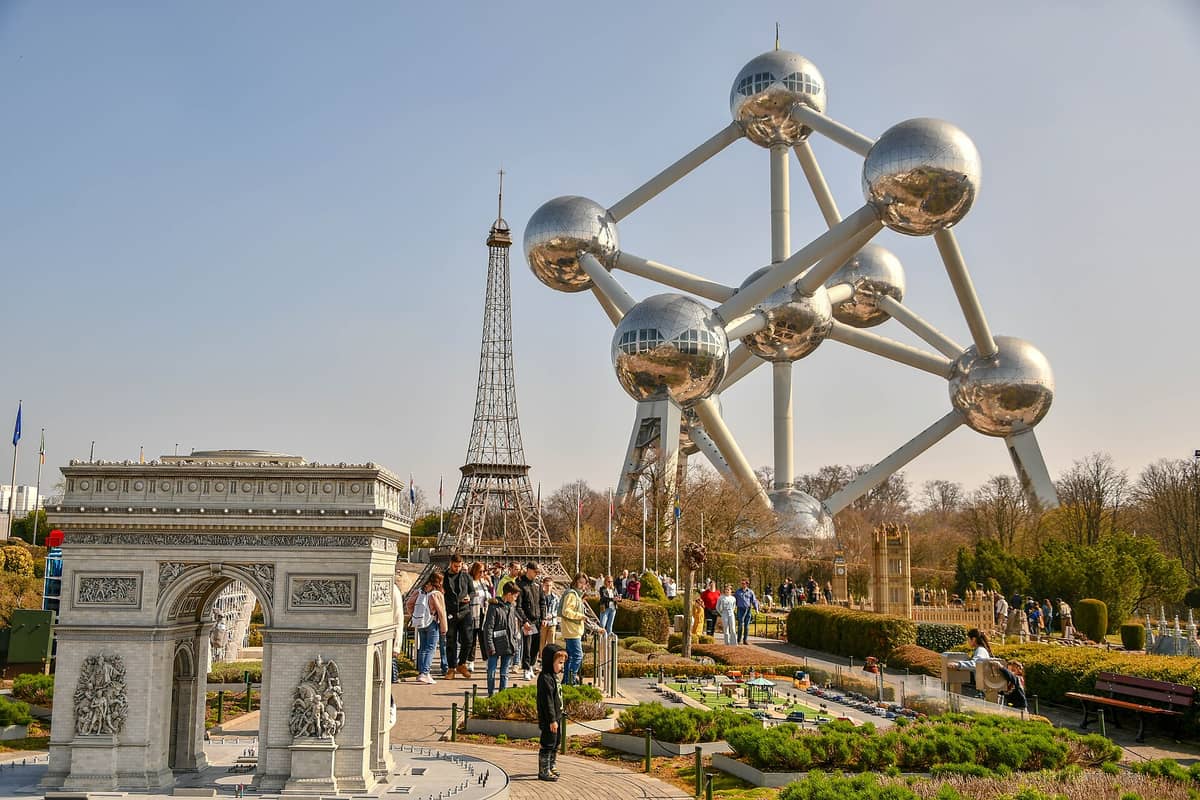
Mini-Europe is an outdoor miniature park in the Bruparck entertainment complex, located in the Laeken district of northern Brussels. It sits directly beside the Atomium, and the two attractions share a visual relationship that is hard to miss: the gleaming steel spheres of the Atomium loom over the tiny Eiffel Tower and the miniature Acropolis like a sci-fi colossus. That juxtaposition is genuinely surreal and oddly photogenic.
The park presents scale reproductions of famous monuments from across Europe, built at a ratio of 1:25. The models are not rough approximations. Many include working mechanical details: miniature trains run through the Swiss Alps section, windmills rotate in the Netherlands display, and the Vesuvius model occasionally erupts with a theatrical hiss of smoke. The level of craft varies across the park, but the best pieces are genuinely impressive up close.
Brussels sits at the center of the European project both geographically and symbolically, and Mini-Europe leans into that identity. It opened as a celebration of European unity and the city's role as the de facto capital of the EU. For context on Brussels's political and cultural weight in Europe, the Brussels EU institutions guide explains how the city functions as the seat of the European Commission, Council, and Parliament.
💡 Local tip
Book tickets online before you visit. The on-site price is roughly €3 more per person than the online rate, and buying ahead also means you skip the ticket queue entirely.
The Layout and What You Will See
The park is organized by country rather than by geography, so you move through sections representing Belgium, France, the United Kingdom (included before Brexit and retained as a historical record), Germany, Spain, Portugal, Greece, and all other EU member states. Each section groups several landmarks together with informational panels in French, Dutch, and English.
Some highlights command more attention than others. The Brandenburg Gate reproduction, the Sacrada Família, the Alhambra, and the Grand Place of Brussels (rendered at miniature scale within the city that contains the real thing) are among the more detailed constructions. The Eiffel Tower model is predictably popular with visitors who want a photo where they can appear taller than it. Paths are paved and flat, looping through the grounds in a way that is easy to follow even without a map.
Water features, small railways, and occasional sound effects animate the environment in ways that hold children's attention without overwhelming adult visitors. The park's surface area means most people complete a full circuit in under two hours, though those who stop to read every panel will take longer.
Tickets & tours
Hand-picked options from our booking partner. Prices are indicative; availability and final rates are confirmed when you complete your booking.
Skip-the-line ticket to Mini-Europe
From 23 €Instant confirmationFree cancellationGhent tour from Brussels
From 43 €Instant confirmationFree cancellationTablet Workshop at Choco-Story Brussels
From 45 €Instant confirmationShared tour of Delft and the Keukenhof Estate from Brussels
From 86 €Instant confirmationFree cancellation
Time of Day and Seasonal Considerations
Morning visits, particularly on weekdays, offer noticeably calmer conditions. By late morning on weekends and throughout July and August, the park fills with school groups and families, and the narrower paths between model clusters can become congested. Arriving at opening time (09:30 in summer) gives you the best light for photography and the most comfortable walking experience.
The park is entirely outdoors, which means Brussels weather plays a significant role in the experience. The city receives regular rainfall throughout the year, with summer being somewhat wetter than spring. A light rain jacket is practical regardless of the forecast. In good weather, the park is pleasant; in a downpour, the appeal drops sharply since there is limited covered space to wait out a shower.
Summer hours extend to 19:00 in July and August, which allows for a late-afternoon visit when direct sunlight softens and the worst of the midday crowds have thinned. The autumn and winter schedule (October through early January) sets hours at 10:00 to 18:00, with early closures on December 24 and 31. The park closes annually from early January to early March for maintenance (for example, 5 January to 6 March in 2026). Always confirm current hours on the official website before planning your visit.
⚠️ What to skip
Mini-Europe is fully outdoors with no significant shelter. If rain is forecast, bring a waterproof layer. The paved paths handle light rain reasonably well, but the experience in heavy rain is genuinely unpleasant.
Getting There
The most straightforward route from Brussels city center is metro line 6 to the Heysel terminus. From there, Mini-Europe is a five-minute walk, with clear signage pointing toward both the park and the Atomium. The journey from the city center takes roughly 20 to 25 minutes depending on your starting point. Tram 7 and bus 83 also stop at Heysel. Trams 7 and 9, along with several De Lijn regional buses, serve nearby stops such as Roi Baudouin and Stade, which add about ten minutes on foot.
If you are driving, note that the main Bruparck car park is not the recommended access point for visitors with reduced mobility. The more accessible parking is via Avenue du Championnat. Standard car parking is available in the Bruparck complex but can fill quickly during peak summer weekends.
For visitors arriving in Brussels by train or air, the guide to getting around Brussels covers metro, tram, and bus options in detail, including how to purchase STIB/MIVB tickets.
Combining Mini-Europe with the Atomium
Mini-Europe and the Atomium share a physical boundary, and most visitors combine the two. Combination tickets are available via either attraction’s ticket desk or websites, and given that arriving at the Atomium separately also requires queueing and paying again, the combined option generally makes more financial sense if you plan to do both. The Atomium is a wholly different kind of experience: architectural, contemplative, and best appreciated slowly, while Mini-Europe is more active and kinetic.
The Atomium opened in 1958 for the Brussels World's Fair and remains one of the most recognizable structures in Belgium. Together, the two attractions make a natural full morning or afternoon itinerary in Laeken.
If you have children with you and are considering extending the day, the wider Bruparck complex also includes Kinepolis (a large cinema complex), though it requires separate admission; note that the former Océade indoor water park closed permanently in 2018.
Photography Tips
The obvious appeal of a miniature park is playing with forced perspective: crouching down to eye level with the models makes them look more monumental, while photographing from above emphasizes their toy-like quality. Both approaches work depending on what you are going for. A wide-angle lens or a smartphone with a wide mode helps capture a model and its surrounding context without distortion.
Early morning light is softer and warmer, which suits the stone and terracotta tones of many Mediterranean models. The Atomium in the background creates an unavoidable compositional element in wide shots from certain angles, which is either a feature or a distraction depending on your aesthetic preferences. Small details reward close-up work: the mechanical trains, the working windmills, and the texture of the masonry reproductions are all worth isolating.
💡 Local tip
For the best forced-perspective shots, shoot at model eye level rather than standing above them. A phone with a flexible arm or tripod placed low to the ground makes this easier without lying on the pavement.
Accessibility
Mini-Europe has flat, paved pathways throughout, and accessibility assessments indicate that approximately 99 percent of the park is reachable for visitors using wheelchairs or mobility aids. Adapted toilets are available in the restaurant area. European Disability Card holders can obtain reduced admission prices, but this reduction must be requested at the ticket office rather than applied during online purchase.
The park is not well-suited for visitors with visual impairments, as touching the models is not permitted and the experience is primarily visual. Visitors with very young children will find the flat, stroller-friendly paths straightforward to navigate.
Who Should Temper Their Expectations
Adults traveling alone or in couples without a strong interest in European geography or architecture may find that the experience satisfies curiosity in about 45 minutes rather than the 1.5 to 2 hours the park is sized for. The entry price is not negligible, and if your time in Brussels is limited, the same window could be spent at the Magritte Museum, the Musical Instruments Museum, or walking the Grand-Place area in more depth.
Visitors focused on deeper cultural experiences might better use their time at the Magritte Museum or exploring the Grand-Place and its surrounding streets, which offer more layered historical and architectural content per hour.
Mini-Europe works best as part of a Laeken afternoon that includes the Atomium rather than as a standalone destination requiring a dedicated trip from the city center. The combination ticket pricing reflects this logic.
Insider Tips
- Buy your ticket online rather than on-site to save roughly €3 per adult and skip the ticket queue entirely, which matters on busy summer mornings.
- The Belgium section near the entrance features a miniature Grand-Place. It is easy to rush past because you have likely just come from the real one, but the detail level on the Hôtel de Ville reproduction is some of the finest craftsmanship in the park.
- The Vesuvius eruption runs on a timer. Check with staff at entry for the approximate schedule if you want to be positioned near the Naples section when it fires.
- A combination ticket with the Atomium costs less than buying both separately and makes logistical sense since the two are adjacent. If you arrive at one and want to add the other, the ticket desk at either attraction can arrange it.
- Weekday mornings in May, June, and September offer the best balance of good weather, manageable crowds, and full seasonal opening hours. July and August are the busiest months by a significant margin.
Who Is Mini-Europe For?
- Families with children aged 4 to 12 who enjoy interactive outdoor spaces
- First-time visitors to Brussels looking for an introduction to European geography in a light, accessible format
- Travelers with a strong interest in European Union history and symbolism
- Visitors pairing the park with the Atomium for a full Laeken afternoon
- Photography enthusiasts interested in forced-perspective and architectural miniature work
Nearby Attractions
Other things to see while in Laeken:
- Design Museum Brussels (ADAM Design Museum)
Design Museum Brussels, located steps from the Atomium in the Laeken district, turns everyday objects into cultural statements. From mid-century plastic furniture to contemporary fashion, this museum makes a compelling case for design as a serious art form — and it rarely gets the crowds its quality deserves.
- Atomium
Built for the 1958 World's Fair, the Atomium is Brussels' most recognizable landmark: a steel structure representing an iron crystal magnified 165 billion times. Here is everything you need to know to make the most of your visit.
- Japanese Tower & Chinese Pavilion
Commissioned by King Leopold II and completed in the early 1900s, the Japanese Tower and Chinese Pavilion in Laeken are two of Brussels's most architecturally eccentric landmarks. Currently closed for structural restoration since 2013, they remain visible from the surrounding park and are worth understanding before any visit to the Laeken royal domain.
- Royal Greenhouses of Laeken
The Royal Greenhouses of Laeken are among the most extraordinary glass-and-iron structures in Europe, open to the public for only a few weeks each spring. This guide covers what you'll see inside, how to secure your tickets, and whether the visit lives up to the anticipation.