Grand-Place (Grote Markt): Brussels' Extraordinary Medieval Heart
The Grand-Place is the central square of Brussels and one of Europe's most architecturally unified public spaces. Free to enter at any hour, it anchors the historic core of Belgium's capital with a ring of gilded guild houses, a towering Gothic town hall, and centuries of layered history that reward curious visitors who look beyond the postcard view.
Quick Facts
- Location
- Grand-Place / Grote Markt, 1000 Brussels, Belgium (city centre, pedestrian zone)
- Getting There
- Metro lines 1 & 5 to Gare Centrale or De Brouckère; trams 4 & 10 to Bourse or De Brouckère
- Time Needed
- 30–45 min for the square itself; 2–3 hours including Town Hall tour and City Museum
- Cost
- Square: free, open 24/7. Town Hall tours: approx. €5–10 per person (verify current prices). City Museum: separate ticket required.
- Best for
- History enthusiasts, architecture lovers, first-time Brussels visitors, photographers
- Official website
- www.brussels.be/grand-place-brussels
What the Grand-Place Actually Is
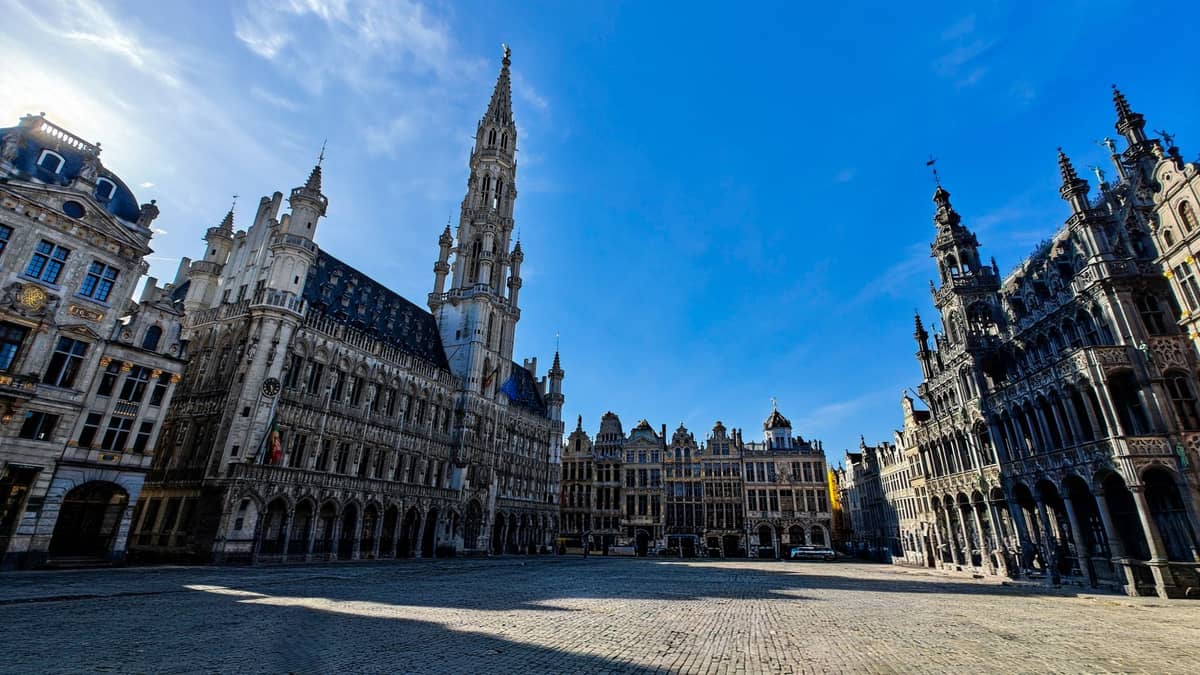
The Grand-Place of Brussels (known in Dutch as the Grote Markt) is the central public square of the City of Brussels and a UNESCO World Heritage Site. It measures roughly 110 by 68 metres and is enclosed on all sides by an almost unbroken wall of 17th-century architecture: guild houses covered in ornate gilded facades, the soaring Gothic spire of the Brussels Town Hall on the west side, and the neo-Gothic Maison du Roi (King's House) directly opposite. The effect when you step into the square for the first time is of arriving inside a room, not standing in an open space.
The square sits at the heart of the Grand-Place and Îlot Sacré neighbourhood, the dense historic core of Brussels' city centre. It is a few minutes on foot from Brussels Central Station, which puts it within easy reach of visitors arriving by train from anywhere in Belgium or from Paris and Amsterdam via Eurostar.
ℹ️ Good to know
The square itself is free to enter at any hour, every day of the year. You need no ticket, no reservation, and no guided tour to experience it. The surrounding buildings — the Town Hall, the Brussels City Museum (Maison du Roi), and the guild house interiors — have separate ticketing and opening hours.
A Brief History Worth Knowing Before You Arrive
A market has occupied this space since at least the 10th century. By the late medieval period it had become the commercial and civic heart of the duchy, surrounded by the wooden premises of powerful trade guilds. That earlier city was largely erased in August 1695, when French forces under Marshal de Villeroy bombarded Brussels for three days, destroying roughly 4,000 buildings including most of the Grand-Place. What visitors see today is a near-complete rebuilding, accomplished in just a few years after the bombardment, which is why the facades are so stylistically coherent: late Baroque guild houses built by prosperous merchants who wanted to signal that the city had recovered and that they were still powerful.
The Town Hall on the west side is the exception: its Gothic tower, rising 96 metres, pre-dates the bombardment and survived it. Construction began in the early 15th century. The spire is topped by a gilded bronze statue of the Archangel Michael. Directly across the square, the Maison du Roi (which never actually housed a king) was rebuilt in its current neo-Gothic form in the late 19th century and today contains the Brussels City Museum, with the original Manneken Pis statue on display and its wardrobe now exhibited nearby at the Garderobe MannekenPis museum. UNESCO inscribed the Grand-Place on the World Heritage List in 1998, citing the 'outstanding example of an eclectic blending of architectural and artistic styles' and its role as the symbolic heart of a European capital.
Tickets & tours
Hand-picked options from our booking partner. Prices are indicative; availability and final rates are confirmed when you complete your booking.
Origins of Brussels exploration game and tour
From 10 €Instant confirmationFree cancellationThe best of Brussels walking tour
From 229 €Instant confirmationFree cancellationBrussels audio tour with BELvue Museum admission
From 20 €Instant confirmationBrussels beer city exploration game and tour
From 10 €Instant confirmationFree cancellation
What It Feels Like at Different Hours
Early morning, before 8am, is the most honest version of the Grand-Place. Street cleaners move across the cobblestones; the smell of fresh bread drifts from a nearby bakery on the Rue du Marché aux Herbes. The gilded facades catch the low morning light differently than at any other time of day, the gold appearing warmer and the stonework more three-dimensional. At this hour you can stand in the centre of the square and take in the full geometry of the space without anyone blocking your view.
By mid-morning the crowds arrive quickly. Between 10am and 4pm on any decent weather day, the square fills with tour groups, school parties, and independent visitors. The cobblestones amplify noise; the sound of dozens of languages overlapping is constant. This is not the time for quiet contemplation, but it is the best time to inspect the guild house facades at close range, since the ambient light is good and the street-level detail on each building (carved allegories, gilded emblems, Latin inscriptions) is easier to read.
After 9pm, the square shifts again. The coach tour groups have left. Restaurants and bars around the perimeter are full, spilling warm light onto the cobblestones. The Town Hall and guild houses are illuminated by floodlights that pick out the gold leaf against the dark sky. If you want the classic postcard image, this is the moment for it. The square is rarely fully empty at night — there is always some foot traffic — but it is substantially quieter, and you can hear the specific echo of the cobblestones that you cannot notice during the day.
💡 Local tip
For photography: arrive at first light (around 6–7am depending on season) for the best combination of soft light, empty square, and clean cobblestones. Return after 9pm for the illuminated night view. Midday in summer produces harsh shadows and the square is at its most crowded.
Reading the Architecture: What to Look For
Each guild house on the Grand-Place has a name, a number, and a story. The easiest way to orientate yourself is to stand with the Town Hall to your left and work clockwise. The southern row (houses 1–7) includes the Roi d'Espagne (No. 1–2), former headquarters of the bakers' guild, now a well-known café. Its upper facade is decorated with a bust of Charles II of Spain flanked by allegorical figures representing Fame and Fortune. The building retains its original 17th-century bones and gives a sense of how the entire square would have felt in the years immediately after the rebuilding.
The northern side, facing the Town Hall, contains some of the most ornate facades. The Maison des Brasseurs (No. 10), built for the brewers' guild, now houses the Belgian Brewers Museum in its basement. Look up at the equestrian figure of Charles of Lorraine on the roof — it was added in the 18th century and stands out against the more tightly packed 17th-century decoration below it. The guild houses were not designed to be uniform; each merchant wanted his building to outdo the neighbours. The result is a controlled competition of gilded scrollwork, classical pilasters, and heraldic devices that somehow coheres into a single impression.
For a broader understanding of Brussels' architectural heritage, the Grand-Place connects naturally to the city's other significant historic spaces. The Galeries Royales Saint-Hubert, one of Europe's earliest covered shopping arcades, is less than 150 metres from the square and offers a direct contrast: the Baroque density of the Grand-Place versus the neo-Renaissance lightness of an 1847 iron-and-glass gallery.
The Square Through the Year: Seasonal Events
The Grand-Place serves as Brussels' civic stage. Every two years in August, the cobblestones are covered by the Flower Carpet (Tapis de Fleurs), a roughly 77 by 24 metre design occupying about 1,800 square metres of begonias laid by volunteers over two days and visible for four days before it is dismantled. The event draws very large crowds; if you are in Brussels during a Flower Carpet year and want to see it without waiting in a long queue, arrive before 9am on the first or second morning.
In December, the square hosts one of Belgium's largest Christmas markets, with wooden chalets selling local crafts, hot wine, and seasonal food occupying the full perimeter. A large illuminated tree stands at the centre. The Brussels Christmas market is genuinely atmospheric in the early evening but extremely crowded on weekends. Weekday mornings in December offer a much calmer experience. In summer, occasional concerts and light shows use the surrounding facades as a backdrop; check the official City of Brussels events calendar for current programming.
Getting There and Getting Around the Square
The Grand-Place sits in a pedestrian zone, so arriving by car is not practical. Brussels Central Station (Gare Centrale) is a five-minute walk: exit the station and head downhill toward the old town. Alternatively, take metro lines 1 or 5 to Gare Centrale or De Brouckère; both are around a five-minute walk from the square. Trams 4 and 10 stop at Bourse, which puts you two minutes from the square via the pedestrian Rue au Beurre.
The square is paved entirely in cobblestones, which are uneven and can be slippery when wet. Comfortable walking shoes are strongly recommended. Visitors using wheelchairs or pushchairs should be aware that there are no smooth paths across the square itself, and some of the surrounding street-level entries to buildings involve steps. The open-air square is fully accessible in the sense that there are no barriers, but the surface is a practical challenge for mobility aids.
⚠️ What to skip
Pickpocketing is a known issue in high-traffic areas of Brussels city centre, including around the Grand-Place. Keep bags on your front, do not leave phones on cafe tables, and be alert when the square is at its most crowded, typically between 11am and 3pm in summer.
What Is Actually Worth Paying For Here
The square itself costs nothing and can be explored entirely for free. The Brussels Town Hall offers guided interior tours — ticket prices are approximately €5–10 per person, though you should verify current pricing directly with the City of Brussels before visiting, as these can change. The tour takes you through ornate council chambers decorated with Flemish tapestries and Gothic woodwork that are invisible from the square.
The Brussels City Museum inside the Maison du Roi is separately ticketed and covers the history of Brussels from medieval times through the 20th century. Its most visited exhibits include the history of Brussels and the original Manneken Pis statue, while most of the famous costume collection is displayed nearby at the Garderobe MannekenPis museum. For visitors interested in Belgian beer history, the brewers' museum beneath the Maison des Brasseurs provides context for the country's brewing culture, which you can explore further through resources like the Belgian beer guide for Brussels.
Honest Assessment: Is It Worth the Hype?
The Grand-Place earns its reputation more reliably than most famous European squares. Unlike some landmarks that disappoint when you finally see them in person, the Grand-Place tends to have the opposite effect: photographs do not fully convey the enclosure of the space or the density of the decoration on the facades. Victor Hugo, living in exile in Brussels in the 1850s, reportedly called it the most beautiful square in the world. Whether you agree or not, the architectural achievement is genuinely impressive and deserves time.
That said, the experience is heavily shaped by when you visit. In July and August at midday, the square is packed to a degree that makes it difficult to appreciate the architecture or hear yourself think. If you visit only at that time, you may leave underwhelmed. The square rewards patience and timing. Visitors who find crowds consistently draining may prefer to spend most of their time in the surrounding neighbourhood, using the Grand-Place as a brief orientation stop rather than the centrepiece of their day.
For those who want to move beyond the immediate square, the surrounding Îlot Sacré neighbourhood contains a dense network of chocolate shops, beer cafes, and narrow medieval streets. The broader city has much more to offer beyond this immediate area — the full guide to things to do in Brussels covers neighbourhoods and attractions that many visitors miss entirely by spending too long in the city centre.
Insider Tips
- The best elevated view of the square's layout is from the upper floors of the Maison du Roi (Brussels City Museum). You can look down onto the cobblestones and see the full geometry of the space that is impossible to appreciate at ground level.
- The guild houses are numbered, and each has a name displayed on a small plaque near the entrance. Bring a list or download a map in advance — trying to identify them without preparation while surrounded by crowds is frustrating. The City of Brussels website provides an official numbered guide.
- Avoid the café terraces directly on the Grand-Place for food and drink unless the atmosphere is your priority. Prices are significantly higher than at equivalent establishments one or two streets away, and quality is not proportionally better.
- The Flower Carpet (Tapis de Fleurs) occurs every two years in August on even-numbered years, coinciding with Assumption Day. If you are planning a Brussels trip around this event, book accommodation at least several months in advance, as the city fills quickly during that week.
- If you are visiting in winter, the Grand-Place floodlighting combined with light snowfall — rare but possible from December to February — produces what many consider the most striking version of the square. Even without snow, the illuminated facades on a cold clear December evening have a quality that the summer crowds cannot replicate.
Who Is Grand-Place (Grote Markt) For?
- First-time visitors to Brussels who need a geographic and cultural anchor point for the city
- Architecture enthusiasts interested in late Baroque civic buildings and the history of guild culture
- Photographers working in early morning or after dark, when the light conditions are most favourable
- Travellers combining the square with a walking route through the Îlot Sacré neighbourhood and surrounding historic streets
- Families with children who need a central, open, free space that functions as a base for exploring the surrounding area
Nearby Attractions
Other things to see while in Grand-Place & Îlot Sacré:
- Belgian Comic Strip Center
Housed in a Victor Horta-designed Art Nouveau masterpiece, the Belgian Comic Strip Center tells the story of Belgium's extraordinary contribution to comic art. From Tintin to the Smurfs, this is one of Brussels's most rewarding museum experiences for visitors of almost any age.
- Brussels Beer Museum
Tucked into the cellars of a baroque guild house on the Grand-Place, the Belgian Brewers Museum (Musée des Brasseurs belges) tells the story of Belgian brewing through historic equipment, documents, and a glass of beer included with your €5 ticket. Small, unhurried, and genuinely atmospheric, it rewards curiosity about one of Belgium's defining cultural exports.
- Brussels Town Hall (Hôtel de Ville)
The Brussels Town Hall, or Hôtel de Ville de Bruxelles, is the Gothic building that has anchored the UNESCO-listed Grand-Place for centuries. Interior access is by guided tour only, making advance planning essential. The exterior, however, is free to admire at any hour.
- Cathedral of St. Michael and St. Gudula
Rising above a broad flight of stone steps just minutes from Grand-Place, the Cathedral of St. Michael and St. Gudula is the most architecturally significant church in Belgium. Entry to the main nave is free, the stained-glass windows are among the finest in Northern Europe, and the atmosphere shifts dramatically between early morning quiet and afternoon tour-group activity.