Brussels Town Hall (Hôtel de Ville): The Gothic Heart of Grand-Place
The Brussels Town Hall, or Hôtel de Ville de Bruxelles, is the Gothic building that has anchored the UNESCO-listed Grand-Place for centuries. Interior access is by guided tour only, making advance planning essential. The exterior, however, is free to admire at any hour.
Quick Facts
- Location
- Grand-Place (Grote Markt), 1000 Brussels, Belgium
- Getting There
- Metro lines 1/5 to Gare Centrale or De Brouckère; trams 3, 4 to Bourse
- Time Needed
- About 1 hour for the guided interior tour; 10–15 min for exterior viewing
- Cost
- Adults €15 / Seniors & Students €8 / Children 0–6 free / Family pack €40. Grand-Place exterior: free, 24/7
- Best for
- History lovers, architecture enthusiasts, first-time Brussels visitors
- Official website
- www.bruxelles.be/hotel-de-ville
What You're Looking At
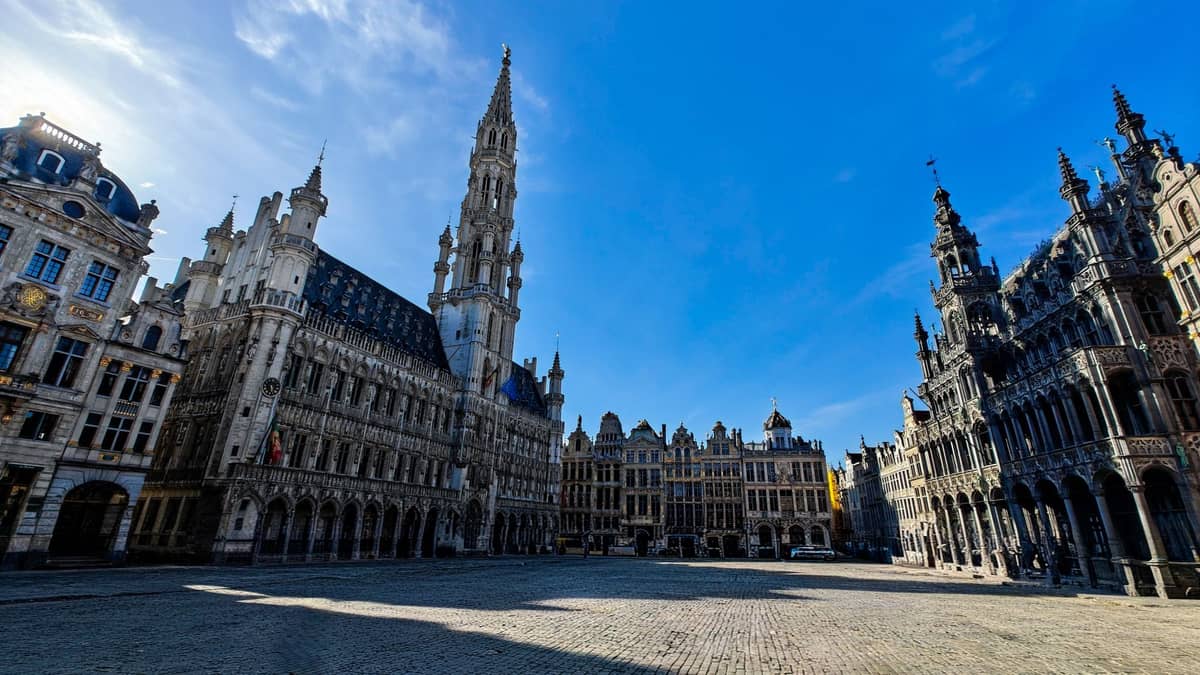
The Brussels Town Hall, officially the Hôtel de Ville de Bruxelles (Dutch: Stadhuis van Brussel), is the defining structure of the Grand-Place, one of Europe's most celebrated medieval squares and a UNESCO World Heritage Site since 1998. The Brussels Town Hall, officially the Hôtel de Ville de Bruxelles (Dutch: Stadhuis van Brussel), is the defining structure of the Grand-Place, one of Europe’s most celebrated medieval squares and a UNESCO World Heritage Site since 1998. Standing on the Grand-Place, it is the only building on the square that survived the French bombardment of 1695, which reduced much of the surrounding lower town to rubble. That survival alone gives it a weight that goes beyond architectural style.
The building is Gothic in character, with a facade of three unequal wings that were constructed in stages across the fifteenth century. The left wing dates from around 1402–1444, the right wing from approximately 1444–1480. The asymmetry is immediately noticeable: the main tower does not sit at the center of the facade. According to a long-standing local legend, the architect threw himself from the top of the tower upon realizing the error. The story is almost certainly apocryphal, but it does capture how attention-grabbing that off-center spire really is. The asymmetry is immediately noticeable: the main tower does not sit at the center of the facade. According to a long-standing local legend, the architect threw himself from the top of the tower upon realizing the error. The story is almost certainly apocryphal, but it does capture how attention-grabbing that off-center spire really is.
The tower itself rises roughly 96 meters and is topped by a gilded statue of the Archangel Michael, patron saint of Brussels, slaying a dragon. On clear afternoons, the gold catches the light and glows above the roofline of the surrounding guild houses. At street level, the facade is lined with Gothic niches housing statues of historical figures, allegorical figures, and former rulers of the Low Countries.
💡 Local tip
The interior is only accessible via guided tour, with tickets starting at €15 for adults. Tours can be booked through the City of Brussels official site or via its visitor services. Check current tour schedules before your visit, as times vary by season.
The Grand-Place Setting: Time of Day Matters Enormously
The Town Hall does not exist in isolation. It frames the south-west corner of the Grand-Place, and the square's collective atmosphere changes significantly depending on when you arrive. Early morning, roughly 7:00–8:30, is the most rewarding time for photography and quiet observation. The cobblestones are damp from overnight temperatures, the flower vendors are setting up along the perimeter, and the guildhalls on the east and north sides catch the low morning light while the Town Hall facade remains in soft shadow. Crowds are thin.
By mid-morning, the tour groups arrive in waves. Between 10:00 and 12:00, the square can feel genuinely congested, with selfie sticks and audio-guide headsets creating a background hum. The Town Hall entrance becomes a focal point for queuing. If you have booked an interior tour for this slot, budget extra time to navigate the crowd at the door.
Late afternoon, especially from around 16:30 onward in summer, sees the western sunlight hit the Town Hall's tower directly. The gilded Michael catches fire. This is the best light for exterior photographs. Evening brings a different kind of spectacle: the Grand-Place is illuminated after dark, and the Town Hall's Gothic tracery, lanterns, and statuary read differently under artificial light. The square is free and open at all hours, so there is no cost to simply standing in front of the building at 10pm.
ℹ️ Good to know
During the Brussels Flower Carpet, held every two years in August, the Grand-Place is covered with a 1,800-square-meter tapestry of begonias. Check dates in advance if this event influences your travel timing.
Tickets & tours
Hand-picked options from our booking partner. Prices are indicative; availability and final rates are confirmed when you complete your booking.
Escape Tour self-guided, interactive city challenge in Brussels
From 30 €Instant confirmationEscape Tour self-guided, interactive city challenge in Brussels
From 30 €Instant confirmationBrussels' history audio tour with Halle Gate admission ticket
From 17 €Instant confirmationGhent tour from Brussels
From 43 €Instant confirmationFree cancellation
The Interior Guided Tour: What to Expect
The Town Hall interior is not a conventional museum. It is a functioning municipal building that has hosted civic ceremonies, official receptions, and city council functions for centuries. Guided tours move through a sequence of ceremonial rooms, each furnished and decorated according to the tastes of different eras.
The most visually striking spaces include the Gothic Hall, with its vaulted ceilings and carved stonework, and the Maximilian Room, lined with eighteenth-century Brussels tapestries depicting the history of the city. The tapestries alone justify the entry price for anyone with an interest in decorative arts. The most visually striking spaces include the Gothic Hall, with its vaulted ceilings and carved stonework, and the Maximilian Room, lined with eighteenth-century Brussels tapestries depicting the history of the city. The Council Chamber is sober by comparison but contextually significant for Brussels civic life.
Group visioguide options are also available, priced at approximately €10–13 per person depending on group size (verify current rates when booking). The tower is not open for independent climbing; access to upper levels, if available at all, is limited to occasional special tours arranged through the City of Brussels tourism office.
Tours are conducted in multiple languages. The ground floor reception also houses a tourism information desk with seasonal hours; check the City of Brussels site for the latest opening times before your visit.
Getting There and Arriving
Brussels Central Station (Gare Centrale/Brussel-Centraal) is the most convenient rail arrival point. From the station exit, the Grand-Place is roughly a five-minute walk downhill through the Galeries Royales Saint-Hubert arcade or via the Rue de la Montagne. Metro lines 1 and 5 stop at Gare Centrale. Trams 3 and 4 serve Bourse or De Brouckère, both within a two to three minute walk of the square. Multiple bus lines also stop in the vicinity. Multiple bus lines (29, 33, 46, 48, 66, 71, 95) also stop in the vicinity.
If you are arriving from Brussels Airport (BRU, in Zaventem), the fastest option is the SNCB/NMBS train to Brussels Central, with journey times of around 18–20 minutes and fares typically around €11 one way (verify current prices with SNCB before traveling). From the station, the Town Hall is a short walk. For full transit options from the airport, see theBrussels Airport transport guide.
On the accessibility front, the Grand-Place is paved with uneven cobblestones that can be challenging for wheelchairs and strollers. The City of Brussels maintains an accessibility resource through Handy.Brussels, which lists specific accessible visit options and sign-language tour schedules for the Town Hall. Visitors with mobility needs should contact the Town Hall in advance to confirm what arrangements are available on their chosen date.
Historical and Architectural Context
Brussels in the fifteenth century was a significant commercial and political center in the Duchy of Brabant, part of the Low Countries under Burgundian and later Habsburg rule. The Town Hall's construction, funded by the prosperous city, was a statement of civic ambition. The left wing and its tower were built first, largely under the direction of Jacob van Thienen; the right wing followed under a different architect decades later. The tower was completed by 1455, and the resulting asymmetry, whether accidental or pragmatic, became one of the building's defining characteristics. The resulting asymmetry, whether accidental or pragmatic, became one of the building's defining characteristics.
The 1695 bombardment, ordered by Louis XIV's forces under Marshal de Villeroy, lasted 36 hours and destroyed or severely damaged thousands of buildings in Brussels. The surrounding guild houses were rebuilt within a few years, largely in Baroque style, creating the architectural contrast visible today between the Gothic Town Hall and its neighbors. That contrast is part of what makes the Grand-Place so legible as a place: you can read the history of two centuries of architectural change just by turning your head. The surrounding guild houses were rebuilt within a few years, largely in Baroque style, creating the architectural contrast visible today between the Gothic Town Hall and its neighbors. That contrast is part of what makes the Grand-Place so legible as a place: you can read the history of two centuries of architectural change just by turning your head.
The Grand-Place as a whole merits its own exploration. For a closer look at the square and the Maison du Roi opposite the Town Hall, see the dedicated guide to Grand-Place and the Maison du Roi (Museum of the City of Brussels).
Photography, Practicalities, and What to Bring
For exterior photography, the ideal position is from the north-east corner of the Grand-Place, which gives a diagonal view of the Town Hall's full facade and tower. A wide-angle lens or phone camera in landscape orientation works better than a standard portrait crop at this distance. In summer, afternoon light between 16:00 and 18:00 hits the tower directly. In winter, the square's Christmas lighting creates a different but equally photogenic atmosphere.
Brussels has a temperate maritime climate with rain possible in any month. July and August see the highest rainfall frequency, though showers tend to be short. Bringing a compact umbrella is a reasonable precaution year-round. The cobblestones of the Grand-Place become slippery when wet, so flat-soled shoes with grip are more practical than smooth-soled dress shoes or heels.
Interior photography policies within the Town Hall vary by room and tour. Check current rules when booking. Photography is unrestricted outside on the Grand-Place itself. If the weather turns, the Galeries Royales Saint-Hubert are a two-minute walk and provide a covered alternative while you wait for the rain to pass.
⚠️ What to skip
The Grand-Place can be very crowded between 10:00 and 14:00 on weekends and during peak summer months (July–August). If you have an interior tour booked, arrive at least 10 minutes early. Tour slots fill up, and latecomers may not be admitted.
Honest Assessment: Is It Worth It?
The exterior of the Brussels Town Hall is, without exaggeration, one of the most accomplished examples of Gothic civic architecture in Northern Europe. As a free, 24-hour spectacle it is unambiguously worth visiting as part of any time in Brussels. The square it anchors has genuine historical gravity and is not simply a tourist stage set.
The interior guided tour is a different calculation. At €15 for adults, it offers good value for visitors with a genuine interest in Gothic architecture, medieval civic history, or Belgian decorative arts, particularly the tapestries. For visitors primarily interested in checking a box on a city itinerary, the exterior experience may be sufficient. The interior guided tour is a different calculation. At €15 for adults, it offers good value for visitors with a genuine interest in Gothic architecture, medieval civic history, or Belgian decorative arts, particularly the tapestries. For visitors primarily interested in checking a box on a city itinerary, the exterior experience may be sufficient. The tour does not include independent access to the tower, which is a limitation worth knowing before you decide.
Travelers who want the broader context of Brussels's historic core should combine the Town Hall with a walk through the Grand-Place and Îlot Sacré neighborhood. A half-day in this area, including the Galeries Royales, the Manneken Pis, and the surrounding medieval street grid, gives a much richer picture than the Town Hall alone.
Insider Tips
- The tourism information desk inside the Town Hall is a useful place to pick up maps, event listings, and transport information. Even if you skip the guided tour, stepping inside is free and takes five minutes. Even if you skip the guided tour, stepping inside to pick up maps, event listings, and transport information is free and takes five minutes.
- The Town Hall's asymmetrical tower is most obvious when viewed from directly in front of the main entrance. Step back to the far edge of the square and look straight at the facade: the tower sits noticeably left of center. Most visitors walk past without registering why the building looks slightly unusual.
- If you want the Grand-Place to yourself, visit on a weekday morning before 08:30. The flower market begins setting up around this time, the light is soft, and the square can have fewer than a dozen people in it. By 09:30, the first tour groups appear.
- Book interior tour tickets online rather than queuing at the reception desk. Walk-up availability exists but is not guaranteed, particularly on summer weekends and during major events on the Grand-Place.
- The gilded Archangel Michael at the top of the tower rotates slowly in strong wind. On a breezy day, watching the figure turn against the sky is one of those small details that sticks in the memory longer than the architecture itself.
Who Is Brussels Town Hall (Hôtel de Ville) For?
- First-time visitors to Brussels who want to understand the city's historical foundation
- Architecture and Gothic art enthusiasts who will appreciate the interior tapestries and vaulted ceilings
- Photographers seeking dramatic European civic Gothic in a well-lit, open square setting
- Families with children interested in medieval history; children under 7 enter the guided tour free
- Travelers combining Brussels with a broader Belgian or European history itinerary
Nearby Attractions
Other things to see while in Grand-Place & Îlot Sacré:
- Belgian Comic Strip Center
Housed in a Victor Horta-designed Art Nouveau masterpiece, the Belgian Comic Strip Center tells the story of Belgium's extraordinary contribution to comic art. From Tintin to the Smurfs, this is one of Brussels's most rewarding museum experiences for visitors of almost any age.
- Brussels Beer Museum
Tucked into the cellars of a baroque guild house on the Grand-Place, the Belgian Brewers Museum (Musée des Brasseurs belges) tells the story of Belgian brewing through historic equipment, documents, and a glass of beer included with your €5 ticket. Small, unhurried, and genuinely atmospheric, it rewards curiosity about one of Belgium's defining cultural exports.
- Cathedral of St. Michael and St. Gudula
Rising above a broad flight of stone steps just minutes from Grand-Place, the Cathedral of St. Michael and St. Gudula is the most architecturally significant church in Belgium. Entry to the main nave is free, the stained-glass windows are among the finest in Northern Europe, and the atmosphere shifts dramatically between early morning quiet and afternoon tour-group activity.
- Choco-Story Brussels
Choco-Story Brussels, officially the Musée du Chocolat, walks visitors through 3,000 years of chocolate history from ancient Mesoamerica to Belgian praline. Set a short walk from the Grand-Place, it combines exhibits, live demonstrations, and tastings into a 90-minute experience that works for families and curious adults alike.