Cathedral of St. Michael and St. Gudula: Brussels's Gothic Heart
Rising above a broad flight of stone steps just minutes from Grand-Place, the Cathedral of St. Michael and St. Gudula is the most architecturally significant church in Belgium. Entry to the main nave is free, the stained-glass windows are among the finest in Northern Europe, and the atmosphere shifts dramatically between early morning quiet and afternoon tour-group activity.
Quick Facts
- Location
- Parvis Sainte-Gudule, 1000 Brussels (Grand-Place / Îlot Sacré quarter)
- Getting There
- Brussels-Central Station (5-min walk); bus lines 29, 63, 65, 66 to Parc stop
- Time Needed
- 45–90 minutes for the nave and treasury; allow extra time for the crypt or archaeological site
- Cost
- Main nave: free. Treasury: €2 (under 14 free). Archaeological site: €1. Romanesque crypt: €3 (by appointment). Combined ticket €6
- Best for
- Architecture lovers, history seekers, photography, quiet reflection, and anyone curious about Belgian royal heritage
- Official website
- cathedralisbruxellensis.be/en
First Impressions: A Cathedral That Earns Its Scale
The Cathedral of St. Michael and St. Gudula announces itself before you reach it. Walking north from Brussels-Central Station, the dual Gothic towers appear above the rooftops at the end of a broad staircase, framed by the kind of formal plaza that Belgian urban planners seemed to reserve for their most serious institutions. The approach on foot is genuinely theatrical — the steps climb steeply, the towers grow with every stride, and by the time you reach the parvis, the sheer mass of cream-coloured limestone overhead creates a physical pressure that no photograph quite captures.
The facade is High Gothic at its most composed: twin towers completed in the 15th century, a central rose window, and stone carvings worn soft by centuries of Brussels rain. What makes the exterior unusual is the layered timeline visible even from the forecourt. The lower sections of the nave are noticeably older than the towers — darker stone, heavier proportions — a physical record of the cathedral's 300-year construction campaign.
💡 Local tip
Arrive between 8:00 and 9:30 on a weekday morning for the best combination of empty interior, soft directional light through the south-facing windows, and no tour groups. The main nave is free to enter and rarely feels crowded before mid-morning.
History and Significance: Nine Centuries on the Same Hill
A chapel dedicated to St. Michael stood on this elevated site as early as the 11th century. Construction of the present Gothic structure began in earnest in the 13th century and continued, in successive waves of ambition and interruption, through to the 15th. The result is not a single coherent vision but an accumulation of decisions across generations — which is why the nave and transepts feel stylistically distinct from the choir, and why the proportions shift as you move deeper into the building.
Despite its visual dominance over central Brussels, the cathedral only received official cathedral status in 1962, when the Diocese of Brussels was elevated and the building became the seat of the Archbishop of Mechelen-Brussels. Before that, it was technically a collegiate church — an important distinction that explains why Belgian royalty used it for coronations and state funerals long before it held cathedral rank. The site remains Belgium's primary venue for royal and state ceremonies, including royal weddings and funerals in the 21st century.
The cathedral sits at the meeting point of several of Brussels's most historically dense streets. The Grand-Place is roughly a 10-minute walk south, and the surrounding Grand-Place and Îlot Sacré quarter contains some of the oldest surviving urban fabric in the city. The cathedral's hill was always the civic and religious counterweight to the commercial bustle below.
Tickets & tours
Hand-picked options from our booking partner. Prices are indicative; availability and final rates are confirmed when you complete your booking.
Ghent tour from Brussels
From 43 €Instant confirmationFree cancellationTablet Workshop at Choco-Story Brussels
From 45 €Instant confirmationShared tour of Delft and the Keukenhof Estate from Brussels
From 86 €Instant confirmationFree cancellationOrigins of Brussels exploration game and tour
From 10 €Instant confirmationFree cancellation
Inside the Nave: Light, Stone, and Stillness
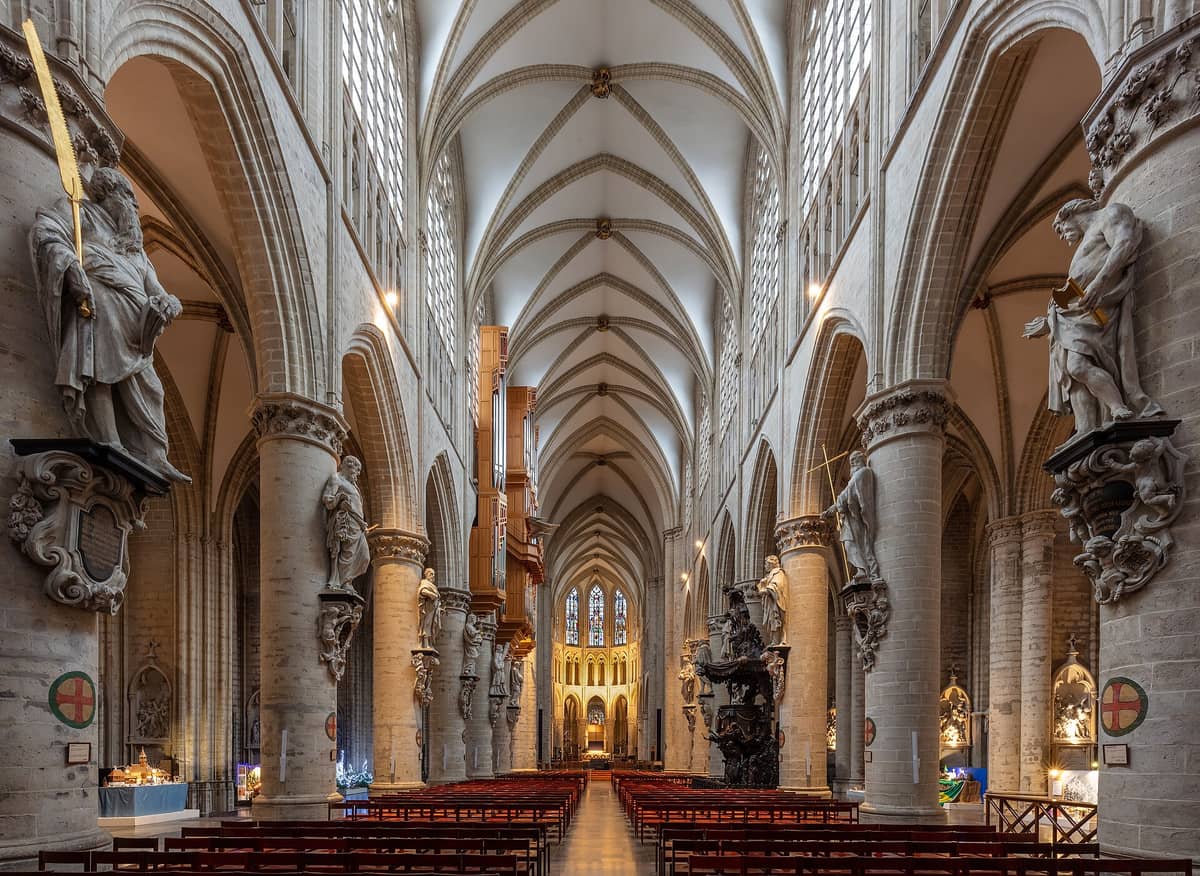
The interior is large enough to feel genuinely monumental — the nave rises to about 26 metres — without becoming the cold, echoing void that some Gothic cathedrals produce. The stone floor is worn unevenly by centuries of foot traffic, and the smell inside is a specific blend of cool limestone, aged wood, and faint candle smoke that no amount of renovation quite eliminates.
The stained-glass windows are the interior's single greatest asset. The oldest and finest are the 16th-century Habsburg windows in the transepts, commissioned by members of the imperial family and depicting royal donors alongside religious scenes. The quality of the glass and the complexity of the iconography repay close attention — these are not decorative backgrounds but carefully composed theological and political statements. On a bright afternoon when sunlight comes through the south transept windows, the nave floor is painted in deep reds, blues, and golds.
The choir is separated from the nave by a carved wooden screen, and the chapels lining the ambulatory each contain a different accumulated history of altarpieces, memorial plaques, and donated objects. The Chapel of the Blessed Sacrament in the north transept contains a series of windows depicting the so-called Miracle of the Holy Sacraments — a sequence of medieval religious narratives that remained central to Brussels's civic identity for centuries.
⚠️ What to skip
Visiting hours are reduced or suspended during religious services. Sunday mornings in particular are primarily for worshippers — visitor access begins at 13:00 on Sundays. Check the cathedral's official schedule before planning an early Sunday arrival.
The Treasury, Crypt, and Archaeological Site
Beyond the free main nave, three paid areas extend the visit considerably. The Treasury — accessible for €2 — holds a focused collection of ecclesiastical metalwork, reliquaries, vestments, and manuscripts. It is small and not comprehensively labelled in English, but the objects themselves, particularly the goldsmith work, are of genuinely high quality. Children under 14 enter free.
The archaeological site beneath the nave, accessible for €1, preserves the foundations and floor levels of earlier churches on the site, tracing back to pre-Gothic construction. The remains are modest — this is not a sweeping underground museum — but the layering of stone and the explanatory panels give a clear sense of how long this particular hill has been a site of organised Christian worship.
The Romanesque crypt is the most atmospheric of the three additions, but it requires advance arrangement and costs €3. It is not accessible via casual walk-in during standard visiting hours. If you have a particular interest in early medieval ecclesiastical architecture, contact the cathedral beforehand. If not, the main nave and treasury provide more than enough for a standard visit.
How the Experience Changes Through the Day
Early morning weekdays are almost solitary. The only sounds are distant footsteps on stone, the occasional creak of a wooden pew, and the subdued noise of city traffic filtered through thick walls. Light enters at a low angle through the east end windows, and the nave has the quality of a space that hasn't quite committed to the day yet.
By mid-morning, tour groups begin arriving from the direction of Brussels-Central, and the atmosphere becomes noticeably more instructional. Guides speak in multiple languages simultaneously near the nave entrance, and the transepts fill with people angling smartphones at the Habsburg windows. The cathedral handles crowds reasonably well — it is large enough that the nave never feels truly packed — but if contemplative visits matter to you, late morning is the least rewarding window.
Saturday afternoons have their own rhythm: fewer organised tours but more families and couples. The light in late afternoon through the south transept windows, particularly in autumn, is exceptional for photography. Sunday afternoons, after 13:00, are often the quietest visitor sessions of the week, with most tour groups having moved on.
💡 Local tip
For photography, the south transept windows face the best afternoon light. Bring a camera that handles low-light interiors without flash — flash is not permitted inside, and tripods require prior permission from the cathedral administration.
Getting There and Practical Notes
The cathedral is among the most accessible major sights in Brussels. Brussels-Central Station (Gare Centrale) is a five-minute walk along Rue du Bois Sauvage and then up the steps of the parvis. Several STIB/MIVB bus lines — including 29, 63, 65, and 66 — stop at Parc, a short walk from the cathedral. From Grand-Place, the walk north takes roughly 10 minutes on mostly flat ground before a short climb.
Accessibility at the main entrance is step-free from the parvis level, and the nave is wheelchair accessible. The crypt and archaeological site involve stairs and are not accessible to visitors with mobility limitations. The cathedral is also well positioned for combining with other nearby sights: the Mont des Arts complex is a 5-minute walk south, and the Galeries Royales Saint-Hubert is reachable in under 10 minutes.
Opening hours are Monday to Friday 8:00–18:00, Saturday 8:00–17:00, and Sunday 13:00–18:00. These hours apply year-round but are subject to change on religious holidays and during special liturgical events. Always check the official website before visiting, particularly around Easter, Christmas, and Belgian national holidays.
Dress codes are not posted at the entrance, but as an active place of worship, covered shoulders and modest dress are appropriate. There are no signs asking visitors to whisper, but the acoustic quality of the space naturally encourages quieter behaviour. Loud conversations in the nave tend to carry in unpleasant ways.
A Clear-Eyed Assessment: Worth the Time?
The Cathedral of St. Michael and St. Gudula is not the most famous Gothic cathedral in this part of Europe — it sits comfortably below Cologne Cathedral and Notre-Dame de Paris in international recognition — but it is a serious, architecturally rich building that rewards time spent inside it. The stained glass alone is worth the walk from Grand-Place.
Visitors who find Gothic churches uniformly interchangeable, or who are primarily in Brussels for food, beer, and the comic strip scene, may find 30 minutes sufficient. But anyone with an interest in medieval architecture, Belgian royal history, or European religious art will find the cathedral genuinely substantial. It pairs well with the BELvue Museum nearby, which covers Belgian political history and occupies a former royal palace at the foot of the same hill.
If you are planning your Brussels itinerary more broadly, the cathedral fits naturally into a morning that also takes in the Royal Quarter and Mont des Arts area — a circuit described in more detail in our 2-day Brussels itinerary.
Insider Tips
- The best single photograph of the cathedral exterior is taken from the bottom of the staircase on the eastern approach from Brussels-Central, in the early morning before delivery traffic parks on the parvis. The towers are fully visible and the light is clean.
- The Habsburg stained-glass windows in the transepts are labelled by donor rather than subject. Ask at the cathedral information desk for the free explanatory sheet in English — it maps each window to its commissioner and iconographic programme.
- If you want to visit the Romanesque crypt, email or call the cathedral administration in advance rather than hoping for walk-in access. It is not reliably open during standard visitor hours and is genuinely different in character from the rest of the building.
- The cathedral hosts free organ recitals on certain Sundays after the main mass. These are not widely advertised to tourists but are listed on the official website calendar and provide a genuinely memorable way to experience the acoustics of the space.
- The parvis in front of the cathedral is one of the better vantage points in central Brussels for photographing the city's layered topography — the rooftops below, the towers above, and the mix of Gothic and 19th-century civic architecture in the middle distance.
Who Is Cathedral of St. Michael and St. Gudula For?
- Architecture and art history enthusiasts who want to examine medieval stained glass up close
- Travellers combining the Royal Quarter with Grand-Place in a single half-day walk
- Photographers looking for interior low-light opportunities and dramatic Gothic exteriors
- Visitors interested in Belgian royal history and state ceremonial traditions
- Anyone seeking a quiet, non-commercial pause in the middle of a dense sightseeing day
Nearby Attractions
Other things to see while in Grand-Place & Îlot Sacré:
- Belgian Comic Strip Center
Housed in a Victor Horta-designed Art Nouveau masterpiece, the Belgian Comic Strip Center tells the story of Belgium's extraordinary contribution to comic art. From Tintin to the Smurfs, this is one of Brussels's most rewarding museum experiences for visitors of almost any age.
- Brussels Beer Museum
Tucked into the cellars of a baroque guild house on the Grand-Place, the Belgian Brewers Museum (Musée des Brasseurs belges) tells the story of Belgian brewing through historic equipment, documents, and a glass of beer included with your €5 ticket. Small, unhurried, and genuinely atmospheric, it rewards curiosity about one of Belgium's defining cultural exports.
- Brussels Town Hall (Hôtel de Ville)
The Brussels Town Hall, or Hôtel de Ville de Bruxelles, is the Gothic building that has anchored the UNESCO-listed Grand-Place for centuries. Interior access is by guided tour only, making advance planning essential. The exterior, however, is free to admire at any hour.
- Choco-Story Brussels
Choco-Story Brussels, officially the Musée du Chocolat, walks visitors through 3,000 years of chocolate history from ancient Mesoamerica to Belgian praline. Set a short walk from the Grand-Place, it combines exhibits, live demonstrations, and tastings into a 90-minute experience that works for families and curious adults alike.