BELvue Museum: Belgium's History in the Heart of the Royal Quarter
The BELvue Museum traces Belgium's history from its founding in 1830 to the present day through seven thematic galleries and around 200 carefully selected objects. Located at Place des Palais, steps from the Royal Palace, it offers a clear-eyed account of a country that has rarely had a simple story to tell.
Quick Facts
- Location
- Place des Palais 7, 1000 Brussels (Royal Quarter)
- Getting There
- Brussels-Central rail station; Metro Parc (lines 1, 5); Tram 92, 93 (Parc stop)
- Time Needed
- 1.5 to 2.5 hours
- Cost
- Adults €10 | Seniors €8 | Under 18 free | Free every Wednesday from 14:00 and free entry to BELvue on the first Sunday of the month (Coudenberg ticket still required)
- Best for
- History enthusiasts, first-time visitors to Belgium, rainy day exploring, families with older children
- Official website
- www.belvue.be/en
What Is the BELvue Museum?
The BELvue Museum is a history museum dedicated entirely to Belgium as a nation: its formation, its contradictions, its social upheavals, and its ongoing identity as one of Europe's most complex countries. The permanent exhibition spans seven thematic chapters covering roughly 200 objects, from royal portraits and political pamphlets to industrial artifacts and postwar documents. It is not an encyclopedic archive. It is a curated, accessible argument about what Belgium is and how it came to be.
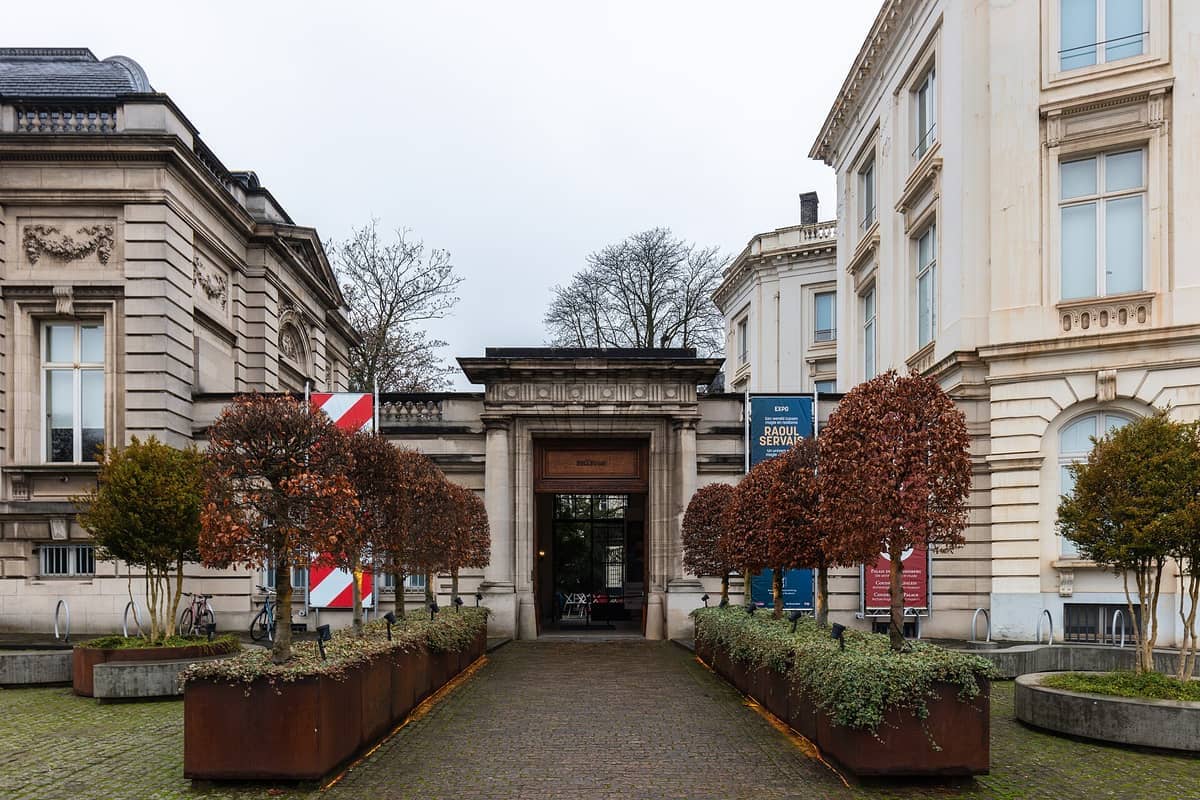
The museum sits at Place des Palais 7, directly opposite the Royal Palace of Brussels in the heart of the Royal Quarter. Its neoclassical building once served as the former Hotel Bellevue, a grand 18th-century hotel that hosted European royalty and diplomats. That context matters: you are standing in a space that watched Belgian history unfold from the very beginning of the modern state.
Crucially, the BELvue Museum shares its entrance with the Coudenberg Palace archaeological site, the ruins of the medieval palace where Habsburg emperors once ruled the Low Countries. A combined ticket for both sites offers exceptional value and a compelling contrast: one venue looks forward from 1830, the other reaches back nearly a thousand years into Brussels's buried past.
The Setting: Place des Palais and the Royal Quarter
Arriving at Place des Palais, you immediately sense the weight of institutional Belgium. The square itself is broad and formal, flanked by the Royal Palace on one side and the Parc de Bruxelles stretching toward Parliament on the other. On weekday mornings, the area is quieter than you might expect for a capital city center: a handful of joggers cutting through the park, civil servants crossing on their way to nearby government buildings, the occasional tourist pausing at the palace gates.
The Royal Quarter is one of Brussels's most architecturally composed neighborhoods, with wide neoclassical avenues designed to project state authority. If you want to understand the district more deeply before or after your visit, the Royal Quarter neighborhood guide covers the full sweep of monuments, palaces, and museums concentrated here.
The museum entrance is unassuming for the location: a modest doorway on the ground floor of the old hotel building. Inside, the scale shifts. The building's original grandeur shows through in ceiling heights and staircase proportions, though the modern exhibition design keeps the focus firmly on content rather than architecture.
Tickets & tours
Hand-picked options from our booking partner. Prices are indicative; availability and final rates are confirmed when you complete your booking.
Brussels audio tour with BELvue Museum admission
From 20 €Instant confirmationGhent tour from Brussels
From 43 €Instant confirmationFree cancellationTablet Workshop at Choco-Story Brussels
From 45 €Instant confirmationShared tour of Delft and the Keukenhof Estate from Brussels
From 86 €Instant confirmationFree cancellation
Inside the Exhibition: Seven Themes, One Country's Story
Belgium declared independence in 1830 after a revolution against Dutch rule, and the BELvue Museum begins its story there. The seven thematic chapters do not progress in strict chronological order. Instead, the curators organize the narrative around key tensions that have defined Belgian society: the relationship between monarchy and democracy, the linguistic divide between French and Dutch speakers, industrialization and labor, colonial history, immigration, and the ongoing federalization of the state.
The exhibition does not shy away from difficult chapters. Belgium's colonial record in the Congo is addressed with documentary evidence rather than euphemism. The Flemish-Walloon linguistic conflicts that have periodically threatened to split the country entirely are presented with enough nuance that visitors from outside Belgium leave with a genuine understanding of why this small nation has had more than fifty governments since 1945.
Around 200 objects anchor each section: original documents, period photographs, personal letters, industrial objects, and political ephemera. The density of text is moderate, not overwhelming. Captions and panel text are available in French, Dutch, and English throughout the permanent galleries, making this one of the more genuinely accessible history museums in the city for international visitors.
💡 Local tip
Allow at least 90 minutes for the permanent exhibition alone. If you plan to visit the Coudenberg Palace underground ruins on the same ticket, budget an additional 45 to 60 minutes and wear comfortable shoes, as the archaeological site involves uneven surfaces and low-lit passages.
When to Visit: Time of Day and Seasonal Considerations
The BELvue Museum is an entirely indoor experience, which makes it one of the better options on a rainy Brussels afternoon. Given that the city receives regular rainfall throughout the year with no true dry season, having a solid indoor plan is practical rather than optional.
Tuesday through Friday mornings between 09:30 and noon tend to be the least crowded periods. School groups do visit, particularly during term time, so mornings on weekdays can occasionally see the ground floor busy with younger students. If you prefer a quieter pace, arriving after 14:00 on a weekday usually means more space in the galleries. For more general timing advice on visiting Brussels, the best time to visit Brussels guide covers seasonal crowd patterns and weather across the city.
Weekends see a broader mix of visitors: Belgian families, European tourists, and travelers using the Royal Quarter as a base for a day of walking. Saturday afternoons in particular can feel more animated, with visitors crossing between the BELvue and the surrounding gardens and monuments.
In July and August, the museum extends its public opening hours to 10:00 to 18:00 from Tuesday to Sunday (Mondays remain for pre-booked groups only). This aligns well with summer tourist flows and gives more flexibility for morning starts. Note that the museum is closed on 1 January, 21 July (Belgium's National Day, when the surrounding area sees large public ceremonies), and 25 December.
Practical Information: Tickets, Access, and Getting There
Standard adult admission is €10. Seniors aged 65 and over pay €8. Visitors under 18 enter free. Those with disabilities or job seekers pay a reduced rate of €5. For groups working with vulnerable audiences, a social rate of €3 per person is available on request.
Two free entry windows are worth planning around: every Wednesday afternoon, and the first Sunday of every month (free for BELvue; Coudenberg still requires a paid ticket). These slots are particularly useful for budget travelers or those visiting with families. Wednesday afternoons tend to be calmer than the first Sunday, which can draw larger local crowds.
ℹ️ Good to know
Opening hours: Tuesday to Friday 09:30 to 17:00; Saturday and Sunday, and public opening in July and August, 10:00 to 18:00. Closed Mondays for individual visitors (open only for pre-booked groups), and closed 1 January, 21 July, and 25 December. On 24 and 31 December the museum closes early at 16:00.
Getting here is straightforward from most parts of central Brussels. Brussels-Central railway station is the closest major hub, a short walk across the Parc de Bruxelles. Metro lines 1 and 5 stop at both Gare Centrale and Parc. Tram line 92 stops at Parc on its route between the upper and lower city. Buses 33, 38, 71, and 95 serve the Royale stop nearby. From the Grand-Place area, the museum is reachable on foot in under fifteen minutes via the park.
The museum is fully accessible for buggies and provides facilities for visitors with reduced mobility, making it a practical choice for families with young children or visitors who find cobblestone-heavy sites like the Old Town uncomfortable.
Context and Honest Assessment
The BELvue Museum is not a grand spectacle. It does not have a single headline object that draws crowds the way royal collections or art museums do. What it offers is rarer in the Brussels museum landscape: a coherent, honest narrative about a country that is genuinely difficult to summarize. Brussels is the de facto capital of the European Union, a bilingual federal state with a colonial past, a country that has sometimes come closer to dissolution than its steady bureaucratic image suggests. The exhibition engages with all of this without either self-congratulation or excessive hand-wringing.
Visitors who come expecting a conventional royal or national monument may find the critical tone refreshing. Those primarily interested in art or architecture might find the content-heavy format less engaging. If your Brussels itinerary leans toward paintings and design, the Royal Museums of Fine Arts are a short walk away and offer a very different kind of cultural immersion.
For those with a specific interest in Brussels's political and institutional dimension, the museum pairs naturally with a visit to the House of European History in the European Quarter, which picks up many of the same threads from a continental rather than national perspective.
⚠️ What to skip
The museum is closed on 21 July, Belgium's National Day. The area around Place des Palais sees major public events on this date, including military parades. If you are visiting Brussels in mid-July, plan your BELvue visit for a different day.
Photography and Visitor Experience
The interior lighting in the galleries is museum-standard, which means relatively dim in certain sections to protect documents and paper objects. Smartphone photography is generally possible in the permanent collection without flash, though you should verify current policy at the entrance desk. The building's neoclassical windows and the view toward the Royal Palace from the square outside offer better natural light photography opportunities than the galleries themselves.
The square in front of the museum is worth pausing on before entering. In morning light, the symmetry between the hotel facade, the palace gates, and the park creates a clean architectural frame. In summer, the park benches nearby fill up by midday with office workers and visitors eating lunch, and the atmosphere shifts from formal to relaxed in a way that captures something genuine about how Belgians inhabit their capital.
Insider Tips
- The free Wednesday afternoon slot from 14:00 is consistently less crowded than the free first Sunday of the month. If you have flexibility, Wednesday is the calmer option for a contemplative visit.
- Buy a combined ticket for both BELvue and the Coudenberg Palace archaeological site underneath the same building. The contrast between Belgium's modern national story and the medieval Habsburg ruins beneath your feet is genuinely striking and the combined visit takes a half day well spent.
- The Parc de Bruxelles directly across the square is one of the few large formal gardens in central Brussels. A walk through the park before or after the museum adds about twenty minutes and provides context for the wider Royal Quarter layout without requiring additional entry fees.
- If you are visiting with children, the under-18 free admission and buggy-accessible layout make this a lower-stress option than many Brussels museums. The object-led exhibitions tend to hold younger attention better than text-heavy galleries.
- Check the museum's website before visiting for temporary exhibitions. The permanent collection is the core offering, but temporary shows occasionally address contemporary Belgian themes and can add significant depth to the visit.
Who Is BELvue Museum For?
- First-time visitors to Belgium who want a clear foundation for understanding the country before exploring other museums and monuments
- History and politics enthusiasts interested in modern European state formation, federalism, and postcolonial identity
- Rainy day travelers looking for a substantive indoor experience in a central location
- Families with older children or teenagers, given the free under-18 admission and accessible layout
- Budget travelers who can time their visit to the free Wednesday afternoon or first Sunday of the month slots
Nearby Attractions
Other things to see while in Royal Quarter & Mont des Arts:
- BOZAR – Centre for Fine Arts
Housed in a landmark Art Deco building designed by Victor Horta, BOZAR is Belgium's premier multidisciplinary arts centre, blending major exhibitions, classical concerts, film screenings, and contemporary performance under one roof. Located steps from Brussels Central station in the Mont des Arts district, it rewards curious visitors who want more from their cultural itinerary than a single painting collection.
- Coudenberg Palace Archaeological Site
Beneath the Place des Palais lies one of Brussels' most unexpected attractions: the excavated ruins of the Coudenberg Palace, once the most powerful royal court in northern Europe. This underground archaeological site lets visitors walk through streets and halls that haven't seen daylight since the 18th century.
- Magritte Museum
The Musée Magritte Museum in Brussels holds the world's largest collection of works by René Magritte, with over 200 paintings, drawings, sculptures, and archival materials spread across multiple floors. Located on Place Royale in the Royal Quarter, it is one of the most focused single-artist museums in Europe and a serious destination for anyone interested in Surrealism, 20th-century painting, or Belgian cultural history.
- Mont des Arts
Mont des Arts (Kunstberg in Dutch) is a stepped urban complex in Brussels' Royal Quarter that connects the lower and upper city through terraced gardens, monumental staircases, and a cluster of major cultural institutions. The view from the upper terrace over the rooftops toward the Grand-Place is one of the most satisfying in the Belgian capital — and it costs nothing to see it.