Royal Museums of Fine Arts of Belgium: A Complete Visitor's Guide
The Royal Museums of Fine Arts of Belgium bring together one of Europe's most comprehensive art collections, spanning the 15th through the 21st century. From Bruegel's unsettling peasant scenes to Magritte's bowler-hatted paradoxes, the complex near Place Royale rewards both first-time visitors and devoted repeat visitors. Here is everything you need to plan a focused, rewarding visit.
Quick Facts
- Location
- Rue de la Régence 3, 1000 Brussels — Royal Quarter, near Place Royale
- Getting There
- Tram 92/93 to Royale/Koning stop; Metro lines 2/6 to Trône/Troon, then a short uphill walk
- Time Needed
- 2–3 hours for highlights; a full day if visiting all four museums
- Cost
- Adults from €10 (single museum); combined ticket with Magritte Museum €15. Free entry first Wednesday of the month from 13:00
- Best for
- Art lovers, history enthusiasts, rainy-day culture seekers, families with older children
- Official website
- fine-arts-museum.be
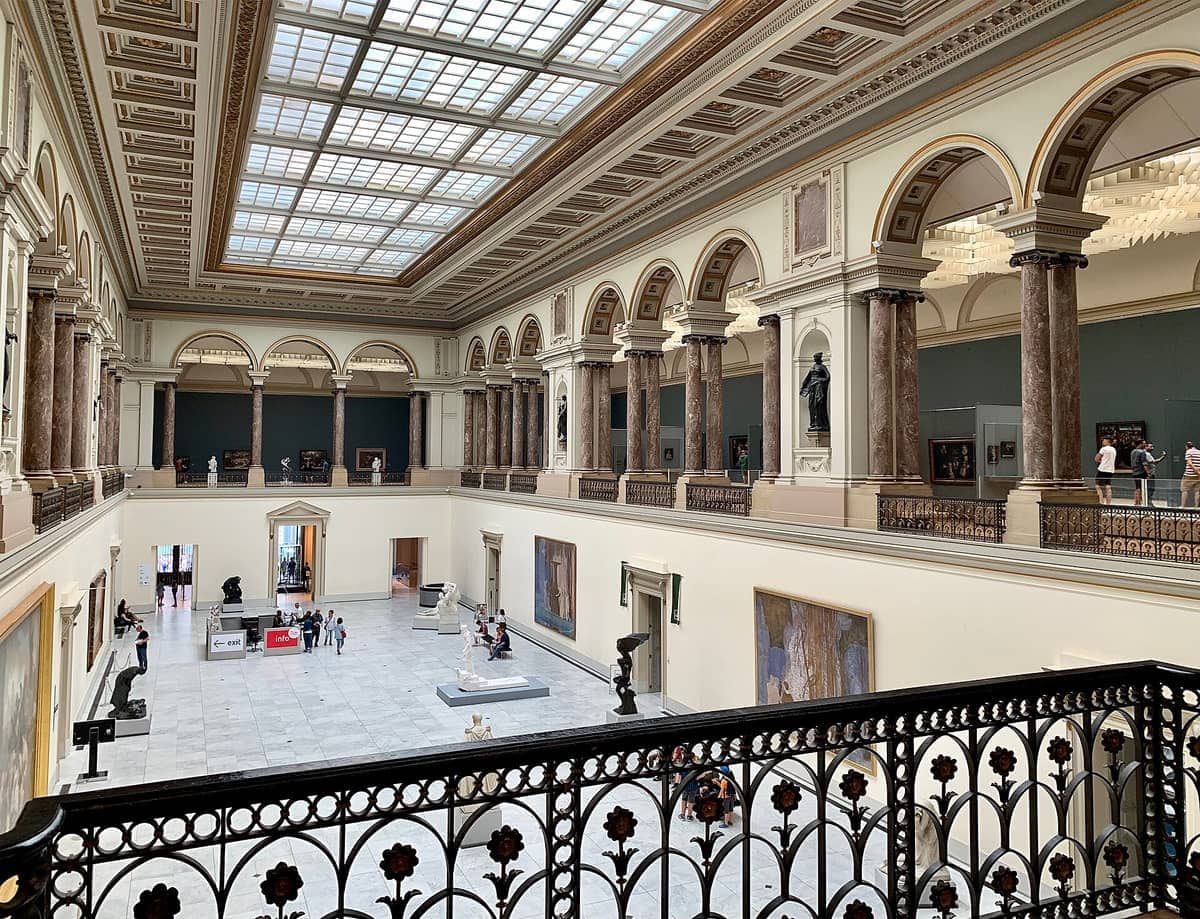
What the Royal Museums of Fine Arts Actually Are
The Royal Museums of Fine Arts of Belgium (French: Musées royaux des Beaux-Arts de Belgique) is not a single museum but a complex of several interconnected institutions occupying an imposing neoclassical building and its extensions near Place Royale in Brussels's Royal Quarter. The main city-center museums are the Old Masters Museum, the Museum of Modern Art, the Magritte Museum, and the Fin-de-Siècle Museum. Together they hold more than 20,000 works, making this one of the largest and oldest art complexes in the Low Countries.
The backbone of the collection was assembled from royal and aristocratic holdings as far back as the 16th century, with the founding of a public museum following the French Revolutionary period in the late 18th century. The main building, designed by Alphonse Balat (the same architect who later guided Victor Horta's early career), opened in 1887. Its grand stone facade and colonnaded entrance still dominate the top of the Rue de la Régence, and the building itself is worth a few minutes of attention before you even walk through the door.
💡 Local tip
The combined ticket (adults €15) covers the Old Masters Museum, the Museum of Modern Art, the Magritte Museum, and the Fin-de-Siècle Museum. If you have more than two hours, this is almost always better value than a single-museum entry.
The Collections: What You Will Actually See
Old Masters Museum
This is the core of the complex and the reason serious art travelers make the trip. The Flemish and Dutch holdings from the 15th to the 18th century are exceptional. Rogier van der Weyden's portrait work and Hieronymus Bosch's triptychs sit alongside the largest collection of Pieter Bruegel the Elder works outside Vienna — his 'Fall of Icarus' and the 'Census at Bethlehem' are displayed here, and neither photograph as well as they look in person. The scale of the Bruegel panels surprises many visitors who have only seen them reproduced; the detail in the 'Census' — figures bundled against the cold of a Flemish winter that clearly references the Low Countries rather than Judea — rewards slow, close looking.
Rubens is also well represented. His large-scale allegorical canvases occupy several rooms and give a clear sense of the theatrical ambition of Flemish Baroque painting. If you are not already a Rubens enthusiast, these rooms can feel overwhelming; if you are, the depth of the holdings here is genuinely satisfying. The collection of Anthony van Dyck portraits, including several of aristocratic Genoese and Flemish subjects, is less discussed but equally precise.
Magritte Museum
The Magritte Museum occupies a separate section of the complex and has its own entrance at Place Royale 2, which is useful if you have booked timed tickets online. This is the world's largest collection of René Magritte's work, with more than 200 pieces across three floors organized chronologically through the Belgian Surrealist's career. It traces his early commercial work, his relationship with fellow Belgian Surrealists, and the development of the iconic imagery — bowler hats, pipes, floating rocks, green apples — that made his name internationally.
The museum is popular and can feel compressed on weekend afternoons when school groups and tour parties occupy the lower floors. If Magritte is your primary reason for visiting, arrive at opening time on a Tuesday or Wednesday to move through the rooms without crowding. The top floor, which covers his later career, is quieter and gives more space to the work.
Fin-de-Siècle Museum and Museum of Modern Art
The Fin-de-Siècle Museum covers art, decorative arts, and design from roughly 1868 to 1914 — a period in which Brussels was genuinely one of Europe's most artistically significant cities. The Art Nouveau movement, Symbolism, and the work of artists such as Fernand Khnopff and Félicien Rops are given serious space here. Khnopff's unsettling, sphinx-like figures are among the most distinctive works in the building, and the applied arts sections — furniture, glasswork, jewelry — connect directly to the broader story of Brussels as a center of Art Nouveau design.
The Museum of Modern Art, covering 20th and 21st century work, was previously housed in underground galleries and has been undergoing significant renovation, with parts of the collection progressively reopening in new configurations. Its relationship to the permanent collection is worth checking on the official website before your visit, as display configurations have changed. For contemporary art, WIELS Contemporary Art Centre in Forest offers a very different but equally compelling experience.
Tickets & tours
Hand-picked options from our booking partner. Prices are indicative; availability and final rates are confirmed when you complete your booking.
Brussels audio tour with BELvue Museum admission
From 20 €Instant confirmationBrussels Art and History Museum ticket with Ancient Egypt audio tour
From 19 €Instant confirmationBanksy Museum admission and Brussels' highlights audio tour
From 28 €Instant confirmationAntwerp Day Trip from Brussels
From 45 €Instant confirmationFree cancellation
How the Experience Changes by Time of Day
Tuesday through Friday mornings, particularly before noon, are the quietest periods across all four museums. The Old Masters galleries on a Tuesday at 10:30 feel almost private — footsteps on the parquet floors, the occasional museum guard, and very little competition for space in front of the Bruegel panels. The natural light in some of the upper galleries shifts noticeably between morning and afternoon, which affects how the older varnished canvases read; the warm northern European light coming through the roof lanterns in late morning is particularly flattering to the Flemish works.
Weekend afternoons are the most crowded period, especially in the Magritte Museum. Saturday between 13:00 and 16:00 sees the highest footfall, with organized tour groups and families concentrating on the ground and first floors. The upper floors of the Old Masters building tend to stay calmer even on busy days.
The first Wednesday afternoon of each month (free entry from 13:00) draws a noticeably different crowd: more young visitors, more local Brussels residents, and a livelier atmosphere. It is a legitimate way to visit on a budget, but expect the Magritte Museum in particular to be full by 14:30.
ℹ️ Good to know
Opening hours: Tuesday–Friday 10:00–17:00; Saturday–Sunday 11:00–18:00. Closed Monday. Early closing at 14:00 on 24 and 31 December. Also closed 1 January, 1 May, 18 June, 1 November, 11 November, and 25 December. Always verify before visiting.
Getting There and Practical Navigation
The main entrance is at Rue de la Régence 3. Trams 92 and 93 stop at the Royale/Koning stop, which places you directly in front of Place Royale and a two-minute walk from the entrance. Metro lines 2 and 6 serve the Trône/Troon station, but from there the walk is uphill through the Sablon area — about ten minutes and worth it as a route, but not ideal if you are carrying luggage or have mobility concerns. The accessible entrance for visitors requiring step-free access is at 1a Rue de la Régence.
The museums sit directly above the Coudenberg Palace archaeological site, which is a separate attraction with its own entrance on Place Royale. If you have an afternoon free after the museums, the underground remains of the medieval palace make a logical next stop.
The cloakroom accepts bags and luggage up to approximately standard airline cabin size. Larger bags are not permitted in the galleries. The museums have a cafe and a well-stocked art bookshop; the bookshop in particular is worth browsing for exhibition catalogs and Belgian art publications that are hard to find elsewhere.
⚠️ What to skip
Photography is generally permitted in the permanent collection galleries without flash. Tripods and selfie sticks are not allowed. Rules for temporary exhibitions differ — check signage at each entrance.
Context: Why These Collections Matter for Brussels
Brussels occupied an unusual position in European art history. As the capital of the Southern Netherlands under Habsburg rule, it was a city of considerable wealth and artistic ambition from the 15th century onward. The Flemish Primitives, the Bruegel dynasty, and the Antwerp Mannerists all operated within a cultural and economic network centered partly on Brussels. The Old Masters collection here is not an assembled acquisition — much of it grew organically from the city's own history. Understanding this gives the visit more weight than a comparable tour through, say, a 19th-century encyclopedic museum built from purchases and colonial acquisitions. For a broader sense of how Brussels shaped and was shaped by art and architecture, the Art Nouveau Brussels guide provides useful historical context, particularly for the Fin-de-Siècle Museum.
The Fin-de-Siècle Museum's significance is also directly tied to Brussels's role as an Art Nouveau capital. The same period that produced Khnopff and the Symbolist movement also produced Victor Horta's revolutionary domestic architecture a few streets away. Visiting the Horta Museum on the same day as the Fin-de-Siècle Museum gives a complete picture of why the 1890s and early 1900s were so creatively dense in this city.
Tickets, Discounts, and What the Brussels Card Covers
Admission prices as of available 2025 data: a single-museum adult ticket is approximately €10, reduced to approximately €8 for visitors 65 and over, and approximately €3 for visitors aged 6 to 25. Visitors under 19 enter free. Disabled visitors and certain concession categories pay approximately €5. The combined ticket covering the main museums costs approximately €15 for adults, €10 for seniors, and €5 for young visitors aged 18 to 25. Under-19s enter free on the combined ticket.
Free admission applies on the first Wednesday of every month from 13:00. This typically covers the permanent collection; temporary exhibitions may have separate charges. Holders of the Brussels Card receive free or reduced entry — confirm current terms when purchasing the card, as coverage can vary. Visitors under 18 may qualify for free or reduced entry; verify at the ticket desk.
If you are planning a full day of museum visits in Brussels, the best museums in Brussels guide outlines how to sequence the Royal Museums with other major collections like the Magritte, the Musical Instruments Museum, and the BELvue without museum fatigue.
Who Should Think Carefully Before Going
The Royal Museums of Fine Arts of Belgium is a serious, large-scale art museum. Visitors who are primarily interested in a quick cultural checkbox rather than extended looking may find the scale and density of the collection overwhelming rather than satisfying. Young children under eight will generally find the galleries difficult — the works are large and text-heavy, and the building offers limited interactive elements compared to science or natural history museums.
Visitors arriving solely for Magritte should be aware that the Magritte Museum, while excellent, is not a large space and can feel overcrowded in under an hour if the galleries are full. If Magritte is the only draw, consider whether the visit justifies a separate trip or whether it pairs naturally with other nearby attractions in the Royal Quarter, such as the Musical Instruments Museum or the Mont des Arts garden terrace.
The building is physically large and requires significant walking, including between levels and between museum sections. Comfortable shoes are a genuine practical requirement, not a cliché.
Insider Tips
- The underground passage connecting the Old Masters Museum to the Magritte Museum and Fin-de-Siècle Museum means you can move between all sections without going outside — useful in Brussels's frequently rainy weather.
- The roof lantern rooms in the Old Masters section are the best-lit galleries in the building. If you are photographing works without flash, aim for these spaces in late morning when natural light is strongest.
- Audioguides are available at the ticket desk and add significant context to the Old Masters collection in particular, where the religious iconography and donor portraiture can be opaque without background knowledge.
- The museum bookshop stocks exhibition catalogs for both current and past shows at prices below what you will find for the same titles in general bookshops. It is a legitimate source for serious Flemish and Belgian art publications.
- On free Wednesday afternoons, the Fin-de-Siècle Museum is consistently less crowded than the Magritte Museum, despite holding equally interesting work. Start there and work your way through to Magritte before the afternoon peak.
Who Is Royal Museums of Fine Arts of Belgium For?
- Art history enthusiasts, particularly those with an interest in Flemish, Dutch, and Belgian painting from the 15th to early 20th century
- Magritte and Surrealism specialists who want the most comprehensive single collection of his work anywhere in the world
- Travelers visiting Brussels on a rainy day who want several hours of absorbing indoor time near the city center
- Culture-focused couples or solo travelers building a full Royal Quarter day combining the museums with the Mont des Arts and the Sablon district
- Visitors with a serious interest in Art Nouveau and Symbolism, for whom the Fin-de-Siècle Museum provides essential context alongside nearby architectural landmarks
Nearby Attractions
Other things to see while in Royal Quarter & Mont des Arts:
- BELvue Museum
The BELvue Museum traces Belgium's history from its founding in 1830 to the present day through seven thematic galleries and around 200 carefully selected objects. Located at Place des Palais, steps from the Royal Palace, it offers a clear-eyed account of a country that has rarely had a simple story to tell.
- BOZAR – Centre for Fine Arts
Housed in a landmark Art Deco building designed by Victor Horta, BOZAR is Belgium's premier multidisciplinary arts centre, blending major exhibitions, classical concerts, film screenings, and contemporary performance under one roof. Located steps from Brussels Central station in the Mont des Arts district, it rewards curious visitors who want more from their cultural itinerary than a single painting collection.
- Coudenberg Palace Archaeological Site
Beneath the Place des Palais lies one of Brussels' most unexpected attractions: the excavated ruins of the Coudenberg Palace, once the most powerful royal court in northern Europe. This underground archaeological site lets visitors walk through streets and halls that haven't seen daylight since the 18th century.
- Magritte Museum
The Musée Magritte Museum in Brussels holds the world's largest collection of works by René Magritte, with over 200 paintings, drawings, sculptures, and archival materials spread across multiple floors. Located on Place Royale in the Royal Quarter, it is one of the most focused single-artist museums in Europe and a serious destination for anyone interested in Surrealism, 20th-century painting, or Belgian cultural history.