Horta Museum: Inside the House Victor Horta Built for Himself
The Horta Museum in Saint-Gilles is the former home and workshop of architect Victor Horta, the man who effectively invented Belgian Art Nouveau. A UNESCO World Heritage Site, it offers one of the most intimate encounters with turn-of-the-century design anywhere in Europe.
Quick Facts
- Location
- Rue Américaine 23–25, 1060 Saint-Gilles, Brussels
- Getting There
- Tram 81 or 97 and various bus lines serving Saint-Gilles; short walk from Midi/Zuid station
- Time Needed
- 1–1.5 hours
- Cost
- Adults €14 | Students/job-seekers €6 | Ages 6–17 €3.50 | Free first Sunday of the month
- Best for
- Architecture lovers, design enthusiasts, Art Nouveau fans
- Official website
- hortamuseum.be
What the Horta Museum Actually Is
The Horta Museum is not a reconstructed period room or a civic monument retrofitted into a gallery. It is the actual house and workshop that architect Victor Horta designed for himself between 1898 and 1901, on Rue Américaine in the Saint-Gilles municipality of Brussels. He lived and worked here until 1919, and virtually everything you see inside, from the sinuous ironwork banisters to the mosaic tile floors to the amber-tinted skylights, was conceived by the same hand. That biographical continuity is what makes the place unusual.
Horta is the architect most credited with bringing Art Nouveau from theory into brick and iron. Before him, decorative flourishes were applied to buildings like ornaments on a cake. Horta integrated decoration into structure: the curving steel columns in his stairwell are not cladding over something else, they are the building's skeleton, exposed and shaped. When you stand in the central stairwell and look up at the light filtering through the glass roof, you are seeing the core argument of Art Nouveau made physical.
The building is a UNESCO World Heritage Site, inscribed in 2000 as part of a group of four major Brussels townhouses by Horta. The others, including the Hôtel Solvay and the Van Eetvelde House, were built for wealthy clients. This one, by contrast, was Horta's personal statement: the place where he had no client to satisfy but himself.
Opening Hours and Tickets
The museum is open Tuesday through Friday from 14:00 to 17:30, and Saturday through Sunday from 11:00 to 17:30. It is closed on Mondays. Note that on weekdays the doors do not open until 2 pm, which catches a surprising number of visitors off-guard. If you arrive mid-morning on a Tuesday planning to spend the afternoon elsewhere, you will be standing outside an unmoved door.
Admission is €14 for adults, €6 for students and job-seekers, and €3.50 for children aged 6 to 17. Entry is free on the first Sunday of each month, which brings noticeably larger crowds. Prices are based on information verified in 2024; confirm current rates on the official website before visiting.
💡 Local tip
Weekday afternoons (Tuesday through Friday, shortly after 14:00) offer the quietest experience. Weekends, especially Saturday mornings and free-entry Sundays, draw considerably more visitors, which matters in a building this small.
Tickets & tours
Hand-picked options from our booking partner. Prices are indicative; availability and final rates are confirmed when you complete your booking.
Ghent tour from Brussels
From 43 €Instant confirmationFree cancellationTablet Workshop at Choco-Story Brussels
From 45 €Instant confirmationShared tour of Delft and the Keukenhof Estate from Brussels
From 86 €Instant confirmationFree cancellationOrigins of Brussels exploration game and tour
From 10 €Instant confirmationFree cancellation
Moving Through the House: Room by Room
The visit follows a prescribed route through both the residential house and the adjacent workshop wing. You begin on the ground floor, where the entrance hall and dining room set the tone immediately: wooden paneling inlaid with stylized plant forms, mirror glass panels that bounce light into corners, and floors where the geometry shifts subtly from room to room. The scale is domestic, not palatial, and that intimacy works in the museum's favor.
The central stairwell is the piece everyone photographs, and it earns the attention. Curved ironwork rises through three floors, the handrail flowing without interruption from the ground to the top landing. The walls are clad in pale ochre stone. At the summit, a glass roof sends diffused daylight down the whole shaft. On overcast Brussels afternoons, the light is soft and even. On rare sunny days, the space fills with warmth that feels almost Southern European, incongruous and lovely.
The upper floors contain Horta's private rooms and studio spaces. Furniture, drawings, and personal objects are displayed throughout, giving the tour biographical weight. The workshop section, connected but distinct in character, has higher ceilings and a more utilitarian feeling, though Horta could not resist decorating even the workspaces. Exposed brick, iron brackets, and large north-facing windows remain from the original studio configuration.
Victor Horta and the Context of Art Nouveau in Brussels
Victor Horta was born in Ghent in 1861 and died in Brussels in 1947. His career spans the full arc of Art Nouveau: from the radical early work of the 1890s through a later pivot toward the stripped-back modernism that would eventually supplant the style he had championed. The house on Rue Américaine belongs to his peak period, when every detail, down to door handles and light fixtures, was designed as part of a unified whole.
Brussels at the turn of the twentieth century was one of Europe's wealthiest cities, enriched by the industrial boom and by revenues flowing from King Leopold II's brutally exploited Congo colony. That wealth funded a remarkable building boom in the city's middle-class and upper-middle-class residential districts. Horta's clients were industrialists, scientists, and lawyers who wanted homes that looked progressive rather than aristocratic. Saint-Gilles and the neighboring communes became testing grounds for a new kind of urban domesticity.
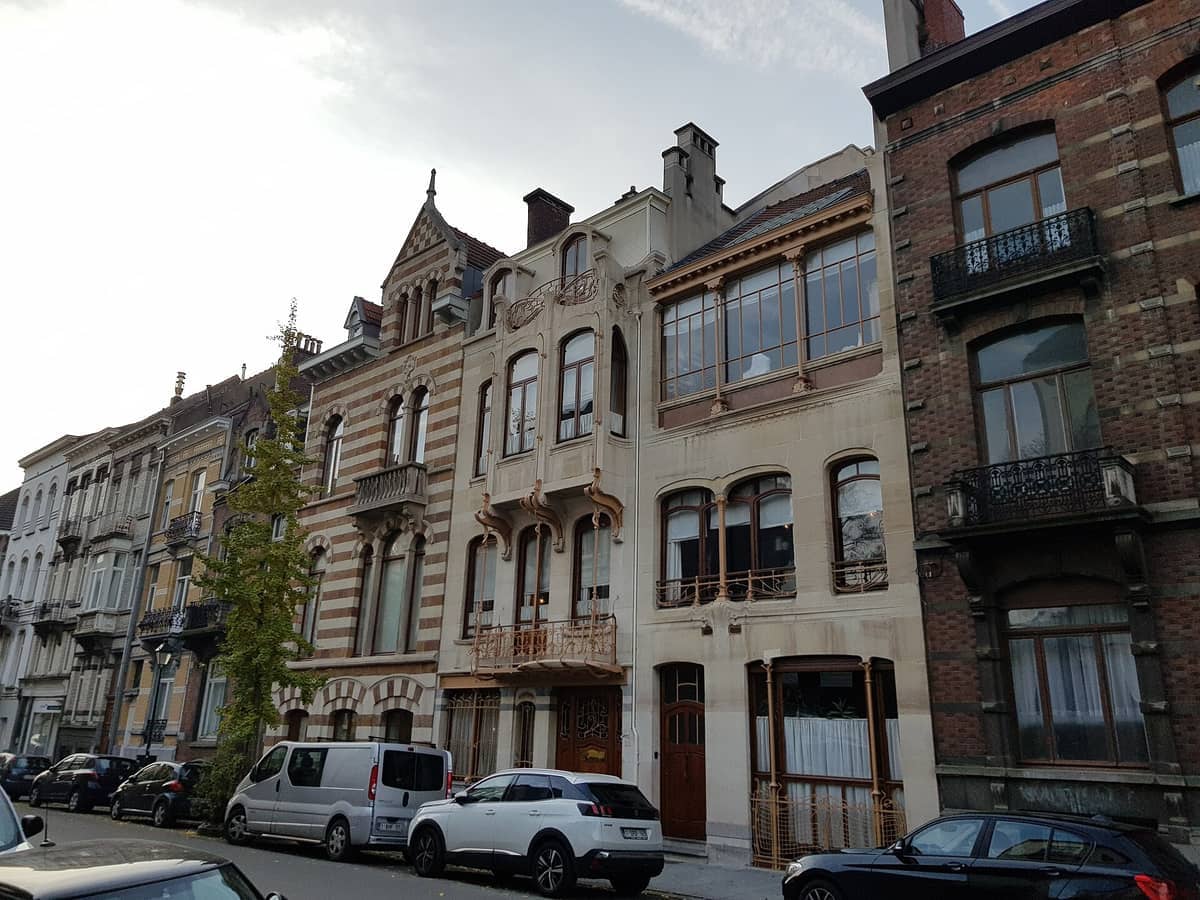
If the Horta Museum opens an appetite for Art Nouveau in Brussels, the surrounding streets reward further exploration. The Art Nouveau facades of Saint-Gilles are within easy walking distance, and the neighborhood contains a dense concentration of late-nineteenth and early-twentieth century townhouses that range from faithful Horta imitations to more eclectic personal experiments. You do not need a guide; simply walking the side streets around Rue Américaine reveals facades that would headline a lesser city's architecture tour.
Practical Details: Getting There, What to Bring
The museum sits in a residential part of Saint-Gilles, one of Brussels's nineteen municipalities, located south of the city centre. It is walkable from Brussels-Midi station in roughly 15 to 20 minutes, passing through the dense streetscape of Saint-Gilles along the way. Tram lines serving the area provide a shorter connection if you prefer. The STIB/MIVB network covers this part of Brussels well; check the official journey planner for current routes.
The museum is small and the visit is conducted on multiple floors connected by the famous staircase. There is no lift. The official information available indicates the building is not accessible to wheelchair users or visitors with significantly reduced mobility, which is a genuine limitation of a protected historic structure. If accessibility is a concern, contact the museum directly before planning your visit.
Photography without flash is generally permitted for personal use, though policies can change. The stairwell is the obvious subject, but the dining room's ceiling detail and the workshop's north-facing windows also reward a careful shot. Bring a lens or phone setting that handles low light well; the interiors are deliberately intimate rather than brightly lit, and that atmosphere is part of what you are there to experience.
⚠️ What to skip
The museum is closed on Mondays and does not open until 14:00 on weekdays. Many visitors, especially those combining it with a morning in the Grand-Place area, arrive too early and have to return. Plan your day accordingly.
Honest Assessment: Is It Worth Your Time?
For anyone with a genuine interest in architecture, decorative arts, or the history of modernism, the Horta Museum is among the most rewarding single hours you can spend in Brussels. The building is the argument: you do not need to read lengthy explanations to understand why Horta mattered, because you are standing inside the proof. That clarity of experience is rare in a museum context.
The visit is short by the standards of major museums, and the space is small. Visitors expecting a large institution with multiple galleries, a restaurant, and an extensive gift shop will be disappointed. This is a house. The ticket price reflects an institution maintaining a UNESCO-listed private residence rather than a publicly subsidized national collection. Whether that feels fair depends on what you are looking for.
Those primarily interested in Belgian painting, medieval history, or broad survey collections would be better served by the Royal Museums of Fine Arts or the Art and History Museum in the Cinquantenaire. The Horta Museum is specific in its focus, and that specificity is precisely its strength.
For a broader orientation to what makes Brussels architecturally distinctive, the Art Nouveau in Brussels guide provides useful context before or after your visit.
Insider Tips
- Arrive promptly at 14:00 on a Tuesday or Wednesday for the quietest possible visit. The afternoon light in the stairwell is at its best in the hour after opening on days with partial cloud cover.
- The free first-Sunday entry is well worth the trade-off in crowds only if you arrive at 11:00 when the doors open. By early afternoon, the stairwell photo becomes a queue management exercise.
- Look at the floor mosaics closely in each room. The patterns shift between spaces in ways that are easy to miss if you are focused on the ironwork above. Horta treated every surface as part of the same visual conversation.
- The workshop wing has a different, more austere atmosphere than the residential rooms. Spend time there rather than rushing back through the house; the contrast tells you something about Horta's working method that the polished interiors do not.
- Saint-Gilles has a strong local café culture in the streets immediately around the museum. Arriving fifteen minutes early and sitting at one of the nearby terraces gives you a sense of the neighborhood that frames the museum better than any introductory panel inside.
Who Is Horta Museum For?
- Architecture and design enthusiasts with a specific interest in Art Nouveau or the history of modernism
- Travelers combining the museum with a walking tour of Saint-Gilles's residential streets
- Visitors who prefer focused, intimate cultural experiences over large survey institutions
- Photographers interested in interiors, light, and decorative detail
- Anyone curious about the domestic life and working environment of a major historical figure
Nearby Attractions
Other things to see while in Saint-Gilles:
- Art Nouveau Facades of Saint-Gilles
The Art Nouveau facades of Saint-Gilles form one of Brussels's finest open-air architectural collections. Clustered around Chaussée de Waterloo and the surrounding streets, these protected townhouses showcase the full decorative range of Belgium's early 20th-century architectural movement, and they cost nothing to visit.