Art & History Museum (Cinquantenaire): Brussels's Most Underrated World-Class Collection
Housed in the grand neoclassical wings of the Parc du Cinquantenaire, the Art & History Museum holds one of Belgium's most important collections, covering ancient civilisations, decorative arts, and non-European cultures across dozens of galleries. It draws far fewer crowds than its scale deserves, making it a rare opportunity to spend hours with world-class artefacts in relative calm.
Quick Facts
- Location
- Parc du Cinquantenaire 10, 1000 Brussels
- Getting There
- Metro: Merode (line 5) or Schuman (lines 1/5) — both within a 5–10 minute walk
- Time Needed
- 2 to 4 hours; allow a full half-day if you plan to cover the permanent collection seriously
- Cost
- Adults €10 | Seniors €8 | Students €4 | Under 18 free (verify current prices on official site)
- Best for
- History enthusiasts, archaeology lovers, families with older children, rainy-day culture seekers
- Official website
- www.artandhistory.museum/en
What the Art & History Museum Actually Is
The Art & History Museum (French: Musée Art & Histoire; Dutch: Museum Kunst & Geschiedenis) sits at the eastern end of the Parc du Cinquantenaire, the monumental park that the Belgian government developed under King Leopold II’s patronage to mark the 50th anniversary of Belgian independence in 1880. The museum is part of the Royal Museums of Art and History complex, one of the largest encyclopaedic museums in Europe, though it rarely makes international top-ten lists. That omission works in your favour as a visitor.
The collection spans an almost impractical range: Egyptian and Near Eastern antiquities, Greco-Roman archaeology, pre-Columbian artefacts from the Americas, Byzantine and early medieval decorative arts, Art Nouveau applied arts, and extensive holdings from Asia and Oceania. This is not a narrow specialist museum. It is, in the tradition of great 19th-century national collections, an attempt to hold the breadth of human material culture in a single building.
The museum shares the Cinquantenaire complex with the Autoworld classic car museum and the Royal Museum of the Armed Forces. All three occupy wings of the same triumphal arch ensemble, meaning you can combine visits to the same park in a single afternoon.
The Building: Architecture Worth Noticing Before You Enter
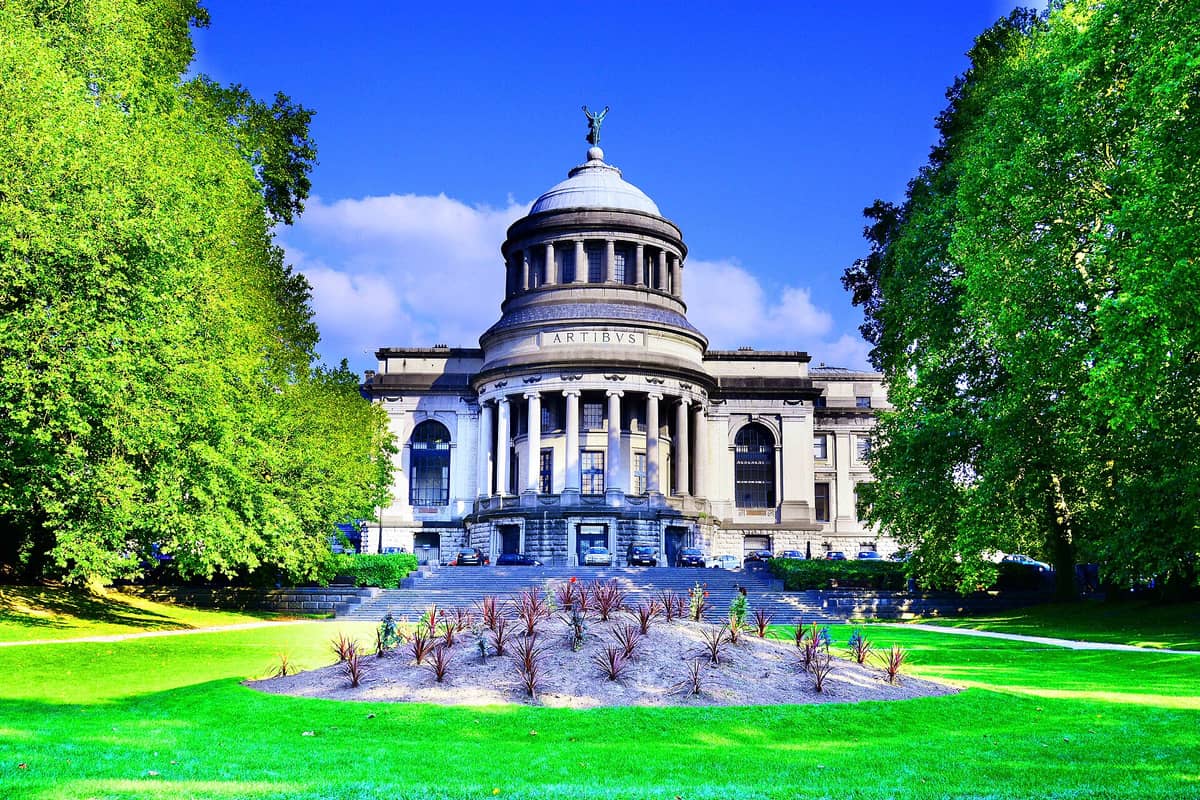
Approach the museum from the park side rather than the street, and you get the full effect of Gédéon Bordiau's neoclassical facade, a long, colonnaded hall with high arched windows and a roofline that signals civic ambition on a 19th-century European scale. The central triumphal arch, added later and completed in 1905, frames a panorama that Belgian postcards have used for over a century. Early morning, when the park is nearly empty and the stone catches low-angle light, is genuinely striking.
Inside, the main hall is the first signal that this building was designed to impress. The glassed-over central nave rises to an iron and glass vault reminiscent of a grand railway terminus, an intentional 19th-century device that equated the collection of knowledge with the engineering of progress. The floor patterns, the ironwork, and the proportions of the connecting galleries are all original to the late 19th-century construction. Walk slowly here before heading into the galleries.
💡 Local tip
Pick up a floor plan at the entrance desk. The museum is large enough that without one, you will almost certainly miss entire wings. The layout is not immediately intuitive, and some gallery connections are less obvious than they appear on signage.
Tickets & tours
Hand-picked options from our booking partner. Prices are indicative; availability and final rates are confirmed when you complete your booking.
Brussels Art and History Museum ticket with Ancient Egypt audio tour
From 19 €Instant confirmationPrivate walking tour of Brussels' history and art
From 129 €Instant confirmationFree cancellationBrussels pub crawl meet people and party
From 16 €Instant confirmationFree cancellationPrivate exclusive history walk through Brussels with a local expert
From 337 €Instant confirmationFree cancellation
The Collection: What to Prioritise
The Egyptian antiquities galleries are among the strongest in Belgium, with a collection that includes mummies, sarcophagi, shabtis, and papyrus fragments assembled from 19th-century excavations. The display cases are older in style and the lighting more subdued than in newer museum fitouts, which gives the galleries an atmosphere somewhere between scholarly and slightly atmospheric. This is not a criticism: the objects are well-labelled and the density of material is serious.
The decorative arts section covering European applied arts from the medieval period through Art Nouveau is substantial. Belgium's own Art Nouveau heritage is well represented here, with furniture, glasswork, and metalwork from the period when Brussels was one of the movement's capitals. If you are following the city's architectural trail, the museum provides useful context for what you see on the streets of Saint-Gilles and Ixelles.
The non-European collections, covering the Americas, Asia, and the Pacific, are extensive. The pre-Columbian section in particular contains artefacts that rarely feature in the museum's own promotional materials, yet reward close attention. For broader context on Brussels's complex relationship with its colonial-era collections, the AfricaMuseum in Tervuren provides a more focused and extensively re-contextualised examination of Central African collections specifically.
The Greco-Roman and Near Eastern archaeology floors round out the encyclopaedic picture. Assyrian reliefs, Cypriote ceramics, and Roman glass sit alongside Belgian archaeological finds from pre-Roman and Gallo-Roman sites. For visitors with a serious interest in any one period, this is not a substitute for specialist collections in London, Paris, or Rome, but it is a coherent and well-maintained survey collection that covers ground most Belgian museums do not.
How the Experience Changes by Time of Day
Tuesday through Friday mornings, particularly before 11:00, the museum is quiet enough that you can stand alone in front of major objects for as long as you like. School groups arrive from around 10:00 and tend to concentrate in the Egyptian and classical antiquity sections, so moving to the decorative arts or non-European wings at that point keeps the experience calm.
Weekend afternoons are the most crowded period, though even then the museum rarely reaches the density you would encounter at comparable institutions in Paris or London. The scale of the building absorbs visitors well. Saturday mornings from opening (10:00) until around noon tend to offer a reasonable balance between atmosphere and quiet.
Afternoon light through the glass roof of the central hall shifts noticeably between 14:00 and 16:00, illuminating the ironwork and making the hall itself worth revisiting later in the visit. Last ticket sales are at 16:00 (last entry at 16:15), with galleries beginning to close at 16:45, so a late arrival leaves insufficient time for the full collection. Do not try to see everything in under two hours: the building and its contents both reward a slower pace.
ℹ️ Good to know
Opening hours: Tuesday to Friday 09:30–17:00; Saturday, Sunday, and public holidays 10:00–17:00. Closed Mondays and on 1 January, 1 May, 1 November, 11 November, and 25 December. On 24 and 31 December the museum closes at 15:00. Ticket sales close one hour before closing (last entry 15 minutes after ticket sales end).
Getting There: Practical Transit Notes
Metro line 5 connects the Cinquantenaire complex to Brussels city centre in under ten minutes. The Merode stop deposits you at the eastern edge of the park, a two-minute walk from the museum entrance. The Schuman stop, one station west, is also walkable in about eight to ten minutes and is useful if you are coming from the area around the European institutions.
The museum is located in the European Quarter, which means it sits within easy reach of the Schuman roundabout and the main EU institutional buildings. If you are spending time exploring the quarter before or after your visit, the walk between the museum and the European Commission takes about ten minutes through the park.
By bike, Brussels's shared cycling infrastructure covers this area well and the park itself has clear cycling paths. Driving is possible but parking in the European Quarter can be limited and expensive on weekdays. Transit is the practical choice for most visitors.
💡 Local tip
If you are coming directly from the Brussels Airport (BRU) area, STIB bus line 12 (weekdays) and 21 (evenings and weekends) run directly to the Schuman stop in the European Quarter, making the Art & History Museum a logical first stop after arrival without needing to change to the metro.
Accessibility, Photography, and Practical Details
The museum is wheelchair accessible for most of its permanent galleries, with lifts connecting the main floor levels. Visitors requiring assistance in planning their visit can contact the museum at +32 (0)2 741 73 02 or reservations@kmkg-mrah.be in advance. Some sections of the older building may have limited access, so confirming specifics beforehand is worthwhile.
Photography of the permanent collection is generally permitted without flash for personal use, which makes the Egyptian gallery and the glass-roofed central hall particularly rewarding for photography. The ironwork vault shot upward from the centre of the hall in the mid-morning light is one of the cleaner architectural interior shots available in Brussels without a ticket fee, since the hall is visible from the entrance foyer.
The museum has a café and a bookshop on site. The café is modest in size and can be full during peak weekend hours around lunchtime. The bookshop carries a reasonable selection of exhibition catalogues and books on the collection's major themes, with titles in French, Dutch, and English.
Honest Assessment: Who This Museum Is For, and Who Might Leave Disappointed
The Art & History Museum is not a contemporary museum experience. The display design in many galleries is functional rather than interpretive: labels are informative, but interactive elements, immersive installations, and curated visitor journeys are largely absent compared to what you might expect from a major national museum elsewhere in Europe. The pace and format suit visitors who are comfortable navigating a traditional collection-based museum independently.
For visitors primarily interested in Belgian fine art, the museum's holdings are less relevant than the Royal Museums of Fine Arts, which covers Belgian painting from the 15th century to the present and includes the Magritte Museum. The Art & History Museum is about material culture, archaeology, and decorative arts, not painting.
Visitors who prefer short, curated experiences with a clear narrative may find the breadth of the collection disorienting. The museum rewards those who arrive with a specific interest (Egyptian antiquities, Art Nouveau applied arts, pre-Columbian artefacts) and use the floor plan to focus, rather than attempting a comprehensive walkthrough.
For families with younger children, the museum can work well given its range of objects and the visual impact of the Egyptian and classical galleries. However, families specifically focused on interactive or hands-on exhibits might find the Museum of Natural Sciences (which includes the famous dinosaur gallery) a more immediately engaging option for children under ten.
Insider Tips
- Enter from the park side, not the street side, for the best first impression of the building's scale. The approach through the Cinquantenaire park, past the triumphal arch, gives the full architectural context that the street entrance skips entirely.
- The decorative arts galleries on the upper floors are frequently bypassed by visitors who spend all their time on the ground floor archaeology sections. The Art Nouveau furniture and glasswork holdings here are directly connected to what you see walking around Saint-Gilles — they make more sense seen together.
- Tuesday and Wednesday mornings are consistently the quietest times in the building during opening hours. If your schedule allows a weekday morning visit, you will have the Egyptian gallery almost entirely to yourself between 09:30 and 10:30.
- The combined ticket option covering multiple Cinquantenaire museums (Art & History Museum, Autoworld, and the Royal Museum of the Armed Forces and Military History) is worth calculating against individual entry prices if you plan to visit Autoworld or the Armed Forces Museum on the same day. Check the current combined offer at the ticket desk on arrival.
- The glass-roofed central hall is worth a second visit at a different time within the same visit. It reads differently in morning versus afternoon light, and the architecture alone justifies the entry fee on days when temporary exhibitions are less compelling.
Who Is Art & History Museum (Cinquantenaire) For?
- Archaeology and ancient history enthusiasts who want depth without museum fatigue from crowds
- Visitors on a rainy day in Brussels looking for several hours of serious cultural content under one roof
- Travellers exploring Brussels's Art Nouveau heritage who want material context for the architecture they see on the streets
- Families with older children (10+) who can engage independently with archaeological objects and historical artefacts
- Museum professionals and students of decorative arts, applied arts, or Egyptology looking for a research-quality permanent collection
Nearby Attractions
Other things to see while in European Quarter:
- Autoworld Brussels
Autoworld Brussels presents more than 250 historic automobiles inside one of Brussels' most spectacular 19th-century exhibition halls, at the heart of the Parc du Cinquantenaire. From brass-era carriages to mid-century American cruisers, the collection spans over a century of automotive history, set beneath soaring iron-and-glass vaulting that is itself worth the visit.
- House of European History
Opened in 2017 and free to enter, the House of European History sits in Brussels's Leopold Park and explores the development of European identity with a particular focus on modern history and the 20th century. It is one of the few major museums in the city that genuinely rewards slow, careful attention rather than a quick walkthrough.
- Museum of Natural Sciences
The Museum of Natural Sciences in Brussels is one of Europe's most significant natural history institutions, home to the world's largest display of Iguanodon skeletons and collections spanning billions of years of life on Earth. Located in Leopold Park near the European Quarter, it rewards both families and serious science enthusiasts with far more depth than a single visit can exhaust.
- Parc du Cinquantenaire
Parc du Cinquantenaire is a 34-hectare formal park in Brussels's European Quarter, anchored by a monumental triumphal arch and flanked by three major museums. Laid out in 1880 to mark 50 years of Belgian independence, it draws joggers at dawn, families on weekends, and EU staff at lunch — all for free.