House of European History: What to Expect Before You Visit
Opened in 2017 and free to enter, the House of European History sits in Brussels's Leopold Park and explores the development of European identity with a particular focus on modern history and the 20th century. It is one of the few major museums in the city that genuinely rewards slow, careful attention rather than a quick walkthrough.
Quick Facts
- Location
- Rue Belliard 135, 1000 Brussels
- Getting There
- Metro line 1/5, Schuman station (5‑min walk); bus 12 from Brussels Airport serves the European Quarter and stops nearby
- Time Needed
- 2 to 3 hours for a thorough visit
- Cost
- Free admission
- Best for
- History enthusiasts, EU-watchers, curious travelers seeking context for modern Europe
- Official website
- historia.europa.eu
What the House of European History Actually Is
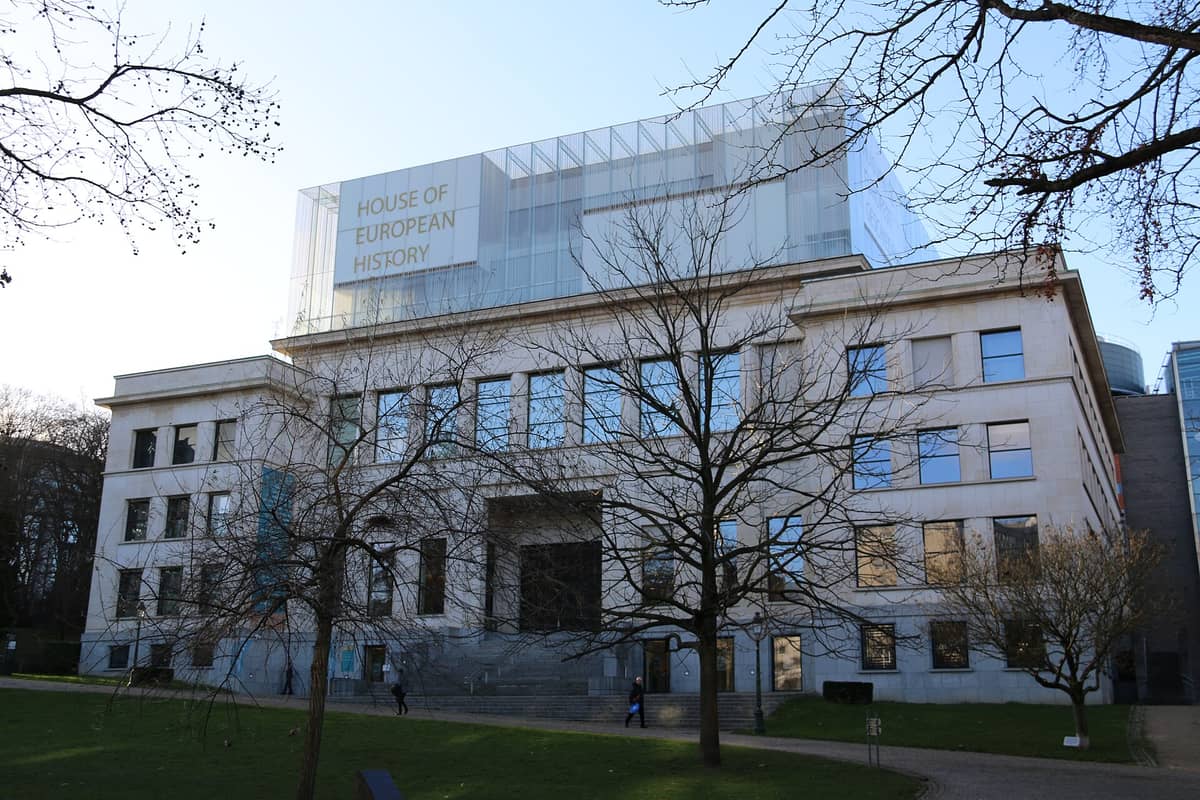
The House of European History opened its doors in May 2017, the result of a decade-long initiative by the European Parliament to create a permanent space dedicated to European memory and identity. It occupies the beautifully restored Eastman Building in Leopold Park, a 1935 Art Deco structure originally built as a dental clinic funded by George Eastman, founder of Kodak. That history alone tells you something about the museum's curatorial instinct: Europe as a place of intersections and unexpected connections.
The museum is not a monument to EU institutions. That distinction matters. You will not spend two hours looking at policy documents or portraits of commissioners. Instead, the permanent exhibition takes a genuinely ambitious arc, from pre-modern European identity through the devastation of the 20th century's wars to the construction of the modern European project and its current tensions. It is one of the more intellectually honest history museums in a city that has plenty of them.
ℹ️ Good to know
Admission is free for everyone. No booking is required for general visits. The museum is open seven days a week; last entry is at 17:30. It is closed on 1 January, 1 May, 1 November, 24–25 December, and 31 December.
The Building and Its Setting
Arriving at the museum on foot from Schuman metro station takes about five minutes along Rue Belliard. The street itself runs through the heart of Brussels's European Quarter, flanked by the glass towers of EU institutions and the grey facades of lobbying firms. It is not a charming walk. But as you turn into Leopold Park, the atmosphere shifts. The park is genuinely calm by European Quarter standards, with mature trees, benches, and a small pond. The Eastman Building sits at its center, its white stone facade and symmetrical wings giving it a quiet authority.
A modern glass extension connects the original building to the new exhibition wing. The architectural contrast is handled well: the old building houses the entrance, the café, and temporary exhibition spaces, while the contemporary addition holds the main permanent galleries across multiple floors. Outside, you can spend a few minutes in the park itself before or after your visit. On weekday mornings, it is almost entirely free of tourists. On summer weekends, local families and EU workers tend to occupy the benches by mid-morning.
The museum sits in the European Quarter, and is within reasonable walking distance of the Parlamentarium, the European Parliament's visitor center. If European governance and history interest you, the two make a logical pairing on the same day.
Tickets & tours
Hand-picked options from our booking partner. Prices are indicative; availability and final rates are confirmed when you complete your booking.
Brussels Art and History Museum ticket with Ancient Egypt audio tour
From 19 €Instant confirmationPrivate exclusive history walk through Brussels with a local expert
From 337 €Instant confirmationFree cancellationBrussels' history audio tour with Halle Gate admission ticket
From 17 €Instant confirmationPrivate walking tour of Brussels' history and art
From 129 €Instant confirmationFree cancellation
Inside the Permanent Exhibition: What You Will See
The permanent exhibition spans roughly 4,000 square meters across several thematic floors. It begins with a philosophical question rather than a timeline: what does it mean to be European? Visitors encounter fragments of ancient maps, myths, and medieval manuscripts before the narrative moves into recognizable modern history. The pacing is deliberate. You are not meant to rush.
The floors covering the 20th century are the strongest part of the museum. World War I and World War II are addressed with genuine weight, using personal testimonies, original objects, and multi-language audio stations. A section on totalitarianism, covering both Nazism and Soviet communism in parallel, avoids false equivalence while making structural comparisons clear. The audio guides are available in all 24 official EU languages, which says something about the museum's commitment to its own stated mission.
The upper floors deal with European integration after 1945 and the contemporary period. These sections are necessarily more abstract than the war galleries, and some visitors find the object-to-panel ratio shifts unfavorably here. But the curators have included personal artifacts, photographs from everyday life across different European countries, and interactive stations where visitors can contribute their own memories to the museum's growing archive. The effect is more participatory than didactic.
💡 Local tip
Pick up a physical floor plan at the entrance. The signage inside is good but not always intuitive on the upper floors, and backtracking between levels can be confusing if you lose your orientation.
How the Experience Changes by Time of Day
Tuesday through Friday mornings, particularly between 9:00 and 11:30, offer the quietest conditions. School groups arrive from around 10:00, but they tend to move through the lower floors in guided clusters, leaving the upper galleries largely free. If you prefer to read panels at your own pace without navigating around strollers or children, a weekday morning is your window.
Monday is the most unusual day to visit. The museum opens at 13:00 on Mondays, and the afternoon crowds are noticeably thinner than weekends. The trade-off is that you have less total time before the 17:30 last entry. For most visitors who want three unrushed hours, a Tuesday or Wednesday morning is the practical first choice.
Weekends draw a broader range of visitors: families, day-trippers from elsewhere in Belgium, and tourists staying near the Grand-Place who have made their way out to the European Quarter by midday. The museum handles weekend crowds reasonably well because the multi-floor layout disperses people, but the entrance hall and ground-floor café can feel congested between 12:00 and 14:00 on Saturdays.
Getting There and Getting Around
Metro lines 1 and 5 both stop at Schuman, which puts you directly in front of the European Commission buildings and a short walk from Leopold Park. From Brussels-Central station, the journey takes under ten minutes. Bus 12, which connects Brussels Airport to the European Quarter, also stops nearby, making the museum a genuinely convenient first stop for visitors arriving by air who want to begin their Brussels visit before checking in.
If you are combining the museum with a broader day in the European Quarter, the Parlamentarium is a ten-minute walk and also free to enter. The two institutions share a commitment to accessibility and multilingual interpretation, so they make a natural pairing for anyone interested in understanding how the EU works alongside understanding how Europe got here.
The museum is fully accessible for wheelchair users: all galleries and facilities meet accessibility standards, and the elevator connects all floors. The layout is linear but not rigid, and visitors with mobility considerations can navigate the entire permanent exhibition without difficulty.
💡 Local tip
Wear comfortable shoes. The exhibition route covers multiple floors and several hundred meters of walking, and most of it involves standing while reading. There are a handful of seating areas but they are not frequent enough for visitors who need regular rests.
A Frank Assessment: What Works and What Doesn't
The House of European History is a serious, well-funded institution that does several things unusually well. The 20th-century galleries are among the most thoughtful treatments of European trauma available to general visitors anywhere in Brussels. The free admission removes the threshold question entirely: there is no cost to stopping in even if you stay only an hour. The multilingual approach, with audio content in 24 languages, reflects a genuine commitment to inclusion rather than box-ticking.
The weaker sections are the contemporary ones. The closer the narrative gets to the present, the more the exhibition struggles to maintain critical distance from the EU institutions that partly fund it. This is an inherent tension the museum's own curators acknowledge, but it is visible in the way the post-1990 galleries feel more celebratory and less analytical than the earlier floors. Visitors expecting a hard-edged examination of Eurozone crises, Brexit, or rising nationalism will find the treatment somewhat cautious.
Travelers who might want to skip this museum: if you have limited time in Brussels and prioritizing art over history, the Royal Museums of Fine Arts or the Magritte Museum will likely serve you better. If you want immersive architecture rather than exhibition content, there are Art Nouveau houses in Saint-Gilles that provide a more sensory experience. The House of European History rewards genuine curiosity about European identity and 20th-century history; it is less suited to casual browsers looking for impressive objects.
For visitors building a wider Brussels itinerary, the best museums in Brussels guide can help you calibrate how the House of European History sits relative to the city's other major collections.
Photography and Practical Details
Photography is permitted in the permanent galleries for personal use. The lighting in the older, lower floors is atmospheric but dim, which can make handheld shots of individual objects challenging. The upper floors, with their larger window sections and lighter interiors, photograph more easily. The exterior of the Eastman Building in morning light, particularly with the park's trees in frame, is worth a few minutes before you go inside.
The café on the ground floor is a reasonable option for a coffee or light lunch. It is not a destination in itself but it is comfortable, and the terrace facing the park is pleasant in dry weather. Dedicated restaurant options are limited within immediate walking distance; the broader Schuman area tends toward business-lunch cafes rather than tourist-friendly spots.
If you are planning a full day in this part of Brussels, the two-day Brussels itinerary includes the European Quarter as a logical half-day block alongside other central attractions.
Insider Tips
- The museum opens at 09:00 Tuesday through Friday during most of the year. The first hour after opening is typically the quietest you will get on a weekday.
- The audio guide app (downloadable via the museum's website before arrival) is more comprehensive than the in-gallery panels alone and can be used without relying heavily on mobile data. Download it on your hotel Wi‑Fi before you travel to the museum.
- The rooftop terrace on the upper floor offers a direct view over Leopold Park and toward the European Parliament complex. It is easy to miss if you follow the standard floor route without deviating. Ask staff at the entrance how to access it.
- In July and August, Tuesday through Friday opening hours shift to 10:00 rather than 09:00. If you are visiting in summer and want the quiet morning window, arrive at 10:00 on the dot rather than expecting a 09:00 opening.
- Temporary exhibitions rotate throughout the year and are announced on the official website. If a particular theme is running alongside your visit, it can significantly deepen the permanent exhibition's themes. Check before you go.
Who Is House of European History For?
- History enthusiasts who want structured context for modern European politics and identity
- First-time Brussels visitors who want to understand the city's role as the EU's de facto capital
- Families with older children (12+) who can engage with text-heavy, multimedia exhibitions
- Solo travelers with several hours to spare who prefer intellectual engagement over sightseeing checklists
- EU professionals or students looking for a public-facing complement to the Parlamentarium
Nearby Attractions
Other things to see while in European Quarter:
- Art & History Museum (Cinquantenaire)
Housed in the grand neoclassical wings of the Parc du Cinquantenaire, the Art & History Museum holds one of Belgium's most important collections, covering ancient civilisations, decorative arts, and non-European cultures across dozens of galleries. It draws far fewer crowds than its scale deserves, making it a rare opportunity to spend hours with world-class artefacts in relative calm.
- Autoworld Brussels
Autoworld Brussels presents more than 250 historic automobiles inside one of Brussels' most spectacular 19th-century exhibition halls, at the heart of the Parc du Cinquantenaire. From brass-era carriages to mid-century American cruisers, the collection spans over a century of automotive history, set beneath soaring iron-and-glass vaulting that is itself worth the visit.
- Museum of Natural Sciences
The Museum of Natural Sciences in Brussels is one of Europe's most significant natural history institutions, home to the world's largest display of Iguanodon skeletons and collections spanning billions of years of life on Earth. Located in Leopold Park near the European Quarter, it rewards both families and serious science enthusiasts with far more depth than a single visit can exhaust.
- Parc du Cinquantenaire
Parc du Cinquantenaire is a 34-hectare formal park in Brussels's European Quarter, anchored by a monumental triumphal arch and flanked by three major museums. Laid out in 1880 to mark 50 years of Belgian independence, it draws joggers at dawn, families on weekends, and EU staff at lunch — all for free.