Parlamentarium: Inside the European Parliament's Story
The Parlamentarium is the official visitor centre of the European Parliament, located in the heart of Brussels' European Quarter. Free to enter and open seven days a week, it offers one of the most substantive introductions to the EU's democratic institutions available anywhere in the world.
Quick Facts
- Location
- Esplanade Solidarność 1980, Rue Wiertz 60, Willy Brandt Building, European Quarter, Brussels
- Getting There
- Brussels-Luxembourg stop; nearby metro connections include Trône/Troon
- Time Needed
- 1.5 to 2.5 hours
- Cost
- Free admission (security screening required)
- Best for
- Politics and history enthusiasts, students, curious adults, families with older children
What the Parlamentarium Actually Is
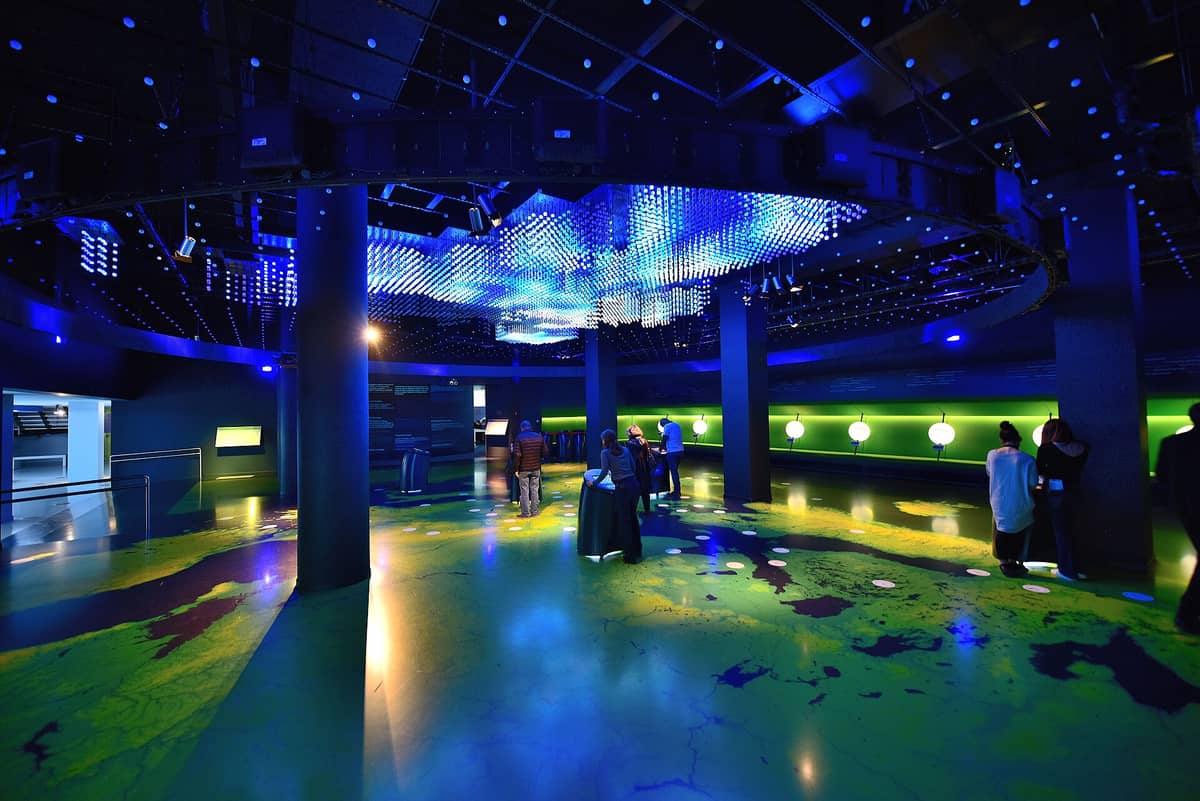
The Parlamentarium is the European Parliament's permanent visitor centre in Brussels, housed in the Willy Brandt building on Rue Wiertz, steps from Place du Luxembourg. It is not a museum in the conventional sense: there are no static display cases, no roped-off artefacts. Instead, the entire space is built around interactive multimedia exhibits that walk visitors through the Parliament's origins, its evolving powers, and the 705-plus members who represent over 400 million EU citizens.
Admission is completely free, which makes the depth of the experience here genuinely surprising. The production quality rivals paid attractions in any European capital. Audio guides are available in all 24 official EU languages, which is one of the more practical multilingual setups you will encounter in Brussels.
ℹ️ Good to know
Opening hours: Monday 13:00–18:00, Tuesday–Friday 09:00–18:00, Saturday–Sunday 10:00–18:00. Last entry 30 minutes before closing. Closed 1 January, 1 May, 1 November, and 24, 25, and 31 December.
Getting Here and the Arrival Experience
The European Quarter sits roughly 1.5 kilometres east of the Grand-Place, and the Parlamentarium is at its geographic and symbolic centre. From Brussels-Luxembourg station, the walk takes under five minutes along Rue Wiertz. The Trône/Troon metro stop adds another option if you're coming from the city centre or from the Schuman direction. Bus connections also run through this corridor, serving commuters from the wider Brussels-Capital Region.
If you are combining this visit with a broader exploration of the European Quarter, the logical circuit connects the Parlamentarium to the surrounding EU institutional buildings, the Parc Léopold, and the nearby House of European History, which sits just behind the Parliament complex and offers a complementary perspective on the continent's political development.
Security at the entrance is thorough but efficient. Expect airport-style bag screening and a brief ID check. On busy days, particularly Tuesday through Thursday mornings when school groups arrive, the queue outside can stretch to 15 minutes. Arriving before 09:30 on a weekday, or after 14:00 on a weekend, tends to give you a smoother entry and more breathing room inside.
💡 Local tip
Arrive early on weekday mornings or on Monday afternoon (when the centre opens at 13:00) to avoid school group congestion. Weekends are generally quieter than midweek mornings.
Tickets & tours
Hand-picked options from our booking partner. Prices are indicative; availability and final rates are confirmed when you complete your booking.
Ghent tour from Brussels
From 43 €Instant confirmationFree cancellationTablet Workshop at Choco-Story Brussels
From 45 €Instant confirmationShared tour of Delft and the Keukenhof Estate from Brussels
From 86 €Instant confirmationFree cancellationOrigins of Brussels exploration game and tour
From 10 €Instant confirmationFree cancellation
The Exhibition: What You Will See and Do
The exhibition unfolds across two main floors. The centrepiece on the lower level is a 360-degree digital panorama: a curved screen environment that immerses visitors in the story of European integration from the rubble of the Second World War to the present. The sound design here is restrained but effective, and the scale of the installation gives it genuine impact, especially if you encounter it without expectation.
The personal touch throughout the Parlamentarium distinguishes it from institutional exhibitions that tend to feel self-congratulatory. Individual MEP profiles, voting records, and constituency origins are woven into the interactive panels. A rotating display maps the political composition of the current Parliament, showing how party groups form and how power is distributed across member states. For anyone who has followed European politics from the outside, it is clarifying.
There is a dedicated section on the Parliament's legislative process, presented clearly enough for non-specialists but detailed enough to be genuinely informative for university-level students or policy-adjacent professionals. The exhibition does not shy away from describing the Parliament's limitations, including its lack of legislative initiative power, which gives the content a degree of intellectual honesty you might not expect from a self-funded institutional showcase.
How the Experience Changes by Time of Day
On a Tuesday or Wednesday morning, the Parlamentarium fills quickly with secondary school groups from Belgium and neighbouring countries. The handheld guide devices are designed for individual exploration, which means the tour unfolds at your own pace regardless of the crowd, but the ambient noise level rises significantly when groups arrive. The touchscreen panels can feel congested at peak times.
By late afternoon, roughly from 15:30 onward, the school groups have largely cleared. The space feels different: quieter, more contemplative, and the lighting in the lower-level panorama room hits differently when you have it largely to yourself. Staff are more available for questions. This is when the exhibition rewards slow engagement.
Weekends attract a different mix: tourists from across Europe who have made Brussels a short break destination, alongside locals who have simply never visited despite passing the building daily. The Saturday morning crowd tends to include families with children aged eight and above, for whom the interactive format holds attention well. Very young children will find little to hold their interest here.
Historical and Institutional Context
Brussels is the de facto capital of the European Union, and the European Quarter is where that status becomes physical. The Parliament's Brussels seat, along with the Commission and Council buildings nearby, concentrates more decision-making power per square kilometre than almost anywhere else on the continent. The Parlamentarium exists partly to address the persistent problem of EU institutions feeling remote from the citizens they represent.
The visitor centre, in the Willy Brandt building, opened to the public in 2011. The investment in the interactive technology at the time was significant, and while some of the hardware has aged in ways that show, the content itself has been regularly updated to reflect current parliamentary composition and recent legislative history.
The Brussels-Capital Region has served as the seat of European institutions since the 1960s, and the architecture of the quarter reflects that history in layers. The Parliament complex itself, the glass and steel Espace Léopold, is a controversial piece of late 20th-century institutional architecture. For context on the broader urban environment around it, the Brussels EU institutions guide maps the major buildings and explains their functions.
Practical Walkthrough and What to Bring
A thorough visit takes between 90 minutes and two hours, depending on how closely you engage with the interactive content. The handheld guide is central to the experience: it connects via the building's internal system and delivers commentary, video clips, and additional data layers linked to each exhibit panel. Pick it up at the entrance desk and take a moment to set your language before entering the main gallery space.
There is a cloakroom available for bags and coats, and a small café near the entrance area. The building is fully accessible, with lift access between floors and adapted facilities throughout. Photography is permitted inside the exhibition, though the 360-degree panorama room is best experienced through observation rather than through a lens.
💡 Local tip
The handheld guide device is available in all 24 official EU languages. Set your language preference before entering the main gallery.
If you have time after the Parlamentarium, the House of European History is a ten-minute walk away and provides a broader narrative of European history from the late 19th century onward. Together the two institutions make a full half-day in the European Quarter. For visitors with wider interests in Brussels' museum landscape, the best museums in Brussels guide offers a useful overview of how the Parlamentarium fits relative to the city's paid and free cultural institutions.
Who Should Skip This
The Parlamentarium is not for everyone. If you have no interest in European politics or institutional history, the content will feel dry regardless of how well it is presented. Visitors looking for art, architecture, or sensory spectacle will not find them here. The building itself is functional rather than beautiful, and the surrounding streets of the European Quarter have a weekday corporate atmosphere that does not disappear on weekends.
Travellers with very limited time in Brussels who are prioritising the Grand-Place, the art nouveau heritage, or the city's food and drink culture should weight those experiences first. The Parlamentarium is genuinely worthwhile but occupies a specific niche: it rewards intellectual curiosity about how Europe governs itself, not aesthetic or gastronomic appetite.
Insider Tips
- The 360-degree panorama room on the lower level is the most technically impressive part of the exhibition. Arrive before a school group enters it or you will experience it surrounded by noise. If groups are present, wait five minutes outside the room and enter when they move on.
- The handheld guide device delivers relevant content as you move between panels. Trust it rather than rushing ahead to read the wall text first.
- Monday afternoons, when the centre opens at 13:00, are consistently among the quietest visiting times. Most school groups visit Tuesday through Thursday, and Mondays see primarily individual adult visitors.
- Combine this visit with the House of European History, located in the same parliamentary complex. Together they form a coherent half-day on EU history and institutions. Both are free.
- If you want to see the actual Parliament chamber, check the European Parliament's visiting schedule separately. The Parlamentarium is the visitor centre, not a gallery access point for plenary sessions, which are ticketed independently when in session.
Who Is Parlamentarium For?
- Students of politics, law, or European history looking for an authoritative and engaging introduction to the EU's legislative branch
- Families with children aged 10 and above who can engage with interactive content independently
- Professionals working in or adjacent to EU policy who want to orient themselves in the institutional geography of Brussels
- Visitors on a tight budget seeking substantive cultural experiences at no cost
- Anyone curious about how democracy functions at a supranational scale, regardless of political outlook
Nearby Attractions
Other things to see while in European Quarter:
- Art & History Museum (Cinquantenaire)
Housed in the grand neoclassical wings of the Parc du Cinquantenaire, the Art & History Museum holds one of Belgium's most important collections, covering ancient civilisations, decorative arts, and non-European cultures across dozens of galleries. It draws far fewer crowds than its scale deserves, making it a rare opportunity to spend hours with world-class artefacts in relative calm.
- Autoworld Brussels
Autoworld Brussels presents more than 250 historic automobiles inside one of Brussels' most spectacular 19th-century exhibition halls, at the heart of the Parc du Cinquantenaire. From brass-era carriages to mid-century American cruisers, the collection spans over a century of automotive history, set beneath soaring iron-and-glass vaulting that is itself worth the visit.
- House of European History
Opened in 2017 and free to enter, the House of European History sits in Brussels's Leopold Park and explores the development of European identity with a particular focus on modern history and the 20th century. It is one of the few major museums in the city that genuinely rewards slow, careful attention rather than a quick walkthrough.
- Museum of Natural Sciences
The Museum of Natural Sciences in Brussels is one of Europe's most significant natural history institutions, home to the world's largest display of Iguanodon skeletons and collections spanning billions of years of life on Earth. Located in Leopold Park near the European Quarter, it rewards both families and serious science enthusiasts with far more depth than a single visit can exhaust.