Autoworld Brussels: Europe's Finest Classic Car Museum in a Palace of Steel and Glass
Autoworld Brussels presents more than 250 historic automobiles inside one of Brussels' most spectacular 19th-century exhibition halls, at the heart of the Parc du Cinquantenaire. From brass-era carriages to mid-century American cruisers, the collection spans over a century of automotive history, set beneath soaring iron-and-glass vaulting that is itself worth the visit.
Quick Facts
- Location
- Parc du Cinquantenaire 11, 1000 Brussels
- Getting There
- Metro Merode (lines 1 & 5), approx. 350 m walk
- Time Needed
- 1.5 to 2.5 hours
- Cost
- Adults approx. €17; reduced rates around €13–15 for children, seniors, and students; under-6 free
- Best for
- Automotive enthusiasts, families with older children, architecture lovers, rainy-day sightseeing
- Official website
- www.autoworld.be
What Autoworld Actually Is
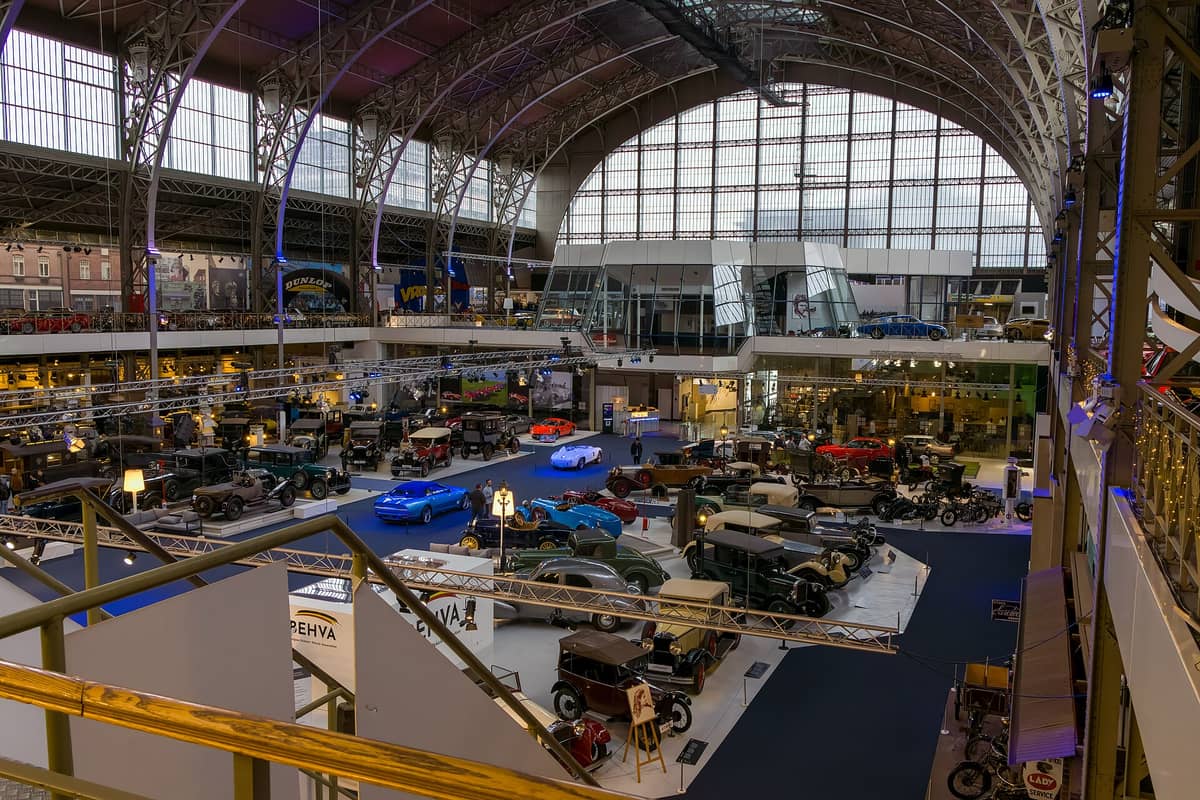
Autoworld Brussels is a permanent automobile museum displaying over 250 vehicles that trace the full arc of motoring history, from horse-drawn carriages and early petrol-powered tricycles of the 1890s through to sleek post-war European and later 20th-century European and American cars. The collection is one of the largest of its kind in Europe, and it earns that claim not through sheer volume alone but through the quality of individual pieces: immaculately restored coachwork, intact period interiors, and vehicles that once belonged to Belgian royalty or appeared on race circuits.
The museum occupies the south wing of the Palais du Cinquantenaire, a monumental complex commissioned by King Leopold II to mark the 50th anniversary of the Belgian Revolution in 1880. That architectural context matters: you are not browsing cars in a converted warehouse. The main exhibition hall rises several storeys under a barrel-vaulted iron-and-glass roof, flooding the floor with natural light that plays differently across the vehicles depending on the hour and the season. On overcast mornings the hall has a grey, contemplative quality; on sunny afternoons shafts of light hit polished bonnets and chrome trim in ways that make photography feel almost effortless.
ℹ️ Good to know
Autoworld is open Monday to Friday 10:00–17:00 and Saturday to Sunday 10:00–18:00, seven days a week. Ticket prices (as of 2025–2026 listings) run approximately €17–19 for adults and around €14 for reduced-rate visitors; confirm current prices at autoworld.be before visiting, as they are subject to change.
The Collection: What You Will See
The permanent collection is organised roughly chronologically, beginning near the entrance with the oldest surviving road vehicles. The earliest exhibits include wooden-wheeled landaus and early internal-combustion prototypes that look more like furniture than transport. Reading the dates stamped on the plaques against the mechanical complexity on display is a recurring small surprise: cars that appear impossibly primitive were already competing in early races by the time Brussels was hosting its first world fair.
Moving deeper into the hall, the collection passes through the teens, twenties, and thirties with a particularly strong selection of pre-war European luxury cars: long-bonneted Belgian Minervas, French Hispano-Suizas, and a handful of American Packards and Cadillacs whose proportions feel almost architectural. Belgian manufacturing pride runs through this section of the display; Belgium was once one of Europe's leading car-producing nations, and Autoworld does not let you forget it. Look for the Minerva marque especially, a Belgian luxury brand that competed directly with Rolls-Royce before the company collapsed in the 1930s.
Post-war decades bring Citroën DS models, early Volkswagen Beetles, and a scattering of American fins-and-chrome behemoths from the 1950s that dwarf everything around them. There is also a section dedicated to vehicles with royal provenance: cars that served Belgian monarchs in official capacity, which adds a layer of historical specificity you will not find in most automotive museums. Labels are in French, Dutch, and English throughout.
The museum sits within the broader Parc du Cinquantenaire complex, which also houses the Art and History Museum and the Royal Museum of Armed Forces. Combining two or three of these in a single visit is straightforward and makes a full day in the European Quarter.
Tickets & tours
Hand-picked options from our booking partner. Prices are indicative; availability and final rates are confirmed when you complete your booking.
Brussels' landmarks audio guide and Autoworld entry ticket
From 33 €Instant confirmationGhent tour from Brussels
From 43 €Instant confirmationFree cancellationTablet Workshop at Choco-Story Brussels
From 45 €Instant confirmationShared tour of Delft and the Keukenhof Estate from Brussels
From 86 €Instant confirmationFree cancellation
The Building: Why the Architecture Deserves Attention
Even visitors with no particular interest in cars tend to pause when they step inside the main hall. The scale is deliberately imperial: Leopold II wanted to project Belgian industrial and cultural ambition, and the Cinquantenaire complex was built to impress foreign dignitaries and international exhibition visitors. The steel framework supporting the glazed roof was cutting-edge construction for its era, and the space it creates has the grandeur of a 19th-century train station crossed with a cathedral nave.
The ground-level exhibition floor is polished stone, and sound behaves in ways that feel slightly formal: footsteps carry, voices carry, but the ambient noise stays low because the museum draws a steady rather than an overwhelming stream of visitors. On weekday mornings the hall can feel almost private, which is ideal if you want to get close to individual vehicles without navigating around other people's elbows.
💡 Local tip
For the best combination of light and crowd conditions, arrive on a weekday morning between 10:00 and 11:30. The hall is at its quietest, natural light from the roof glazing is at a useful angle for photography, and you can move through at your own pace. Weekend afternoons bring families and tour groups, which makes the space feel much busier.
Getting There and Getting Around the Neighbourhood
The most straightforward approach is Metro lines 1 or 5 to Merode station, which puts you about 350 metres from the museum entrance on the south side of the park. The walk cuts through the park itself, past manicured lawns and the triumphal arch that forms the centrepiece of the Cinquantenaire complex. Tram line 81 also stops at Merode. From Schuman station, which is served by buses including the airport bus lines 12 and 21, the walk is roughly 750 metres through the park.
Drivers can access the museum from Nerviërslaan 1 or Galliërslaan 141. Visitors with reduced mobility who arrive by car can use these routes to reach reserved parking spaces directly in front of the building. Inside, the museum is wheelchair-accessible, with ramps and elevators connecting the exhibition levels.
Autoworld sits in Brussels' European Quarter, the district centred on the EU institutions around Schuman and Luxembourg. The area is quieter and more administrative in character than the city centre, which means streets around the park are easy to navigate on foot and traffic is manageable outside rush hours.
If you are planning a broader Brussels itinerary, the European Quarter pairs well with a visit to the House of European History and the Parlamentarium, both of which are a short walk away and free to enter.
Practical Walkthrough: What a Visit Looks Like
After buying tickets at the entrance desk (cash and card accepted; the Brussels Card may provide discounts, so check current partner offers before visiting), you enter directly into the main ground-floor hall. There is a small gift shop near the entrance with automobile-related books, models, and prints. A café area is available for drinks and light refreshments.
The collection unfolds across the ground floor and a mezzanine gallery that runs along the interior perimeter. The mezzanine offers elevated views down onto the larger vehicles on the ground floor, which is particularly useful for photographing broad compositions of the collection against the vaulted roof. Most visitors complete a thorough circuit in around 90 minutes to two hours; enthusiasts who stop to read every label and examine interiors can easily spend three hours.
Audio guides are available for hire and add context to specific vehicles, including information on manufacturing history and the cars' provenance. Labels at each exhibit are consistently informative in all three languages. There are no interactive digital screens or high-tech installations to speak of: the experience is essentially contemplative, focused on the physical objects and their historical information. That is either a strength or a limitation depending on what you are looking for.
⚠️ What to skip
Autoworld does not have a large dedicated restaurant, only a café offering snacks and drinks. Plan lunch or dinner either before you arrive or at one of the restaurants near Schuman or in the Grand Place area. The park itself has benches for a picnic if the weather cooperates.
Honest Assessment: Who Gets the Most From This Museum
Autoworld delivers best for anyone with a genuine interest in automotive history, engineering, or industrial design. The collection is comprehensive and well-maintained, the building is genuinely impressive, and the absence of crowds on weekday mornings makes for an unusually calm museum experience in a European capital. For car-obsessed visitors, this is one of the best such collections in Europe, full stop.
For families, the museum works well with children who are old enough to appreciate the visual spectacle of the vehicles, generally eight and up. Younger children may find a two-hour stationary collection harder to sustain, though the scale and variety of the cars tends to hold attention better than an art museum would. The park outside offers space to run around before or after.
If cars genuinely hold no interest for you and you are visiting Brussels for its art, food, or street culture, this is probably not where your limited time is best spent. The building is spectacular, but you can admire the Cinquantenaire architecture from the park exterior without paying admission. That said, if Brussels rain has forced a change of plan, Autoworld is one of the better indoor alternatives: the ticket price is reasonable, the experience is unhurried, and it takes you somewhere architecturally remarkable.
For context on the broader range of museums worth your time in Brussels, the best museums in Brussels guide covers the full spectrum from fine art to natural history. And for days when the weather is genuinely uncooperative, the Brussels rainy-day activities guide positions Autoworld alongside other solid indoor options.
Insider Tips
- The mezzanine gallery running around the interior perimeter is underused by most visitors who stick to the ground floor. Head up early in your visit and walk the full loop before descending: the overhead perspective lets you see the spatial relationship between vehicles and understand the layout before you get close to individual cars.
- Temporary exhibitions at Autoworld can be genuinely excellent and are sometimes themed around a single manufacturer, a racing era, or a design movement. Check the website before visiting rather than assuming the permanent collection is all that is on offer.
- The Cinquantenaire complex includes two other major museums in adjacent wings. If you are combining visits, buy your Autoworld ticket first and use the park to walk between buildings rather than retracing through metro stations.
- Photography is permitted throughout the museum without flash. The natural roof light makes for clean, shadow-free images of the vehicles, but direct sun through the glass on summer afternoons can create harsh contrast. Overcast or morning light is more flattering for detailed shots of coachwork and interiors.
- Arrive slightly before the 10:00 opening on weekdays and you will likely have the main hall almost to yourself for the first thirty to forty minutes. The museum rarely gets genuinely crowded on weekday mornings, which is uncommon for a well-known Brussels attraction.
Who Is Autoworld Brussels For?
- Automotive history enthusiasts and vintage car collectors looking for one of Europe's most comprehensive collections
- Architecture and design admirers drawn to the monumental 19th-century Cinquantenaire hall
- Families with children aged eight and older who respond well to large, visually varied displays
- Travellers sheltering from Brussels' frequent rain in search of a substantive, unhurried indoor experience
- European Quarter visitors combining a cultural afternoon with nearby EU institutions and the Cinquantenaire park
Nearby Attractions
Other things to see while in European Quarter:
- Art & History Museum (Cinquantenaire)
Housed in the grand neoclassical wings of the Parc du Cinquantenaire, the Art & History Museum holds one of Belgium's most important collections, covering ancient civilisations, decorative arts, and non-European cultures across dozens of galleries. It draws far fewer crowds than its scale deserves, making it a rare opportunity to spend hours with world-class artefacts in relative calm.
- House of European History
Opened in 2017 and free to enter, the House of European History sits in Brussels's Leopold Park and explores the development of European identity with a particular focus on modern history and the 20th century. It is one of the few major museums in the city that genuinely rewards slow, careful attention rather than a quick walkthrough.
- Museum of Natural Sciences
The Museum of Natural Sciences in Brussels is one of Europe's most significant natural history institutions, home to the world's largest display of Iguanodon skeletons and collections spanning billions of years of life on Earth. Located in Leopold Park near the European Quarter, it rewards both families and serious science enthusiasts with far more depth than a single visit can exhaust.
- Parc du Cinquantenaire
Parc du Cinquantenaire is a 34-hectare formal park in Brussels's European Quarter, anchored by a monumental triumphal arch and flanked by three major museums. Laid out in 1880 to mark 50 years of Belgian independence, it draws joggers at dawn, families on weekends, and EU staff at lunch — all for free.