Parc du Cinquantenaire: Brussels's Grand Imperial Park
Parc du Cinquantenaire is a 34-hectare formal park in Brussels's European Quarter, anchored by a monumental triumphal arch and flanked by three major museums. Laid out in 1880 to mark 50 years of Belgian independence, it draws joggers at dawn, families on weekends, and EU staff at lunch — all for free.
Quick Facts
- Location
- European Quarter, Brussels (Jubelpark 10, 1000 Brussels)
- Getting There
- Metro: Schuman (lines 1, 5) or Merode (lines 1, 5); Bus lines 22, 27, 61, 80
- Time Needed
- 45 min (park only) to 3–4 hours (with one museum)
- Cost
- Park entry free; on-site museums charge separate admission
- Best for
- Architecture lovers, families, picnickers, history enthusiasts
- Official website
- cinquantenaire.brussels
What Is Parc du Cinquantenaire?
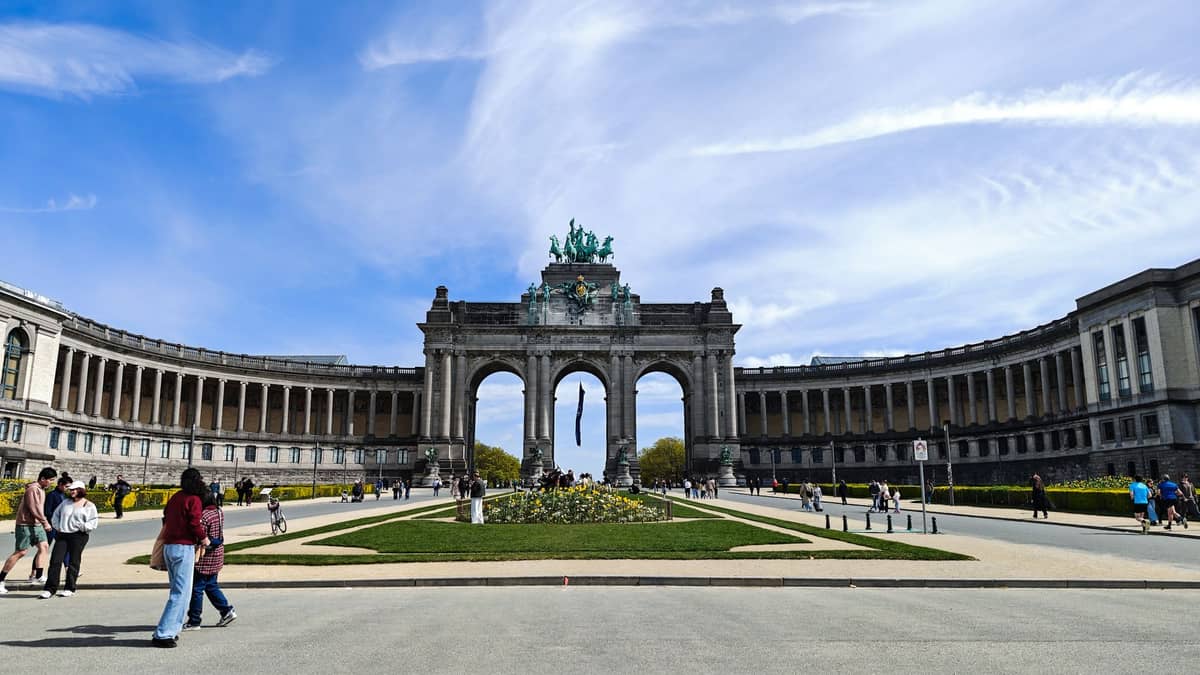
Parc du Cinquantenaire is Brussels's most architecturally ambitious public park: 34 hectares of manicured lawns, tree-lined avenues, and formal gardens grouped around a massive triumphal arch that frames the sky at the park's western end. It sits in the European Quarter, roughly 15 minutes on foot east of the Grand-Place, and it reads less like a city park and more like a planned imperial precinct — because that is exactly what it was designed to be.
The park occupies a space that matters in Brussels's civic identity. It was conceived to host the 1880 National Exhibition, staged to celebrate the 50th anniversary of Belgian independence. King Leopold II ordered a monumental complex to showcase the young kingdom's confidence and ambition. The result was the triumphal arch (officially the Arcade du Cinquantenaire), a set of exhibition halls that later became permanent museums, and the formal park grounds that connected them. The same royal energy that later built the Atomium for the 1958 World's Fair ran directly through this place.
ℹ️ Good to know
The park's seasonal opening hours vary: 07:00–19:00 in winter (November–February), 06:00–21:00 in spring (March–April), 06:00–22:00 in summer (May–August), and 07:00–20:00 in autumn (September–October). Entry to the grounds is always free.
The Arcade: Brussels's Most Overlooked Landmark
The Arcade du Cinquantenaire is the park's dominant visual element and one of the most imposing pieces of architecture in Belgium. Three arched passageways, topped by a quadriga sculpture of Brabant raising the national flag, span the park's central axis with a width that makes Brussels's other monuments feel modest by comparison. The whole structure was not completed until 1905, a full 25 years after the park's inauguration, after various architects and budgets came and went.
Most visitors photograph it from the western side — the grand formal approach from the direction of Schuman metro — but the eastern face is worth seeking out. From that angle, the arch frames a long green axis stretching toward Avenue de Tervuren, and on clear mornings the low sun catches the stone in a way that turns it almost amber. The surrounding lawns are often empty before 9:00, making that window the best time for undisturbed photography.
For context on how Brussels deploys this kind of civic monumentalism across the city, the Palace of Justice on the Galgenberg is a useful comparison: both projects reflect the same Leopoldian drive to project state power through scale. The Cinquantenaire is, in some ways, the more successful of the two — it is less oppressive precisely because the park softens it.
Tickets & tours
Hand-picked options from our booking partner. Prices are indicative; availability and final rates are confirmed when you complete your booking.
Ghent tour from Brussels
From 43 €Instant confirmationFree cancellationTablet Workshop at Choco-Story Brussels
From 45 €Instant confirmationShared tour of Delft and the Keukenhof Estate from Brussels
From 86 €Instant confirmationFree cancellationOrigins of Brussels exploration game and tour
From 10 €Instant confirmationFree cancellation
The Park at Different Hours
Early mornings, particularly on weekdays, the park belongs almost entirely to commuters cutting through on bicycles and to runners using the gravel paths that ring the lawns. The air smells of cut grass and damp stone; the only sounds are birdsong and the occasional distant tram on Avenue de la Renaissance. By 08:30, EU institution workers begin crossing the park as a shortcut between the Schuman and Merode metro exits, and the atmosphere becomes purposeful rather than leisurely.
Midday from roughly 12:00 to 14:00 is the park's most social hour on weekdays. Sandwiches appear on benches, groups of EU staff and translators spread out on the grass, and the central fountain area fills with the low murmur of half a dozen languages at once. This is perhaps the most distinctly Brussels moment the park offers: a quietly international lunchtime in the shadow of a 19th-century Belgian nationalist monument.
Weekend afternoons shift the demographic entirely. Families with young children take over the lawns, dogs chase each other through the lower garden sections, and the museums draw steady queues. Summer evenings — the park stays open until 22:00 from May through August — are genuinely pleasant, with the arch lit softly from below and the paths cool under the plane trees.
💡 Local tip
Come on a weekday morning between 06:30 and 08:30 for the park at its quietest and most photogenic. Weekend afternoons are lively but crowded around the museums and central arch.
The Museums: What's Inside
Three major museums occupy the buildings flanking the Arcade. The largest is the Art and History Museum, one of the biggest museums in Belgium, covering ancient civilisations, decorative arts, and archaeological collections spanning Egypt, Greece, Rome, and pre-Columbian America. Its sheer scale is both its strength and its weakness: a single visit can cover only a fraction of the permanent collection, and navigating it without a plan means wandering through grand vaulted halls that can feel under-explained.
The south wing houses Autoworld, a collection of around 250 historic vehicles displayed in a former exhibition hall with an impressive iron-and-glass roof. It is one of the better car museums in Europe in terms of spatial presentation, even if you arrive without strong prior interest in automobiles. The north wing contains the Royal Museum of the Armed Forces and Military History, which covers Belgian and broader European military history from the late 18th century to the post-war period.
All three museums charge separate admission. Prices and free-entry days change, so check directly with each museum before your visit rather than relying on third-party listings. The park grounds themselves remain free regardless.
Getting There and Getting Around
The easiest approach is Metro lines 1 or 5 to Schuman, which deposits you at the park's western entrance on Avenue de la Joyeuse Entrée within a two-minute walk. The Merode stop on the same lines brings you to the eastern side, which is quieter and gives a different perspective on the arch. Several bus lines also serve the surrounding avenues.
The park is in the heart of the European Quarter, which means the surrounding streets have a daytime energy shaped by EU institutions rather than tourism. There are cafés and sandwich bars within a few minutes' walk in any direction, but few are remarkable — this is not a neighbourhood optimised for eating. Plan to picnic in the park itself or eat in the city centre before or after your visit.
The park is flat and wide, with broad paved paths connecting its main entrances. This makes it accessible for pushchairs and for visitors with limited mobility, though the museums inside have their own specific access arrangements. Contact the individual museums for step-free route details. Cycling through the park is common practice even if not formally encouraged on all paths.
⚠️ What to skip
The park has multiple entrances from different avenues. If you are arriving by GPS navigation, specifying 'Schuman metro' rather than a street address is more reliable for first-time visitors.
Weather, Seasons, and Practical Considerations
Brussels has an oceanic climate with no reliable dry season. Rain can fall in any month, and the park's open lawns offer no shelter. Bring a layer and a compact umbrella regardless of the forecast, particularly from October through April when temperatures sit between 5°C and 15°C and showers arrive with little warning.
The park looks its best from late April through early October, when the formal gardens are in flower and the lawns are green and actively used. In winter, the bare plane trees along the central axis have their own austere appeal, and the park is practically empty on weekday mornings — which suits photographers. The arch itself is worth seeing year-round; it does not depend on flowers or sunshine to make an impression.
If rain catches you in the park, the Art and History Museum is large enough to absorb a few unplanned hours. Alternatively, Brussels rainy day options in the surrounding EU Quarter are limited, so having a backup plan before you arrive is sensible.
Who Should Skip This, and Why
The park is less suited to visitors with only half a day in Brussels who are choosing between major sights. The Grand-Place area, the historic centre, and the concentration of museums along the Mont des Arts offer a more time-efficient introduction to the city for first-timers. The Cinquantenaire rewards those who are either specifically interested in the museums, want a long walk in a formal European park, or are already spending time in the European Quarter.
It is also worth being direct about one limitation: the park's surroundings are architecturally interesting but not charming. The streets immediately around it are wide, traffic-heavy EU-quarter avenues. You will not stumble into a neighbourhood café culture here the way you might in Ixelles or the Sablon. The park is an island of green in an administrative district, and that defines the experience.
Insider Tips
- The arch's passage is open to pedestrians and cyclists throughout park hours — walking through it from east to west at dusk gives you one of the more dramatic urban framing experiences in Brussels, with the city skyline visible through the western opening.
- The upper terrace of the Arcade can be accessed from inside the Art and History Museum on certain visit conditions — check with museum staff on arrival, as most visitors never know this viewing point exists.
- Weekday lunchtimes between 12:00 and 13:30 are the only time you will reliably see the park genuinely full of people. If you want the lawns to yourself, arrive before 08:30 or on a cold weekday morning.
- The formal garden sections in the southeastern quadrant of the park are less visited than the central lawn and arch area. The boxwood hedging and statuary there are well maintained and almost always quiet.
- If you are combining the Cinquantenaire with other European Quarter sights, the walk from Schuman metro westward to Maelbeek and then into the EU institutions area takes under 15 minutes and passes some architecturally interesting buildings along Avenue de Cortenbergh.
Who Is Parc du Cinquantenaire For?
- Architecture and urban history enthusiasts who want to understand Brussels's 19th-century civic ambitions
- Families looking for a large, safe, free outdoor space with nearby museum options if the weather turns
- Photographers targeting formal European monumental architecture without tourist crowds
- Visitors spending a day in the European Quarter who want a green space for a midday break
- Museum visitors who want to combine the Art and History Museum or Autoworld with a walk
Nearby Attractions
Other things to see while in European Quarter:
- Art & History Museum (Cinquantenaire)
Housed in the grand neoclassical wings of the Parc du Cinquantenaire, the Art & History Museum holds one of Belgium's most important collections, covering ancient civilisations, decorative arts, and non-European cultures across dozens of galleries. It draws far fewer crowds than its scale deserves, making it a rare opportunity to spend hours with world-class artefacts in relative calm.
- Autoworld Brussels
Autoworld Brussels presents more than 250 historic automobiles inside one of Brussels' most spectacular 19th-century exhibition halls, at the heart of the Parc du Cinquantenaire. From brass-era carriages to mid-century American cruisers, the collection spans over a century of automotive history, set beneath soaring iron-and-glass vaulting that is itself worth the visit.
- House of European History
Opened in 2017 and free to enter, the House of European History sits in Brussels's Leopold Park and explores the development of European identity with a particular focus on modern history and the 20th century. It is one of the few major museums in the city that genuinely rewards slow, careful attention rather than a quick walkthrough.
- Museum of Natural Sciences
The Museum of Natural Sciences in Brussels is one of Europe's most significant natural history institutions, home to the world's largest display of Iguanodon skeletons and collections spanning billions of years of life on Earth. Located in Leopold Park near the European Quarter, it rewards both families and serious science enthusiasts with far more depth than a single visit can exhaust.