Palace of Justice (Palais de Justice): Brussels' Most Overwhelming Building
The Palace of Justice in Brussels is a working courthouse and one of the largest structures built in 19th-century Europe. Free to enter on weekdays, it rewards visitors with staggering neoclassical interiors, a turbulent architectural history, and one of the best elevated perspectives over the lower city.
Quick Facts
- Location
- Place Poelaert 1, 1000 Brussels (Marolles district, above the Marolles neighbourhood)
- Getting There
- Tram 92/93 to Poelaert; bus 48 to Place Poelaert; or walk 10 min uphill from the Sablon
- Time Needed
- 30–60 minutes for exterior and main hall; allow longer if exploring the surrounding area
- Cost
- Free entry; guided tours available by prior written request only
- Best for
- Architecture enthusiasts, history seekers, photographers, curious walkers
What You're Actually Looking At
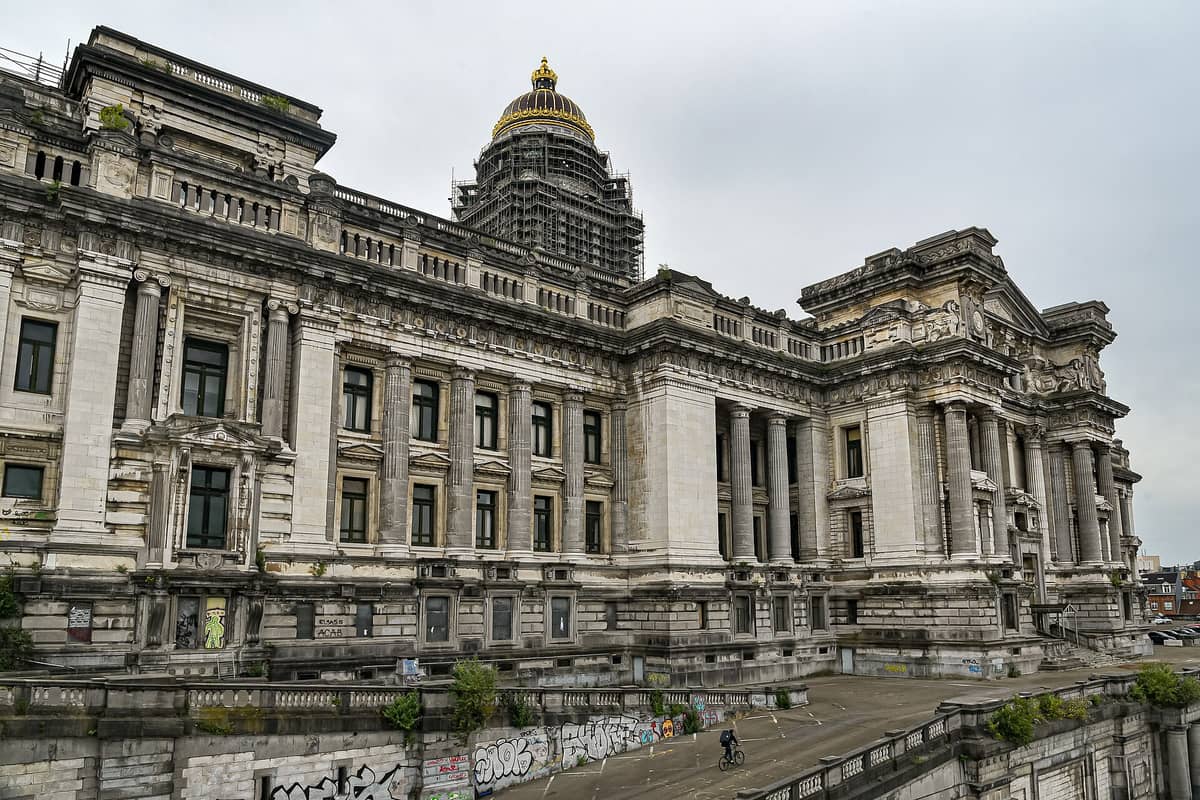
The Palace of Justice (Palais de Justice de Bruxelles) is not just large. It is preposterously, almost confrontationally large. Completed in 1883 after more than 17 years of construction under architect Joseph Poelaert, it covers roughly 26,000 square metres of ground surface and remains one of the biggest courthouse buildings constructed anywhere in the 19th century. The dome alone rises approximately 104 metres above street level. Standing on Place Poelaert and looking up at the central lantern tower, you get an immediate sense of why Poelaert reportedly died insane before its completion, and why Brussels residents of his era reportedly called him a sorcerer.
The style is eclectic neoclassicism with heavy Greco-Roman references: Corinthian columns stacked at monumental scale, rusticated stone podiums, and a stepped silhouette that dominates the Brussels skyline when seen from the lower city to the west. This is deliberate. The building was placed on the Galgenberg hill, historically the site of public executions, to signal the authority of Belgian justice over the city below. That symbolism still reads clearly today.
⚠️ What to skip
Important access note: The historic main entrance on Place Poelaert is closed due to ongoing façade restoration works. Use the temporary entrance on the lateral façade facing Rue des Minimes, accessed via the ramps descending from the square. Personnel and persons with reduced mobility should use the Rue aux Laines entrance.
The Interior: Courts, Marble, and Silence
Entry to the Palace of Justice is free on weekdays, but access and opening times can vary; it primarily operates during standard court hours on working days. It is generally closed to visitors on weekends and public holidays. Bear in mind this is a functioning courthouse, not a tourist attraction: judicial services operate during standard court hours (roughly 08:30–12:30 and 13:30–16:00), and the building has the specific energy of a working legal institution. You will see robed lawyers, court staff, and families waiting on benches alongside any tourists who wander in.
The main hall, the Salle des Pas Perdus (Hall of Lost Steps), is the architectural centrepiece. The ceiling vaults upward in a series of coffered arches, and the polished stone floors amplify every footstep into a soft echo. At midday, when natural light falls through the upper windows, the space takes on a pale gold quality that no photograph quite captures. Early morning visits, around 08:30 when the building first opens, are the quietest: the hall is largely empty, security staff are settling in, and the sheer scale of the space is easier to absorb without the visual noise of passing crowds.
Be realistic about what you can see. Much of the building consists of active courtrooms, administrative offices, and restricted areas. Visitors circulate through the public entrance corridor, the main vestibules, and the central hall. Guided tours with deeper access require a prior written request to the administration, and these are not walk-in experiences. If deep architectural access is your goal, plan well in advance.
💡 Local tip
Security screening is required at the temporary entrance. Carry a valid ID. Large bags slow the process considerably, so leave bulky luggage at your hotel.
Tickets & tours
Hand-picked options from our booking partner. Prices are indicative; availability and final rates are confirmed when you complete your booking.
Ghent tour from Brussels
From 43 €Instant confirmationFree cancellationTablet Workshop at Choco-Story Brussels
From 45 €Instant confirmationShared tour of Delft and the Keukenhof Estate from Brussels
From 86 €Instant confirmationFree cancellationOrigins of Brussels exploration game and tour
From 10 €Instant confirmationFree cancellation
Place Poelaert and the View Over Brussels
Even if you have no interest in going inside, Place Poelaert is worth reaching for the view alone. The esplanade in front of the building faces northwest, looking out across the lower town toward Molenbeek, Laeken, and the distant Atomium on clear days. The elevation is dramatic: the Marolles neighbourhood sits directly below, connected to the square by the Poelaert lift (free, operating most days), a useful and underused urban lift that descends to Rue Haute.
Late afternoon is the best time for this view in terms of light. The sun moves toward the northwest in summer, and around 17:00–19:00 the lower city takes on warm tones while the dome behind you casts long shadows across the square. For a broader perspective on Brussels from height, the best viewpoints in Brussels guide covers Place Poelaert alongside alternatives like Mont des Arts and the Atomium.
In winter, the square can be bitterly cold and exposed, with wind channelling around the building's corners. Summer mornings, before 10:00, are calm and pleasant: you get the view, the light is crisp, and the tourist presence on this square is never as heavy as around the Grand-Place. Cloud cover affects the experience significantly. On overcast days the building looks stern and grey; under blue sky it reads as genuinely impressive.
Architectural and Historical Context
Understanding why this building exists helps explain both its scale and its controversy. Belgium became an independent state in 1830, and through the second half of the 19th century, King Leopold II pursued an aggressive programme of monumental public construction to assert national prestige. The Palace of Justice was central to that vision: a building so large it would communicate, without ambiguity, the permanence and grandeur of the Belgian state.
Joseph Poelaert won the commission in 1860 and spent years revising the designs to ever-greater scales. Construction required demolishing significant parts of the Galgenberg hill and displacing a large working-class community in the process. The resentment this generated in the Marolles below gave rise to the Brussels dialect word 'architekt' becoming a term of abuse, a linguistic trace of genuine historical grievance that persists to the present day. The Marolles neighbourhood immediately below the esplanade still has a distinct identity partly shaped by that displacement.
The building has been under various phases of renovation and restoration almost continuously since the 1980s. The Régie des Bâtiments (Belgian federal building management authority) oversees these works, which include new office facilities for the Court of Cassation and Court of Appeal. The scaffolding and covered façade sections have become so familiar to Brussels residents that locals sometimes joke the renovation is permanent. Current exterior works are in phased progress and are scheduled to run into the early 2030s, affecting the main entrance and parts of the exterior.
How to Get There and What to Combine
The most straightforward public transport options are trams 92 and 93, which stop at Poelaert directly on the square. Bus route 48 also serves the area. From the Sablon, it is a short but steep uphill walk of about 5 minutes via Rue de la Régence. From the Grand-Place, the walk takes roughly 15–20 minutes through the upper town.
The Poelaert free elevator connects the square down to Rue Haute in the Marolles, making it easy to combine a visit here with the Place du Jeu de Balle flea market below. On the upper side, the building sits minutes from the Sablon antiques district and Notre-Dame du Sablon church, making a logical half-day circuit: Sablon church, up to the Palace of Justice for the view, then down by elevator to browse the Marolles.
Visitors interested in Brussels' broader architectural heritage should also consider the Horta Museum in Saint-Gilles, which offers a completely different register of Belgian architectural ambition from roughly the same era, or the Parc du Cinquantenaire, another product of Leopold II's monumental building programme.
Photography Notes and Practical Details
Photographing the exterior requires distance. The building is simply too wide to frame from Place Poelaert itself without a very wide-angle lens. The best exterior shots come from the esplanade looking back at the dome from its western edge, or from the lower city looking up, particularly from the area around Rue Haute and Rue Blaes where the full vertical height reads clearly against the sky.
Interior photography in the public areas (the main hall and corridors) is generally possible, but this is an active courthouse. Exercise discretion near courtrooms, do not photograph individuals without consent, and expect security staff to redirect you if you venture toward restricted areas. Natural light in the Salle des Pas Perdus is strongest between 10:00 and 13:00.
On accessibility: the Palace of Justice is architecturally challenging for visitors with reduced mobility, partly because its protected heritage status limits the modifications that can be made. Temporary ramps, adapted signage, and human assistance measures have been introduced, but the building's scale and historic structure make full accessibility difficult. The Rue aux Laines entrance is the designated accessible route.
ℹ️ Good to know
Weather matters here more than at most Brussels attractions. The dome and square are fully exposed. On rainy days, the exterior experience is unpleasant and the view disappears in cloud. The interior hall remains impressive regardless of weather, but the view from the esplanade, which is often the main reason visitors make the trip, requires a clear or partly clear day to be worthwhile.
Insider Tips
- Take the free Poelaert elevator from Place Poelaert down to Rue Haute rather than walking. It is fast, free, and saves your knees on the descent. The entrance is at the western edge of the square, slightly set back from the main esplanade.
- The best single photograph of the building is not from the square itself but from Rue Blaes in the Marolles, looking steeply upward. From there you get the dome, the full vertical stack of the building, and a sense of how it towers over the neighbourhood below.
- Arrive before 09:30 on a weekday if you want the main hall to yourself. Court activity picks up between 09:30 and 11:30, and the public areas become noticeably more crowded with lawyers and litigants.
- Guided tours with extended access require a prior written request to the administration. This is not a spontaneous option. If this is important to you, contact the building management through the Régie des Bâtiments well ahead of your visit.
- The renovation scaffolding on the main façade has been in place for years and is likely still present during your visit. Factor this into your expectations for exterior photography from the front.
Who Is Palace of Justice (Palais de Justice) For?
- Architecture enthusiasts wanting to understand Brussels' 19th-century monumental ambitions
- Photographers seeking elevated city views and dramatic neoclassical scale
- Walkers combining the Sablon upper town with the Marolles lower town via the free elevator
- History-minded visitors interested in Belgian national identity and Leopold II-era urbanism
- Budget travellers: the entire experience, including the view and the interior hall, costs nothing
Nearby Attractions
Other things to see while in Le Sablon:
- Jardin du Petit Sablon
Tucked between Rue de la Régence and Rue aux Laines in the Sablon quarter, the Jardin du Petit Sablon is a formal 19th-century garden distinguished by 48 bronze statuettes representing medieval Brussels trades. Entry is free, the atmosphere is surprisingly calm, and the surrounding streets form one of the city's most rewarding walks.
- Notre-Dame du Sablon
Rising above the antiques dealers and chocolate shops of the Sablon quarter, the Church of Our Lady of Victories at the Sablon is one of Brussels's finest examples of Brabantine Gothic architecture. Built between the 15th and early 16th centuries, it draws around 500,000 visitors a year and charges no admission. This guide covers what to expect inside, the best times to visit, and how the surrounding neighbourhood shapes the experience.
- Place du Grand Sablon
Place du Grand Sablon is a centuries-old public square in the Sablon neighborhood of central Brussels, lined with chocolate shops, antique dealers, and café terraces. Free to enter at any hour, it hosts a weekend antiques market and sits beside the Gothic Notre-Dame du Sablon church. It rewards visitors who linger rather than rush.