Place du Jeu de Balle Flea Market: Brussels's Oldest Daily Antique Market
The Marché aux Puces du Jeu de Balle is Brussels's most enduring open-air flea market, held every single day of the year on a cobbled square in the working-class Marolles district. With up to 450 stallholders spreading everything from chipped ceramics to genuine Art Deco silverware, it rewards early risers and casual browsers alike — and entry is always free.
Quick Facts
- Location
- Place du Jeu de Balle, 1000 Brussels (Marolles district)
- Getting There
- Metro: Porte de Hal (line 2/6); Bus: use nearby stops such as Porte de Hal or Chapelle on routes serving the Marolles
- Time Needed
- 45 minutes to 2 hours depending on browsing depth
- Cost
- Free entry; bring cash (EUR) for purchases
- Best for
- Antique hunters, photographers, slow-travel explorers, budget travelers
- Official website
- markets.brussels.be/markets/place-du-jeu-de-balle-market
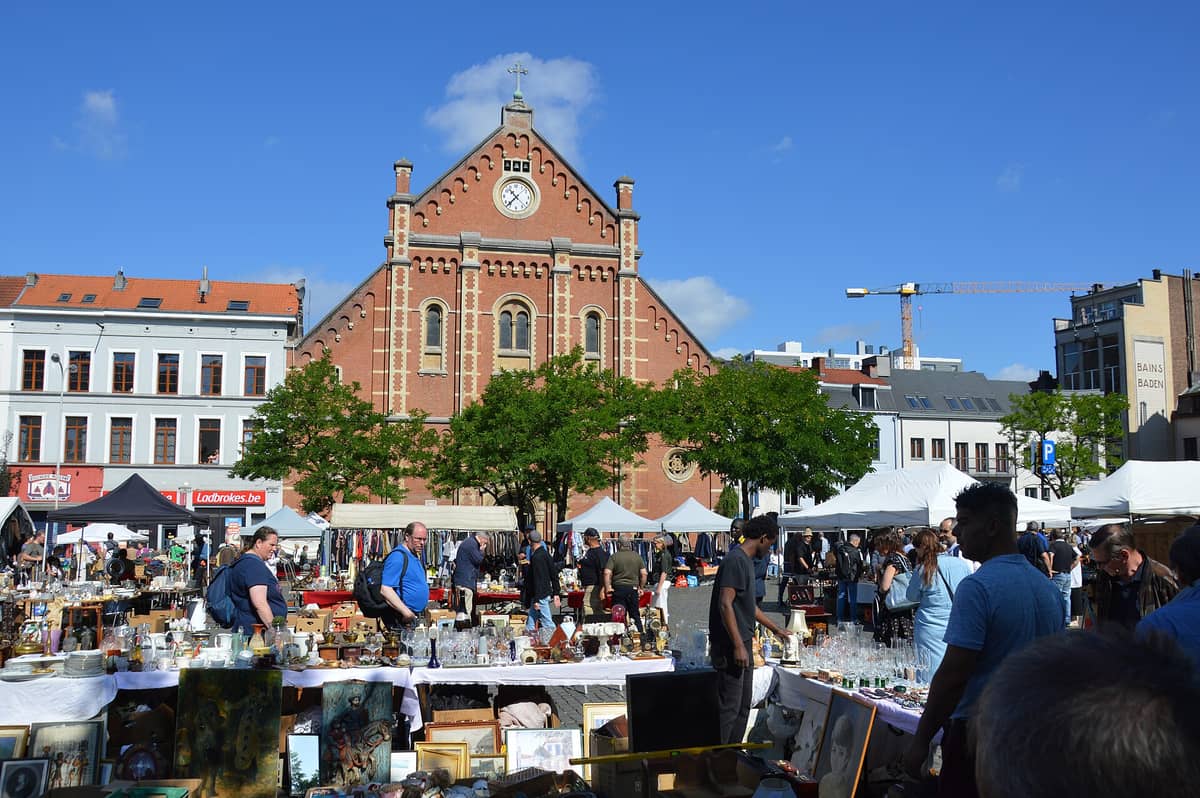
What Is the Place du Jeu de Balle Flea Market?
The Place du Jeu de Balle Flea Market, officially called the Marché aux Puces du Jeu de Balle, is Brussels's oldest and most characterful open-air market. It occupies the entire cobbled expanse of Place du Jeu de Balle in the Marolles, a neighborhood that has stubbornly resisted gentrification while everything around it has shifted. The market runs every single day of the year, with no seasonal closure.
On any given morning, between 300 and 450 stallholders lay out their goods directly on the ground or across collapsible trestle tables: stacks of pre-war magazines, mismatched cutlery, oil paintings with cracked varnish, Belgian linen, Art Nouveau lamp fixtures, old religious statues, and the occasional piece of genuine value buried under decades of clutter. The scale is real. This is not a curated vintage pop-up. It is a proper flea market with all the disorder that implies.
💡 Local tip
Opening hours vary slightly by source. The most commonly cited times are daily from 06:00–14:00, with weekends extending to 15:00. The official City of Brussels markets pages list 09:00–14:00 Monday–Friday and 09:00–15:00 on Saturdays, Sundays, and public holidays. In practice, serious dealers arrive well before 09:00 on weekends. If you want the best selection, aim to arrive by 08:00 on Saturdays or Sundays.
The Marolles: Why the Neighborhood Matters
The Marolles is one of Brussels's oldest working-class districts, sitting at the foot of the ridge topped by the colossal Palace of Justice. The weight of that building is not just physical: its 19th-century construction displaced thousands of Marolles residents, a grievance locals still reference. The neighborhood developed its own dialect (Brusseleer, a French-Dutch creole), its own black humor, and a deep suspicion of anything too polished.
That history saturates the flea market. The stallholders are an eclectic mix: professional antique dealers who work the market daily, private sellers clearing a deceased relative's apartment, and a contingent of vendors who have been setting up on this square for decades. Conversations happen in French, Dutch, Arabic, and the occasional sharp burst of Brusseleer slang. If you speak French even moderately, vendors will engage. If you don't, most will manage.
The streets radiating off Place du Jeu de Balle, particularly Rue Blaes and Rue Haute, are lined with antique shops and second-hand furniture dealers. A morning at the market followed by a walk up these streets makes for a coherent half-day. The Marolles neighborhood rewards slow exploration on foot.
Tickets & tours
Hand-picked options from our booking partner. Prices are indicative; availability and final rates are confirmed when you complete your booking.
Origins of Brussels exploration game and tour
From 10 €Instant confirmationFree cancellationSelf-guided discovery walk in Brussels' Place Sainte Catherine
From 26 €Instant confirmationFree cancellationThe best of Brussels walking tour
From 229 €Instant confirmationFree cancellationBrussels audio tour with BELvue Museum admission
From 20 €Instant confirmation
What the Market Looks and Feels Like at Different Times
Early Morning (06:00–08:30)
Before 08:00, the market belongs to dealers. The square smells of damp stone and cigarette smoke. Vendors are still arranging their layouts, and professional buyers move quickly with practiced eyes, sometimes crouching to flip through boxes before stalls are fully set up. The light at this hour is low and grey more often than not, Brussels being a city of overcast mornings for a good part of the year. Paving stones can be wet and uneven, so footwear with grip matters.
This is when genuine finds are most likely. Dealers and experienced collectors know this, which is why they come early. If you are not looking for serious antiques, this hour can feel frenetic and poorly lit. But for photographers, the low morning light on stalls piled with old clocks and cracked mirrors is hard to replicate at noon.
Mid-Morning (09:00–11:00)
By 09:30 on a weekend, the square fills noticeably. Tourists mix with locals doing a habitual weekly browse. The atmosphere loosens. Cafe terraces on the edges of the square begin serving coffee, and the smell of fresh bread drifts over from the surrounding streets. This is the most social hour: vendors chat with regulars, haggling happens at a relaxed pace, and the full spread of goods is visible. Weekend mornings in spring and early autumn draw the largest crowds, and navigation between stalls becomes slow.
Late Morning to Close (11:30–14:00/15:00)
After 11:30, packing-up starts gradually at the edges. Vendors who sold well begin folding down early. The selection thins, but prices soften too. If you missed the morning, this is actually a reasonable time to negotiate: a seller who has been standing since 06:00 and has 90 minutes left before loading the van is often willing to deal. The atmosphere is less charged than early morning, more like a collective wind-down.
What to Buy — and What to Be Realistic About
The market genuinely produces finds. Old Belgian comic books, Art Deco brass fixtures, lace, hand-painted ceramics, Soviet-era cameras, religious artwork, and early 20th-century postcards all turn up regularly. Prices range from coins to several hundred euros for larger furniture pieces or genuine antiques.
That said, a significant portion of the market is low-quality junk: broken electronics, counterfeit goods, worn-out clothes. This is not a criticism — it is the nature of a daily working-class flea market. Managing expectations helps. If you come looking for cheap treasure, you will find both cheap and treasure, just not always together.
Serious antique buyers visiting Brussels should also check the Place du Grand Sablon, a short walk away, which hosts a more curated antiques market on weekends and is surrounded by established dealer galleries. The two markets serve very different market segments, but together they form the core of Brussels's antique-hunting circuit.
⚠️ What to skip
Cash is essential. Most stalls do not accept cards. Bring small denominations in euros — vendors often struggle to break larger notes early in the morning. ATMs are available nearby on Rue Haute.
Getting There and Getting Around
Place du Jeu de Balle is roughly a 15–20-minute walk from Brussels Central Station. The most direct public transport option is metro lines 2 or 6 to Porte de Hal, followed by a short 5–7 minute walk north through the Marolles. Bus services stopping at nearby points such as Porte de Hal or Chapelle are useful if you are coming from Ixelles or the lower city.
The market is also walkable from the Grand-Place in around 20 minutes through the lower town, passing through recognizably working-class streets that contrast sharply with the tourist core. This walk is instructive: it shows Brussels as a city of very different registers within short distances.
The square itself is flat cobblestone, accessible without steps. However, the irregular surface and close-packed stalls make navigation slow with a pushchair or wheelchair, particularly during busy weekend mornings. There are no dedicated accessible toilet facilities on the square; the surrounding cafes are the practical option.
ℹ️ Good to know
Parking around Place du Jeu de Balle is limited and the surrounding streets are narrow. On weekend mornings when the market is at its largest, arriving by public transport is significantly easier than by car.
Photography and Practical Tips
The market is an excellent subject for street photography. Vendors generally do not object to photographs of their goods; ask before pointing a lens directly at a person. The most photogenic conditions are either early morning with low-angle light on the stalls, or overcast midday when diffused light reduces harsh shadows on the cluttered surfaces.
Bring a tote bag or backpack rather than a roller suitcase. The cobblestones make wheeled luggage impractical, and a bag across your shoulder keeps hands free for picking up and examining goods. Standard pickpocket precautions apply in any crowded market: keep wallets and phones in front pockets or a zipped bag.
If you plan to explore further into Belgian material culture after the market, the Art and History Museum at the Cinquantenaire holds significant collections of decorative arts that give context to many of the objects you will encounter at Jeu de Balle.
Who Should Skip This
Travelers who dislike crowds, noise, and unpredictability will find the weekend market genuinely uncomfortable. The quality floor is low: much of what is on display is damaged, overpriced given its condition, or simply not interesting. If you have limited time in Brussels and are not interested in antiques or urban market culture, this is a reasonable attraction to skip in favor of the city's world-class museums.
Visitors with young children will find the weekend edition particularly slow-going due to crowd density and difficult terrain. Families might get more from the dedicated family-friendly options in Brussels instead.
Insider Tips
- Arrive on a Saturday or Sunday before 08:00 if you are looking for anything genuinely old or valuable. Professional dealers are already working the stalls from 06:30, and the best pieces disappear before most tourists have finished breakfast.
- Weekday mornings are quieter and the atmosphere is more relaxed, with fewer tourists and more locals. Selection is smaller, but haggling is easier and vendors have more time to talk about what they are selling.
- The cafes on the south side of the square are good reference points for a break. Order a coffee and watch the market rather than walking through it — you often spot something worth investigating from a seated position that you missed on the first pass.
- If a vendor quotes a price that seems high, a calm counter-offer of 60–70% of the asking price is generally acceptable practice. Walking away slowly after making an offer also works, particularly in the last 30 minutes before closing.
- For furniture and larger pieces, some dealers have van space and will discuss delivery within Brussels. This is informal and not guaranteed, but worth asking if you find something significant you cannot carry.
Who Is Place du Jeu de Balle Flea Market For?
- Antique collectors and vintage hunters who know what they are looking for
- Photographers interested in street scenes and texture-rich market environments
- Travelers who want to experience an unreconstructed, non-touristy side of Brussels
- Budget travelers who enjoy the search even when they do not buy anything
- Anyone building a morning itinerary through the Marolles and Sablon area
Nearby Attractions
Other things to see while in Marolles:
- Porte de Hal (Halle Gate)
Porte de Hal is the sole surviving gate of Brussels' second medieval city walls, a 14th-century tower that now houses a museum dedicated to the city's medieval history. Located on the edge of the Marolles neighborhood, it offers panoramic rooftop views and a collection that rewards curious visitors willing to climb its worn stone stairs.