Place du Grand Sablon: Brussels's Most Elegant Square
Place du Grand Sablon is a centuries-old public square in the Sablon neighborhood of central Brussels, lined with chocolate shops, antique dealers, and café terraces. Free to enter at any hour, it hosts a weekend antiques market and sits beside the Gothic Notre-Dame du Sablon church. It rewards visitors who linger rather than rush.
Quick Facts
- Location
- Place du Grand Sablon, 1000 Brussels, Sablon neighborhood
- Getting There
- Tram stop Petit Sablon (STIB tram lines 92 and 93); Brussels-Central station ~10 min walk
- Time Needed
- 1–2 hours (longer if browsing the antiques market or nearby shops)
- Cost
- Free to enter the square; weekend antiques market is free to browse
- Best for
- Antiques hunters, chocolate lovers, architecture admirers, weekend wanderers
What Place du Grand Sablon Actually Is
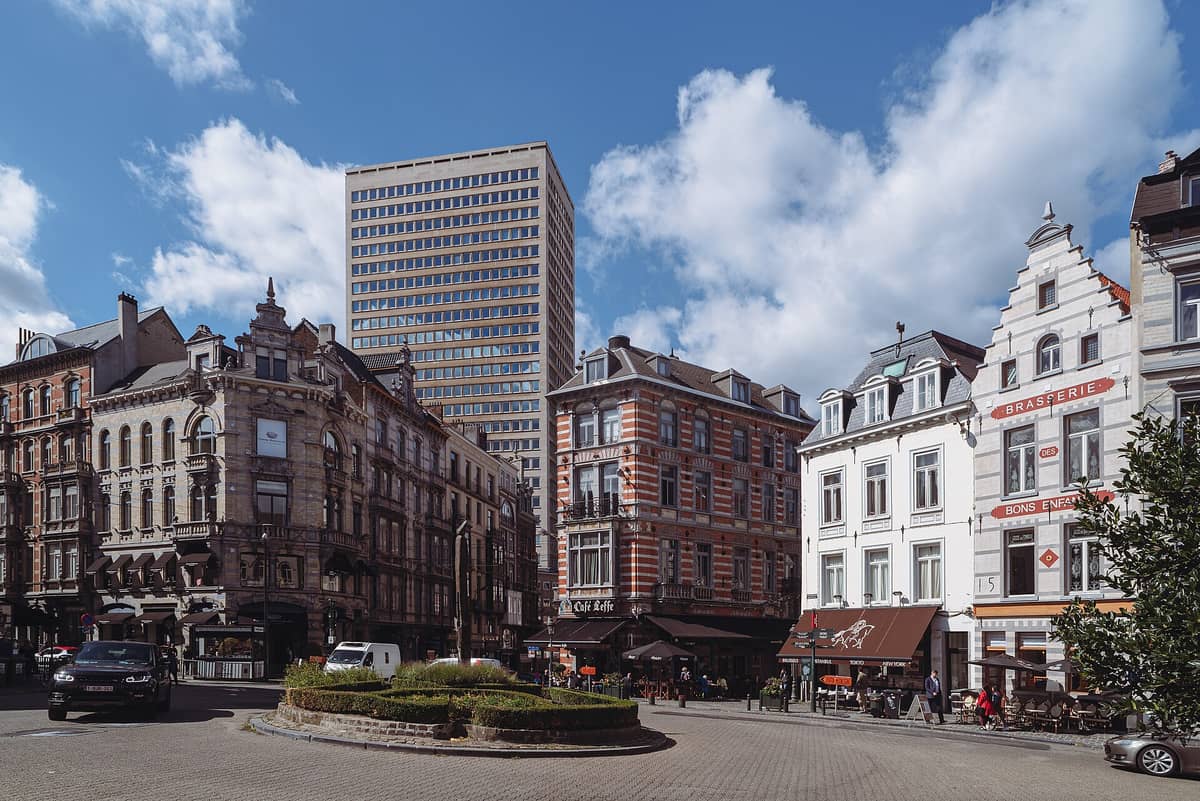
Place du Grand Sablon (Dutch: Grote Zavelplein) is an irregular, elongated public square roughly 150 meters long, wider at its eastern end (about 40 meters) and narrowing toward the west (around 30 meters). It sits in the Sablon quarter of Brussels, uphill from the Grand-Place and just below the Royal Quarter. The square is free to enter at any time, 24 hours a day, and there is no ticket required for access.
The ground level is dominated by café terraces, high-end chocolate shops, and antique galleries. The northern side of the square is flanked by the flamboyant Gothic facade of Notre-Dame du Sablon church, whose detailed stonework is visible from across the square at almost any point. The overall atmosphere is more restrained and residential than the Grand-Place tourist circuit, which is part of its appeal and part of why it can quietly disappoint visitors who expect dramatic spectacle.
ℹ️ Good to know
The square is open 24/7. The weekend antiques market runs Saturday 9:00–17:00 and Sunday 9:00–15:00. Arrive before 10:30 on Sunday if you want a full browse before stalls begin packing up.
How the Square Changes Through the Day
On a weekday morning, Place du Grand Sablon is among the quietest corners of central Brussels. Café staff arrange chairs on the cobblestones, delivery vans drop pastries and flowers at side entrances, and the air carries a faint mix of roasting coffee and fresh bread from the surrounding patisseries. At this hour the square belongs mostly to locals picking up breakfast.
By midday the square fills at a moderate pace. The café terraces attract a mixture of Belgian office workers, diplomats from nearby EU-adjacent institutions, and tourists who've walked up from the Grand-Place. The light falls well on the northern facade of the Notre-Dame du Sablon church around noon in summer, which is worth noting for photography. In winter, the low angle of afternoon sun catches the stonework differently, creating strong shadows on the carved details from around 14:00 onward.
Evenings have a different character. The chocolate shops close earlier than the restaurants, and the square settles into a neighbourhood dining scene rather than a tourist one. Several restaurants on and just off the square serve Belgian and French cuisine at prices that reflect the area's upmarket reputation. If you want a terrace seat on a warm Friday or Saturday evening, arrive before 19:30.
Tickets & tours
Hand-picked options from our booking partner. Prices are indicative; availability and final rates are confirmed when you complete your booking.
Origins of Brussels exploration game and tour
From 10 €Instant confirmationFree cancellationThe best of Brussels walking tour
From 229 €Instant confirmationFree cancellationBrussels audio tour with BELvue Museum admission
From 20 €Instant confirmationBrussels beer city exploration game and tour
From 10 €Instant confirmationFree cancellation
The Weekend Antiques Market
The Sablon Antiques Market is the primary reason many visitors time their trip for a weekend. Held every Saturday from 9:00 to 17:00 and every Sunday from 9:00 to 15:00, it occupies the central paved area of the square with dealers selling silverware, vintage maps, porcelain, Art Nouveau objects, old prints, jewellery, and Belgian antiques of variable quality. The market is free to browse.
The range of stock varies considerably from stall to stall. Some dealers are specialists with authenticated pieces and corresponding prices; others lean toward decorative collectibles and flea-market-adjacent items. Serious buyers typically arrive early on Saturday when selection is fullest. Sunday is more relaxed in pace but shorter in duration, and by 14:30 some stalls are already wrapping up.
The market complements the permanent antique galleries that line the streets immediately around the square, particularly Rue de Rollebeek and the passages connecting to the Jardin du Petit Sablon. These galleries keep regular weekday hours and represent a more curated, higher-end extension of the same trade.
Notre-Dame du Sablon: The Church Next Door
The northern edge of the square is dominated by the Church of Notre-Dame du Sablon, one of the finest examples of Brabantine Gothic architecture in Belgium. Construction began in the early 15th century, though the building was extended and modified over subsequent decades. The church's interior is notable for its stained glass windows, which cast colored light onto the stone floor on sunny mornings. Entry to the church is typically free and independent of the square itself. For more on the church, see the dedicated page on Notre-Dame du Sablon.
From the square, the church's western facade is the most photogenic angle. The carved stonework, including the gallery of pointed arches and the decorative tracery, is best appreciated from mid-square, where you have enough distance to frame the full height. Early morning provides the cleanest light on the facade before the café umbrellas open and obstruct lower sight lines.
Chocolate, Patisseries, and the Real Reason to Linger
The Sablon neighborhood has an established reputation as Brussels's premier address for praline chocolate, and Place du Grand Sablon is where that reputation is most concentrated. Several of Belgium's most recognized chocolatiers have flagship or historic shops on or within a few steps of the square. This is not incidental; the Sablon's affluent, bourgeois character made it a natural home for luxury food retail over the past century. For context on Belgian chocolate more broadly, the Belgian chocolate guide for Brussels covers the full landscape.
Beyond chocolate, the square and immediate side streets have several high-quality patisseries and a handful of specialty food shops. Prices here are noticeably higher than equivalent shops in other Brussels neighborhoods. If budget is a consideration, browsing the windows is still entirely worthwhile; buying selectively from one or two places rather than all of them is the practical approach.
💡 Local tip
Chocolate shops on the square often have small tasting counters near the entrance. You are not obligated to buy after tasting, though the expectation leans toward a small purchase if you try multiple pieces.
Getting There and Getting Around
The most practical public transport connection is the tram stop Petit Sablon, served by STIB/MIVB tram lines 92 and 93. From Brussels-Central station, the square is a comfortable 10-minute uphill walk via Rue de la Madeleine and Rue des Sablons. The route passes through the lower Sablon and gives you a gradual introduction to the neighborhood's character before arriving at the square itself.
The square is fully pedestrian-accessible, and the main surface is paved cobblestone. Wheelchair access is possible across most of the square, though the cobbles are uneven in places. Visitors combining the square with the Jardin du Petit Sablon can walk there in under three minutes via Rue de la Régence. The Magritte Museum and the Royal Museums of Fine Arts cluster are a further five-minute walk north along the same road.
Driving to the square is not recommended. Parking in the Sablon is limited and expensive, and the surrounding streets are narrow. Most visitors find the tram or a walk from the city center more practical.
Weather and When to Visit
Brussels has an oceanic climate with no true dry season, so rain is possible at any time of year. The square's cobblestones become slippery when wet, and café terraces close their outdoor seating during heavy rain. Late spring (May to early June) and early autumn (September) tend to offer the most agreeable outdoor conditions: mild temperatures, reasonable daylight, and lower crowd pressure than July and August.
In December, the Sablon area participates in Brussels's wider Christmas market circuit. The square itself takes on a different character, with seasonal stalls joining the usual weekend antiques market. If you're visiting during that period, the Brussels Christmas market guide explains what to expect across the city.
⚠️ What to skip
On rainy Sunday afternoons, some antiques market stalls close early. If the market is your main reason for visiting, check weather forecasts and aim for Saturday as a more reliable alternative.
Honest Assessment: Who Will Love It and Who Won't
Place du Grand Sablon rewards a specific kind of visitor: someone who enjoys slow browsing, architecture viewed without crowds, and the pleasure of a good café terrace. It is not a dramatic attraction in the way that the Grand-Place or the Atomium is. There is no single impressive moment. The satisfaction is cumulative, built from the quality of the surroundings rather than any one feature.
Visitors who arrive expecting a formal tourist site with structured activities are likely to find it underwhelming. There are no guided experiences built into the square itself, no audiovisual installations, and nothing that demands more than an hour unless you are actively shopping or eating. Children under ten often find little to engage with unless they are specifically interested in chocolate or the church interior.
For travelers with a limited schedule in Brussels, the square makes most sense as part of a longer Sablon and Royal Quarter walk rather than as a standalone destination. Combined with the Jardin du Petit Sablon, Notre-Dame du Sablon, and a pass through the Rue Haute antiques strip, it forms a coherent half-day itinerary that shows a very different side of Brussels from the Grand-Place tourist circuit.
Insider Tips
- The best unobstructed view of Notre-Dame du Sablon's facade is from the fountain in the center of the square, reached by mid-morning before the café terraces fill the foreground with umbrellas.
- Saturday morning is the antiques market at its fullest and most competitive among dealers; Sunday morning is calmer but ends early, with stalls starting to pack up well before the official 15:00 closing time.
- The side streets immediately east of the square, particularly Rue de Rollebeek, have several smaller antique and curiosity shops that are open on weekdays and less browsed than the market stalls.
- If you want a terrace seat at one of the square's most popular cafés on a sunny weekend, note that these fill quickly from around 11:00. Arriving just after 09:30 when things open gives you relaxed seating and better service.
- The square sits at a gentle elevation above Brussels's lower town. Walking downhill from here toward the Marolles neighborhood via Rue Haute or Rue Blaes takes about 10 minutes and puts you in one of Brussels's most distinct and less-touristed quarters.
Who Is Place du Grand Sablon For?
- Antiques and vintage collectors visiting on weekends
- Chocolate enthusiasts wanting to compare Belgian praline makers in one concentrated area
- Architecture and Gothic church admirers with time to observe the Notre-Dame du Sablon closely
- Travelers seeking a quieter, more residential Brussels experience away from the Grand-Place
- Couples or solo travelers who enjoy a slow café morning with architectural surroundings
Nearby Attractions
Other things to see while in Le Sablon:
- Jardin du Petit Sablon
Tucked between Rue de la Régence and Rue aux Laines in the Sablon quarter, the Jardin du Petit Sablon is a formal 19th-century garden distinguished by 48 bronze statuettes representing medieval Brussels trades. Entry is free, the atmosphere is surprisingly calm, and the surrounding streets form one of the city's most rewarding walks.
- Notre-Dame du Sablon
Rising above the antiques dealers and chocolate shops of the Sablon quarter, the Church of Our Lady of Victories at the Sablon is one of Brussels's finest examples of Brabantine Gothic architecture. Built between the 15th and early 16th centuries, it draws around 500,000 visitors a year and charges no admission. This guide covers what to expect inside, the best times to visit, and how the surrounding neighbourhood shapes the experience.
- Palace of Justice (Palais de Justice)
The Palace of Justice in Brussels is a working courthouse and one of the largest structures built in 19th-century Europe. Free to enter on weekdays, it rewards visitors with staggering neoclassical interiors, a turbulent architectural history, and one of the best elevated perspectives over the lower city.