Jardin du Petit Sablon: Brussels' Most Sculptural Garden
Tucked between Rue de la Régence and Rue aux Laines in the Sablon quarter, the Jardin du Petit Sablon is a formal 19th-century garden distinguished by 48 bronze statuettes representing medieval Brussels trades. Entry is free, the atmosphere is surprisingly calm, and the surrounding streets form one of the city's most rewarding walks.
Quick Facts
- Location
- Place du Petit Sablon 12, 1000 Brussels (Sablon district)
- Getting There
- Trams 92 and 93, stop 'Petit Sablon'; bus lines 27 and 95 also serve the area
- Time Needed
- 20–45 minutes for the garden; allow 1.5–2 hours to combine with the Sablon neighbourhood
- Cost
- Free entry
- Best for
- History lovers, architecture walkers, couples, quiet breaks between museum visits
- Official website
- gardens.brussels/fr/espaces-verts/square-du-petit-sablon
What Is the Jardin du Petit Sablon?
The Jardin du Petit Sablon, officially known as the Square du Petit Sablon in French and the Kleine Zavelsquare in Dutch, is a compact, formally designed public garden in Brussels' Sablon neighbourhood. It sits just southeast of the Church of Our Blessed Lady of the Sablon, framed on two sides by ornate wrought-iron railings and bordered by Rue de la Régence and Rue aux Laines.
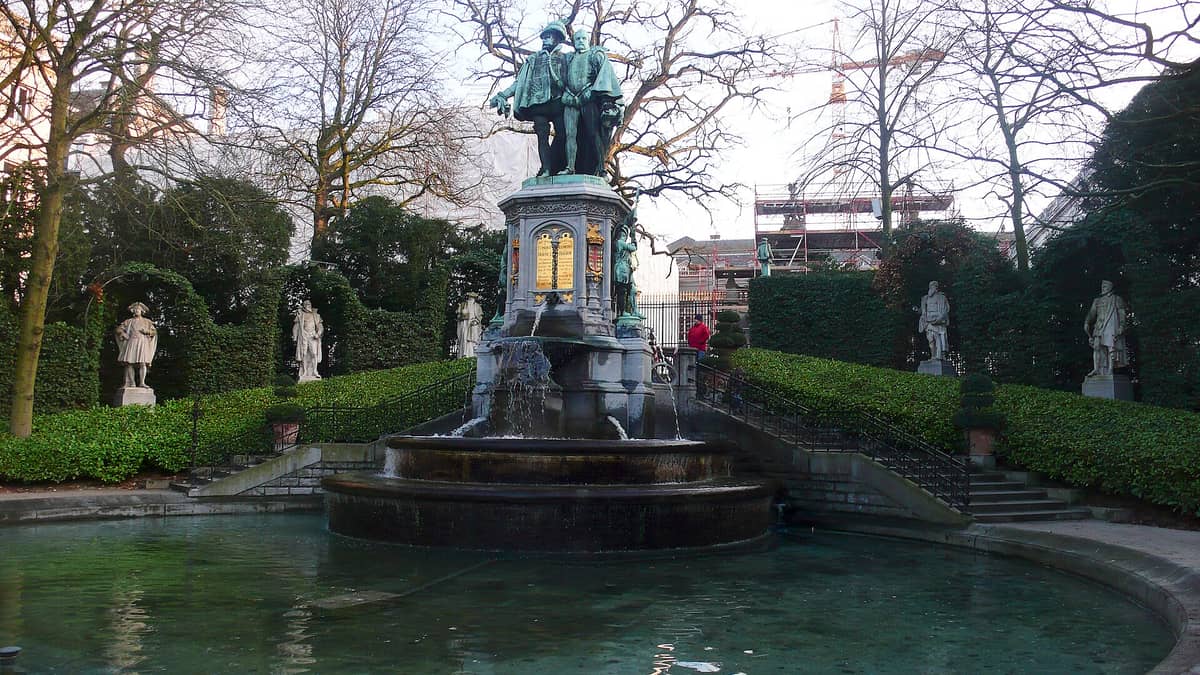
The garden's defining feature is its perimeter fence, which incorporates 48 bronze statuettes each representing a different medieval Brussels trade guild, from tanners and coopers to goldsmiths and tailors. These figures give the garden a sculptural density unusual for such a small space. The rectangular layout is arranged with clipped hedges, flowering beds, and shaded pathways converging on a central fountain and pool, all maintained by Brussels Environment.
It is not a grand park. The entire garden can be walked end-to-end in under five minutes. What it offers instead is a precise, composed urban retreat, and an unusually legible piece of 19th-century Brussels civic design. For visitors already exploring the Sablon area, it requires no detour; it sits directly on the natural route between the antiques market at Place du Grand Sablon and the upper-city institutions near the Royal Quarter.
💡 Local tip
Opening hours change seasonally. In summer (1 May–31 August) the garden is open 08:15–20:30. In winter (1 October–31 March) it closes at 16:45, with slightly longer hours (08:15–18:30) from 1–30 April. Arriving outside these hours means finding the gates locked.
The 48 Statuettes: What to Actually Look For
Most visitors glance at the iron fence and move on. That's a mistake. The 48 statuettes set into the railings represent the organised trade guilds that gave Brussels much of its medieval economic identity. Each figure carries the attributes of its craft: a tanner holds a hide, a brewer cradles a barrel, a lace-maker bends over her work. Walking the full perimeter and reading the inscriptions takes about ten minutes and rewards the patient observer with a street-level history of what Brussels' working population actually did for centuries.
The quality of the casting varies; some figures are worn smooth by weather, others remain crisply detailed. Morning light, particularly in spring and summer when the garden opens at 08:15, falls at a low angle across the fence and makes the relief work on each statuette far easier to read than it is at midday. If you're photographing the sculptures, this early window is the most productive.
The guilds represented here connect directly to the broader story of Brussels' medieval commercial life, the same story told in architectural form at the Grand-Place, where the guild houses were rebuilt in Baroque stone after the French bombardment of 1695. The Petit Sablon statuettes predate that story, pointing to the era when these guilds held real economic and political power.
Tickets & tours
Hand-picked options from our booking partner. Prices are indicative; availability and final rates are confirmed when you complete your booking.
Banksy Museum admission and Brussels' highlights audio tour
From 28 €Instant confirmationBrussels audio tour with The View big wheel ticket
From 20 €Instant confirmationBrussels' history audio tour with Halle Gate admission ticket
From 17 €Instant confirmationGhent tour from Brussels
From 43 €Instant confirmationFree cancellation
The Garden's Interior: Layout and Atmosphere
Inside the fence, the garden is organised around a central water feature and low hedgerows that define compartmentalised planting beds. Mature trees provide shade in summer, making the interior noticeably cooler than the surrounding stone streets of the Sablon. The smell shifts seasonally: in May, flowering plantings bring a faint sweetness to the air; by midsummer the dominant note is cut grass and damp earth after Brussels' frequent light rain.
Benches along the inner paths are occupied at lunch by office workers from the nearby government buildings on Rue de la Régence, and by tourists catching a few quiet minutes between the Magritte Museum and the antiques quarter. Weekend mornings are the calmest time to visit. By early afternoon on Saturdays, the surrounding streets fill with the antiques market crowd, and foot traffic increases noticeably, though the garden itself rarely becomes overcrowded.
The garden is only accessible on foot during daytime hours. Visitors are directed to stay on the paths. Wheelchair accessibility is not explicitly confirmed by Brussels Environment documentation; anyone with significant mobility requirements should contact the city's parks service in advance.
Historical Context: Why This Garden Exists Here
The Sablon quarter has been a focal point of Brussels' upper-city life since the medieval period. The church immediately north of the garden, Notre-Dame du Sablon, dates its origins to the early 14th century, and the Place du Grand Sablon was a site of public markets and social exchange for centuries. The garden itself is a creation of the late 19th century, reflecting Brussels' civic confidence during a period of rapid urban expansion and institutional construction.
The wider upper city, stretching from the Sablon toward the Parc du Cinquantenaire, is dense with this period's ambition. The Church of Notre-Dame du Sablon directly adjacent to the garden is among the finest examples of Brabantine Gothic architecture in Belgium, and together with the garden forms a civic composition that rewards close attention.
The Petit Sablon also carries a monument to the Counts of Egmont and Hoorn, two 16th-century Flemish nobles executed in 1568 on the orders of the Duke of Alba during the Spanish occupation of the Low Countries. Their statues stand in the garden as a reminder that the Sablon was not only a place of craft and commerce but of political history with real consequences. This detail is easily missed by visitors treating the garden as merely decorative.
How It Changes Through the Day and Year
Early morning in the warmer months (the garden opens at 08:15 from April through August, and again from 1–30 September) is the most pleasant time to visit. The Sablon streets are quiet, the antiques shops are shuttered, and the quality of light is good for both photography and general observation. At this hour the garden smells of moist soil and hedge, and you may have it largely to yourself.
By mid-morning the area around Place du Grand Sablon begins to activate. Coffee drinkers fill the terrace chairs of the chocolate shops and cafés, and a slow stream of tourists follows. The garden remains calmer than its surroundings throughout, partly because it requires a deliberate decision to enter rather than simply passing through.
Brussels' climate is maritime and oceanic, with rainfall distributed across the year and no real dry season. Summer highs reach around 23°C in July and August, which makes the shaded interior of the garden genuinely comfortable. Autumn brings golden foliage to the trees and softer light, which many photographers prefer. Winter is the least rewarding season for a purely visual visit: the garden closes at 16:45, the beds are bare, and the short daylight hours compress your window. The gates lock on schedule regardless of conditions.
ℹ️ Good to know
Seasonal opening hours at a glance: 1 Oct–31 Mar: 09:30–16:45 | 1–30 Apr: 08:15–18:30 | 1 May–31 Aug: 08:15–20:30 | 1–30 Sep: 08:15–19:30. All hours sourced from Brussels Environment / Brussels Gardens.
Getting There and Combining With the Sablon Area
Trams 92 and 93 stop directly at Petit Sablon on Rue de la Régence. Bus lines 27, 34, 48, 95, and 96 also serve the surrounding streets. The garden is a 15-minute walk from Brussels-Central station through the upper city, passing the Coudenberg and the Palace of Justice. From the Grand-Place, the walk uphill takes roughly 20 minutes through the historic centre.
The Sablon neighbourhood itself is worth an hour or two beyond the garden. The Place du Grand Sablon hosts a weekend antiques market (Saturdays and Sundays) and is lined with chocolate shops, galleries, and cafés. The Magritte Museum is a seven-minute walk north on Rue de la Régence, making it a natural pairing for a half-day itinerary.
For those building a broader walking route, the Mont des Arts garden terrace is a ten-minute walk downhill toward the city centre, and offers the most photographed panoramic view over Brussels' lower town roofscape. Together, these three points form a natural arc through the upper city that can be completed comfortably in a morning.
Who Should Skip It
Visitors with very limited time in Brussels and a strong preference for major indoor collections may find the Jardin du Petit Sablon a low priority. It is a 15–20 minute experience at best, and those who haven't read anything about the statuettes or the history of the Counts of Egmont will find it simply a tidy garden. Without context, the sculptural programme on the railings reads as decoration rather than historical documentation.
It is also not a children's attraction in the conventional sense. There is no play area, no interactive element, and the paths are short. Families with young children may prefer the larger open spaces at the Parc du Cinquantenaire or the Bois de la Cambre. The garden is best suited to adults who enjoy walking at a pace that allows for observation.
Insider Tips
- Walk the full perimeter of the fence before entering the garden, reading the trade guild statuettes in sequence. Most visitors skip straight inside and miss the most historically interesting element entirely.
- The Counts of Egmont and Hoorn monument in the garden interior is often overlooked. These two figures were executed on the Grand-Place in 1568, and their presence here creates a direct historical link between the Sablon and Brussels' most famous public square.
- If you plan to combine this visit with the Place du Grand Sablon antiques market, go to the garden first. By the time the market reaches full activity on a Saturday morning, you'll have had the garden to yourself.
- Tram 92 or 93 is often the most direct approach from the lower city when they are running normally; the Petit Sablon stop places you at the Rue de la Régence entrance within seconds. If there are service disruptions on these lines, opt for the buses serving Petit Sablon or consider walking up from Grand-Place only if your time and energy allow, as the hill is steep.
- In summer, the garden is open until 20:30, which means you can visit after dinner with good evening light in June and July. The Sablon café terraces are active at this hour, making it a natural end to an evening walk through the upper city.
Who Is Jardin du Petit Sablon For?
- History and architecture enthusiasts who want to understand Brussels beyond the Grand-Place
- Couples looking for a calm, photogenic walk through the Sablon quarter
- Travellers combining a visit with the Magritte Museum or Notre-Dame du Sablon
- Photographers working in early morning or evening light
- Anyone building a budget-friendly Brussels day, since entry is free
Nearby Attractions
Other things to see while in Le Sablon:
- Notre-Dame du Sablon
Rising above the antiques dealers and chocolate shops of the Sablon quarter, the Church of Our Lady of Victories at the Sablon is one of Brussels's finest examples of Brabantine Gothic architecture. Built between the 15th and early 16th centuries, it draws around 500,000 visitors a year and charges no admission. This guide covers what to expect inside, the best times to visit, and how the surrounding neighbourhood shapes the experience.
- Palace of Justice (Palais de Justice)
The Palace of Justice in Brussels is a working courthouse and one of the largest structures built in 19th-century Europe. Free to enter on weekdays, it rewards visitors with staggering neoclassical interiors, a turbulent architectural history, and one of the best elevated perspectives over the lower city.
- Place du Grand Sablon
Place du Grand Sablon is a centuries-old public square in the Sablon neighborhood of central Brussels, lined with chocolate shops, antique dealers, and café terraces. Free to enter at any hour, it hosts a weekend antiques market and sits beside the Gothic Notre-Dame du Sablon church. It rewards visitors who linger rather than rush.