Mont des Arts: Brussels' Most Rewarding Free Viewpoint
Mont des Arts (Kunstberg in Dutch) is a stepped urban complex in Brussels' Royal Quarter that connects the lower and upper city through terraced gardens, monumental staircases, and a cluster of major cultural institutions. The view from the upper terrace over the rooftops toward the Grand-Place is one of the most satisfying in the Belgian capital — and it costs nothing to see it.
Quick Facts
- Location
- Between Place Royale and the Albertine/Carrefour de l’Europe, 1000 Brussels — Royal Quarter, overlooking Brussels-Central Station
- Getting There
- Bruxelles-Central / Brussel-Centraal train station (3-min walk); tram/bus stops at Gare Centrale and Parc
- Time Needed
- 30–60 min for the gardens and viewpoint; 2–4 hrs if visiting museums
- Cost
- Free (outdoor areas and gardens); individual museums and exhibitions charge separately
- Best for
- City views, photography, architecture lovers, and cultural institution hopping
- Official website
- www.montdesarts.org/en
What Mont des Arts Actually Is
Mont des Arts is not a museum, not a park in the conventional sense, and not simply a viewpoint. It is a structured urban complex in the heart of Brussels' Royal Quarter that physically bridges the lower town (around Brussels-Central Station) with the upper town (around Place Royale and the Place du Grand Sablon). The name translates loosely as 'Hill of the Arts,' and the Dutch name Kunstberg means exactly the same thing. Both names are accurate: this is a designed cultural landscape, assembled over more than a century, where formal gardens, grand institutional buildings, and open terraces coexist in a deliberate composition.
The site holds the Royal Library of Belgium (KBR), a convention centre, and the National Archives of Belgium, with the Brussels City Museum (Maison du Roi) located on the Grand-Place just down the hill, and proximity to both the Royal Museums of Fine Arts and the Magritte Museum. The gardens themselves, laid out by Belgian landscape architect René Pechère in the 1950s, are geometric and clipped, in the French formal style. The overall complex as it stands today was built primarily between the mid‑1950s and 1969 to designs by architects J. Ghobert and M. Houyoux, though its origins go back much further.
💡 Local tip
The outdoor terraces and gardens are free and accessible at all times as a public space. The Jardin du Mont des Arts has seasonal opening hours (roughly early morning to evening, with longer access in summer). Individual buildings on the complex — the library, museums, and convention centre — have their own hours and admission fees. Check each venue separately before visiting.
A Long History of Ambition and Demolition
The story of Mont des Arts is inseparable from the story of how Brussels transformed itself from a dense medieval city into a modern European capital. The area was once occupied by the Montagne de la Cour neighbourhood, a tightly packed district of streets, houses, and workshops that connected the upper and lower town. In the late 19th century, King Leopold II — who also commissioned the Cinquantenaire arch and the Laeken greenhouses — promoted a grand scheme to demolish this neighbourhood and create a monumental arts precinct in its place.
The first physical expression of that ambition came with the 1910 Brussels International Exhibition, for which a temporary park and monumental staircase by landscape architect Jules Vacherot were constructed on the cleared land. That was the provisional version. The definitive buildings and garden layout came in a postwar push from 1954 to 1969, producing the rational, slightly severe institutional architecture that frames the complex today. It is not a universally loved style, but it is honest about its era and its civic ambitions.
The gardens have aged better than the buildings in most visitors' estimations. Pechère's formal beds, trimmed hedges, and central fountain give the space a composed, deliberate character that contrasts pleasantly with the organic chaos of the Grand-Place and Îlot Sacré just down the hill.
Tickets & tours
Hand-picked options from our booking partner. Prices are indicative; availability and final rates are confirmed when you complete your booking.
Ghent tour from Brussels
From 43 €Instant confirmationFree cancellationTablet Workshop at Choco-Story Brussels
From 45 €Instant confirmationShared tour of Delft and the Keukenhof Estate from Brussels
From 86 €Instant confirmationFree cancellationOrigins of Brussels exploration game and tour
From 10 €Instant confirmationFree cancellation
The View: What You See and When to See It
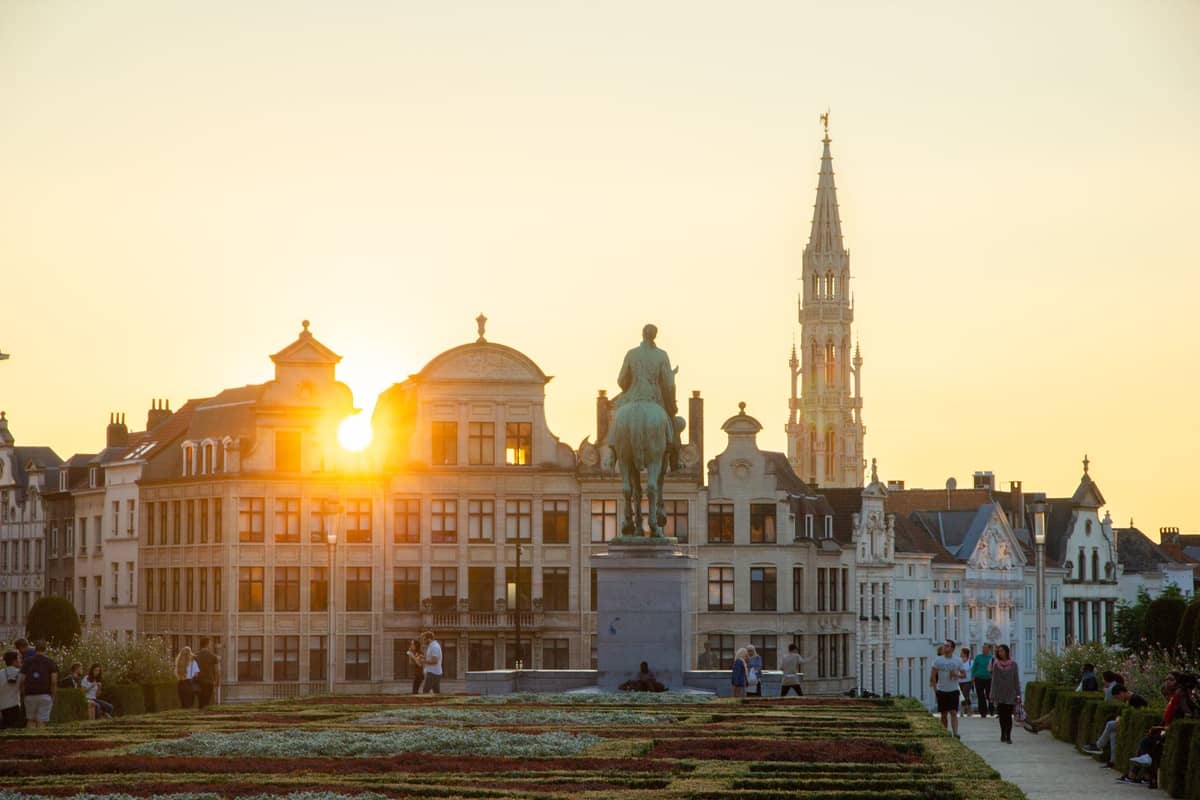
The panoramic terrace at the upper end of Mont des Arts is the site's single most compelling feature. From here, you look out over the rooftops of the lower city toward the spire of Brussels Town Hall on the Grand-Place, with the broader cityscape spreading east and west. On a clear day you can see considerable distances, and the angle of the view places the Town Hall's Gothic spire in a frame that few other vantage points can match.
Morning light, between roughly 8 and 10 am, hits the lower town facade directly and gives photographers the cleanest conditions. By midday the terrace fills with workers from the nearby EU-adjacent offices and tourists who have walked up from Brussels-Central. Late afternoon in summer is perhaps the most atmospheric time: the sun drops toward the west, the stone of the lower buildings warms to a honey tone, and the fountain in the garden catches the light.
Winter visits have their own logic. Crowds thin considerably after October. On frosty mornings the formal garden takes on a stark, graphic quality, and the view has a clarity that summer haze occasionally softens. December also brings the Brussels Christmas Market, which sets up in the nearby streets and adds light and activity to the lower town visible from the terrace.
ℹ️ Good to know
Photography tip: For a view that includes both the garden's geometry and the Town Hall spire in one frame, position yourself at the central axis of the upper terrace, slightly back from the railing, in the first two hours after sunrise. Midday crowds and flat light make the same shot significantly less interesting.
Navigating the Site: A Practical Walkthrough
Most visitors approach Mont des Arts from Brussels-Central Station, which takes roughly three minutes on foot. You walk up from the station plaza and the complex opens in front of you: the formal garden in the centre, flanked by institutional buildings on either side, with the upper terrace and Place Royale at the top of the slope. The main axis is walkable in about five minutes at a stroll, though stairs at the upper end require some effort.
The site is a stepped hillside, which means staircases are part of the experience. Visitors who have difficulty with stairs should note that there are streets around the perimeter — including Rue Montagne de la Cour — that provide a less steep route to the upper level. The buildings on the complex (the library, museums) have their own accessibility provisions; check with each institution directly.
At the top, you arrive at Place Royale, from which you can continue easily to the Royal Museums of Fine Arts (a five-minute walk) or the Magritte Museum. Going downhill from the bottom of the garden takes you toward the Grand-Place area in about ten minutes on foot.
The Cultural Institutions Around the Complex
Mont des Arts is as much a cultural campus as it is a garden. The Royal Library of Belgium (KBR) occupies a major portion of the complex's built fabric. The library holds one of the most significant collections of manuscripts, maps, and printed books in Western Europe; it hosts temporary exhibitions open to the public, though admission fees and hours vary and should be verified directly with the KBR before visiting.
A short walk from the upper terrace places you at the BOZAR Centre for Fine Arts, one of Brussels' most respected venues for contemporary art, music, and cultural events. The concentration of institutions in this small area makes Mont des Arts a logical starting point for a day focused on Brussels' cultural output.
Below the complex, the Maison du Roi on the Grand-Place and the Coudenberg Palace archaeological site (the ruins of the former royal palace, partially beneath Place Royale itself) round out what is one of the densest concentrations of historical and cultural material in the Belgian capital.
Weather, Seasons, and What to Bring
Brussels has an oceanic climate with no true dry season, and the Mont des Arts terrace is exposed. In winter, temperatures regularly sit between 1°C and 5°C, and wind on the upper terrace amplifies the cold considerably. A proper coat is not optional from November through March. In summer, highs reach around 22–23°C in July and August, and the garden is genuinely pleasant in those months, though the terrace can be crowded on sunny afternoons.
Rain is a constant possibility throughout the year. The site has limited shelter, so a compact umbrella or rain layer is useful to carry. Wet weather does change the atmosphere of the gardens for the better in some ways: the formal hedges take on a deep green, reflections appear in the fountain basin, and tourist numbers drop, making photography easier. The view from the terrace, however, loses interest in heavy overcast conditions when the lower city's colours flatten.
⚠️ What to skip
The main staircase and stone terraces can become slippery in wet conditions. Footwear with grip is advisable, especially in autumn and winter.
A Clear-Eyed Assessment: Is It Worth Your Time?
Mont des Arts is not the kind of attraction that produces a strong reaction on its own. The garden is formally pleasant rather than spectacular; the buildings are serviceable institutional architecture from the 1960s, not beautiful in themselves. Visitors expecting the drama of, say, the Atomium or the intricacy of the Grand-Place should recalibrate their expectations. What Mont des Arts offers is something more subtle: a coherent urban space that gives you perspective on Brussels, literally and figuratively.
The view is the point. Standing at the upper terrace and looking down over the lower town, with the Town Hall spire in the distance, you understand the city's topography in a way no map or museum can convey. And because it is free, open always, and takes less than an hour to walk through, the risk of visiting is essentially zero. The calculation is straightforward: anyone spending more than a day in Brussels should walk through Mont des Arts at least once.
Those who should skip it: visitors with very limited mobility who cannot manage stairs or slopes (though workarounds exist), and travelers who are visiting Brussels for a single afternoon and must prioritise. If you are choosing between this and the Grand-Place, start with the Grand-Place. But Mont des Arts makes an excellent route between Brussels-Central and Place Royale, so it rarely requires a dedicated detour.
Insider Tips
- The benches along the central garden axis fill up fast on warm lunch hours with office workers from the nearby institutions. If you want a quiet sit-down in the garden, aim for before 11 am or after 2 pm on weekdays.
- The upper terrace is also accessible from Place Royale by descending a short staircase. If you're coming from the Magritte Museum or Royal Museums of Fine Arts, this is the natural downhill exit toward Brussels-Central and the Grand-Place.
- The view is notably better in winter on clear days than in summer haze. If you're visiting Brussels between November and February and get a bright morning, this should be your first stop before 9 am.
- The Jardin du Mont des Arts is one of the few formal gardens in central Brussels maintained to a consistently high standard. It is often used as a backdrop for professional photography and occasional public events; check the official site for seasonal programming.
- If you enter the complex from the Brussels-Central Station side, look for the carved stone details on the flanking institutional buildings. They are easy to walk past without noticing, but the architectural detailing repays a slower pace.
Who Is Mont des Arts For?
- Architecture and urban design enthusiasts who want to understand Brussels' layered city-building history
- Photographers looking for the classic elevated view over the Brussels rooftops and Town Hall spire
- Visitors planning a cultural day who want a logical route connecting the station, garden, and upper-town museums
- Travelers on a tight budget who want a quality experience without admission fees
- Winter visitors who want to appreciate Brussels without the summer crowds
Nearby Attractions
Other things to see while in Royal Quarter & Mont des Arts:
- BELvue Museum
The BELvue Museum traces Belgium's history from its founding in 1830 to the present day through seven thematic galleries and around 200 carefully selected objects. Located at Place des Palais, steps from the Royal Palace, it offers a clear-eyed account of a country that has rarely had a simple story to tell.
- BOZAR – Centre for Fine Arts
Housed in a landmark Art Deco building designed by Victor Horta, BOZAR is Belgium's premier multidisciplinary arts centre, blending major exhibitions, classical concerts, film screenings, and contemporary performance under one roof. Located steps from Brussels Central station in the Mont des Arts district, it rewards curious visitors who want more from their cultural itinerary than a single painting collection.
- Coudenberg Palace Archaeological Site
Beneath the Place des Palais lies one of Brussels' most unexpected attractions: the excavated ruins of the Coudenberg Palace, once the most powerful royal court in northern Europe. This underground archaeological site lets visitors walk through streets and halls that haven't seen daylight since the 18th century.
- Magritte Museum
The Musée Magritte Museum in Brussels holds the world's largest collection of works by René Magritte, with over 200 paintings, drawings, sculptures, and archival materials spread across multiple floors. Located on Place Royale in the Royal Quarter, it is one of the most focused single-artist museums in Europe and a serious destination for anyone interested in Surrealism, 20th-century painting, or Belgian cultural history.