BOZAR – Centre for Fine Arts: Brussels's Most Ambitious Cultural Venue
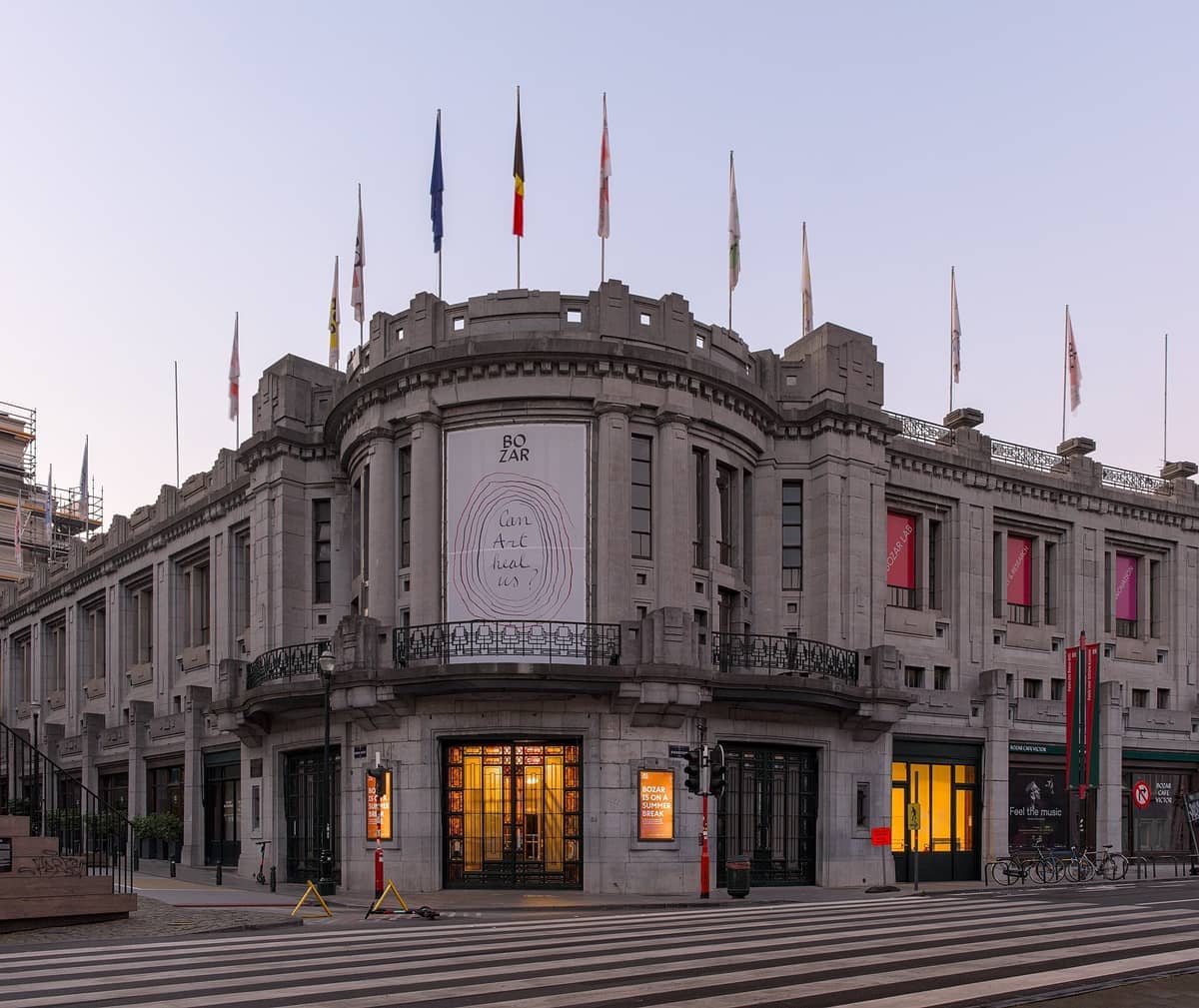
Housed in a landmark Art Deco building designed by Victor Horta, BOZAR is Belgium's premier multidisciplinary arts centre, blending major exhibitions, classical concerts, film screenings, and contemporary performance under one roof. Located steps from Brussels Central station in the Mont des Arts district, it rewards curious visitors who want more from their cultural itinerary than a single painting collection.
Quick Facts
- Location
- 23 Rue Ravenstein, 1000 Brussels (Mont des Arts / Royal Quarter)
- Getting There
- Brussels-Central train station (3-min walk); tram and bus stops at Mont des Arts
- Time Needed
- 1.5 to 3 hours for exhibitions; add more for concerts or film
- Cost
- Varies by event and exhibition; check bozar.be for current prices. Wheelchair users and visually impaired visitors: free entry with EU Disability Card (one companion included)
- Best for
- Architecture lovers, contemporary art enthusiasts, classical music audiences, and travellers who want cultural depth beyond the typical tourist circuit
- Official website
- www.bozar.be
What BOZAR Actually Is (and Why That Matters)
BOZAR, officially the Centre for Fine Arts (Palais des Beaux-Arts de Bruxelles), is not a conventional museum. It holds no permanent collection. Instead, it functions as a rotating cultural platform: major international art exhibitions share the building with a concert hall that hosts the Belgian National Orchestra, a cinema programme, and literary events. On any given week, you might walk past a retrospective of a 20th-century European painter, then down a corridor toward a contemporary installation, with a pre-concert crowd gathering near the Henry Le Boeuf Hall at the far end.
That range is BOZAR's defining quality, and also the reason some visitors leave underwhelmed. If you arrive expecting a permanent collection of Belgian masterworks, you will find empty galleries where a show recently closed, or rooms being reconfigured for the next exhibition. BOZAR rewards visitors who check the programme before they arrive.
💡 Local tip
Always check bozar.be before visiting. Exhibitions change regularly, and some halls are closed during installation periods. The programme is usually posted months in advance.
The Building: Victor Horta's Restrained Masterpiece
The building itself is a reason to visit, regardless of what is showing. Victor Horta, the architect most associated with Brussels Art Nouveau, designed the Palais des Beaux-Arts in a markedly different register: Art Deco, sober and monumental, construction running from 1922 to 1929. The project was formalised in 1922 through the creation of a non-profit organisation bringing together the Belgian State, the Province of Brabant and the City of Brussels. The palace officially opened in May 1928 and was completed in 1929.
Horta faced an unusual constraint here: the site sits between the upper city (around the Royal Palace) and the lower city (around the Grand-Place), and the building could not exceed the roofline of the street above. His solution was to dig downward. The Henry Le Boeuf concert hall, seating about 2,150 people, sits partially below ground level, invisible from the street, its ceiling contained by the grade change of the slope. Walk the corridor that runs alongside the hall and the architectural ingenuity of this solution becomes clear: the building is far larger inside than its street presence suggests.
Horta's other Brussels interiors lean on sinuous ironwork and natural light flooding through glass. The Palais des Beaux-Arts trades that vocabulary for stone, travertine, and restrained geometric ornament. It shares the Mont des Arts area with the Mont des Arts garden and viewpoint, and forms part of a formal cultural district that also includes the Royal Museums of Fine Arts just a few minutes on foot.
Tickets & tours
Hand-picked options from our booking partner. Prices are indicative; availability and final rates are confirmed when you complete your booking.
Ghent tour from Brussels
From 43 €Instant confirmationFree cancellationTablet Workshop at Choco-Story Brussels
From 45 €Instant confirmationShared tour of Delft and the Keukenhof Estate from Brussels
From 86 €Instant confirmationFree cancellationOrigins of Brussels exploration game and tour
From 10 €Instant confirmationFree cancellation
The Exhibition Spaces: What You Actually Walk Through
The main visitor entrance is on Rue Ravenstein, where the ticketing desk operates Tuesday through Sunday, 10:00 to 17:00 (with reduced hours on 24 and 31 December). The exhibition galleries are open Tuesday to Sunday, 10:00 to 18:00, and are closed on Mondays. Note that on 24 and 31 December exhibitions close at 16:00, and BOZAR is fully closed on 25 December and 1 January.
The internal layout feels like a layered city block rather than a single gallery sequence. Corridors widen into circulation halls with high ceilings and pale stone surfaces. The sound underfoot shifts from echoing marble in the public areas to the quieter, more contained atmosphere of the temporary exhibition rooms. Natural light is used sparingly, mainly in transition zones, so the galleries themselves rely on controlled artificial lighting, which suits the type of large-scale touring exhibitions BOZAR typically hosts.
During a busy exhibition, the space absorbs crowds reasonably well. Weekday mornings, particularly Tuesday and Wednesday before noon, are noticeably calmer. Weekend afternoons, especially when a major show is in its final weeks, can feel congested in the central hallways, though the galleries themselves rarely become impassable.
ℹ️ Good to know
During the summer season (1 July to 31 August), the Bozar Tickets desk operates on adjusted hours: typically 11:00 to 19:00. Plan your visit and any ticket purchases accordingly.
The Henry Le Boeuf Hall: One of Europe's Finest Concert Rooms
If you have any interest in classical music, a concert at the Henry Le Boeuf Hall is worth planning your Brussels visit around. The hall has a reputation among musicians and acousticians for its warm, precise sound, and it serves as the home stage of the Belgian National Orchestra. The seating arrangement feels close and focused, far less anonymous than large opera houses, which makes even the upper tiers feel connected to the stage.
The foyer areas before a concert have a particular atmosphere, with the slightly formal energy of a city audience dressing just enough for the occasion. The stone corridors, lit more warmly in the evening than during daytime exhibition visits, give the building a different character after dark. Arriving fifteen minutes early allows time to walk the connecting corridors and appreciate the architecture in this quieter state before doors open.
BOZAR's concert programme extends well beyond the Belgian National Orchestra: chamber music, jazz, world music, and contemporary composition all feature in the annual schedule. If your interests run more toward opera or theatrical performance, the La Monnaie Opera is about ten minutes on foot and offers a very different but equally serious programme.
Getting There and Moving Around the Neighbourhood
BOZAR sits at 23 Rue Ravenstein, in the Mont des Arts district of the Royal Quarter. Brussels-Central station is a three-minute walk, making it one of the most accessible major cultural venues in the city. From Brussels-Central, trains connect directly to Brussels Airport (Zaventem) in roughly 20 to 25 minutes, which matters if you are combining an arrival day with an evening concert.
The Royal Quarter is a calm, administratively formal part of Brussels, less commercially animated than the area around the Grand-Place but pleasant to walk through. The Royal Museums of Fine Arts are directly adjacent, sharing the same cultural district, and the Magritte Museum is within the same complex. A half-day that combines BOZAR's current exhibition with the Magritte Museum is a natural pairing.
For visitors arriving by metro, tram, or bus, the Mont des Arts stops serve the area. STIB/MIVB routes connect the Royal Quarter to the city's broader network. If you are travelling from further afield within Belgium using SNCB/NMBS rail, Brussels-Central is the most convenient terminus.
💡 Local tip
The Ravenstein Gallery, directly opposite the entrance, is worth a short detour before or after your visit. This covered passage connects to the area around the Grand-Place and contains independent art galleries and a quiet cafe.
Accessibility and Practical Visitor Notes
BOZAR provides adapted access for visitors with reduced mobility, including accessible entrance routes. Wheelchair users and visually impaired visitors receive free admission for themselves and one accompanying person upon presentation of an EU Disability Card, while other visitors with disabilities receive a 50% discount with relevant social security or EU Disability Card documentation. For specific accessibility questions before your visit, BOZAR operates a free information phone line: 0800 99 962.
The building's multi-level layout means that some internal routes involve stairs, but adapted routes exist. Given that parts of the building are below street grade, the accessible circulation paths are not always the most direct, so consulting the venue ahead of a visit is sensible if you have specific mobility requirements.
BOZAR falls within the wider cultural orbit of the Royal Quarter, which includes several institutions relevant to travellers interested in Belgian history and European politics. The BELvue Museum on Place des Palais covers Belgian history from independence to the present, and the Museum of Musical Instruments is a short walk away in a striking Art Nouveau building, offering a counterpoint to BOZAR's programming for visitors with musical interests.
Who Should Consider Skipping It
BOZAR is not the right stop for every traveller. If your Brussels visit is short and focused on the city's iconic visual landmarks, the venue's changing exhibition model means you may find limited return for the entry cost on a day when the programme does not align with your interests. Families with young children will generally find the contemporary and fine arts exhibitions less engaging than nearby alternatives designed for interactive learning.
Visitors primarily interested in Belgian art history are better served at the Royal Museums of Fine Arts, which holds a permanent collection spanning Flemish Primitives to the 20th century. BOZAR's value lies in its international programme and its architecture, not in a defined collection you can reliably plan around.
Insider Tips
- The ticketing desk closes at 17:00, one hour before the exhibitions themselves close at 18:00. If you want a full visit, arrive no later than 16:00. For evening concerts and other events, the desk reopens one hour before the performance starts.
- The building's internal corridors are free to walk even when you have not purchased an exhibition ticket. The main entrance hall and the circulation spine give a genuine sense of Horta's spatial logic without entering any ticketed space.
- BOZAR's programme is often at its richest in the autumn season, roughly September through November, when major international touring exhibitions tend to open. Visiting in this window also means Brussels is busy but not overwhelmed.
- If you are attending an evening concert, the walk from Brussels-Central station along Rue Ravenstein takes about three minutes, but the uphill approach from the lower city via the Mont des Arts steps adds another five minutes and offers a useful view of BOZAR's rear facade and garden terrace.
- The venue offers combined pricing for certain exhibition and concert pairings during the same visit. Check the website when booking to see whether a bundled option is available for your specific dates.
Who Is BOZAR – Centre for Fine Arts For?
- Architecture enthusiasts wanting to see a late Victor Horta building in a working cultural context
- Classical music listeners and concert-goers seeking a serious programme in an acoustically respected hall
- Travellers on a second or third Brussels visit who have already covered the permanent museum collections
- Art world professionals and students following major international touring exhibitions
- Couples looking for an evening of culture before dining in the nearby Sablon or Royal Quarter
Nearby Attractions
Other things to see while in Royal Quarter & Mont des Arts:
- BELvue Museum
The BELvue Museum traces Belgium's history from its founding in 1830 to the present day through seven thematic galleries and around 200 carefully selected objects. Located at Place des Palais, steps from the Royal Palace, it offers a clear-eyed account of a country that has rarely had a simple story to tell.
- Coudenberg Palace Archaeological Site
Beneath the Place des Palais lies one of Brussels' most unexpected attractions: the excavated ruins of the Coudenberg Palace, once the most powerful royal court in northern Europe. This underground archaeological site lets visitors walk through streets and halls that haven't seen daylight since the 18th century.
- Magritte Museum
The Musée Magritte Museum in Brussels holds the world's largest collection of works by René Magritte, with over 200 paintings, drawings, sculptures, and archival materials spread across multiple floors. Located on Place Royale in the Royal Quarter, it is one of the most focused single-artist museums in Europe and a serious destination for anyone interested in Surrealism, 20th-century painting, or Belgian cultural history.
- Mont des Arts
Mont des Arts (Kunstberg in Dutch) is a stepped urban complex in Brussels' Royal Quarter that connects the lower and upper city through terraced gardens, monumental staircases, and a cluster of major cultural institutions. The view from the upper terrace over the rooftops toward the Grand-Place is one of the most satisfying in the Belgian capital — and it costs nothing to see it.