La Monnaie / De Munt: Inside Belgium's National Opera House
La Monnaie / De Munt is Belgium's national opera house, occupying a neoclassical building at Place de la Monnaie in central Brussels. This guide covers what to expect from a performance visit, how to get tickets, the building's historical significance, and practical tips for making the most of an evening at one of Europe's leading lyric theatres.
Quick Facts
- Location
- 5, Place de la Monnaie, 1000 Brussels
- Getting There
- Metro lines 1 & 5 (De Brouckère); Brussels-Central station on foot (~8 min)
- Time Needed
- 2.5–4 hours for a full opera or ballet; around 1 hour for a guided tour
- Cost
- Performance tickets for opera from €12 to €170 depending on seat category and production
- Best for
- Classical music lovers, architecture enthusiasts, cultural evenings, date nights
- Official website
- www.lamonnaiedemunt.be/en
What La Monnaie Actually Is
La Monnaie / De Munt, officially the Théâtre Royal de la Monnaie in French and Koninklijke Muntschouwburg in Dutch, is Belgium's national opera house. It sits on Place de la Monnaie in the historic centre of Brussels, roughly ten minutes on foot from the Grand-Place and a short walk from Brussels-Central Station. For anyone interested in European lyric theatre, this is one of the continent's serious houses, not a tourist spectacle.
The theatre stages opera, ballet, and orchestral concerts throughout the season, drawing international casts and conductors. Its resident orchestra and ballet company, La Monnaie Symphony Orchestra and Ballet, maintain a year-round programme. Compared to some larger capitals, opera tickets here remain genuinely accessible, with the cheapest seats starting at €12 for certain productions and rising to around €170 for the most in-demand performances. That price point is unusual for a house of this calibre and worth knowing.
ℹ️ Good to know
The MM Tickets box office at the theatre's entrance (14, rue des Princes) is open Tuesday to Friday 12:00–18:00 and Saturday 11:00–18:00, plus one hour before each performance. The box office closes from early July to mid-August; tickets remain available online during that period. Confirm dates on the official website before planning a visit.
A Building with a Revolution Attached
The current neoclassical facade dates to the early nineteenth century, but the site's theatrical history stretches back further. What makes La Monnaie unusual in European cultural history is a specific evening in August 1830: a performance of Auber's opera La Muette de Portici triggered political unrest in the audience that spilled out onto the streets and contributed to the spark of the Belgian Revolution, the uprising that led directly to Belgian independence. The opera house is, in this sense, physically tangled with the founding of the Belgian state.
That history gives the building a weight that goes beyond its architecture. Standing in the main auditorium, with its gilded tiers and the deep red of the seating, the layered past of the space is present in a way that purpose-built concert halls rarely achieve. The proportions are classical but not cold: the sight lines from the upper balconies are good, and the acoustic warmth is notable for a nineteenth-century house.
Brussels is officially a bilingual French-Dutch city, and the theatre's dual name reflects that. In practice, productions are performed in their original language with surtitles in French and Dutch, and English surtitles available for many productions, which makes the experience accessible to most visitors. If you want to understand more about how La Monnaie fits into Brussels's broader cultural scene, the best museums and cultural institutions in Brussels guide gives useful context.
Tickets & tours
Hand-picked options from our booking partner. Prices are indicative; availability and final rates are confirmed when you complete your booking.
Ghent tour from Brussels
From 43 €Instant confirmationFree cancellationTablet Workshop at Choco-Story Brussels
From 45 €Instant confirmationShared tour of Delft and the Keukenhof Estate from Brussels
From 86 €Instant confirmationFree cancellationOrigins of Brussels exploration game and tour
From 10 €Instant confirmationFree cancellation
Arriving and the First Impression
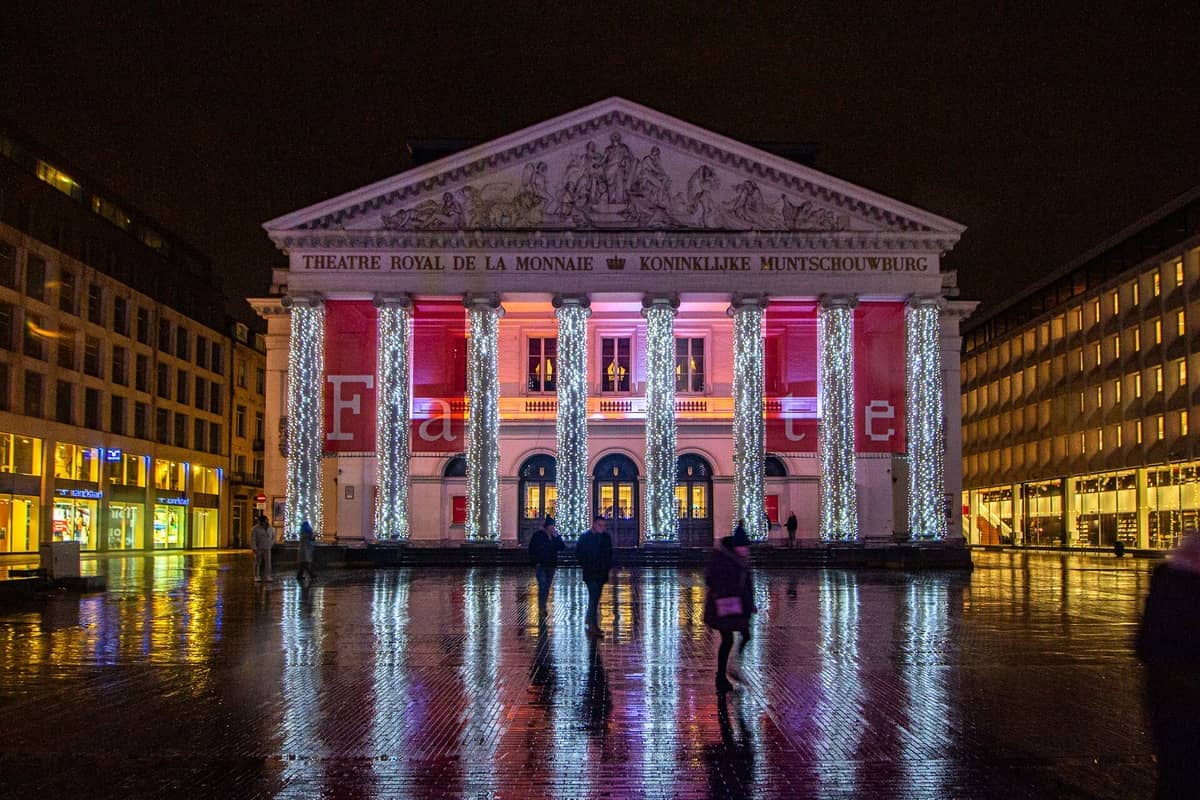
Place de la Monnaie is a pedestrianised square in the commercial heart of the city. Approaching from the direction of the Grand-Place, you pass through shopping streets that can feel relentlessly ordinary, which makes the opera house's facade a genuine architectural interruption. The building faces you squarely: a portico of Ionic columns, a triangular pediment with sculptural relief, and the proportions of a house that was designed to signal civic importance.
On performance evenings, the square changes register noticeably from about 45 minutes before curtain. Audience members gather outside in dress that ranges from formal to casual, which is worth noting: La Monnaie does not enforce a dress code, and you will see everything from evening wear to neat everyday clothes. The no-stress atmosphere around dress is one of the things that makes the house feel less intimidating than its reputation might suggest.
💡 Local tip
The entrance hall (Entrance Hall, accessible from rue des Princes) opens well before curtain. Arriving 30–40 minutes early lets you browse the programme, have a drink at the bar, and take in the interior without rushing. Latecomers are typically held at the doors until a suitable break in the performance.
Tickets, Pricing, and What to Book
Performance tickets for opera use variable pricing, ranging from €12 to €170 depending on production, seat category, and demand. The cheapest seats are genuinely cheap for a national opera house, though at €12 you may be high in the upper tiers with restricted views on some productions. Mid-range seats in the €40–80 bracket generally offer a solid auditorium experience with full sight lines. Wheelchair spaces in the main auditorium are priced at €30.
Under-15s benefit from preferential rates when booked through the MM Tickets service. For wheelchair users, two spaces are reserved at the back of the parterre; the building has a lift connecting ground floor to upper levels, adapted sanitary facilities, and staff who can assist on request. Visitors with reduced mobility can arrange special authorisation to access the theatre entrance by private car or taxi. The theatre encourages contacting MM Tickets in advance to arrange support.
Popular productions and premiere nights sell out weeks or months in advance. Less-heralded mid-season performances often have good availability closer to the date. If you are visiting Brussels without a specific production in mind, checking the season calendar first and building your travel dates around a performance you want to see is a more reliable approach than hoping something good is on the night you happen to be there.
⚠️ What to skip
The box office is closed from approximately early July to mid-August each year (exact dates vary). If you are visiting Brussels in summer, check the season schedule carefully: the house's main programme typically runs September through June.
Getting There: Transit, Walking, and the Surrounding Area
Metro lines 1 and 5 serve De Brouckère station, which is the closest metro stop to Place de la Monnaie. The walk from the metro exit to the theatre takes about two minutes. Brussels-Central railway station is approximately eight minutes on foot, which means passengers arriving from Brussels Airport on the direct SNCB train (journey time roughly 17–20 minutes) can reach the opera house without changing transport. There is no dedicated car access to the square itself, which is pedestrianised.
The theatre sits at the edge of the Îlot Sacré, the historic core neighbourhood surrounding the Grand-Place. After a performance, the area has bars and restaurants open late, and the Grand-Place and Îlot Sacré is entirely walkable. For visitors wanting to combine the evening with dinner beforehand, the streets immediately south of Place de la Monnaie have a concentration of restaurants at various price points.
Guided Tours: Visiting Without a Performance
La Monnaie offers guided tours of the building, which are open to wheelchair users with a 50% discount on the standard tour ticket. Tours allow access to the auditorium and backstage areas depending on the rehearsal schedule. The schedule of available tour dates changes seasonally and is not as predictable as a museum's opening hours; checking the official website before planning a visit specifically around a tour is necessary rather than optional.
The tour experience is the main way to see the interior if attending a performance is not on your agenda. The auditorium by day, empty of audience and stage light, reads quite differently from an evening of opera: the architectural detail is easier to examine, and the scale becomes more apparent. That said, the building reveals itself most fully in performance. A guided tour satisfies architectural curiosity; it does not replicate the experience of an evening.
If you are planning a visit that combines cultural institutions across the city, the BOZAR Centre for Fine Arts is another major venue for classical music and contemporary arts worth pairing with La Monnaie. Both sit within the central Brussels area and can be combined in a cultural itinerary without excessive travel.
Photography, Practical Notes, and Honest Limitations
Photography inside the auditorium during performances is not permitted. The exterior of the theatre in the evening, with its lit portico and the square in front, photographs well and is worth capturing on arrival or departure. The interior during tours may allow photography; confirm with staff on the day.
An honest note for travellers who are not already opera-goers: La Monnaie is not a tick-box tourist attraction in the way that some of Brussels's sights are. You are not buying access to a passive display; you are attending a performance or a tour of a working theatre. If the programme does not interest you, the building's exterior can be appreciated in five minutes from the square. The experience rewards people who are specifically drawn to opera, ballet, or the cultural history of the space.
Brussels has a substantial number of institutions that deserve attention alongside La Monnaie. For a broader sense of what the city's cultural scene covers, the things to do in Brussels overview is a useful starting point, particularly for first-time visitors building an itinerary.
Insider Tips
- Check for 'last-minute' offers on the La Monnaie website in the week before a performance. Unsold tickets at reduced prices sometimes appear for less high-profile productions, giving good value on shorter notice.
- The upper-tier seats (fourth and fifth balconies) at €12–€20 are steep in angle but offer excellent acoustic immersion. If you are more interested in hearing than seeing the staging in full, these are genuinely good seats.
- Arriving early enough to use the bar in the entrance hall is worth it: the interior architecture of the entrance spaces is underappreciated and easy to examine before the crowds settle into their seats.
- Productions with English surtitles are standard, but the surtitle screens are positioned at the sides of the stage. Seats at the extreme ends of the horseshoe tiers can make reading surtitles while watching the stage simultaneously awkward. Centre seats, even at higher tiers, are preferable for non-French and non-Dutch speakers.
- The season runs roughly September through June. If you are visiting Brussels in July or August and specifically want to attend a La Monnaie performance, check the summer schedule on the official site: occasional summer events do occur, but the main season is closed and MM Tickets is typically shut from early July to mid-August.
Who Is La Monnaie / De Munt Opera House For?
- Opera and ballet enthusiasts looking for a serious European house with accessible ticket prices
- Architecture visitors interested in neoclassical civic buildings with a direct link to Belgian national history
- Couples planning a formal cultural evening in central Brussels
- Travellers who want to attend a performance rather than simply photograph a landmark
- Visitors with reduced mobility seeking a well-facilitated cultural venue with lift access and adapted facilities
Nearby Attractions
Other things to see while in Grand-Place & Îlot Sacré:
- Belgian Comic Strip Center
Housed in a Victor Horta-designed Art Nouveau masterpiece, the Belgian Comic Strip Center tells the story of Belgium's extraordinary contribution to comic art. From Tintin to the Smurfs, this is one of Brussels's most rewarding museum experiences for visitors of almost any age.
- Brussels Beer Museum
Tucked into the cellars of a baroque guild house on the Grand-Place, the Belgian Brewers Museum (Musée des Brasseurs belges) tells the story of Belgian brewing through historic equipment, documents, and a glass of beer included with your €5 ticket. Small, unhurried, and genuinely atmospheric, it rewards curiosity about one of Belgium's defining cultural exports.
- Brussels Town Hall (Hôtel de Ville)
The Brussels Town Hall, or Hôtel de Ville de Bruxelles, is the Gothic building that has anchored the UNESCO-listed Grand-Place for centuries. Interior access is by guided tour only, making advance planning essential. The exterior, however, is free to admire at any hour.
- Cathedral of St. Michael and St. Gudula
Rising above a broad flight of stone steps just minutes from Grand-Place, the Cathedral of St. Michael and St. Gudula is the most architecturally significant church in Belgium. Entry to the main nave is free, the stained-glass windows are among the finest in Northern Europe, and the atmosphere shifts dramatically between early morning quiet and afternoon tour-group activity.