Belgian Comic Strip Center: Where Art Nouveau Meets the Ninth Art
Housed in a Victor Horta-designed Art Nouveau masterpiece, the Belgian Comic Strip Center tells the story of Belgium's extraordinary contribution to comic art. From Tintin to the Smurfs, this is one of Brussels's most rewarding museum experiences for visitors of almost any age.
Quick Facts
- Location
- Rue des Sables 20, 1000 Brussels (Grand-Place / Îlot Sacré area)
- Getting There
- Metro De Brouckère (lines 1 & 5, no lift available); Brussels-Central station ~10 min walk
- Time Needed
- 2–3 hours for a thorough visit; 90 minutes if you focus on highlights
- Cost
- Adults approx. €10; seniors 65+ approx. €9; school groups 12–25 approx. €6; children 6–11 approx. €4. Verify current prices before visiting. museumPASSmusées holders enter free.
- Best for
- Comic art fans, architecture enthusiasts, families with older children, rainy-day seekers
- Official website
- www.comicscenter.net
What Is the Belgian Comic Strip Center?
The Belgian Comic Strip Center, known in French as the Centre Belge de la Bande Dessinée (CBBD), is Belgium's national museum dedicated to comic art, or as Belgians call it, the ninth art. Situated at Rue des Sables 20 in central Brussels, it occupies one of the most architecturally significant buildings in the city: a former department store designed by Art Nouveau pioneer Victor Horta in 1906. The pairing of subject matter and setting is not accidental. Belgium is one of the few countries that treats comics as a serious cultural form worthy of institutional preservation, and the choice of a Horta building signals that the museum considers itself part of the city's broader artistic heritage.
The museum covers Belgian comic art across its full sweep, from early 20th-century strips to contemporary graphic novels. Tintin and the Smurfs receive the most prominent treatment, but the collection extends well beyond household names. If you are already exploring the Brussels Comic Strip Route across the city's painted walls, the CBBD provides the institutional context and deeper background that the outdoor murals alone cannot offer.
ℹ️ Good to know
Opening hours: Tuesday–Sunday 10:00–18:00 (last admission 17:00); closed Mondays except during Belgian school holidays. In July and mid-August, the museum opens daily. Closed 25 December and 1 January; reduced hours on 24 and 31 December.
The Building: A Victor Horta Masterpiece You Can Walk Through
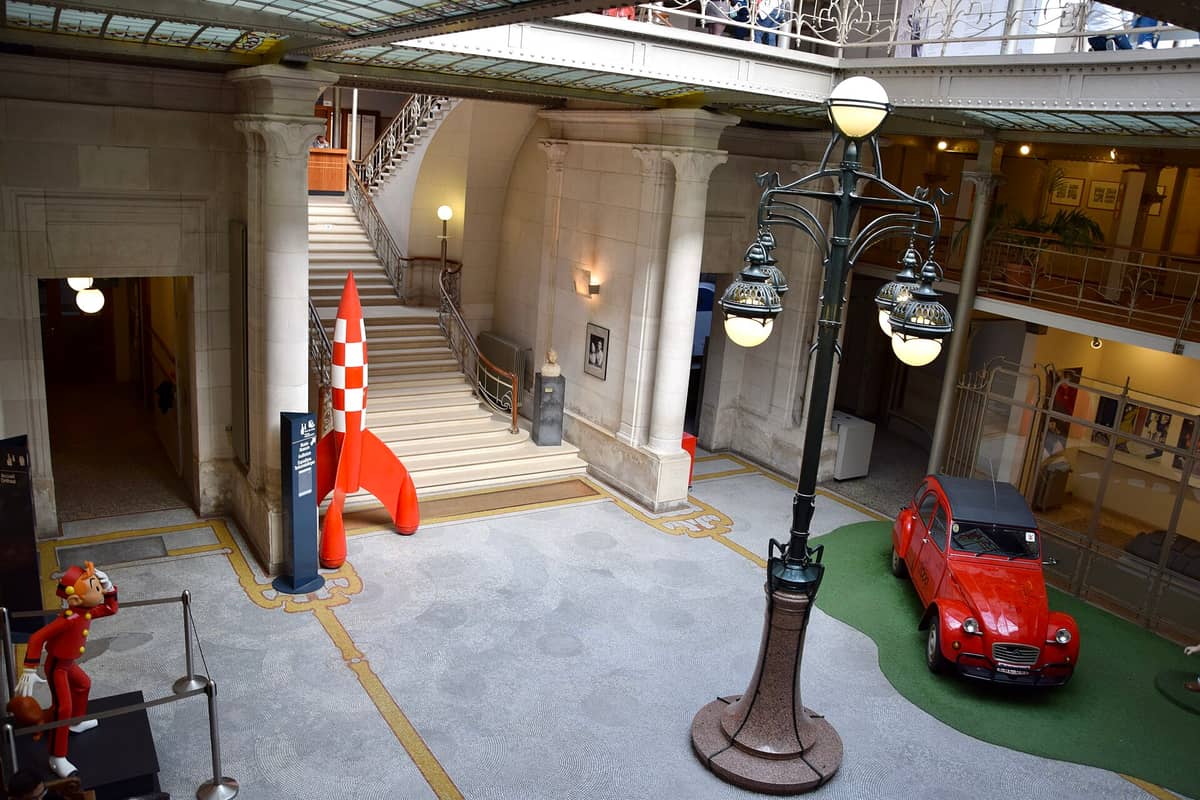
Even visitors with no interest in comics should consider stepping inside for the architecture alone. Victor Horta completed the Waucquez warehouse and department store in 1906, and it remains one of his most intact surviving commercial works in Brussels. Unlike the more intimate residential buildings Horta is famous for, such as his own house in Saint-Gilles, the Waucquez building was designed for public circulation and commerce, which means the grand gestures of Art Nouveau are here scaled up: the soaring glass-and-iron atrium floods the entrance hall with diffuse natural light, the curvilinear ironwork columns branch and curve like stems, and the mosaic floor tiles retain their original pattern.
The ground floor Brasserie Horta, named in the architect's honor, occupies the most spectacular part of the atrium and is open to the public regardless of whether you pay museum admission. Sitting at a table beneath that glass canopy gives you a genuine sense of what the building looked like in commercial use. For a deeper exploration of Horta's residential work, the Horta Museum in Saint-Gilles offers a complementary perspective on the architect's domestic interiors.
Photography inside the entrance hall is generally permitted for personal use. The light inside is soft and even throughout the day thanks to the north-facing glass roof, which means photographs of the ironwork and mosaic floor come out well at almost any hour without harsh shadows. The upper gallery levels, accessed by the original staircase, offer views down into the atrium that are worth pausing for.
Tickets & tours
Hand-picked options from our booking partner. Prices are indicative; availability and final rates are confirmed when you complete your booking.
Pass to Brussels Choco-Story, Belgian Beer World, and bus tour
From 74 €Instant confirmationBelgian Beer World entry and Brussels' landmarks audio guide
From 39 €Instant confirmationBelgian waffle making workshop and beer tasting in Brussels
From 55 €Instant confirmationFree cancellationBelgian Beer World Experience
From 20 €Instant confirmationFree cancellation
The Permanent Collection: More Than Tintin
The museum's permanent galleries begin with a methodical introduction to the mechanics of comic art: how a script becomes a storyboard, how line weights and color choices convey mood, and how the panel grid structures time. This section is more intellectually rigorous than most visitors expect, and it rewards patience. Original sketch pages, inked boards, and preparatory drawings are shown alongside the finished printed versions, making the creative process unusually transparent.
The Tintin galleries are predictably the centerpiece. Original drawings by Hergé, production materials, and contextual panels about the character's evolution from a 1929 newspaper strip to a global franchise are displayed with care. The Smurfs section, covering Pierre Culliford (Peyo) and his characters, is almost equally well developed. But the museum's real depth lies in its coverage of the Brussels school of comic art, the ligne claire tradition, and the generations of Belgian artists who shaped European comics between the 1940s and 1980s. Visitors familiar with names like Edgar P. Jacobs, Willy Vandersteen, or Raymond Macherot will find original material here. For those who aren't, the museum provides enough context to make these figures legible without prior knowledge. The Brussels comic strip guide covers the broader cultural landscape if you want to prepare before visiting.
Temporary exhibitions rotate regularly and tend to be substantive rather than purely promotional. Past exhibitions have addressed comics and politics, the role of women in Belgian comic art, and retrospectives of individual artists. Check the official website before your visit to see what's currently showing, as temporary exhibitions can significantly change the experience and sometimes justify a second visit.
Visiting in Practice: Timing, Crowds, and Navigation
The museum is open Tuesday through Sunday from 10:00 to 18:00, with last admission at 17:00. On Mondays during Belgian school holidays, it also opens. In July and mid-August, it is generally open every day. The building accommodates groups reasonably well, but the atrium and Tintin galleries become noticeably crowded on weekend mornings, particularly when school groups are present. Weekday afternoons, especially Tuesday through Thursday, offer the most comfortable viewing conditions. Arriving at 10:00 on a Tuesday gives you the best chance of moving through the upper galleries at your own pace.
💡 Local tip
Arriving early on a weekday means you often have the Hergé original drawings gallery almost to yourself. The detail in the pencil sketches and inked boards is extraordinary up close, and it is much easier to appreciate without a crowd pressing in from behind.
The museum occupies three main floors connected by the original staircases and a lift that serves all levels. Wheelchair users should use the side entrance via the Brasserie Horta to the right of the main entrance. Adapted restrooms are on the ground floor. A wheelchair is available on-site on request, and visitors presenting a disability card receive a 50% discount on admission to the applicable ticket category. The café and the bookshop, which has one of the best selections of Belgian comics and related publications in the city, are both accessible from the ground floor without requiring full museum admission.
Getting There and the Surrounding Neighborhood
The museum sits within the Îlot Sacré area, the dense historic core immediately north of the Grand-Place. It is about a ten-minute walk from Brussels-Central station, or a short walk from the De Brouckère metro station (lines 1 and 5), which has lift access. The route from De Brouckère along Boulevard Anspach and then east to Rue des Sables is straightforward and passes through the commercial centre of Brussels.
The surrounding streets are worth exploring before or after your visit. The Galeries Royales Saint-Hubert, the 19th-century glass-roofed shopping arcade, is a five-minute walk away and offers a good place for coffee. The neighborhood has plenty of lunch options ranging from quick sandwiches to sit-down Belgian restaurants, though places directly on tourist corridors tend to price accordingly. Walking one or two streets off the main routes usually improves both quality and price.
Honest Assessment: Is It Worth Your Time?
For most visitors, yes. The combination of the Horta architecture and a genuinely well-curated permanent collection makes this more rewarding than the typical theme museum. The explanatory panels are available in French, Dutch, and English throughout the permanent galleries, so language is not a barrier. Two hours is sufficient for a solid visit; three hours lets you read more carefully and spend time in the bookshop.
That said, visitors expecting an interactive, child-oriented experience in the style of a children's science museum may be underwhelmed. The CBBD is a museum in the traditional sense: display cases, original artwork, descriptive text. Children who already have a connection to Tintin or the Smurfs tend to engage well. Very young children without that existing interest may struggle. Adults with no prior exposure to Belgian comics but a general interest in art history and popular culture generally find it more absorbing than they expected. If you are trying to decide between several museums in a single day, the best museums in Brussels guide can help you prioritize based on your interests.
One honest limitation: the museum's focus is almost exclusively on Belgian and Franco-Belgian comics. Japanese manga, American superhero comics, and other traditions appear only in passing. Visitors whose primary interest is in those forms will find the collection narrow. That narrowness is also its strength: as a record of Belgian comic art specifically, it is comprehensive and serious.
Insider Tips
- The Brasserie Horta on the ground floor is open to the public without museum admission. If you are short on time or budget, you can still experience the best of the Horta atrium over a coffee.
- The museum bookshop stocks original albums, art books, and limited editions that are difficult to find elsewhere in Brussels. Allow fifteen minutes to browse even if you didn't plan to buy anything.
- If you hold a museumPASSmusées card (valid for one year, usable across dozens of Belgian museums), entry to the CBBD is included at no extra cost. For frequent museum visitors, the pass pays for itself quickly.
- The glass atrium roof produces the best natural light between about 10:00 and 13:00 on days with any sun. If architectural photography is a priority, morning visits work better than afternoon ones.
- During Belgian school holidays, Monday openings attract more school groups than other weekdays. If your visit falls during a holiday period, Tuesday or Wednesday mornings are quieter.
Who Is Belgian Comic Strip Center For?
- Fans of Tintin, the Smurfs, or Franco-Belgian comic art who want original artwork and production materials
- Architecture enthusiasts interested in Victor Horta's commercial Art Nouveau work
- Families with children aged 8 and older who have some familiarity with Belgian comic characters
- Travelers looking for a substantive indoor activity on a rainy Brussels afternoon
- Cultural visitors interested in how Belgium has institutionalized popular art forms
Nearby Attractions
Other things to see while in Grand-Place & Îlot Sacré:
- Brussels Beer Museum
Tucked into the cellars of a baroque guild house on the Grand-Place, the Belgian Brewers Museum (Musée des Brasseurs belges) tells the story of Belgian brewing through historic equipment, documents, and a glass of beer included with your €5 ticket. Small, unhurried, and genuinely atmospheric, it rewards curiosity about one of Belgium's defining cultural exports.
- Brussels Town Hall (Hôtel de Ville)
The Brussels Town Hall, or Hôtel de Ville de Bruxelles, is the Gothic building that has anchored the UNESCO-listed Grand-Place for centuries. Interior access is by guided tour only, making advance planning essential. The exterior, however, is free to admire at any hour.
- Cathedral of St. Michael and St. Gudula
Rising above a broad flight of stone steps just minutes from Grand-Place, the Cathedral of St. Michael and St. Gudula is the most architecturally significant church in Belgium. Entry to the main nave is free, the stained-glass windows are among the finest in Northern Europe, and the atmosphere shifts dramatically between early morning quiet and afternoon tour-group activity.
- Choco-Story Brussels
Choco-Story Brussels, officially the Musée du Chocolat, walks visitors through 3,000 years of chocolate history from ancient Mesoamerica to Belgian praline. Set a short walk from the Grand-Place, it combines exhibits, live demonstrations, and tastings into a 90-minute experience that works for families and curious adults alike.