Brussels Comic Strip Route: The Complete Guide to the Parcours BD Mural Trail
Brussels' Parcours BD is a free, self-guided trail of more than sixty large-scale comic murals painted on building walls across the city. Created in 1991, it turns the streets themselves into an open-air gallery celebrating Belgium's most distinctive art form. No ticket required, no opening hours to check.
Quick Facts
- Location
- City-wide, Brussels-Capital Region, Belgium. Central murals cluster near Grand-Place and the historic Pentagon district.
- Getting There
- Metro to De Brouckère (lines 1/5) or Gare Centrale/Centraal Station for the core murals. STIB/MIVB bus, tram, and metro cover the wider route.
- Time Needed
- 2–3 hours for a focused central loop; a full day to cover the entire roughly 15 km mapped trail.
- Cost
- Free. Guided tours from the Belgian Comic Strip Center cost approximately €162 per group (up to 25 people; maximum 25 participants per guide). Verify current pricing before booking.
- Best for
- Families, comic art fans, free outdoor sightseeing, photography, and anyone who wants to explore Brussels beyond the usual landmarks.
- Official website
- parcoursbd.brussels
What Is the Comic Strip Route?
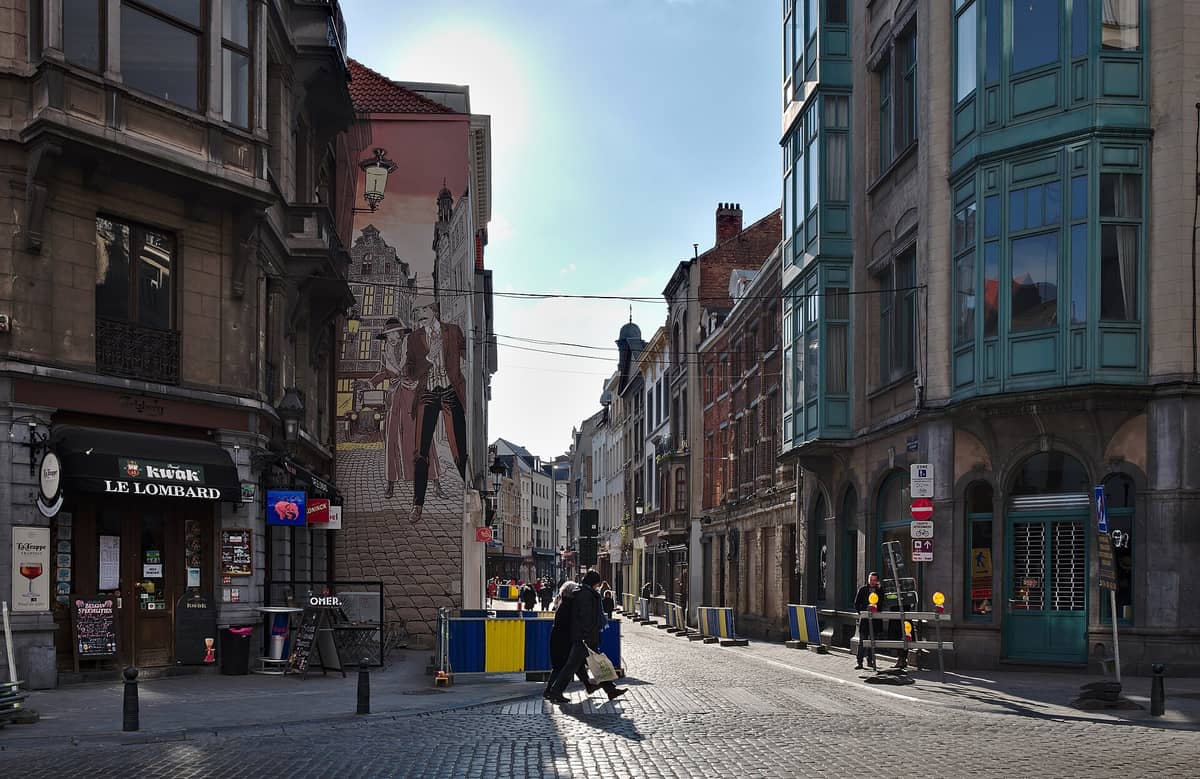
The Comic Strip Route, known officially in French as the Parcours BD, is a network of large-format comic murals painted directly onto the facades of Brussels apartment blocks, warehouses, and commercial buildings. Launched in 1991 as a city-led initiative to celebrate Belgian comic art in public space, the trail has grown to more than sixty murals spread across central Brussels, Laeken, and Haren. It is entirely free, accessible at any hour, and requires no booking.
Belgium has a legitimate claim to being the birthplace of the European comic strip tradition. Hergé created Tintin here in 1929. The Franco-Belgian school of bande dessinée — the album-format comic book — shaped generations of European storytelling, from Lucky Luke to the Smurfs. The murals are not tourist decoration applied after the fact; they are a genuine civic expression of something Belgians take seriously as a cultural form.
The route does not follow a single linear path. The official Parcours BD portal at parcoursbd.brussels lists each mural with its address and the characters depicted. Visit Brussels maps one suggested itinerary of approximately 15 km that takes in murals by public transport as well as on foot. Most visitors do a shorter central loop, walking between murals in the historic Pentagon district.
💡 Local tip
Download the official Parcours BD map or the Visit Brussels comic strip trail PDF before you leave your accommodation. Street signage for the murals is minimal, and the map makes the difference between a coherent walk and a frustrating search.
The Murals Up Close: What You Actually See
The paintings are large. Most cover at least five or six storeys of a building facade, with the image running from close to street level up toward the roofline. Standing beneath one, you tilt your head back and read the scene the same way you would a printed page, except that the lines are meters wide and the color is weather-faded in ways that add rather than subtract from the effect.
The characters range from universally recognized figures to Belgian classics that most non-European visitors will not know. Tintin and Snowy appear on Rue de l'Etuve, a few minutes walk from Manneken Pis. Lucky Luke, the laconic cowboy drawn by Morris, fills a wall in the Marolles. Boule et Bill, Cubitus, Yoko Tsuno, Ric Hochet — the roster rewards visitors who take a moment to read the information plaques beside each mural, which give the character's name, creator, and publication history.
The scale of the paintings means they photograph well at a short distance, which is not always possible with narrower Belgian streets. The best compositions tend to appear when the building opposite is low enough to give you room to step back. Morning light hitting a south- or east-facing wall produces the clearest, most saturated images. By afternoon, several of the central murals fall into shadow as surrounding buildings block the sun.
Tickets & tours
Hand-picked options from our booking partner. Prices are indicative; availability and final rates are confirmed when you complete your booking.
Ghent tour from Brussels
From 43 €Instant confirmationFree cancellationTablet Workshop at Choco-Story Brussels
From 45 €Instant confirmationShared tour of Delft and the Keukenhof Estate from Brussels
From 86 €Instant confirmationFree cancellationOrigins of Brussels exploration game and tour
From 10 €Instant confirmationFree cancellation
How the Experience Changes by Time of Day
Early morning, between roughly 7 and 9 AM, the streets around the murals are quiet enough that you can stand in the middle of the road for a photograph without obstructing traffic. The central neighborhoods are residential as much as commercial, and at that hour you share the pavements with people heading to work rather than other tourists. The light is soft and directional, and the lack of crowds makes it possible to look at each mural without interruption.
Midday brings school groups, guided tour parties, and individual visitors navigating phones in hand. The murals closest to Grand-Place, particularly the Tintin wall, draw the most foot traffic. If you want to photograph without strangers walking into the frame, wait for a pause in pedestrian flow or arrive before 9 AM.
In the evening, the murals in residential streets take on a different quality. Streetlights pick out faces and outlines that disappear in flat daylight. Several of the walls in the Marolles and near Place du Jeu de Balle catch the warm light from nearby cafés and bar windows. The trail is technically walkable after dark, though unfamiliarity with the street layout makes it less practical unless you know the area.
ℹ️ Good to know
Brussels has a temperate maritime climate with rain possible year-round. Spring and early autumn are among the least rainy periods and offer mild temperatures ideal for extended street walking. In winter, temperatures drop to around 1–5°C; the murals are still there, but a two-hour walk in January requires proper layers.
Planning Your Route: Central Loop vs. Full Trail
Most visitors with two to three hours focus on the central cluster of murals between Grand-Place, the Marolles, and the area around the Bourse. These are the most densely packed and the easiest to link on foot. Metro stations De Brouckère or Gare Centrale/Centraal Station are practical starting points. From either, you can walk a compact loop and see a dozen or more murals without using public transport.
The full 15 km trail mapped by Visit Brussels extends beyond the centre into outer neighborhoods and requires using the STIB/MIVB metro, tram, and bus network to connect sections efficiently. For context on navigating Brussels by public transport, the getting around Brussels guide covers the key lines and ticketing options in detail.
The Parcours BD also pairs naturally with a visit to the Belgian Comic Strip Center, located on Rue des Sables in a converted Art Nouveau warehouse designed by Victor Horta. The museum gives context to the characters and artists you encounter on the street, and its permanent collection covers the full arc of Belgian comic history from 1900 to the present. Admission is charged separately.
Photography, Accessibility, and What to Bring
A standard smartphone camera handles the murals well in good light. The challenge is distance: the paintings are tall, and in narrow streets you may not be able to fit the entire image in the frame without a wide-angle lens or a phone with an ultra-wide setting. A polarizing filter, if you shoot with a mirrorless or DSLR camera, helps reduce glare on sunny mornings.
Comfortable shoes matter more than most other gear choices. The central cobblestone streets are uneven, and the wider trail involves several kilometers of pavement. Some sections in the historic centre use rounded Belgian cobblestones that are harder on ankles than flat stone. Wheelchair access is variable: most of the central murals are on standard city pavements, but the Marolles and some outer districts include steep gradients and rougher surfaces. Anyone with significant mobility limitations should plan their route carefully using the address list on the official site.
There are no facilities at the murals themselves. Water, toilets, and food are available in the surrounding streets, which in the central areas means they are never far away. The route passes close to several covered markets and cafés, and the Galeries Royales Saint-Hubert is nearby for a weather break.
Cultural Context: Why Brussels Has This Trail
Belgium produces more comic albums per capita than any other country in the world. The Franco-Belgian tradition of the bande dessinée is considered a legitimate art form here, studied in schools and exhibited in galleries alongside painting and sculpture. The decision in 1991 to take that tradition into the streets was not a quirky tourism gimmick; it was a response to what the city already was. Brussels is the capital of Belgium and the de facto capital of the European Union, a city with a complicated relationship between its French-speaking majority and Dutch-speaking minority, where comic art has long served as shared cultural ground. For more background on how comics became woven into Brussels' identity, the Brussels comic strip guide covers the full history.
Each mural is commissioned through a formal process involving the city, the rights holders of the characters, and the building owners. The painters who execute the works are professional muralists, and the level of technical detail in the line work is visible up close — the shading on Tintin's tuft of hair, the precise reproduction of Morris's ligne claire brushwork on Lucky Luke's jawline. These are not approximations. They are faithful transpositions of printed images onto architectural surfaces at a scale that required significant technical problem-solving.
The trail also reflects the layered character of Brussels as a walking city. Many of the murals are on side streets and residential passages that most visitors would otherwise bypass entirely. Finding them means walking into neighborhoods with their own rhythms — the second-hand market culture of the Marolles, the narrow lanes off the Rue Haute — and the murals become a reason to look up, slow down, and notice the city at street level.
Honest Assessment: What Works and What Doesn't
The Comic Strip Route is one of the more genuinely satisfying free activities in Brussels. It is not, however, a polished attraction with signage, facilities, or a clear start and finish. Visitors who expect a theme park-style experience with numbered stops and audio guides will be disappointed. The murals require some navigation effort, and several are in streets with nothing else to see.
Some murals have deteriorated over time. A few depict characters that will be unfamiliar to anyone outside the Franco-Belgian comic tradition, which reduces the emotional impact of finding them. The full 15 km trail is ambitious for a single day, particularly in combination with other Brussels sightseeing, and trying to rush it produces a mechanical checklist feeling rather than genuine discovery.
Visitors who are not interested in comic art at all, or who have very limited walking capacity, will likely find better use of their time elsewhere. The trail is genuinely rewarding for people who approach it with curiosity rather than completionism.
⚠️ What to skip
Several murals are located on streets with light vehicle traffic. The temptation to step into the road for a better photograph is understandable but requires care, particularly in the narrower lanes of the historic centre where sight lines are short.
Insider Tips
- The official Parcours BD website at parcoursbd.brussels lists every mural with its precise street address and a small image of the character depicted. Cross-referencing this with Google Maps before you set out saves significant time compared to relying on tourist maps, which sometimes omit recently added murals.
- Several murals are positioned on streets that also have good independent coffee shops and bakeries within a few meters. Rue Haute and the surrounding Marolles area in particular reward arriving around 9 AM when both the light and the morning café culture are at their best.
- If you are visiting with children, prioritize the Tintin mural near Rue de l'Etuve and the Smurfs mural first. They are immediately recognizable and create genuine excitement that carries energy into the rest of the walk. Starting with obscure Belgian characters can deflate enthusiasm early.
- Guided tours from the Belgian Comic Strip Center offer expert commentary but are priced for groups rather than individuals. If you are traveling solo or as a couple, the self-guided option with a downloaded map is more cost-effective and more flexible in pace.
- The murals are painted on privately owned buildings, and renovation or demolition occasionally removes one. Check the official site for the current list before planning a long detour to see a specific painting.
Who Is Comic Strip Route (Mural Trail) For?
- Families with children who recognize Tintin, the Smurfs, or Lucky Luke
- Photography enthusiasts looking for large-scale graphic subjects in natural urban settings
- Budget travelers wanting a full half-day of meaningful sightseeing at zero cost
- Comic art enthusiasts and bande dessinée readers who want to see the tradition in its home city
- Visitors who want to explore Brussels neighborhoods beyond the Grand-Place tourist core
Nearby Attractions
Combine your visit with:
- AfricaMuseum Tervuren
Set in a grand neoclassical palace 14 km east of Brussels, the AfricaMuseum is one of Europe's largest museums dedicated to Central Africa. Reopened in 2018 after a five-year renovation, it now confronts its own colonial past head-on while housing world-class natural history, ethnographic, and art collections.
- Basilica of the Sacred Heart (Koekelberg)
The National Basilica of the Sacred Heart in Koekelberg is one of the largest Art Deco religious buildings in the world, its green copper dome rising 89 metres above Brussels. Entry to the basilica is free; a paid climb to the dome platform delivers one of the city's most underrated panoramas.
- Cantillon Brewery (Brasserie Cantillon)
Cantillon Brewery (Brasserie Cantillon) is one of the few remaining traditional lambic breweries in Brussels, doubling as the Brussels Museum of the Gueuze since 1978. Located a short walk from Gare du Midi in Anderlecht, it is a working industrial site and a serious destination for anyone wanting to understand why Belgian beer culture earned UNESCO recognition.
- Erasmus House (Maison d'Érasme)
Built between 1460 and 1515, the Maison d'Érasme in Anderlecht is among the oldest surviving houses in Brussels and one of the few places in the world where you can stand in rooms Erasmus himself occupied. The museum pairs period furnishings with original prints, manuscripts, and artworks in a late-Gothic setting that rewards slow, attentive visitors.