Cantillon Brewery: Brussels's Living Cathedral of Lambic Beer
Cantillon Brewery (Brasserie Cantillon) is one of the few remaining traditional lambic breweries in Brussels, doubling as the Brussels Museum of the Gueuze since 1978. Located a short walk from Gare du Midi in Anderlecht, it is a working industrial site and a serious destination for anyone wanting to understand why Belgian beer culture earned UNESCO recognition.
Quick Facts
- Location
- Rue Gheude 56, 1070 Anderlecht, Brussels, Belgium
- Getting There
- Gare du Midi (Brussels-South) – approx. 5 min walk; also served by STIB tram and bus lines
- Time Needed
- 1.5 to 2 hours for a self-guided visit; longer if you linger in the tasting room
- Cost
- Around €7 per person including a glass of beer
- Best for
- Beer enthusiasts, food culture travellers, history and industrial heritage fans
- Official website
- http://www.cantillon.be/?lang=en
What Cantillon Actually Is
Cantillon Brewery (officially Brasserie Cantillon, also known as the Brussels Museum of the Gueuze) is not a heritage recreation or a themed tasting room. It is an active, family-run brewery that has been producing lambic, gueuze, and kriek in Anderlecht since 1900. The museum designation came in 1978, but the label understates what you are actually walking into: a fully operational industrial building where fermentation tanks still bubble, oak barrels line the walls three-deep, and the smell of wild yeast and aged wood is the dominant sensory experience from the moment you push through the front door.
Lambic is one of the world's few remaining spontaneously fermented beers. Rather than adding cultivated yeast, Cantillon leaves freshly brewed wort exposed overnight in a shallow copper vessel called a coolship (koelschip) installed in the attic, allowing wild Brettanomyces yeast and other naturally occurring microorganisms from the Brussels air to inoculate the liquid. The resulting beer is then aged in wooden barrels for one to three years before blending into gueuze, the traditional Brussels style. This process is genuinely ancient and genuinely fragile: Cantillon only brews between October and April, when outdoor temperatures are cool enough to control spontaneous fermentation.
ℹ️ Good to know
Cantillon brews during the cooler months (roughly October to April). If you visit in summer, the brewery is still open as a museum and shop, but you will not see active production. Winter and early spring visits offer the most complete experience.
The Visit, Floor by Floor
Entry is self-guided. You collect a laminated information sheet at the desk and move through the brewery at your own pace, which suits the space well. There is no rope-and-stanchion barrier between you and the equipment; you walk among active barrels, past the mash tun, and up narrow wooden stairs toward the coolship attic. The building is a late 19th-century Brussels industrial structure, brick-walled and entirely unrestored in the cosmetic sense, which is precisely what gives it authority.
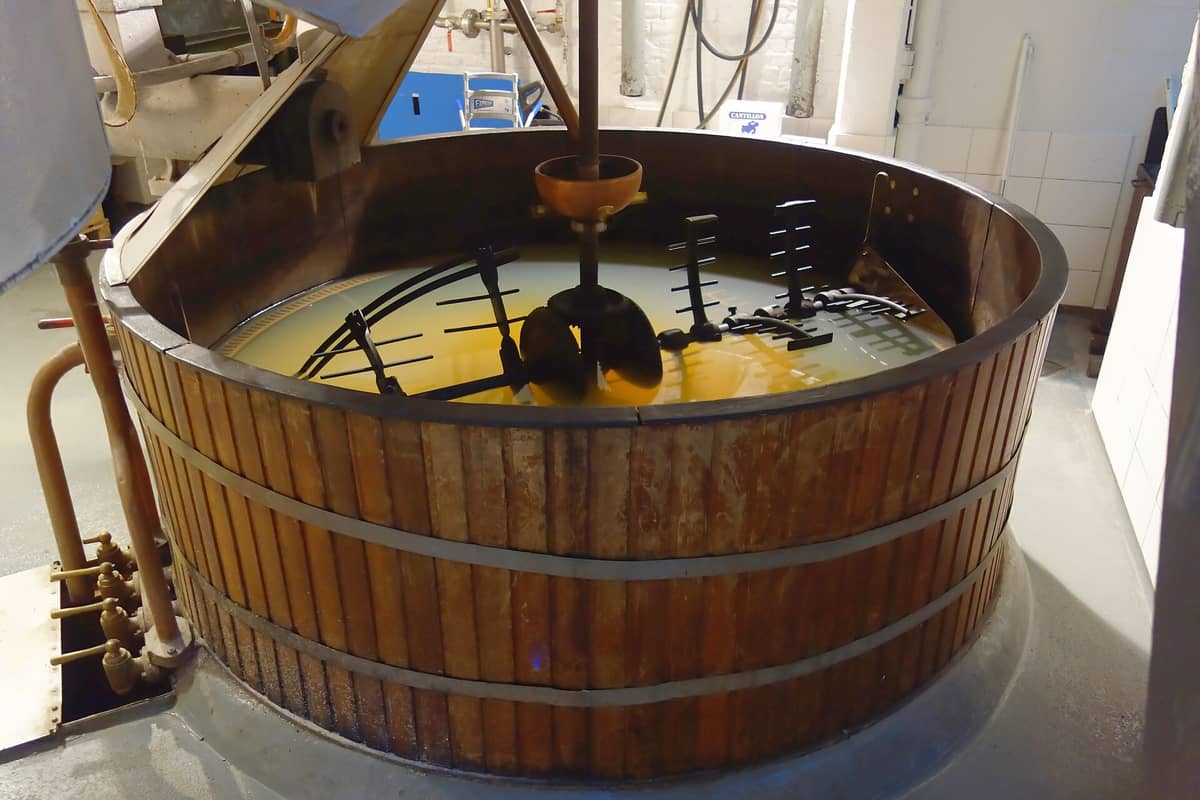
The ground floor takes you through the brewing hall, where the copper kettle and mash tun occupy the main room. In the brewing season, the heat and the sour-sweet smell of cooking malt are unmistakable. The barrel room beyond holds hundreds of oak casks in various stages of ageing, some still showing the stencils of their previous contents (whisky, port, wine). The combination of low light, irregular stone floors, and the faint sound of slow fermentation makes this the atmospheric centre of the visit.
The attic coolship is reached by steep wooden stairs and is not accessible to wheelchair users. The room itself is unexpectedly large: a wide, shallow copper pan occupying most of the floor space, with louvred windows on two sides that open to allow cold Brussels air in overnight. On a bright morning in January or February, the slanted light through those windows and the scale of the vessel make for one of the more striking sights in Belgian brewing. In summer the room is still worth seeing, even empty.
The cellar, also reached by stairs, stores bottles in various stages of secondary fermentation. It is quieter than the barrel room and smaller, but it completes the picture of how gueuze is assembled: barrel-aged lambics of different ages blended and re-fermented in the bottle, then laid down for further conditioning. Labels on the racks identify vintages and batches. The whole circuit takes roughly 45 to 60 minutes of walking, leaving time for the tasting room at the end.
Tickets & tours
Hand-picked options from our booking partner. Prices are indicative; availability and final rates are confirmed when you complete your booking.
Discover the history and mystery of Bruges
From 0 €Instant confirmationDiscover the history and mystery of Bruges
From 0 €Instant confirmationDiscover the history and mystery of Bruges
From 0 €Instant confirmationGhent tour from Brussels
From 43 €Instant confirmationFree cancellation
Tasting Room and Shop
Admission includes one glass of beer, served at the counter near the entrance. The choice typically covers Cantillon's core range: the house gueuze (sharp, carbonated, bone-dry, with a distinct Brett funk), kriek (made with whole cherries from Saint-Gilles, sour and assertive), and occasionally a rosé de gambrinus or lou pepe fruit variant. The tasting room is a plain, functional space with wooden benches and tables. It gets crowded on Saturday mornings, when a mix of local regulars, visiting beer enthusiasts, and tourists share the same small room.
The shop sells bottles to take away, including some limited releases not available elsewhere. Prices reflect both the labour-intensive production process and the international reputation Cantillon has developed over the past two decades. Certain bottles sell out quickly; there is no allocation system for casual visitors, so availability depends on timing. If you want specific bottles, arrive when the shop opens.
💡 Local tip
Thursday and Friday mornings are noticeably quieter than Saturday. If you want space to move through the brewery without crowds and time to ask questions at the counter, a weekday visit is significantly more comfortable.
Historical and Cultural Context
Lambic brewing was once common across the Senne river valley and the broader Brussels region. By the late 20th century, consolidation and changing consumer tastes had reduced the number of active lambic producers to a handful. Cantillon survived partly because of its transition to a public museum in 1978 and partly because of the family's refusal to industrialise the process, a decision that looked eccentric for decades and then, as craft beer culture emerged globally, began to look prescient.
Today Cantillon occupies an unusual position: it is simultaneously a working family business, a registered museum, and one of the most internationally sought-after beer producers in the world. American, Japanese, and Scandinavian beer enthusiasts treat a visit as a pilgrimage. The local Brussels audience has always been there, but the international profile grew substantially after craft beer publications began ranking Cantillon's gueuze among the world's finest fermented beverages. The brewery has not expanded capacity in response to demand, which keeps scarcity real and queues manageable.
For broader context on Belgium's beer culture, the Belgian beer guide for Brussels covers the wider landscape of styles, breweries, and tasting venues across the capital.
Getting There and When to Visit
The brewery is at Rue Gheude 56 in Anderlecht, approximately five minutes on foot from Gare du Midi (Brussels-South station). From the station, walk north along Rue de France and turn left onto Rue Gheude; the brewery's unadorned facade and modest signage are easy to miss if you are not looking for them. STIB tram and bus lines also serve the area; check the STIB/MIVB journey planner for current connections from your starting point.
Opening hours are Monday, Tuesday, Thursday, Friday, and Saturday from 10:00 to 17:00 (last call at 16:00). The brewery is closed on Wednesdays, Sundays, and public holidays. These hours should be confirmed on the official site before travel, as they can change around seasonal brewing events.
⚠️ What to skip
Cantillon is closed on Wednesdays and Sundays. Many visitors arrive on a Sunday expecting it to be open and find a locked door. Double-check the day of your visit.
If you are planning a broader beer-focused itinerary in Brussels, the Belgian Beer World at the Brussels Stock Exchange is another option, covering the full landscape of Belgian brewing styles in a more polished, interactive format.
Accessibility and Practical Considerations
Accessibility at Cantillon is limited by the historic nature of the building. The ground floor, including the brewing hall, barrel room, and the reception and tasting area, is largely reachable for wheelchair users, though there are uneven floors, thresholds, and some tight passages. The coolship attic and the cellar are only accessible by stairs and cannot be reached by visitors with mobility restrictions. Toilet facilities are small and only partially adapted. Visitors with reduced mobility should be aware that a meaningful portion of the building is unavailable to them, though the core brewing equipment on the ground floor is still visible.
Photography is generally permitted throughout the self-guided route. The barrel room offers the best low-light photography if you visit mid-morning when the side windows provide some natural light. The coolship attic, when lit from the louvred windows in winter, is the most visually distinctive space in the building. A wide-angle lens or phone in portrait mode works well in the narrow barrel corridors.
Who Should Skip This
Cantillon is not for everyone, and knowing that in advance saves a wasted trip. If you are not genuinely interested in beer, fermentation, or industrial heritage, the self-guided format can feel thin: the laminated sheets are informative but the experience requires some curiosity to sustain itself over 90 minutes. The beers themselves are intensely sour and funky, with no sweetness to soften the lactic acid bite. If your experience of Belgian beer begins and ends with Leffe or Duvel, the tasting here may be a jarring introduction. The space is also entirely without theatrical production values: no dramatic lighting, no audio tour, no gift shop tchotchkes. It is a brewery, and it smells and feels like one.
Visitors more interested in mainstream Belgian beer culture might find the Brussels Beer Museum near Grand-Place a more accessible starting point, with a broader overview of Belgian beer styles before committing to the more specialist experience at Cantillon.
For a full picture of what Brussels offers beyond beer, the things to do in Brussels guide covers the city's major attractions across food, architecture, and culture.
Insider Tips
- Thursday morning visits (from opening at 10:00) are among the quietest times of the week. You can move through the barrel room and coolship at your own pace without other visitors crowding the narrow corridors.
- If you want to buy specific or limited-release bottles, arrive as close to opening time as possible. There is no advance reservation system for bottle purchases, and popular releases sell out during the day.
- The brewery only brews between October and April. Plan a winter or early spring visit if you want to see the coolship in use or smell the wort cooking in the brewing hall; these are the experiences that make the building come alive.
- The included beer at admission is a serious pour, not a sample-size taste. Drink it slowly before moving back through the brewery if you want to fully appreciate the dry, brett-forward complexity without rushing.
- Gare du Midi is a major international rail hub served by Eurostar and TGV trains. If you are arriving in Brussels by international train, Cantillon is close enough to visit on the same journey before checking into your accommodation.
Who Is Cantillon Brewery (Brasserie Cantillon) For?
- Craft beer enthusiasts and anyone specifically interested in spontaneous fermentation and lambic styles
- Food and drink culture travellers who want to understand Belgian brewing beyond the mainstream
- Industrial heritage and architectural history visitors interested in authentic, unrenovated 19th-century production buildings
- Photographers looking for low-light, textured, atmospheric interiors with real working character
- Travellers arriving via Gare du Midi looking for a nearby, substantive half-day experience before settling into the city
Nearby Attractions
Combine your visit with:
- AfricaMuseum Tervuren
Set in a grand neoclassical palace 14 km east of Brussels, the AfricaMuseum is one of Europe's largest museums dedicated to Central Africa. Reopened in 2018 after a five-year renovation, it now confronts its own colonial past head-on while housing world-class natural history, ethnographic, and art collections.
- Basilica of the Sacred Heart (Koekelberg)
The National Basilica of the Sacred Heart in Koekelberg is one of the largest Art Deco religious buildings in the world, its green copper dome rising 89 metres above Brussels. Entry to the basilica is free; a paid climb to the dome platform delivers one of the city's most underrated panoramas.
- Comic Strip Route (Mural Trail)
Brussels' Parcours BD is a free, self-guided trail of more than sixty large-scale comic murals painted on building walls across the city. Created in 1991, it turns the streets themselves into an open-air gallery celebrating Belgium's most distinctive art form. No ticket required, no opening hours to check.
- Erasmus House (Maison d'Érasme)
Built between 1460 and 1515, the Maison d'Érasme in Anderlecht is among the oldest surviving houses in Brussels and one of the few places in the world where you can stand in rooms Erasmus himself occupied. The museum pairs period furnishings with original prints, manuscripts, and artworks in a late-Gothic setting that rewards slow, attentive visitors.