Basilica of the Sacred Heart (Koekelberg): Brussels' Art Deco Basilica in the Sky
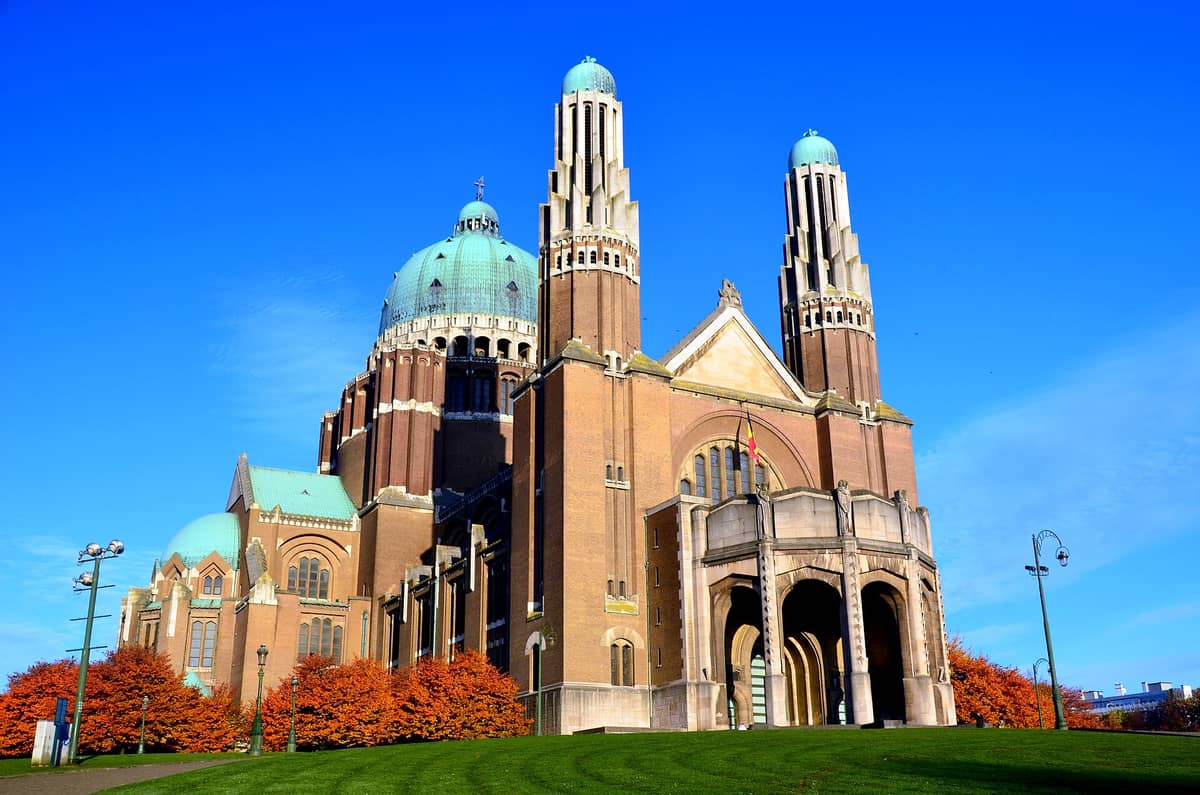
The National Basilica of the Sacred Heart in Koekelberg is one of the largest Art Deco religious buildings in the world, its green copper dome rising 89 metres above Brussels. Entry to the basilica is free; a paid climb to the dome platform delivers one of the city's most underrated panoramas.
Quick Facts
- Location
- Parvis de la Basilique 1, 1083 Brussels (Koekelberg)
- Getting There
- Metro line 2 or 6 to Simonis, then a short walk through Parc Elisabeth; or line 2 to Ribaucourt for tram/bus connections.
- Time Needed
- 45 min for the basilica interior; 1.5–2 hrs if you climb to the dome
- Cost
- Basilica: free. Dome panorama: €8 adults, €6 groups (6+), free under 6. Brussels Card: 40% off dome.
- Best for
- Architecture lovers, photographers chasing city views, travellers who want a grand sight without the crowds
- Official website
- www.basilicakoekelberg.be/?lang=en
What the Basilica of the Sacred Heart Actually Is
The National Basilica of the Sacred Heart — known locally as the Basilique de Koekelberg — is not just a large church. It ranks among the five largest churches in the world by volume, and it is almost certainly the largest Art Deco religious building on earth. That is not marketing language: the nave stretches roughly 141 metres long and 107 metres wide, proportions that only become fully legible once you are standing inside and the scale starts to compress your sense of distance.
The building was conceived in 1905 as a national monument to mark 75 years of Belgian independence, initiated under King Leopold II. Construction was interrupted by two world wars and stretched across 64 years, with the large dome finished in 1969 and the basilica inaugurated in 1970. That unusually long timeline explains why the interior feels architecturally coherent despite the decades: the decision to commit to Art Deco gave the project a singular aesthetic identity, executed primarily in brick and terracotta rather than the Gothic stone most visitors might expect from a Belgian church.
ℹ️ Good to know
The basilica is a functioning Catholic church, not a museum. Masses are held regularly, and entry to the main nave is free year-round. Dress modestly and keep noise to a minimum, especially near the side chapels.
First Impressions: Approaching from Parc Elisabeth
Most visitors arrive on foot through Parc Elisabeth, the sloping green space that separates the basilica from the Simonis metro station. The approach is deliberate. As you climb the gentle incline, the copper dome rises incrementally above the tree line, and by the time you reach the broad forecourt — the Parvis de la Basilique — the full facade presents itself in one unobstructed moment. It is a better reveal than a sudden street-level confrontation would allow.
The forecourt itself is wide and rarely crowded, even on summer weekends. Pigeons, the occasional school group, and a scattering of visitors with cameras are usually the only company. Compared to the permanent crowds at the Grand-Place or the Atomium, the Koekelberg basilica operates at a noticeably quieter register, which is part of what makes the experience worthwhile for travellers who have already done Brussels' main tourist circuit.
If you're building a day around this part of the city, the basilica pairs naturally with the Atomium, located about 3 kilometres north, and the Mini-Europe complex nearby. Both can be reached by tram from Simonis.
Tickets & tours
Hand-picked options from our booking partner. Prices are indicative; availability and final rates are confirmed when you complete your booking.
Ghent tour from Brussels
From 43 €Instant confirmationFree cancellationTablet Workshop at Choco-Story Brussels
From 45 €Instant confirmationShared tour of Delft and the Keukenhof Estate from Brussels
From 86 €Instant confirmationFree cancellationOrigins of Brussels exploration game and tour
From 10 €Instant confirmationFree cancellation
Inside: Light, Scale, and Art Deco Detail
The interior rewards slow attention. The nave is vast enough to muffle ambient sound into a low, diffuse hum, and the light shifts substantially depending on the time of day. Morning visits, roughly between 9:00 and 11:00, produce the most dramatic effect: light enters through the upper clerestory windows and catches the warm terracotta tones of the brick walls, giving the space an amber quality that photographs extremely well. By mid-afternoon on overcast days, the interior reads much darker and heavier.
The stained glass is more restrained than in a Gothic cathedral — the Art Deco approach favours geometric clarity over narrative iconography — but individual chapel windows reward close inspection. The floor plan incorporates a series of side chapels along both aisles, each with a distinct character, some richly decorated and others almost spare. The crypt below the main nave houses additional chapels and is worth a brief visit if you have time.
One practical note: the acoustic properties of the space mean that if a service or rehearsal is underway, the sound carries through the entire building. Check the official schedule before visiting if you want guaranteed quiet time for photography or contemplation.
The Dome Climb: Brussels from 89 Metres
The dome panorama platform is the primary reason many visitors make the trip out to Koekelberg, and it delivers a view of Brussels that most guidebooks underplay. At 89 metres, the copper-clad dome sits above the roofline of virtually everything in the surrounding residential districts, and the panorama sweeps across the entire Brussels-Capital Region in clear conditions.
Access to the platform costs €8 for adults (€6 per person for groups of 6 or more; free for children under 6). Brussels Card holders receive a 40% discount. The climb itself involves a combination of stairs and, for part of the ascent, a lift — though accessibility to the full platform is limited for visitors with mobility constraints. The basilica's contact details for accessibility enquiries are: info@basilicakoekelberg.be or +32 2 421 16 60.
💡 Local tip
The dome platform is exposed to wind and changes in temperature. Even in summer, bring a layer. The platform is open from 09:00 to 17:30 in summer and 10:00 to 16:30 in winter — arrive at least 30 minutes before closing to allow sufficient time at the top.
From the top, you can identify landmarks including the Atomium to the north, the Palais de Justice to the southeast, and on clear days the flat Belgian landscape extending well beyond the city periphery. The view east, toward the city centre, is the sharpest: the density of Brussels' residential fabric becomes visible in a way that is impossible to appreciate from street level. Unlike the Atomium's viewing sphere, which frames the northern suburbs in isolation, the basilica dome gives a genuinely 360-degree reading of the city.
For a full comparison of Brussels' elevated viewpoints, see the guide to the best views in Brussels.
When to Visit and How the Experience Changes
The basilica is open from 08:00 to 18:00 in summer and 08:00 to 17:00 in winter (for the church itself; panorama hours differ). The earliest hour, just after opening, is the quietest: light is low and directional, and the building feels genuinely contemplative. By 10:30 on weekday mornings, occasional tour groups arrive but rarely overwhelm the space. Weekend afternoons in July and August bring the most visitors, though even then 'crowded' means a few dozen people scattered across a building that can comfortably absorb hundreds.
Weather affects the dome visit more than the interior. Overcast Brussels days — common from October through March — reduce the dome platform's range of visibility significantly. If the panorama is your main objective, check the forecast and aim for a morning in late spring or early autumn, when light is clear and temperatures are manageable. In winter the shorter dome hours (closing at 16:30) mean you need to plan the afternoon carefully.
The exterior is worth seeing at dusk when the dome catches the last light and the forecourt empties out. The building is not illuminated at night in the way that the Grand-Place or the Atomium are, so there is limited reason to make a dedicated evening trip.
Getting There
The most straightforward route is Brussels Metro line 6 to Simonis (served by metro lines 2 and 6 at the same interchange). From Simonis, the walk through Parc Elisabeth to the basilica takes approximately 10 minutes on a gentle uphill path. The park itself is pleasant and provides the best approach to the building.
Alternatively, Metro line 6 stops at Ribaucourt, from which tram and bus connections serve the Koekelberg area. For visitors combining the basilica with Laeken or the Atomium, tram connections run from the Simonis area northward. Driving is possible and parking exists near the forecourt, but public transport is straightforward enough that a car is unnecessary.
For general navigation around the city, including how to use the STIB/MIVB metro, tram, and bus network, the getting around Brussels guide covers the essentials.
Honest Assessment: Who Will Love This, Who Might Not
The Basilica of the Sacred Heart is not a conventional tourist highlight in the way that the Grand-Place or the Royal Museums of Fine Arts are. It requires a deliberate journey to a residential part of the city, and the interior, while impressive in scale, lacks the jewel-box decorative richness of Brussels' older Gothic churches. Visitors who come specifically for intricate medieval stonework or elaborate altarpieces will find Koekelberg comparatively austere.
What it does offer is scale, architectural coherence, and a panorama that most visitors to Brussels never see. For anyone with a genuine interest in 20th-century architecture, the combination of Art Deco ambition and the sheer engineering achievement of the dome makes this one of the more rewarding buildings in the city. Architecture students, photographers, and travellers who have already covered Brussels' central landmarks will find it particularly worthwhile.
Travellers planning a broader cultural itinerary might also consider pairing a visit here with the Horta Museum in Saint-Gilles, which covers Brussels' other defining architectural movement — Art Nouveau — within a single afternoon.
Insider Tips
- The Brussels Card discount (40% off the dome) is rarely advertised at the entrance — ask for it specifically when purchasing your dome ticket rather than waiting to be offered it.
- The crypt level beneath the main nave is often overlooked by visitors who walk only through the ground floor. It contains additional chapels and architectural details and is typically empty even when the main nave has visitors.
- Morning light between 9:00 and 10:30 enters the clerestory windows from the east and creates warm directional illumination across the terracotta brick — this is the best window for interior photography with natural light.
- If the dome platform is your priority, confirm the current opening schedule with the basilica directly (info@basilicakoekelberg.be), as seasonal hours and occasional closures for maintenance or events are not always updated promptly on third-party travel sites.
- The walk through Parc Elisabeth to the basilica is notably more pleasant than approaching along the main road. Exit Simonis metro station and take the park path rather than following GPS routing that may take you along Avenue de Jette.
Who Is Basilica of the Sacred Heart (Koekelberg) For?
- Architecture enthusiasts drawn to 20th-century design and Art Deco on a monumental scale
- Photographers seeking city panoramas that are less photographed than the Atomium or Mont des Arts viewpoints
- Travellers who have covered Brussels' central highlights and want to explore the city's outer municipalities
- Visitors looking for a significant free cultural experience — the nave and exterior cost nothing to see
- Those travelling with the Brussels Card who want to maximise its value on discounted dome entry
Nearby Attractions
Combine your visit with:
- AfricaMuseum Tervuren
Set in a grand neoclassical palace 14 km east of Brussels, the AfricaMuseum is one of Europe's largest museums dedicated to Central Africa. Reopened in 2018 after a five-year renovation, it now confronts its own colonial past head-on while housing world-class natural history, ethnographic, and art collections.
- Cantillon Brewery (Brasserie Cantillon)
Cantillon Brewery (Brasserie Cantillon) is one of the few remaining traditional lambic breweries in Brussels, doubling as the Brussels Museum of the Gueuze since 1978. Located a short walk from Gare du Midi in Anderlecht, it is a working industrial site and a serious destination for anyone wanting to understand why Belgian beer culture earned UNESCO recognition.
- Comic Strip Route (Mural Trail)
Brussels' Parcours BD is a free, self-guided trail of more than sixty large-scale comic murals painted on building walls across the city. Created in 1991, it turns the streets themselves into an open-air gallery celebrating Belgium's most distinctive art form. No ticket required, no opening hours to check.
- Erasmus House (Maison d'Érasme)
Built between 1460 and 1515, the Maison d'Érasme in Anderlecht is among the oldest surviving houses in Brussels and one of the few places in the world where you can stand in rooms Erasmus himself occupied. The museum pairs period furnishings with original prints, manuscripts, and artworks in a late-Gothic setting that rewards slow, attentive visitors.