Erasmus House (Maison d'Érasme): A Surprisingly Intimate Window into the Renaissance Mind
Built between 1460 and 1515, the Maison d'Érasme in Anderlecht is among the oldest surviving houses in Brussels and one of the few places in the world where you can stand in rooms Erasmus himself occupied. The museum pairs period furnishings with original prints, manuscripts, and artworks in a late-Gothic setting that rewards slow, attentive visitors.
Quick Facts
- Location
- Rue de Formanoir 31, 1070 Anderlecht, Brussels
- Getting There
- Metro line 5, Saint-Guidon station (2-min walk)
- Time Needed
- 1 to 1.5 hours
- Cost
- Adults €5; concessions €3; combined ticket with Beguinage available; check website for free Beguinage first-Sunday access
- Best for
- History lovers, Renaissance art enthusiasts, quiet cultural afternoons
- Official website
- www.erasmushouse.museum
What Erasmus House Actually Is
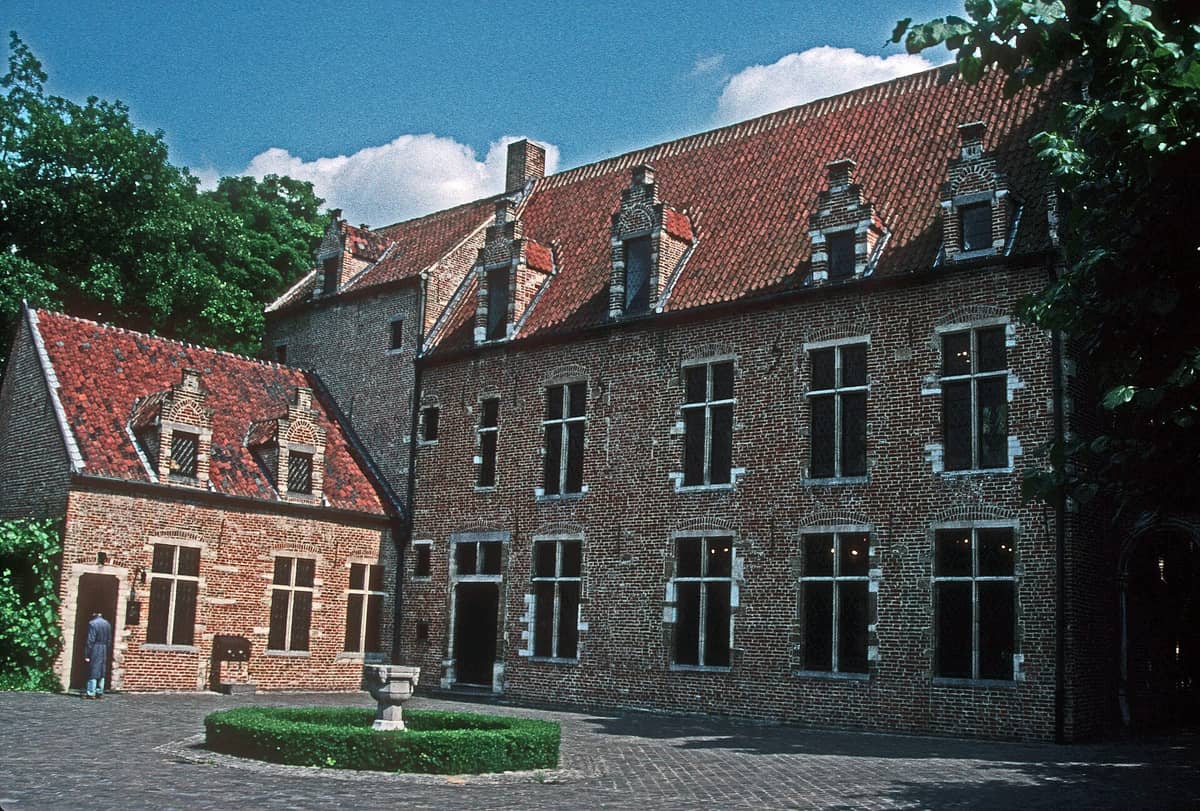
The Maison d'Érasme is a late-Gothic brick townhouse in the municipality of Anderlecht, southwest of Brussels city centre. It was built in stages between 1460 and 1515 and served as a canonical residence attached to the nearby Collegiate Church of Saints Peter and Guidon. In 1521, the great humanist scholar Desiderius Erasmus of Rotterdam stayed here for several months while recovering from illness, hosted by his friend Canon Pieter Wychman. That relatively brief stay is why the house exists today as a museum: the connection to one of the most influential thinkers of the Northern Renaissance transformed an ordinary late-medieval residence into a place of European cultural memory.
The museum is operated by the municipality of Anderlecht and sits beside the Beguinage of Anderlecht, a small medieval courtyard complex from the 14th century. The two sites can be visited together with a combined ticket bought at Erasmus House, while standalone visits to the Beguinage are free. Together they form one of Brussels' most coherent and least crowded historical ensembles, tucked away from the tourist circuits that dominate the Grand-Place area.
💡 Local tip
Visit on the first Sunday of the month if you want to see the restored Beguinage for free; combined access to Erasmus House remains ticketed, and crowds remain thin even on these days, which makes this a genuinely relaxed option for a weekend morning.
The Architecture: Late-Gothic Brick at Close Range
From the street, the house presents a stepped gable facade in the Brabantine Gothic style, modest in scale but carefully proportioned. The dark red brick, the stone window surrounds, and the irregular roofline belong to a type of Flemish urban architecture that was already old-fashioned by the time Erasmus arrived. Walking through the entrance gate, you move into a small courtyard that separates the street noise of Anderlecht from the garden beyond. The transition is immediate and perceptible.
Inside, the rooms are low-ceilinged and unevenly lit by deep-set windows. The floors are original or period-consistent stone and tile. The building has not been restored into smoothness: surfaces retain texture, walls show their age, and the spatial experience is genuinely different from a purpose-built museum. What you feel is the actual mass and proportion of a 15th-century domestic interior, not a reconstruction.
If late-Gothic civic architecture interests you more broadly, Brussels Town Hall on the Grand-Place represents the same era at a grander civic scale, and the Coudenberg Palace archaeological site shows what lies beneath the Royal Quarter from the same period.
Tickets & tours
Hand-picked options from our booking partner. Prices are indicative; availability and final rates are confirmed when you complete your booking.
1-hour tour of Antwerp highlights with a local
From 61 €Instant confirmationFree cancellationGhent tour from Brussels
From 43 €Instant confirmationFree cancellationTablet Workshop at Choco-Story Brussels
From 45 €Instant confirmationShared tour of Delft and the Keukenhof Estate from Brussels
From 86 €Instant confirmationFree cancellation
The Collection: Erasmus in Artifacts
The museum's collection is focused and thematically coherent rather than encyclopedic. The rooms hold period furniture, early printed books and manuscripts, engravings, and paintings connected to Erasmus's circle. Among the most significant objects is a portrait of Erasmus after Hans Holbein the Younger and works in the tradition of Hieronymus Bosch, whose nightmarish imagery Erasmus admired and whose world he inhabited intellectually. These are not facsimiles: the original historical works are here, displayed in rooms whose scale and light feel proportionate to objects meant to be held and studied rather than viewed from a distance.
The arrangement follows Erasmus's biography and intellectual output: his correspondence with Thomas More and Pope Leo X, his edition of the Greek New Testament, his satirical masterpiece 'The Praise of Folly.' The museum presents Erasmus not as a distant canonical figure but as a man with a specific working life, physical ailments, and strong opinions. Reading a wall panel beside an original edition of the 'Moriae Encomium' printed in Basel in the early 16th century is one of those museum experiences that can feel unexpectedly immediate.
ℹ️ Good to know
The collection includes works connected to Hieronymus Bosch and Hans Holbein the Younger, mainly prints and paintings from their circles. For visitors coming primarily for Flemish masters, allow extra time in the main display rooms on the upper floor.
The Garden and the Beguinage
Behind the house, a small formal garden has been planted with medicinal and culinary herbs that would have been familiar in a 16th-century Flemish household. The planting is intentional and documented, not decorative guesswork. In spring and early summer, when the beds are in growth, the garden adds a sensory dimension to the visit: the smell of herbs in morning sun, the sound of the city blocked almost entirely by surrounding walls. It is a genuinely quiet space in an otherwise urban setting.
Adjacent to the main house, the Beguinage of Anderlecht dates from the 14th century and represents one of the few surviving beguine court complexes in the Brussels area. Beguines were lay religious women who lived in community without taking permanent vows, a social and spiritual arrangement that was widespread in the Low Countries from the 13th century onward. The small Gothic chapel and surrounding cells give a concrete sense of how this form of religious life was organized spatially. The beguinage is included in the same ticket as Erasmus House.
Practical Walkthrough: What to Expect on Arrival
The museum is open Tuesday to Sunday, 10:00 to 18:00, and closed on Mondays (including public-holiday Mondays) as well as on 1 January and 25 December. Adult admission is €5; seniors (65+), students (18-26), and youths (6-18) pay €3; children under 6 enter free. Holders of Article 27 social access tickets pay €1.25. Check current partner passes such as Brussels Card or Pass Musées on the museum website, as benefits may vary. Entry to the restored Beguinage is free on the first Sunday of every month, while combined visits with Erasmus House are ticketed.
The ground floor and gardens are wheelchair accessible. The upper floor rooms have original steep stairs that are not adapted for mobility aids. Visitors with limited mobility are advised to contact the museum in advance so that temporary ramp arrangements can be made where possible. The museum is small enough that a thorough visit takes between one and one and a half hours, though the pace is yours to set.
Getting here is straightforward from central Brussels. Metro line 5 stops at Saint-Guidon station, a two-minute walk from the museum entrance. The journey from Brussels Central Station by metro takes around 15 minutes, and about 20 minutes door-to-door. Anderlecht itself is a largely residential municipality with relatively few tourist-focused services nearby, so it is worth eating before you arrive or bringing something with you. There is no on-site museum café or shop of note.
⚠️ What to skip
Anderlecht has limited tourist infrastructure. There are no cafes immediately beside the museum. Plan to eat before your visit or after you return to the city centre.
Time of Day and Crowd Patterns
This museum draws a quiet, self-selected audience: school groups on weekday mornings, individual visitors and couples on weekend afternoons, and occasional academic visitors throughout the week. Unlike the major museums on the Mont des Arts ridge, it never feels crowded. On a typical Tuesday or Wednesday morning, you may have entire rooms to yourself.
Morning visits, particularly in spring and early autumn, suit the garden best. The light in the house is strongest in the afternoon when it enters through the south-facing windows. For photography, afternoon visits bring warmer interior light; for quiet contemplation, mornings are unmatched. Brussels' weather is unpredictable in any season, and rain does not significantly affect the visit since the bulk of the experience is indoors.
If you are building a full day around quieter, less-visited Brussels museums, consider pairing Erasmus House with the Horta Museum in Saint-Gilles for an afternoon. Both reward careful looking over rushed touring. Alternatively, our guide to the best museums in Brussels can help you sequence a full cultural itinerary.
Who This Museum Is For, and Who Should Think Twice
Erasmus House rewards visitors who arrive with some prior interest in the Renaissance, the history of printing, or Flemish late-Gothic architecture. The interpretive panels are informative and well-translated into English, but the collection is not designed to entertain visitors who have no existing frame of reference. If you are traveling with young children or looking for interactive displays, this is the wrong choice. The house does not have the resources or the curatorial philosophy of a science museum or a major national institution.
For visitors who do have that context, or who are willing to build it before arriving, the experience is disproportionately rewarding for its modest entry cost and low profile. This is a genuine historical site, not a themed recreation. The objects in these rooms are old in the way that matters: they were made and used by people operating in the same intellectual and physical world as Erasmus, and some of them passed through his hands.
Brussels has a strong tradition of humanist printing and book culture that connects Erasmus House to the broader city. Galeries Royales Saint-Hubert still houses specialist bookshops in its 19th-century arcades, and the Brussels hidden gems guide covers several other sites that attract fewer visitors than they deserve.
Insider Tips
- Check the museum's website before visiting for temporary exhibitions, which occasionally bring in additional loans from European collections and significantly expand the display beyond the permanent collection.
- The first Sunday of the month is free and still quiet. It is a more pleasant option than many free-Sunday museums in Brussels, which see large crowds on those days.
- Combine the visit with the nearby Collegiate Church of Saints Peter and Guidon, a few minutes on foot, which contains medieval frescoes and is free to enter. The two sites together give a coherent picture of Anderlecht's medieval religious and civic life.
- The garden is at its best in May and June when the medicinal herb beds are in full growth. If you visit in winter, the bare beds and plain brick walls are austere in a way that is historically appropriate but less visually appealing.
- Pick up the English-language room guide at the entrance desk rather than relying solely on wall text. It provides biographical and contextual detail that makes individual objects significantly more legible.
Who Is Erasmus House (Maison d'Érasme) For?
- Visitors with an interest in Renaissance humanism, Erasmus's writings, or the history of early print culture
- Architecture enthusiasts drawn to intact late-Gothic Flemish residential buildings
- Travelers seeking genuinely uncrowded cultural experiences away from the main tourist circuits
- Anyone combining a Brussels visit with an interest in Northern Renaissance painting, particularly the Bosch and Holbein connections
- Budget-conscious cultural visitors, given the low admission price and free first-Sunday option
Nearby Attractions
Combine your visit with:
- AfricaMuseum Tervuren
Set in a grand neoclassical palace 14 km east of Brussels, the AfricaMuseum is one of Europe's largest museums dedicated to Central Africa. Reopened in 2018 after a five-year renovation, it now confronts its own colonial past head-on while housing world-class natural history, ethnographic, and art collections.
- Basilica of the Sacred Heart (Koekelberg)
The National Basilica of the Sacred Heart in Koekelberg is one of the largest Art Deco religious buildings in the world, its green copper dome rising 89 metres above Brussels. Entry to the basilica is free; a paid climb to the dome platform delivers one of the city's most underrated panoramas.
- Cantillon Brewery (Brasserie Cantillon)
Cantillon Brewery (Brasserie Cantillon) is one of the few remaining traditional lambic breweries in Brussels, doubling as the Brussels Museum of the Gueuze since 1978. Located a short walk from Gare du Midi in Anderlecht, it is a working industrial site and a serious destination for anyone wanting to understand why Belgian beer culture earned UNESCO recognition.
- Comic Strip Route (Mural Trail)
Brussels' Parcours BD is a free, self-guided trail of more than sixty large-scale comic murals painted on building walls across the city. Created in 1991, it turns the streets themselves into an open-air gallery celebrating Belgium's most distinctive art form. No ticket required, no opening hours to check.