Coudenberg Palace Archaeological Site: Brussels' Buried Royal World
Beneath the Place des Palais lies one of Brussels' most unexpected attractions: the excavated ruins of the Coudenberg Palace, once the most powerful royal court in northern Europe. This underground archaeological site lets visitors walk through streets and halls that haven't seen daylight since the 18th century.
Quick Facts
- Location
- Place des Palais 7, 1000 Brussels (Royal Quarter, to the right of the Royal Palace)
- Getting There
- Metro line 1/5 to Parc or Trône; Tram 92/93 to Parc or Louise
- Time Needed
- 1.5 to 2 hours
- Cost
- €10 standard; €18 combined with BELvue Museum; free under 18
- Best for
- History enthusiasts, architecture lovers, rainy day visits, curious travellers who prefer depth over spectacle
- Official website
- coudenberg.brussels/en
What Is the Coudenberg Palace Site?
The Coudenberg Palace Archaeological Site preserves the underground remains of a royal palace that once stood at the centre of Burgundian and Habsburg power in the Low Countries. For roughly four centuries, from the 12th to the 18th century, the Coudenberg hill was where dukes and emperors held court, received ambassadors, and shaped the political map of Europe. Charles V, Holy Roman Emperor and ruler of an empire that stretched from Spain to the Americas, grew up here and hosted some of the most consequential gatherings in Renaissance Europe within these walls.
The palace burned in 1731, was gradually buried under urban construction, and largely forgotten until archaeologists excavated the foundations in the second half of the 20th century. What they found, and what you can visit today, is an astonishing stretch of subterranean ruins: vaulted cellars, the remains of the monumental Aula Magna ceremonial hall, and the ghost of Rue Isabelle, a medieval street sealed beneath the city for nearly three centuries.
ℹ️ Good to know
The entrance to Coudenberg is shared with the BELvue Museum at Place des Palais 7, to the right of the Royal Palace as you face it. Look for the signage near the ground-floor entrance rather than the main palace gates.
The Experience Underground
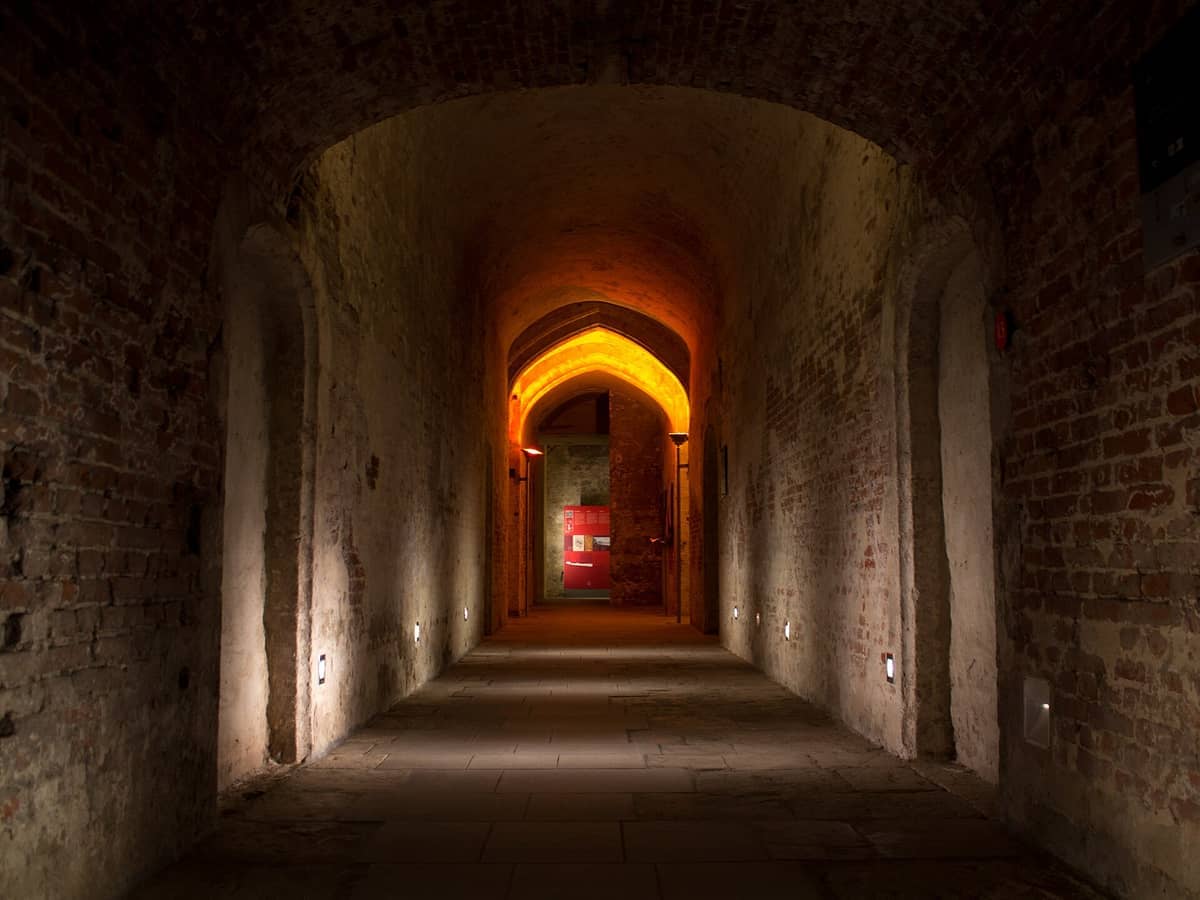
The descent into the site is immediate and disorienting in the best way. Within a few steps of leaving the entrance lobby, the temperature drops noticeably, probably by five or six degrees compared to a mild Brussels afternoon. The air carries that particular cool, slightly mineral smell of old stone and compressed earth. Lighting is deliberately subdued, with low-level spotlights picking out carved stonework and the edges of walls that have survived centuries of being buried.
The route takes you through several distinct zones. The foundations of the Aula Magna, the great hall where Charles V abdicated the rule of the Low Countries to his son Philip II in 1555, are marked out at floor level. The scale is genuinely impressive: this was not a modest hall. Interpretive panels and an audio guide help reconstruct what stood above the surviving masonry, which otherwise asks a fair amount of imagination from visitors. Those who engage with the historical context will get considerably more from the visit than those expecting visual spectacle.
Rue Isabelle is the other centrepiece: an actual medieval street, complete with cobblestones, the base of a wall belonging to the Hoogstraeten House, and the sense of a city frozen mid-existence. Standing on those stones, knowing that Brussels was built directly on top of this layer, reframes how you think about the streets above you.
Tickets & tours
Hand-picked options from our booking partner. Prices are indicative; availability and final rates are confirmed when you complete your booking.
Ghent tour from Brussels
From 43 €Instant confirmationFree cancellationTablet Workshop at Choco-Story Brussels
From 45 €Instant confirmationShared tour of Delft and the Keukenhof Estate from Brussels
From 86 €Instant confirmationFree cancellationOrigins of Brussels exploration game and tour
From 10 €Instant confirmationFree cancellation
Historical and Cultural Significance
The Coudenberg Palace was not simply a royal residence. From the late medieval period through the Habsburg era, it was the administrative capital of the Low Countries, a territory that included modern Belgium, the Netherlands, Luxembourg, and parts of northern France. Decisions made in its halls shaped the Reformation, European trade networks, and the colonisation of the Americas. The palace hosted the Order of the Golden Fleece, one of the most prestigious chivalric orders in European history, and its banqueting halls were referenced by contemporaries as among the finest north of the Alps.
The fire of 1731 destroyed most of the standing structures, and the ruins were subsequently built over as Brussels expanded. The site sat beneath the current Place des Palais and the 19th-century Royal Palace, which replaced the lost medieval complex. The archaeological excavations that began in the 1960s and continued through subsequent decades revealed just how much survived underground. Today the site is managed alongside the BELvue Museum, which covers Belgian history from independence to the present, making the combined ticket a logical pairing for visitors interested in the full arc of the country's political history.
Practical Walkthrough: What to Expect
The visit is self-guided with an audio guide included in the ticket price. The audio guide is available in multiple languages and is worth using: without it, several sections of the site rely heavily on text panels in a dimly lit environment, which can be tiring. The route is linear rather than freely explorable, so there is no risk of getting lost, but also limited flexibility to linger wherever you choose.
The full underground circuit takes most visitors between 60 and 90 minutes if they engage with the audio content. A faster pass through for someone skipping the detailed commentary takes around 45 minutes, though this significantly reduces the experience. Photography is permitted throughout the underground sections, and the low, directional lighting actually creates some compelling shots if you bring a phone or camera that handles low light reasonably well. A wide angle or ultrawide lens is useful in the narrower passages.
⚠️ What to skip
Accessibility is limited underground. The Aula Magna section and parts of Rue Isabelle are not wheelchair accessible. The museum portion above ground has better access via a separate entrance. Confirm specific accessibility arrangements directly with the site before visiting.
Footwear matters more than people anticipate. The floor surfaces alternate between modern walkways and original stonework, and some sections have subtle gradients. Flat-soled shoes with grip are sensible. Bring a light layer: the underground temperature is consistent year-round at a level that feels cold in summer clothing.
Getting There and Opening Hours
The site sits in the Royal Quarter, one of the more formal and less foot-trafficked parts of central Brussels. Metro lines 1 and 5 stop at Parc (a short walk north) or Trône (a short walk southeast). Trams 92 and 93 run along Rue Royale and stop closer to the palace. The surrounding streets are pleasant for a short walk: the Royal Palace of Brussels is directly adjacent, and the Parc de Bruxelles stretches to the north.
Opening hours are Tuesday to Friday 09:30 to 17:00, and Saturday to Sunday 10:00 to 18:00. During July, August, and Belgian school holidays, the site extends to 10:00 to 18:00 daily. The site is closed on Mondays, on 1 January, 21 July, and 25 December, and closes early at 16:00 on 24 and 31 December. Last entry is typically 45 minutes before closing.
Standard tickets are €10, with reduced prices of €8 for seniors and groups, and €5 for visitors aged 18 to 25, job-seekers, and those with disabilities. Under-18s enter free. The combined Coudenberg and BELvue ticket is €18 and represents reasonable value if you plan to spend a half-day in the area. Tickets are available at the entrance and on the official website.
Time of Day, Crowds, and When to Visit
Because the site is underground and climate-controlled, time of day has no effect on the experience itself, which makes it a particularly good option on a rainy Brussels afternoon. The Royal Quarter is quieter than the Grand-Place area in general, and Coudenberg draws a more self-selecting crowd of genuinely curious visitors rather than passing tourists. The site rarely feels overcrowded, and even on busy weekend afternoons the underground passages do not become uncomfortably congested.
Weekday mornings are the quietest time to visit. If you are pairing this with other nearby attractions, consider combining it with the Mont des Arts gardens or the Magritte Museum for a full morning or afternoon in the upper town. The walk between these locations takes under ten minutes.
For context on the broader historical landscape of Brussels, the best museums in Brussels guide offers useful comparisons between Coudenberg and other sites covering the city's past.
Is It Worth Your Time?
Coudenberg is not a visually overwhelming site. The ruins are fragmentary: foundations, floor levels, lower sections of walls. Anyone expecting intact medieval halls or richly decorated chambers will be disappointed. The site rewards visitors who come prepared with at least a basic interest in the period and a willingness to use the audio guide to reconstruct what once stood here.
For visitors who meet that description, it is one of the more genuinely affecting experiences Brussels offers. There is something quietly striking about standing in the space where one of history's most powerful rulers abdicated, in a hall buried and forgotten for generations, beneath a city that has no idea it is walking over it. That is a hard thing to manufacture, and Coudenberg does not need to.
Insider Tips
- Pick up the audio guide at the entrance even if you usually skip them: several key sections of the underground route have minimal physical signage, and the audio content provides the spatial context that makes the ruins legible.
- The combined Coudenberg and BELvue ticket (€18) makes sense if you have two to three hours: BELvue covers Belgian history from 1830 onward, while Coudenberg covers the centuries before. Together they form a coherent arc.
- Bring a jacket or light layer regardless of the season. The underground temperature stays consistently cool year-round and will feel cold against summer clothing after about 20 minutes.
- Photography works best in the Rue Isabelle section, where the cobblestones and low walls create strong lines. A phone with a night mode or a camera that handles low light without flash will get far better results than a point-and-shoot with flash, which blows out the stone textures.
- If you are visiting on a Monday, note that the site is closed. Plan your Royal Quarter day accordingly: the Royal Palace exterior and the Parc de Bruxelles are always accessible, but Coudenberg itself will not be open.
Who Is Coudenberg Palace Archaeological Site For?
- History enthusiasts, particularly those interested in the Habsburg era and Burgundian Europe
- Travellers who want something more intellectually engaging than a surface-level sightseeing circuit
- Rainy day visitors looking for a sheltered, slow-paced indoor experience
- Architecture and archaeology readers who appreciate ruins in their excavated context
- Parents with older children (roughly 10 and above) who engage well with audio guides and historical storytelling
Nearby Attractions
Other things to see while in Royal Quarter & Mont des Arts:
- BELvue Museum
The BELvue Museum traces Belgium's history from its founding in 1830 to the present day through seven thematic galleries and around 200 carefully selected objects. Located at Place des Palais, steps from the Royal Palace, it offers a clear-eyed account of a country that has rarely had a simple story to tell.
- BOZAR – Centre for Fine Arts
Housed in a landmark Art Deco building designed by Victor Horta, BOZAR is Belgium's premier multidisciplinary arts centre, blending major exhibitions, classical concerts, film screenings, and contemporary performance under one roof. Located steps from Brussels Central station in the Mont des Arts district, it rewards curious visitors who want more from their cultural itinerary than a single painting collection.
- Magritte Museum
The Musée Magritte Museum in Brussels holds the world's largest collection of works by René Magritte, with over 200 paintings, drawings, sculptures, and archival materials spread across multiple floors. Located on Place Royale in the Royal Quarter, it is one of the most focused single-artist museums in Europe and a serious destination for anyone interested in Surrealism, 20th-century painting, or Belgian cultural history.
- Mont des Arts
Mont des Arts (Kunstberg in Dutch) is a stepped urban complex in Brussels' Royal Quarter that connects the lower and upper city through terraced gardens, monumental staircases, and a cluster of major cultural institutions. The view from the upper terrace over the rooftops toward the Grand-Place is one of the most satisfying in the Belgian capital — and it costs nothing to see it.