Royal Palace of Brussels: The King's Working Palace, Open to All (For a Few Weeks)
The Royal Palace of Brussels is Belgium's official working palace, used by the King for state functions, and in normal years it opens to the public free of charge for a limited summer period. The neoclassical facade, ceremonial halls, and extraordinary art installations make it one of the most rewarding free experiences in the Belgian capital.
Quick Facts
- Location
- Rue Brederode 16, 1000 Brussels – Royal Quarter, facing Place des Palais
- Getting There
- Brussels-Central railway station (10-min walk); multiple tram and bus lines on Rue Royale
- Time Needed
- 1 to 1.5 hours inside; allow extra time for the exterior and surrounding park
- Cost
- Free admission; time-slot booking may be required during the summer opening via the official monarchy website
- Best for
- History lovers, architecture fans, free cultural experiences, first-time visitors to Brussels
- Official website
- www.monarchie.be/en/heritage/royal-palace-of-brussels
What the Royal Palace of Brussels Actually Is
The Royal Palace of Brussels is not a royal residence in the conventional sense. The King of the Belgians does not sleep here. It functions instead as the administrative and ceremonial heart of the monarchy: the place where the sovereign receives heads of state, signs legislation into law, and conducts the formal business of a constitutional crown. Most of the year, the building is entirely closed to ordinary visitors.
That changes every summer. That changes every summer. For a limited period after Belgium's National Day on 21 July, the doors open free of charge to anyone who books a time slot. The result is a rare chance to walk through a fully operational seat of royal power, and to see the accumulated art, craft, and ceremonial ambition of several Belgian monarchs in one visit.
⚠️ What to skip
Important: Summer opening dates can be affected by renovation works. Always check the official Belgian Monarchy website before planning your visit, as exact dates, hours, and accessible rooms can change year to year.
A Short History on a Very Long Site
The ground beneath the Royal Palace has been politically significant for centuries. The Coudenberg Palace, a medieval and early modern residence that once ranked among the most important courts in northern Europe, occupied this same hilltop overlooking central Brussels. That earlier structure burned in 1731, leaving a clearing that was gradually built over and reorganized as the city expanded.
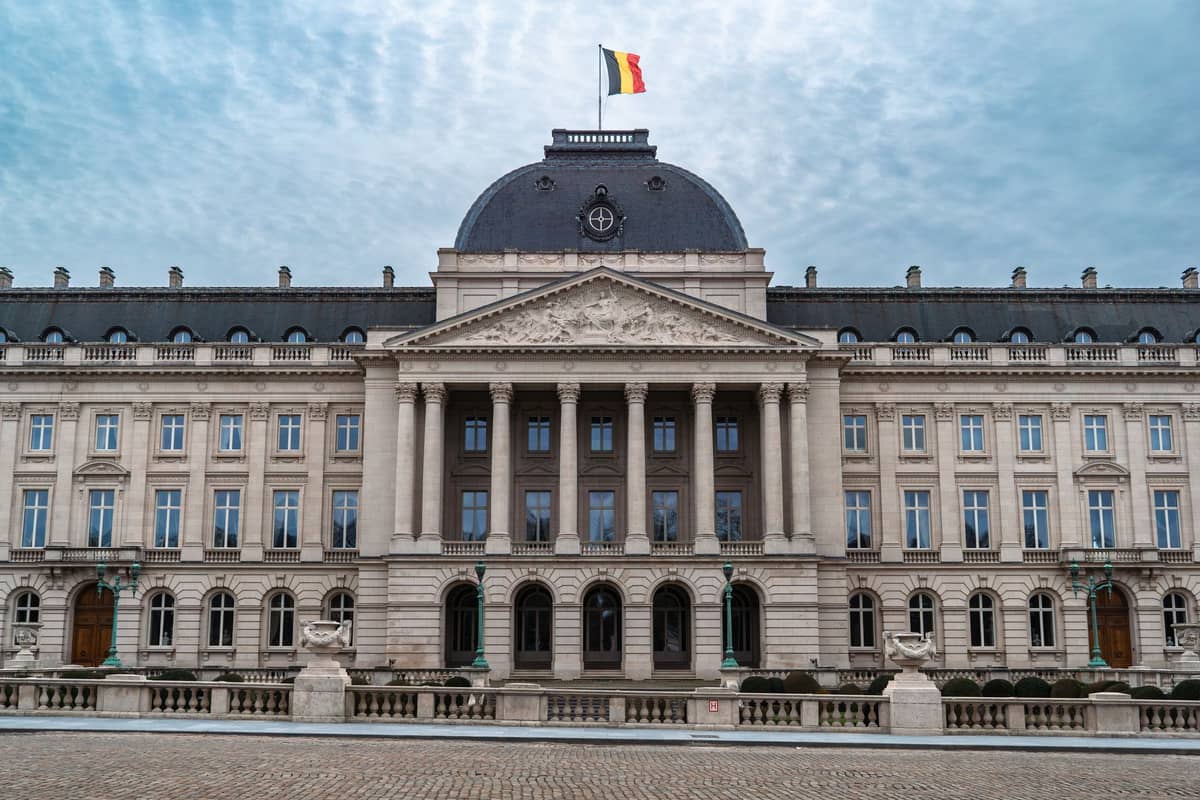
The neoclassical facade visitors see today dates mainly from the 19th century, shaped above all by King Leopold II, who substantially enlarged and embellished the building between the 1890s and early 1900s. Leopold II was determined to give Belgium an architectural statement worthy of a major European power, and the palace's long, symmetrical face on Place des Palais reflects that ambition directly. For the story of what lies beneath, the Coudenberg Palace archaeological site can be visited separately and provides a striking underground counterpart to what you see above ground.
The building sits at the top of the Mont des Arts slope, with Brussels Park to its north and the Sablon district to the south. Its physical position in the city is not accidental: it occupies the high ground between the commercial lower town and the aristocratic upper town, an arrangement that still shapes how the Royal Quarter feels today.
Tickets & tours
Hand-picked options from our booking partner. Prices are indicative; availability and final rates are confirmed when you complete your booking.
Ghent tour from Brussels
From 43 €Instant confirmationFree cancellationTablet Workshop at Choco-Story Brussels
From 45 €Instant confirmationShared tour of Delft and the Keukenhof Estate from Brussels
From 86 €Instant confirmationFree cancellationOrigins of Brussels exploration game and tour
From 10 €Instant confirmationFree cancellation
The Exterior: What You See Before You Enter
Even when the palace is closed, Place des Palais repays a short detour. The square itself is one of the calmer public spaces in central Brussels. The facade is faced in pale stone and flanked by two projecting wings that frame the central portico. The proportions are deliberate and somewhat severe, more about institutional permanence than display. The Belgian flags fly from the roof when the King is not in residence; the Royal Standard replaces them on days when he is present and working inside.
The square itself is one of the calmer public spaces in central Brussels. It connects directly to the green expanse of Brussels Park to the north, and the whole axis from the park through the square to the palace gives a clear sense of how 19th-century city planners understood the relationship between monarchy, parliament, and public space. The Belgian Parliament building faces the palace directly across the park, a spatial arrangement that makes the constitutional balance of power almost legible. If you want to understand the layout more deeply, the BELvue Museum sits immediately adjacent to the palace and covers the history of Belgian democracy and the monarchy in accessible detail.
💡 Local tip
Morning light falls well on the palace facade from around 9 to 11am. If you are visiting in summer, arriving early before your time slot to photograph the exterior from the centre of Place des Palais gives cleaner results than midday, when the light flattens significantly.
Inside the Palace: What the Summer Opening Actually Shows You
The visitor route through the palace changes from year to year depending on which rooms are available, so what follows describes what is typically accessible rather than a guaranteed fixed itinerary. The ceremonial sequence generally moves through a series of state rooms whose scale is intended to impress: high ceilings, chandeliers of considerable size, formal portraits, and parquet floors that absorb the sound of passing visitors surprisingly well.
The most discussed feature of the interior is the ceiling of the Large Mirror Room, which artist Jan Fabre completed in 2002. He covered the surface entirely with the iridescent shells of jewel beetles, with about one million of them creating a ceiling that shifts between green and gold as the light changes. It is genuinely unusual, and more arresting in person than photographs suggest. The decision to commission a contemporary artist to intervene in a 19th-century state room says something about how the Belgian monarchy has chosen to position itself: engaged with contemporary culture rather than frozen in historical display.
Other rooms contain Belgian tapestries, Flemish and Flemish-influenced paintings, formal gilt furniture, and decorative objects assembled over multiple reigns. The quality is uneven, as tends to be true of royal collections that were put together for political and diplomatic reasons as much as aesthetic ones. Some rooms feel genuinely impressive; others are simply large. The overall impression is of a building that functions well as a setting for ceremony even when it does not quite succeed as a gallery.
Practical Walkthrough: Booking, Arriving, and Getting Around
Admission is free, but you need a time-slot reservation. Booking opens via the official Belgian Monarchy website, and slots can fill up quickly during the summer opening. If you are visiting Brussels specifically to see the interior, book soon after reservations go live.
Typical summer opening runs Tuesday through Sunday, 10:30 to 17:00, with last entry around 15:45. The palace is closed on Mondays. The time slot system means queues at the entrance are generally manageable, though weekend mornings in late July can see longer waits outside before entry. Arriving at your slot time rather than early usually works better than arriving ahead and waiting.
Getting there from Brussels-Central station on foot takes around ten minutes, crossing the Mont des Arts gardens. Metro lines 1 and 5 to Parc station bring you within a short walk of the palace, and nearby tram and bus stops also serve the Royal Quarter. By metro, the Parc station on lines 1 and 5 is slightly farther but still walkable in about eight minutes.
ℹ️ Good to know
Bags are scanned and security checks apply at entry. Leave large backpacks at your hotel if possible. Photography is permitted in most rooms but tripods and flash are not allowed.
Detailed accessibility information is not comprehensively published in standard visitor sources. Visitors with specific mobility requirements should contact the Belgian Monarchy website directly or check the City of Brussels visitor information pages before arriving, as arrangements may differ by room and year.
Placing It in the Surrounding Royal Quarter
The Royal Palace anchors a cluster of significant institutions that repays half a day of careful walking. The Mont des Arts terrace immediately to the west provides one of the better viewpoints over central Brussels, with the lower town and its church towers laid out below. The Magritte Museum and the broader Royal Museums of Fine Arts complex are a short walk north of the palace, making a logical pairing for a full morning.
Walking south from Place des Palais toward the Sablon, you pass the Notre-Dame du Sablon church and the antique dealers and chocolate shops of the Sablon neighborhood. The combination of the palace, a museum, and the Sablon makes for a coherent itinerary that uses the uphill geography of Brussels rather than fighting it.
When to Visit and What Weather Does to the Experience
The palace is only open in summer, which in Brussels means temperatures typically between 18 and 23 degrees Celsius, with regular possibility of rain. The interior itself is not air-conditioned, and on days above 25 degrees, the state rooms can become warm and close, particularly later in the afternoon when visitor numbers are higher. Mornings are considerably more comfortable.
Rainy days are actually fine for a palace visit, since the experience is almost entirely indoors. The exterior photographs suffer under grey skies, but if your main interest is the interior rooms, overcast summer weather is no particular obstacle. Brussels gets meaningful rain in July and August, so treating this attraction as a good wet-day option is entirely reasonable.
If you are trying to identify the overall best period for a Brussels visit more broadly, the best time to visit Brussels guide covers seasonal considerations across the city in more detail.
A Clear-Eyed Assessment: Is It Worth Your Time?
The Royal Palace of Brussels is worth a visit if you are in the city during the summer window and have an interest in European history, royal institutions, or simply large ceremonial spaces. The Jan Fabre beetle-shell ceiling alone is memorable enough to justify the hour it takes to see the building. And since admission is free, the question is really about time rather than money.
It is not, however, among the world's great royal palaces in terms of sheer scale or art collection. Visitors who come expecting something comparable to Versailles or the Vienna Hofburg will find a more modest, more functional building. The Belgian monarchy has never been about grandiosity in the French or Austrian mode, and the palace reflects that: polished, serious, and historically interesting without being overwhelming.
Travelers who find formal interiors tedious, or who are visiting Brussels outside the summer window, have no decision to make. The exterior and the surrounding square are worth five minutes at any time of year, but there is no compelling reason to go out of your way.
Insider Tips
- Reservations open weeks before the summer opening date, and the first two weeks fill fastest. Set a reminder for when booking goes live on the official monarchy website rather than trying to book last-minute.
- An audio guide available inside the palace can significantly improve the experience. Without it, several rooms offer little context and can feel like walking through well-decorated corridors.
- Combine the palace visit with the BELvue Museum next door on the same morning. BELvue is small, affordable, and covers exactly the political history that gives the palace rooms their meaning.
- The view back across Place des Palais from the palace entrance steps, looking north toward Brussels Park and the Parliament, is one of the cleaner architectural vistas in the city centre. Take it in before you queue to enter.
- If your time slot is in the afternoon and the weather is hot, the state rooms in the far wings tend to be slightly cooler than the central ceremonial rooms. Follow the full visitor route rather than doubling back through the busier sections.
Who Is Royal Palace of Brussels For?
- First-time visitors to Brussels who want to understand the city's political and royal history
- Architecture and decorative arts enthusiasts, particularly those interested in 19th-century neoclassical and eclectic interiors
- Travelers looking for high-quality free cultural experiences in central Brussels
- Anyone with an interest in contemporary art interventions in historic spaces, specifically the Jan Fabre ceiling
- Families with older children or teenagers studying European history or political systems
Nearby Attractions
Other things to see while in Royal Quarter & Mont des Arts:
- BELvue Museum
The BELvue Museum traces Belgium's history from its founding in 1830 to the present day through seven thematic galleries and around 200 carefully selected objects. Located at Place des Palais, steps from the Royal Palace, it offers a clear-eyed account of a country that has rarely had a simple story to tell.
- BOZAR – Centre for Fine Arts
Housed in a landmark Art Deco building designed by Victor Horta, BOZAR is Belgium's premier multidisciplinary arts centre, blending major exhibitions, classical concerts, film screenings, and contemporary performance under one roof. Located steps from Brussels Central station in the Mont des Arts district, it rewards curious visitors who want more from their cultural itinerary than a single painting collection.
- Coudenberg Palace Archaeological Site
Beneath the Place des Palais lies one of Brussels' most unexpected attractions: the excavated ruins of the Coudenberg Palace, once the most powerful royal court in northern Europe. This underground archaeological site lets visitors walk through streets and halls that haven't seen daylight since the 18th century.
- Magritte Museum
The Musée Magritte Museum in Brussels holds the world's largest collection of works by René Magritte, with over 200 paintings, drawings, sculptures, and archival materials spread across multiple floors. Located on Place Royale in the Royal Quarter, it is one of the most focused single-artist museums in Europe and a serious destination for anyone interested in Surrealism, 20th-century painting, or Belgian cultural history.