Notre-Dame du Sablon: Brussels's Most Beautiful Gothic Church
Rising above the antiques dealers and chocolate shops of the Sablon quarter, the Church of Our Lady of Victories at the Sablon is one of Brussels's finest examples of Brabantine Gothic architecture. Built between the 15th and early 16th centuries, it draws around 500,000 visitors a year and charges no admission. This guide covers what to expect inside, the best times to visit, and how the surrounding neighbourhood shapes the experience.
Quick Facts
- Location
- Rue des Sablons, 1000 Brussels (Sablon quarter)
- Getting There
- Brussels-Central station (10 min walk); tram 92/93 to Petit Sablon stop
- Time Needed
- 30–60 minutes inside; allow extra time for the surrounding square
- Cost
- Free admission, open 365 days a year
- Best for
- Architecture lovers, history enthusiasts, photography, quiet midweek mornings
- Official website
- en.fondsamiseglisesablon.be
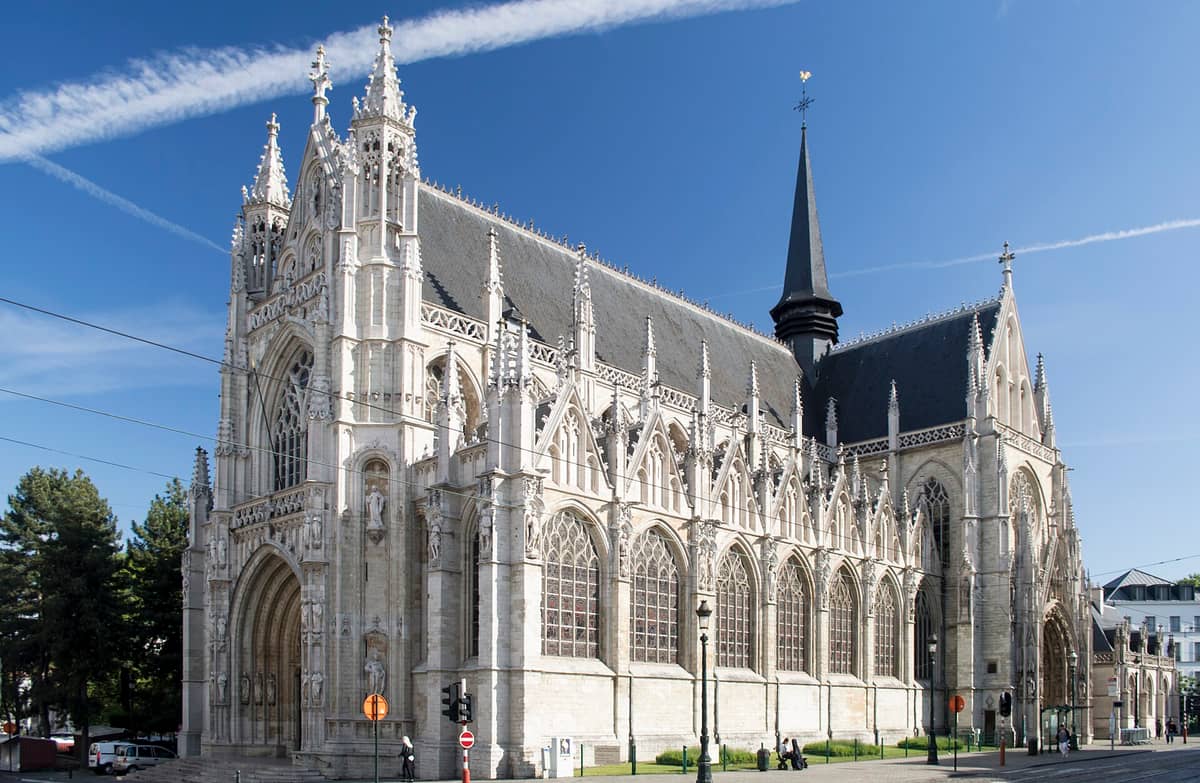
What Is Notre-Dame du Sablon?
The Église Notre-Dame des Victoires au Sablon, known universally as Notre-Dame du Sablon, is a Roman Catholic parish church in the heart of Brussels's Sablon neighbourhood. It occupies the upper edge of the Sablon neighbourhood, a quarter historically associated with art dealers, antique markets, and chocolatiers, and it dominates the streetscape with an authority that most buildings in the city simply cannot match.
Architecturally, it is one of Brussels's clearest examples of Brabantine Gothic, the regional variant of Gothic that flourished in the Duchy of Brabant from the 14th to the 16th centuries. The style is characterised by warm sandstone construction, elaborate tracery in the windows, and a verticality that is slightly more restrained than French High Gothic but no less impressive at close range. The church grew from a modest archers' guild chapel beginning in 1436, expanding through the early 16th century into the substantial five-aisled structure visible today.
About 500,000 people visit each year, which makes it a genuinely popular destination, not a quiet backwater. Yet because the church is large and the visitor flow spreads across the day, it rarely feels overwhelmed. Entry is free, and the church is open 365 days a year.
The Exterior: Reading the Facade Before You Go In
The west facade facing the Place du Grand Sablon is the face most visitors photograph, and it rewards close inspection before you step inside. The stonework shows the characteristic warm grey-gold of Belgian sandstone, darkened with age at the base but noticeably lighter higher up where later restoration work was carried out. The buttresses climb at steep angles, each capped with carved finials. At street level, the main portal's archivolts are carved with figures worn enough to require some imagination to read, but the overall composition is still striking.
Stand back far enough to take in the full tower profile, because the church's silhouette above the antique shops lining the Place du Grand Sablon is one of the more coherent medieval streetscape views in Brussels. Early on weekend mornings, before the antique market on the square fills up, this view is at its most photogenic: soft northern light, the faint smell of coffee from the nearby cafes opening their shutters, and almost no one standing between you and the facade.
💡 Local tip
For the best exterior photographs, arrive before 09:30 on a Saturday or Sunday morning. The Place du Grand Sablon market sets up from around 09:00, but the square is still quiet enough for unobstructed shots of the west facade in the hour after opening.
Tickets & tours
Hand-picked options from our booking partner. Prices are indicative; availability and final rates are confirmed when you complete your booking.
Banksy Museum admission and Brussels' highlights audio tour
From 28 €Instant confirmationBrussels audio tour with The View big wheel ticket
From 20 €Instant confirmationBrussels' history audio tour with Halle Gate admission ticket
From 17 €Instant confirmationGhent tour from Brussels
From 43 €Instant confirmationFree cancellation
Inside the Church: What You Actually See
Stepping through the main doors, the first thing that registers is the scale. The five aisles create a breadth that the exterior, hemmed in by surrounding buildings, does not fully telegraph. The nave columns rise in tightly clustered shafts to the vaulted ceiling, and the proportions feel correct in a way that took medieval builders generations to calibrate. The stone interior is cool even in summer, and there is a faint mineral smell to the air, the accumulated damp of centuries.
The stained glass is the single most compelling interior feature. The windows date from various periods, and the quality varies, but several panels achieve the deep jewel-toned luminosity that Gothic glaziers were aiming for. Light conditions change dramatically depending on time of day and cloud cover. On an overcast Brussels afternoon, the interior glows from the windows rather than from overhead, giving the nave a moody, chromatic atmosphere. On a rare bright morning, the coloured light falls in distinct shafts across the stone floor.
The choir chapels along the ambulatory contain funerary monuments and carved stonework worth examining slowly. Bring your phone's torch if you want to read inscriptions in the darker side chapels. The overall atmosphere is devotional but not forbidding: a constant trickle of tourists moves through respectfully, occasionally pausing for prayers or to light a candle at one of the side altars.
⚠️ What to skip
Visitor access is suspended during church services. Times vary by day and liturgical calendar. If you arrive and a service is in progress, either wait outside or return later. Trying to walk around during Mass is disrespectful and generally not permitted.
Historical Context: From Archers' Chapel to Gothic Monument
The origin story of Notre-Dame du Sablon is part legend, part documented history. The archers' guild of Brussels is credited with establishing a chapel on this site in 1304, dedicated to a statue of the Virgin Mary. According to tradition, a woman named Beatrice Soetkens transported that statue by boat from Antwerp to Brussels in 1348 at the direction of a vision, and the statue subsequently became a focus of Marian devotion in the city. The archers' chapel became a pilgrimage site.
Construction of the current Gothic church began in 1436, funded in part by the Guild of Crossbowmen of Brussels, and continued through the first decades of the 16th century. The church that stands today is essentially this late-medieval building, albeit with repairs and modifications over the subsequent centuries. The full official title, Église Notre-Dame des Victoires au Sablon, reflects the cult of Our Lady of Victories associated with the original devotional statue.
Placing this church within Brussels's broader ecclesiastical landscape helps calibrate expectations. The Cathedral of St Michael and St Gudula is larger, older, and the nominal seat of the Archbishop of Mechelen-Brussels. Notre-Dame du Sablon is a parish church, not a cathedral, and its significance comes from its neighbourhood setting, its architectural completeness, and its historical connection to guild culture in medieval Brussels rather than from ecclesiastical rank.
When to Visit and How the Experience Changes
Weekday mornings between 10:00 and 12:00 are consistently the quietest period for visits. The tourist footfall is lower, services are less likely to disrupt access, and the morning light from the east-facing windows illuminates parts of the interior that are in shadow later in the day. If you are specifically interested in the stained glass, morning visits on days with partial cloud cover provide the most balanced light across the windows.
Weekend afternoons bring the largest crowds, partly because the antique market on the Place du Grand Sablon draws visitors who step inside the church before or after browsing the stalls. The queue to enter is rarely long, but the interior can feel busy, particularly in the nave near the main altar. If you are visiting primarily for the architecture and atmosphere rather than devotion, a Tuesday or Wednesday morning between October and April is probably the ideal scenario: cool, quiet, and free of the tourist density that the summer months bring.
Brussels has a temperate maritime climate with rain distributed across the year, and the Sablon area is no exception. The church is, of course, a natural refuge when the city's characteristic grey drizzle sets in. Visiting on a rainy afternoon is a legitimate strategy: the square outside empties quickly in the rain, but the interior remains accessible and the coloured windows look particularly vivid against a dark sky.
ℹ️ Good to know
Opening hours: Monday to Friday 10:00–18:00, Saturday to Sunday 09:00–18:00. The church generally follows this schedule 365 days a year, though hours may vary slightly around major services and liturgical events. Verify current times via the parish website before planning a tight itinerary.
Getting There and the Surrounding Area
Brussels-Central station (Gare Centrale / Centraal Station) is the most convenient rail access point, approximately 10 minutes on foot heading uphill through the Mont des Arts area. Trams 92 and 93 normally stop at Petit Sablon, which deposits you directly in front of the church's side entrance on Rue de la Régence. The walk from the Grand-Place takes around 15 minutes along Rue de la Madeleine and up through the Coudenberg area.
The immediate neighbourhood rewards the extra time spent before or after a church visit. The Jardin du Petit Sablon is a formal garden directly opposite the church on Rue de la Régence, enclosed by an intricate wrought-iron fence decorated with 48 bronze figurines representing the medieval trade guilds of Brussels. It is a logical pairing with the church visit: five to ten minutes in the garden provides both a rest point and an architectural complement to the Gothic stonework of the nave.
The Place du Grand Sablon itself, which slopes down from the church's west front, is one of the more characterful squares in Brussels. The antique market runs on Saturday and Sunday mornings. The square is lined with chocolate shops, including several of Belgium's more established chocolatiers, and a selection of cafes and brasseries. Belgian chocolate being what it is in this city, the Sablon quarter is a reasonable place to combine a church visit with some considered confectionery shopping.
Photography, Practical Notes, and Who Should Skip This
Photography is generally tolerated inside the church for personal use. Flash photography directed at the altarpieces and fragile textile works is best avoided. A wide-angle lens or the ultra-wide mode on a smartphone is useful for capturing the full height of the nave; the five-aisle layout makes it difficult to get a single frame of the interior without a wide field of view. Tripods are not appropriate during open visitor hours.
Accessibility is not comprehensively documented in current visitor materials, and the historic stone floors and stepped entry points mean that wheelchair or pushchair access should be confirmed directly with the parish before visiting. The church's age means that some areas may have thresholds or uneven surfaces.
Visitors who find Gothic ecclesiastical architecture broadly uninteresting are unlikely to be converted by Notre-Dame du Sablon specifically. The church is impressive within its category, but there is no interactive exhibit, no audio guide, and no particular feature that translates well to visitors with no prior interest in medieval architecture or church history. It is also worth stating plainly: the church is not the Grand-Place. It is quieter, more specialised, and more rewarding for the traveller who takes time to look carefully rather than tick boxes. If your priority is a single quick photograph and a story to tell, the church exterior from the Place du Grand Sablon delivers that in under three minutes.
Insider Tips
- The side entrance on Rue de la Régence is less used than the main west portal and often has no queue. It also gives you a different first impression of the interior, entering from the side aisle rather than the central nave.
- The Jardin du Petit Sablon directly across the street has free entry but follows seasonal opening hours; the view back toward the church from the garden's upper terrace, framed by the wrought-iron fence, is one of the better compositions for a wide-angle photograph.
- If you want to see the stained glass at its most vivid, visit on a morning with broken cloud rather than on a fully overcast or fully sunny day. Shifting cloud cover creates movement in the coloured light that neither extreme produces.
- The Place du Grand Sablon antique market (Saturday and Sunday mornings) means the square fills with browsers and dealers from around 09:00. Arriving at 09:00 sharp lets you see both the church and the market setting up, before the afternoon crowd arrives.
- The church fund website (en.fondsamiseglisesablon.be) carries information on restoration projects and occasional evening concerts held inside the church. These events offer a completely different experience of the acoustic and atmospheric qualities of the building.
Who Is Notre-Dame du Sablon For?
- Architecture and history enthusiasts who want to understand Brabantine Gothic beyond the textbook
- Travellers combining a Sablon neighbourhood walk with antique browsing and chocolate shopping
- Photographers looking for Gothic interior and exterior shots away from the Grand-Place crowds
- Visitors caught in the rain looking for a substantial, free indoor attraction near the city centre
- Anyone following Brussels's broader ecclesiastical and medieval heritage circuit
Nearby Attractions
Other things to see while in Le Sablon:
- Jardin du Petit Sablon
Tucked between Rue de la Régence and Rue aux Laines in the Sablon quarter, the Jardin du Petit Sablon is a formal 19th-century garden distinguished by 48 bronze statuettes representing medieval Brussels trades. Entry is free, the atmosphere is surprisingly calm, and the surrounding streets form one of the city's most rewarding walks.
- Palace of Justice (Palais de Justice)
The Palace of Justice in Brussels is a working courthouse and one of the largest structures built in 19th-century Europe. Free to enter on weekdays, it rewards visitors with staggering neoclassical interiors, a turbulent architectural history, and one of the best elevated perspectives over the lower city.
- Place du Grand Sablon
Place du Grand Sablon is a centuries-old public square in the Sablon neighborhood of central Brussels, lined with chocolate shops, antique dealers, and café terraces. Free to enter at any hour, it hosts a weekend antiques market and sits beside the Gothic Notre-Dame du Sablon church. It rewards visitors who linger rather than rush.