Magritte Museum Brussels: The World's Largest Magritte Collection
The Musée Magritte Museum in Brussels holds the world's largest collection of works by René Magritte, with over 200 paintings, drawings, sculptures, and archival materials spread across multiple floors. Located on Place Royale in the Royal Quarter, it is one of the most focused single-artist museums in Europe and a serious destination for anyone interested in Surrealism, 20th-century painting, or Belgian cultural history.
Quick Facts
- Location
- Place Royale 2, 1000 Brussels (Royal Quarter)
- Getting There
- Tram 92/93 or bus 27/38/71 to Royale stop; metro to Parc (lines 1 and 5), roughly a 10‑minute walk
- Time Needed
- 2 to 3 hours for a thorough visit
- Cost
- Adults €10 at the Place Royale Magritte Museum (confirm on musee-magritte-museum.be); the separate Jette house-museum has its own tariffs
- Best for
- Art lovers, Surrealism enthusiasts, rainy-day culture seekers
- Official website
- musee-magritte-museum.be
What the Magritte Museum Actually Is
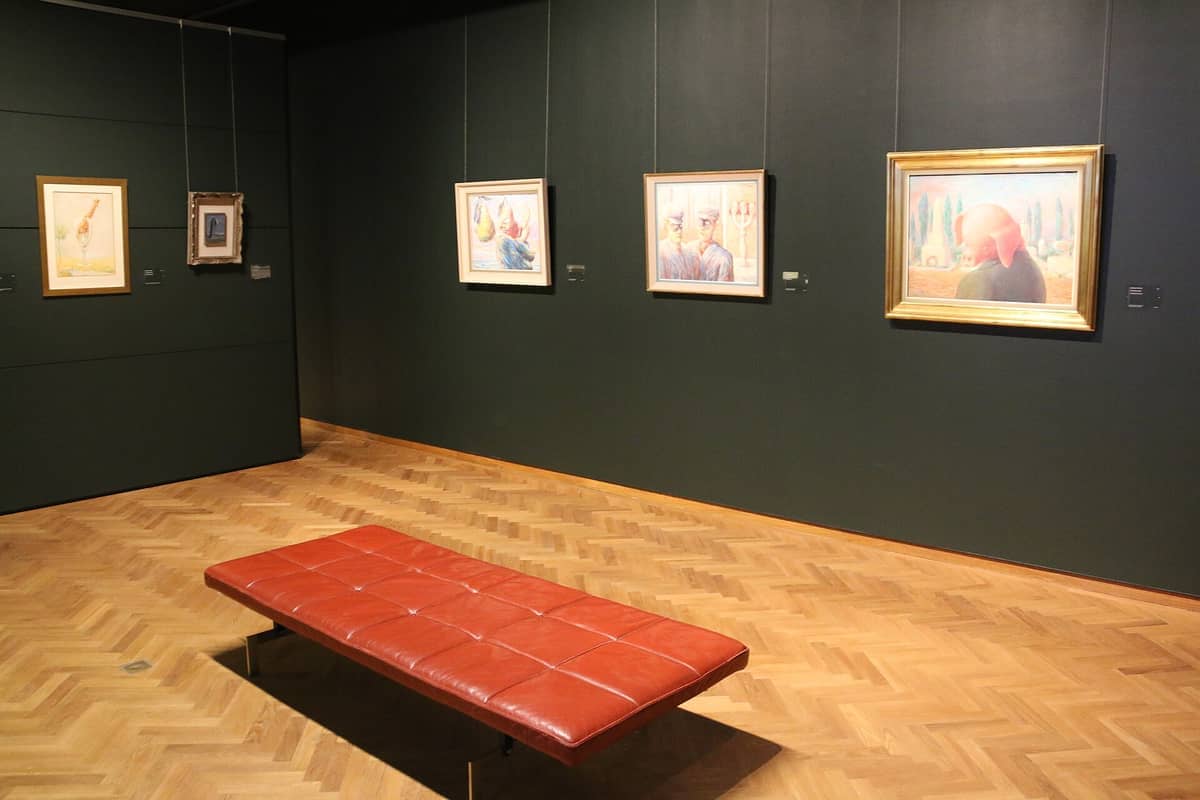
The Musée Magritte Museum is not a general survey of Surrealism or Belgian modernism. It is devoted entirely to one man, René Magritte (1898–1967), the Belgian painter whose bowler hats, floating apples, and impossible domestic scenes became some of the most reproduced images in 20th-century art. The museum opened in 2009 as part of the Royal Museums of Fine Arts of Belgium complex, and it holds over 200 works spanning paintings, gouaches, drawings, sculptures, and film footage, alongside personal archives and documentary material.
That depth of collection is what separates this museum from simply seeing a handful of famous Magritte pieces scattered across other European institutions. You can trace the full arc of his career here, from early commercial poster work and Impressionist-influenced paintings through his mature Surrealist period and into the late Vache period, where his style deliberately coarsened into something more confrontational. The building itself occupies a neoclassical townhouse at Place Royale 2, with an entrance for online‑ticket holders at that address and a ticketing desk at rue de la Régence 3 for walk‑in visitors.
ℹ️ Good to know
Accessibility note: The museum building has limited accessibility for visitors with reduced mobility or pushchairs due to its historic structure. Check the official site for current access provisions before your visit.
The Collection: What You Actually See
The museum is organized roughly chronologically across several floors. The lower levels cover Magritte's formative years, including his time working as a wallpaper designer and in advertising, which shaped his obsession with images, text, and the relationship between objects and their names. These early rooms tend to be quieter and less crowded than the upper floors, and they reward unhurried visitors who want to understand how Magritte arrived at his distinctive visual language rather than simply arriving at the famous paintings.
The middle floors contain the works most visitors come for: related works to “The Treachery of Images” (the original of the “Ceci n’est pas une pipe” painting is in Los Angeles, but the museum holds studies and related pieces), “Golconde,” “The Rape,” and many of the iconic bowler‑hat compositions. These rooms are frequently the most crowded, particularly in the late morning when tour groups arrive. Even well-known works tend to look different in person: the paint surfaces are quieter and more deliberate than reproductions suggest, and the scale of some canvases is surprisingly modest.
The upper floors shift into lesser-known territory: the Renoir-influenced 'Sunlit' period of the 1940s, where Magritte temporarily abandoned darkness for pastel warmth (a direction his Surrealist peers disliked), and the 'Vache' period, where his paintings become aggressively crude and brightly colored. This section surprises many visitors who expect a consistent aesthetic from start to finish. It also tends to be less crowded, giving you more room and time with the work.
Tickets & tours
Hand-picked options from our booking partner. Prices are indicative; availability and final rates are confirmed when you complete your booking.
Ghent tour from Brussels
From 43 €Instant confirmationFree cancellationTablet Workshop at Choco-Story Brussels
From 45 €Instant confirmationShared tour of Delft and the Keukenhof Estate from Brussels
From 86 €Instant confirmationFree cancellationOrigins of Brussels exploration game and tour
From 10 €Instant confirmationFree cancellation
How the Visit Feels at Different Times of Day
Arriving when the museum opens, around 10:00 on weekdays, gives you the first hour in near‑silence. The neoclassical interiors, with their controlled lighting and cream-colored walls, feel almost monastic at this hour. The contrast between the building's formal 18th-century architecture and Magritte's provocations is part of the experience, intentional or not.
By 11:30 on weekdays, and from the moment the museum opens on weekends, the central floors fill up. The famous works on the middle levels attract the densest crowds, and some rooms can feel tight during school holiday periods or on rainy Saturdays when much of Brussels seems to converge on indoor culture. If your priority is spending quiet time in front of specific paintings, weekday mornings are substantially more comfortable.
Afternoon visits, particularly after 14:00 on weekdays, tend to thin out again as tour groups move on. The light inside the museum does not vary dramatically since the galleries are artificially lit for conservation, so the quality of your experience is more dependent on crowd levels than on the time of day in any atmospheric sense.
💡 Local tip
Best timing: Arrive at opening time on a Tuesday or Wednesday for the most uncrowded experience. Avoid Saturday mornings and school holiday periods if crowd-sensitive.
Magritte, Brussels, and the Royal Quarter
René Magritte spent most of his adult life in Brussels, living for over 20 years in a small terraced house in Jette, a northwestern municipality of the city. He was not a figure of grand studios or artistic bohemia; he worked at a domestic kitchen table, surrounded by the ordinary objects that he repeatedly displaced into impossible contexts in his paintings. That deliberate ordinariness of his biography, which the museum documents well through photographs and archival material, makes the work more legible.
The museum sits within the Royal Quarter, one of Brussels' most formally planned areas, built up in the late 18th and 19th centuries around the neoclassical Place Royale and the adjacent Mont des Arts complex. The Royal Quarter also contains the Royal Palace, the Royal Museums of Fine Arts, and several other significant cultural institutions within a few minutes' walk.
If you want to understand Magritte's Jette period more directly, a separate institution, the Erasmus House is not directly related, but Magritte's actual Jette home has been preserved as a small museum at rue Esseghem 135 in Jette, run independently of the Royal Museums. The Musée Magritte Museum on Place Royale is the main institution for his artwork, while the Jette house covers his domestic and personal life.
Practical Walkthrough: Getting There, Tickets, and Navigation
The museum address is Place Royale 2, 1000 Brussels. Visitors who have booked tickets online enter via Place Royale 2 directly. Walk‑in visitors without pre‑booked tickets should go to the ticketing desk at rue de la Régence 3, a short distance around the corner. This distinction matters in practice: arriving at the wrong entrance and being redirected adds unnecessary time, particularly during busy periods.
By public transport, trams 92 and 93 stop at the Royale stop immediately adjacent to Place Royale; this is the most direct option from central Brussels. From the metro, Parc station on lines 1 and 5 is roughly a 10‑minute walk through the park. The area is also well served by buses 27, 38, and 71.
Opening hours for the Musée Magritte Museum at Place Royale are currently listed as Tuesday through Friday 10:00 to 17:00 and weekends 11:00 to 18:00, while the René Magritte Museum house in Jette is open Wednesday through Friday 13:00 to 18:00 and Saturday through Sunday 10:00 to 18:00. Verify current hours directly on the official sites before visiting, since discrepancies in published sources make this a time‑sensitive detail.
⚠️ What to skip
Opening hours discrepancy: The Musée Magritte Museum at Place Royale and the René Magritte Museum house in Jette have different schedules. Always check the relevant official site (musee-magritte-museum.be or magrittemuseum.be) before visiting to confirm current opening times.
At the René Magritte Museum house in Jette, standard admission is €12, under‑23 visitors pay €8, residents of Jette pay €6, the Article 27 social rate is €1.25, and children under 9 enter free. Both the Brussels Card and the museumPASSmusées card cover admission at no additional cost. The museumPASSmusées is particularly worthwhile if you plan to visit multiple Brussels museums during your stay, since it also covers the Royal Museums of Fine Arts and several other institutions.
The Royal Museums complex nearby includes the main Royal Museums of Fine Arts of Belgium, which holds an extensive permanent collection from medieval Flemish painting through to 20th-century Belgian art. Combining both institutions in one day is feasible but requires stamina; most visitors find two to three hours in the Magritte Museum alone is enough for a satisfying visit without fatigue setting in.
Photography, Practicalities, and Who Might Not Enjoy This
Photography policies in Belgian museums change periodically; check current rules on arrival or via the official site. The artificial gallery lighting produces even, flat illumination that is technically consistent for photography but lacks the drama of natural light. Many of the most famous works are also heavily reproduced online, so the photographic value of the visit is less the novelty of the image than the encounter with the object itself: the actual paint surface, scale, and presence of the original work.
Lifts serve the galleries for visitors with reduced mobility. Strollers are not allowed; use a front-facing baby carrier. This is one of the more significant access restrictions among major Brussels cultural institutions. Visitors who require step-free access should instead consider nearby institutions such as the BELvue Museum, which is more accessible.
Visitors who are primarily motivated by famous images rather than a genuine interest in Magritte's broader practice may find the full six-floor experience more demanding than expected. The museum does not shy away from lesser-known and sometimes perplexing work. Equally, anyone expecting the scale and variety of a general art museum will find the single-artist focus intense. This is a museum for people who are either already interested in Magritte or who are genuinely open to becoming so.
If you are building a broader Brussels art itinerary, the Magritte Museum pairs naturally with the BOZAR Centre for Fine Arts a short walk away, and with the best museums in Brussels guide for a fuller picture of what the city's cultural institutions offer.
Insider Tips
- Book online in advance and use the Place Royale 2 entrance. Walk-in visitors must use the rue de la Régence 3 ticketing entrance, which can mean queuing separately from pre-booked visitors during busy periods.
- Start at the top floor and work downward. Most visitors follow the chronological ground-floor-up route, meaning the early career rooms are congested while the upper Vache and Sunlit period galleries are almost empty. Going against the flow gives you the lesser-known work in peace and the famous pieces last, with slightly less company.
- The museumPASSmusées card (an annual pass covering over 200 Belgian museums) costs around €40 and pays for itself after two to three museum visits in Brussels. If you are visiting the Royal Museums of Fine Arts the same day, it is a straightforward calculation.
- The Jette house where Magritte actually lived and worked for over two decades is a separate institution at rue Esseghem 135 in Jette, not run by the Royal Museums. It offers a very different, more intimate perspective and is worth pairing with the main museum if you have a strong interest in his biography.
- The area around Place Royale is significantly quieter for a post-museum coffee or lunch if you walk two or three streets into the Sablon neighborhood rather than staying immediately on the square, where cafes are priced for tourists.
Who Is Magritte Museum For?
- Art and design enthusiasts with a specific interest in Surrealism or 20th-century European painting
- Visitors to Brussels with at least a half-day free and an interest in spending it in one focused cultural institution
- Travelers on a rainy day in Brussels looking for several hours of quality indoor time
- Holders of the Brussels Card or museumPASSmusées who want to maximize their pass value
- Anyone who has encountered Magritte's images in popular culture and wants to understand the actual depth and range of his practice
Nearby Attractions
Other things to see while in Royal Quarter & Mont des Arts:
- BELvue Museum
The BELvue Museum traces Belgium's history from its founding in 1830 to the present day through seven thematic galleries and around 200 carefully selected objects. Located at Place des Palais, steps from the Royal Palace, it offers a clear-eyed account of a country that has rarely had a simple story to tell.
- BOZAR – Centre for Fine Arts
Housed in a landmark Art Deco building designed by Victor Horta, BOZAR is Belgium's premier multidisciplinary arts centre, blending major exhibitions, classical concerts, film screenings, and contemporary performance under one roof. Located steps from Brussels Central station in the Mont des Arts district, it rewards curious visitors who want more from their cultural itinerary than a single painting collection.
- Coudenberg Palace Archaeological Site
Beneath the Place des Palais lies one of Brussels' most unexpected attractions: the excavated ruins of the Coudenberg Palace, once the most powerful royal court in northern Europe. This underground archaeological site lets visitors walk through streets and halls that haven't seen daylight since the 18th century.
- Mont des Arts
Mont des Arts (Kunstberg in Dutch) is a stepped urban complex in Brussels' Royal Quarter that connects the lower and upper city through terraced gardens, monumental staircases, and a cluster of major cultural institutions. The view from the upper terrace over the rooftops toward the Grand-Place is one of the most satisfying in the Belgian capital — and it costs nothing to see it.