Maison du Roi (Brussels City Museum): What to Expect Before You Go
The Maison du Roi stands on Grand-Place as one of Brussels's most recognizable Gothic facades, housing the Brussels City Museum. Inside, it traces the full arc of the city's history, from medieval origins to the legendary wardrobe of Manneken Pis. Here is what the visit actually involves.
Quick Facts
- Location
- Grand-Place / Grote Markt, 1000 Brussels (Grand-Place – Îlot Sacré)
- Getting There
- Metro: Gare Centrale (lines 1, 5) – about a 5-min walk. Premetro/tram: Bourse/Beurs (trams 3, 4, 31, 32, 33) – also around 5 min on foot.
- Time Needed
- 1.5 to 2.5 hours for a thorough visit; 45–60 min for a highlights-only tour
- Cost
- Adults €10 | Seniors (65+) €7 | Students & concessions €5 | Groups (12+) €7 pp. MuseumPassMusées valid.
- Best for
- Brussels history enthusiasts, architecture lovers, travellers with a rainy afternoon to fill
- Official website
- www.brusselscitymuseum.brussels/en
What the Maison du Roi Actually Is
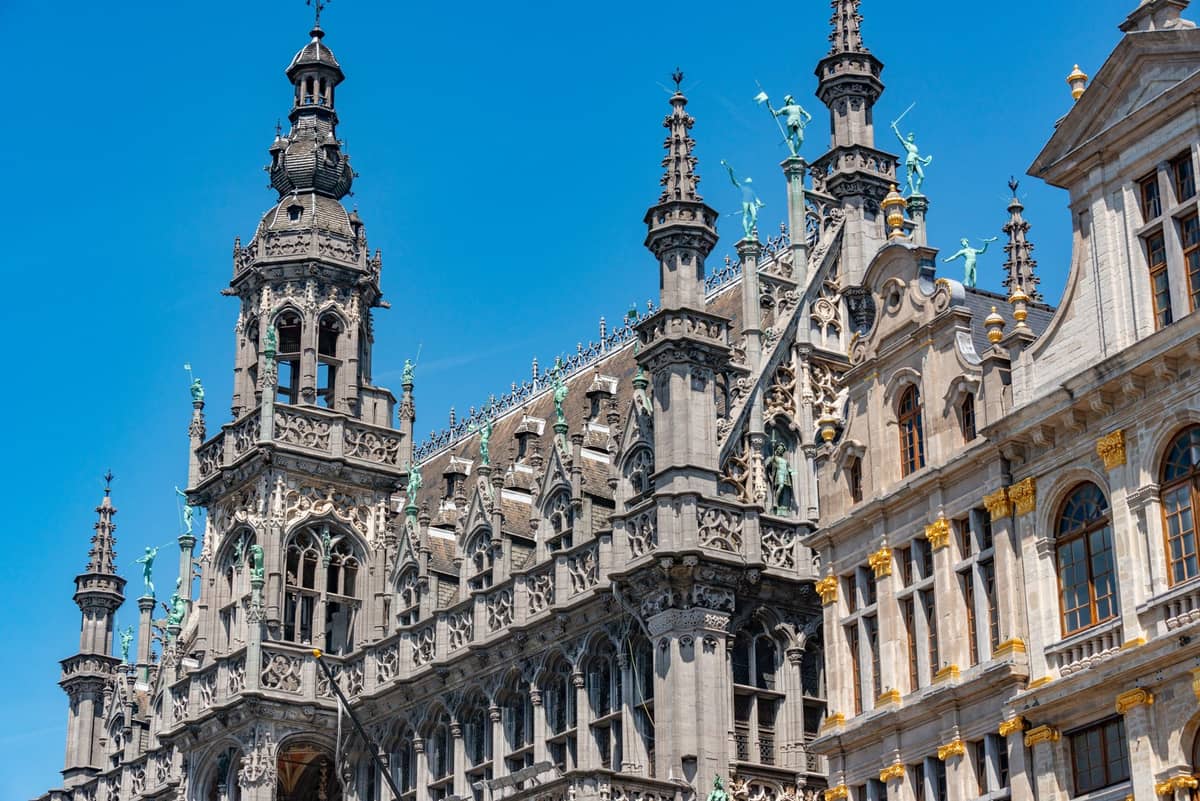
The name is slightly misleading. The Maison du Roi, or 'King's House,' was never a royal residence. In Dutch it is called the Broodhuis, the Bread House, which gets closer to its original function as a market hall and administrative centre. The building you see today on Grand-Place is a 19th-century Neo-Gothic reconstruction, completed between 1873 and 1895, built on the footprint of structures dating to the medieval period. The facade is elaborate and theatrical: pointed arches, ornamental tracery, statuary niches, and a corner turret that photographs well against the cobblestones of the square below.
It sits directly opposite the Brussels Town Hall, the genuine Gothic survivor on the other side of Grand-Place. Seen together, the pair frames the square's central axis, though the Town Hall's spire and asymmetric facade have a rawness that the 19th-century rebuild of the Maison du Roi cannot quite match. Knowing this upfront adjusts expectations usefully: the exterior is impressive, but it is a Victorian interpretation of Gothic rather than the real thing.
The Building at Different Hours
Grand-Place draws dense crowds from mid-morning onward, and the facade of the Maison du Roi is relentlessly photographed from 09:00 to nightfall. For photography, the square faces roughly north-northwest, meaning the Maison du Roi's main facade catches direct light in the late afternoon. By 16:30 in summer, warm low light catches the stone tracery cleanly. At dusk, the building is lit artificially along with the rest of Grand-Place, and the effect is genuinely striking, though by then the museum itself is closed.
The museum opens at 10:00 Tuesday through Sunday. Arriving close to opening time is advisable if you want the upper floors to yourself. The top-floor gallery, which contains the famous Manneken Pis costume collection, becomes crowded by late morning, especially on weekends, when school groups and tour parties fill the stairwells. Weekday mornings in October or November offer the most unhurried experience.
💡 Local tip
The museum is closed every Monday and on five public holidays: 1 January, 1 May, 1 November, 11 November, and 25 December. On 24 December and 31 December it closes at 16:00 instead of 17:00. Plan accordingly.
Tickets & tours
Hand-picked options from our booking partner. Prices are indicative; availability and final rates are confirmed when you complete your booking.
Ghent tour from Brussels
From 43 €Instant confirmationFree cancellationTablet Workshop at Choco-Story Brussels
From 45 €Instant confirmationShared tour of Delft and the Keukenhof Estate from Brussels
From 86 €Instant confirmationFree cancellationOrigins of Brussels exploration game and tour
From 10 €Instant confirmationFree cancellation
What You Will See Inside
The Brussels City Museum covers the history of Brussels across three floors connected by long staircases. The ground floor and lower levels handle the city's urban and commercial development: medieval trade maps, scale models of the city at different periods, guild documents, and artifacts connected to the growth of the Belgian capital. The presentation is methodical rather than immersive, leaning on labels and display cases. It rewards visitors who read carefully, but it is not a high-spectacle digital experience.
The most talked-about section is the collection of costumes belonging to Manneken Pis, the small bronze statue a few streets away. Over centuries, the figurine has been dressed by foreign dignitaries, municipalities, fan clubs, and organisations from across the world, accumulating a wardrobe that currently numbers well over 1,000 outfits. The museum displays a large rotating selection. Some costumes are elaborate national dress from overseas missions; others are miniature versions of professional uniforms or folkloric attire. It is unexpectedly compelling, partly because the sheer volume of the collection reveals something genuine about how a small absurdist symbol became a diplomatic object. A dedicated section also explains the statue's history and the various thefts it has survived.
Other standout pieces include examples of Brussels tapestry from the 15th and 16th centuries, when the city was one of Europe's foremost weaving centres. The collection includes fragments large enough to communicate the scale and technical precision of the craft. There are also works by Pieter Bruegel the Elder's contemporaries connected to Brussels, ceramics, silverwork from the guilds that once occupied Grand-Place, and a set of original sculptural details salvaged before later renovations of the Town Hall across the square.
Historical and Cultural Context
Grand-Place itself was designated a UNESCO World Heritage Site in 1998, and the Maison du Roi is inseparable from that setting. The original structure on this site dates to the early 15th century, when it served as a covered market and later as a seat of ducal administration under the Habsburgs. It was heavily damaged in 1695, when French forces under Marshal Villeroy bombarded Brussels for two days, destroying much of the city centre. Grand-Place was rebuilt with remarkable speed by the guilds, which accounts for the stylistic coherence of the square's surrounding guild houses.
The Maison du Roi was rebuilt more gradually and more radically, reaching its current form in the late 19th century under the direction of architect Victor Jamaer. The Neo-Gothic revival style aligns it with the broader 19th-century effort to give Brussels civic monuments befitting a new national capital: Belgium had only achieved independence in 1830. For more on the architectural context of this era, the Art Nouveau architecture guide to Brussels provides useful background on how the city's built identity evolved across the same decades.
Getting There and Practical Logistics
The museum's address is Grand-Place, 1000 Brussels. The square is pedestrianised and not accessible by car. The two most practical public transport options are Gare Centrale metro station on lines 1 and 5, roughly a five-minute walk south through Rue de la Madeleine, and the Bourse/Beurs premetro tram stop (served by lines 3, 4, 31, 32, 33), a similar walk to the north via Rue au Beurre. Multiple tram lines also stop within easy walking distance.
⚠️ What to skip
Accessibility is a serious limitation. The Maison du Roi has no lift and is explicitly not wheelchair accessible. All three floors are connected only by long staircases. The cobblestoned Grand-Place square also presents difficulty for visitors using mobility aids. Contact the museum directly before visiting if you require adapted access arrangements, including sign language tours available on prior reservation.
If you are arriving in Brussels from abroad, the city is well served by Brussels Airport (BRU) at Zaventem, around 12 km northeast of the centre. Direct SNCB/NMBS trains connect the airport to Brussels-Central station in roughly 17–25 minutes. For full transport options from the airport, the Brussels airport transport guide covers current fares and routes in detail.
Photography, Rainy Days, and Who Might Not Enjoy This
The interior lighting in the museum is functional rather than atmospheric. A camera or phone with decent low-light performance handles the display cases reasonably well. Photography of the exhibits is generally permitted for personal use, but check posted notices on each floor. The real photographic opportunity is outside: the facade of the Maison du Roi is best framed from the centre of the square, where the full height and width of the building comes into view without distortion.
The museum is one of the better choices for a rainy day in Brussels. The Brussels rainy day guide lists other indoor options nearby, several of which can be combined into a single afternoon in the city centre.
Visitors expecting a state-of-the-art interactive experience will likely find the museum slightly dated in its presentation. Display panels and descriptive labels do most of the interpretive work. Families with young children may find the content engages older children more effectively than toddlers. The stair-only access also makes it impractical for pushchairs. Visitors pressed for time who are already familiar with Belgian history may prefer to spend the same hour at the Royal Museums of Fine Arts or the Magritte Museum a short walk uphill.
Tickets and Visitor Information Summary
Adult admission is €10. Seniors aged 65 and over pay €7. Students, job seekers, teachers, and Brussels City residents pay €5 with valid proof. Groups of 12 or more pay €7 per person without a guide. The MuseumPassMusées, priced at €64.95, covers entry here along with many other Brussels museums and grants free entry for pass holders under the conditions specified. Certain categories, including staff of the City of Brussels, have free entry under specific conditions confirmed at the door.
If the Brussels City Museum is one stop on a wider museum itinerary, the guide to Brussels's best museums can help you sequence visits efficiently and identify which pass offers the best return for your plans.
Insider Tips
- The top-floor Manneken Pis costume gallery fills up fast on weekend mornings when tour groups arrive. Head directly upstairs when you enter and work your way back down, rather than following the suggested floor-by-floor route.
- The best exterior photographs of the Maison du Roi's facade are taken from the south side of Grand-Place, roughly in front of the guild houses opposite. Late afternoon in summer or after a rain shower, when the cobblestones reflect light, produces noticeably better results.
- If you hold a Brussels Card or MuseumPassMusées, confirm at the entrance that it covers your specific ticket category. Some concession prices apply only with Belgian ID or specific documentation.
- The museum closes for five public holidays and has an early 16:00 close on Christmas Eve and New Year's Eve. Checking the official site calendar before a holiday-period visit avoids a wasted trip.
- Grand-Place itself is loudest and most crowded between 11:00 and 15:00. If you visit the museum during that window, the square will feel quieter after 17:00 once you exit, making for a more relaxed stroll around the surrounding guild houses.
Who Is Maison du Roi (Brussels City Museum) For?
- History-focused travellers wanting context for what Grand-Place and Brussels actually represent beyond a photogenic square
- Anyone curious about the Manneken Pis story beyond the statue itself, including its costume collection and diplomatic history
- Visitors seeking a weather-proof indoor option in the city centre without trekking to another neighbourhood
- Architecture enthusiasts interested in 19th-century Neo-Gothic civic buildings as a category distinct from medieval originals
- Travellers combining a museum visit with a broader Grand-Place walk and a tour of nearby guild houses
Nearby Attractions
Other things to see while in Grand-Place & Îlot Sacré:
- Belgian Comic Strip Center
Housed in a Victor Horta-designed Art Nouveau masterpiece, the Belgian Comic Strip Center tells the story of Belgium's extraordinary contribution to comic art. From Tintin to the Smurfs, this is one of Brussels's most rewarding museum experiences for visitors of almost any age.
- Brussels Beer Museum
Tucked into the cellars of a baroque guild house on the Grand-Place, the Belgian Brewers Museum (Musée des Brasseurs belges) tells the story of Belgian brewing through historic equipment, documents, and a glass of beer included with your €5 ticket. Small, unhurried, and genuinely atmospheric, it rewards curiosity about one of Belgium's defining cultural exports.
- Brussels Town Hall (Hôtel de Ville)
The Brussels Town Hall, or Hôtel de Ville de Bruxelles, is the Gothic building that has anchored the UNESCO-listed Grand-Place for centuries. Interior access is by guided tour only, making advance planning essential. The exterior, however, is free to admire at any hour.
- Cathedral of St. Michael and St. Gudula
Rising above a broad flight of stone steps just minutes from Grand-Place, the Cathedral of St. Michael and St. Gudula is the most architecturally significant church in Belgium. Entry to the main nave is free, the stained-glass windows are among the finest in Northern Europe, and the atmosphere shifts dramatically between early morning quiet and afternoon tour-group activity.