Manneken Pis: Brussels's Tiny Icon and What It Really Tells You About the City
A 55-centimeter bronze boy urinating into a fountain has become the defining symbol of Brussels — and that says something important about this city's sense of humor. Manneken Pis is free, open 24/7, and worth a few minutes of your time, even if the statue itself will surprise you with its scale., and genuinely worth a few minutes of your time, even if the statue itself will surprise you with its scale.
Quick Facts
- Location
- Corner of Rue de l'Étuve and Rue du Chêne, 1000 Brussels (Grand-Place / Îlot Sacré)
- Getting There
- Metro Bourse (lines 3/4) or Gare Centrale, then a short walk through the city centre
- Time Needed
- 5–15 minutes for the statue itself; 45–60 minutes if you include GardeRobe MannekenPis
- Cost
- Free to view the outdoor statue. GardeRobe MannekenPis museum charges separate admission — verify current prices at mannekenpis.brussels
- Best for
- First-time visitors, families, and anyone curious about Brussels's civic identity and folklore
- Official website
- www.mannekenpis.brussels/en
What You're Actually Looking At
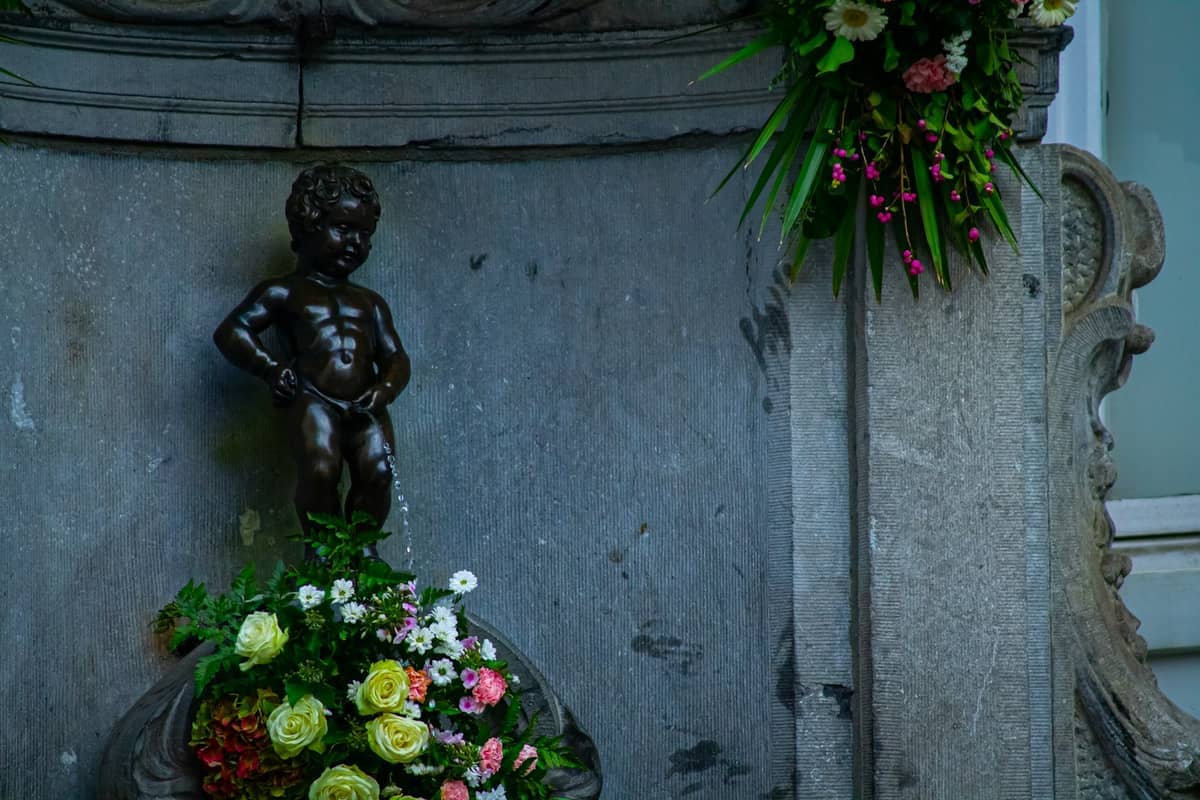
Manneken Pis is a bronze fountain statue of a small naked boy urinating into a basin below. It stands at the corner of Rue de l'Étuve and Rue du Chêne, a short walk southwest of the Grand-Place. The statue measures approximately 55.5 centimeters in height — about 61 centimeters including the base. The very first thing most visitors say when they arrive is some version of: 'That's it?'. The statue measures approximately 55.5 centimeters in height — about 61 centimeters including the base. The very first thing most visitors say when they arrive is some version of: 'That's it?'
Yes, that's it. And part of what makes this attraction interesting is precisely that gap between expectation and reality. Brussels has knowingly placed one of its smallest sculptures in one of its most prominent tourist spots, and the locals find this entirely appropriate. The Brusseleir — the traditional Brussels native — has always prided themselves on irreverence and self-mockery. Manneken Pis is not an accident of tourism; it is a deliberate civic statement.
ℹ️ Good to know
The statue you see today is not the original. The current version was created by Brabant sculptor Jérôme Duquesnoy the Elder and installed in 1619. The fountain's presence on this corner is documented as far back as the mid-15th century, though earlier versions no longer exist.
Historical and Cultural Context
The fountain has stood at or near this corner since at least the 1400s, making it one of the longest-serving public monuments in the city. Its practical function was originally to supply water to the surrounding neighborhood, a common arrangement in medieval cities. Over time, the utilitarian fountain became a symbol of the city itself, and Brussels invested it with an extraordinary amount of civic meaning.. Its practical function was originally to supply water to the surrounding neighborhood, a common arrangement in medieval cities. Over time, the utilitarian fountain became a symbol of the city itself, and Brussels invested it with an extraordinary amount of civic meaning.
The tradition of dressing the statue in costumes dates to the mid-18th century, when Louis XV of France reportedly gifted the figure an embroidered suit as a gesture of goodwill after Belgian soldiers were offended by French troops treating the statue disrespectfully. Today, Manneken Pis has a wardrobe exceeding 1,000 outfits — including uniforms donated by foreign dignitaries, clubs, embassies, and official visitors. On designated days throughout the year, city staff dress the statue in a new costume, sometimes accompanied by a small ceremony., when Louis XV of France reportedly gifted the figure an embroidered suit as a gesture of goodwill after Belgian soldiers were offended by French troops treating the statue disrespectfully. Today, Manneken Pis has a wardrobe exceeding 1,000 outfits — including uniforms donated by foreign dignitaries, clubs, embassies, and official visitors. On designated days throughout the year, city staff dress the statue in a new costume, sometimes accompanied by a small ceremony.
The full wardrobe is displayed at the GardeRobe MannekenPis museum on Rue du Chêne 19, just steps from the statue itself. If you want to understand why this small figure matters so much to Brussels, spending time in that museum is far more rewarding than standing in front of the fountain for ten minutes.
Tickets & tours
Hand-picked options from our booking partner. Prices are indicative; availability and final rates are confirmed when you complete your booking.
Brussels self-guided audio tour with Train World ticket
From 28 €Instant confirmationGhent tour from Brussels
From 43 €Instant confirmationFree cancellationTablet Workshop at Choco-Story Brussels
From 45 €Instant confirmationShared tour of Delft and the Keukenhof Estate from Brussels
From 86 €Instant confirmationFree cancellation
The Experience at Different Times of Day
The statue is accessible at all hours, every day of the year. The corner is lit at night, and the fountain runs continuously. But the character of a visit changes dramatically depending on when you arrive.
Between roughly 10am and 5pm in summer, the surrounding block fills with tour groups. The narrow junction of Rue de l'Étuve and Rue du Chêne is not designed for large numbers of people all trying to photograph a small object at once. Guides hold up umbrellas, coaches idle on nearby streets, and souvenir shops selling chocolate, waffles, and Manneken Pis bottle openers occupy every available storefront. It is loud, compact, and occasionally difficult to get a clear view.
Early morning — before 9am — the corner is almost quiet. The fountain still runs, the cobblestones are still damp from overnight rain in the cooler months, and you can stand directly in front of the niche for as long as you want without anyone crowding you. This is genuinely the best time to see it. The surrounding streets of the Îlot Sacré also have more atmosphere at this hour: bakers are opening, delivery trucks navigate the narrow lanes, and the city feels like it belongs to its residents rather than its visitors.
Evening visits, especially after 8pm in summer, are also calm. The souvenir shops close, and the street takes on a quieter character. The ambient smell of waffles and fried food fades. The statue looks slightly different in artificial light — the bronze surface catches it differently than daylight, and the water sounds more prominent when there's less background noise.
💡 Local tip
Check the official costume calendar at mannekenpis.brussels before you visit. On days when the statue is being dressed in a new outfit, a small crowd gathers for the event itself, which is genuinely more interesting than a standard visit.
Getting There and Navigating the Area
From the Grand-Place, walk south along Rue Charles Buls, then turn right onto Rue de l'Étuve. The statue is at the end of a short walk, roughly 300 meters. You cannot miss the cluster of souvenir shops announcing your arrival before you even see the fountain.. You cannot miss the cluster of souvenir shops announcing your arrival before you even see the fountain.
By metro, the closest stop is Bourse on lines 1 and 5, which places you about a seven-minute walk away through the city centre. Gare Centrale (Brussels-Central station) is also walkable in under ten minutes. The area sits within the Grand-Place and Îlot Sacré neighborhood, a largely pedestrianized historic core where most visitors spend the bulk of their time in central Brussels.
The pavement around the fountain is flat and step-free, making it accessible for wheelchair users and those with pushchairs. The surrounding streets are narrow, however, and during peak hours the volume of foot traffic creates practical difficulties regardless of mobility.
Photography Notes
The statue sits in a niche in the wall at roughly eye level, framed by a small stone surround. It photographs well from directly in front, but the surrounding crowd often makes this difficult during daytime. A slight angle from the left tends to eliminate the worst of the tourist-shop signage in the background.
In wet weather, the cobblestones produce reflections that add something to the scene. Brussels has a temperate maritime climate with rainfall distributed throughout the year, so there is a reasonable chance of encountering damp conditions — especially from October through February, when temperatures drop to single digits and the streets are wet more often than not. Bring a light waterproof layer regardless of season.
What Else Is Nearby
The Grand-Place is a three-minute walk northeast and should anchor any visit to this area. It is one of the most architecturally coherent medieval squares in Europe, and the contrast between its scale and Manneken Pis's scale is part of what makes the pairing interesting.
Two lesser-known companion statues complete a loose trilogy of Brussels's urinating monuments: Jeanneke Pis (a girl, installed in 1987, on Impasse de la Fidélité near Rue des Bouchers) and Zinneke Pis (a dog, installed in 1998, on Rue des Chartreux). Neither attracts the same crowds as Manneken Pis, and both are worth the short detour if you find the humor in the original.
For context on Brussels's broader historic and architectural identity, the Brussels Town Hall on the Grand-Place dates to the 15th century and offers guided interior visits on certain days. The Maison du Roi opposite it houses the Brussels City Museum, which includes additional historical material on Manneken Pis's role in civic life.
Honest Assessment: Is It Worth Your Time?
If you have one day in Brussels and need to prioritize, Manneken Pis should not be at the top of your list. The Grand-Place, the Galeries Saint-Hubert, or the Sablon neighborhood will each offer a richer hour than standing in front of a 55-centimeter bronze figure surrounded by souvenir shops.
That said, dismissing it entirely misses the point. Manneken Pis has been a reference point in Brussels's civic identity for over four centuries. The costume tradition, the legends attached to it, and the city's deliberate maintenance of it as a primary symbol all say something genuine about how Brussels understands itself. Spending ten minutes here — especially if you then walk into the GardeRobe museum — is a more revealing cultural experience than it first appears.
⚠️ What to skip
Travelers who come expecting a grand monument will be disappointed. The statue is genuinely small. If your visit to Brussels is already feeling rushed, this is one attraction where a quick look on your way to the Grand-Place is entirely sufficient.
Insider Tips
- Arrive before 9am or after 8pm (in summer) to see the fountain without the midday crowd. The surrounding streets of the Îlot Sacré are worth exploring at these quieter hours too.
- Check the official costume calendar at mannekenpis.brussels before you visit. Dressing ceremonies happen throughout the year and include military uniforms, regional folk costumes, and outfits from visiting foreign organizations — the event itself is often more memorable than the statue.
- The GardeRobe MannekenPis museum at Rue du Chêne 19 displays over 1,000 costumes and provides genuine historical depth. It transforms what is otherwise a brief photo stop into something worth your time.
- Walk the full 'Pis route' if you enjoy the city's self-aware humor: Manneken Pis, Jeanneke Pis on Impasse de la Fidélité, and Zinneke Pis on Rue des Chartreux form a loose triangle across the city centre — all within a 15-minute walk of each other.
- The souvenir shops on Rue de l'Étuve range from expensive to very expensive for what they are. If you want Belgian chocolate, walk two minutes to the Grand-Place area where you have far more options at comparable or better quality.
Who Is Manneken Pis For?
- First-time visitors to Brussels completing the city's central landmarks
- Families with children who respond well to the statue's irreverent subject matter
- Travelers interested in European civic symbolism and folk traditions
- Anyone walking the Grand-Place area who wants to add ten minutes to their route
- Photography enthusiasts interested in urban scale and crowd dynamics
Nearby Attractions
Other things to see while in Grand-Place & Îlot Sacré:
- Belgian Comic Strip Center
Housed in a Victor Horta-designed Art Nouveau masterpiece, the Belgian Comic Strip Center tells the story of Belgium's extraordinary contribution to comic art. From Tintin to the Smurfs, this is one of Brussels's most rewarding museum experiences for visitors of almost any age.
- Brussels Beer Museum
Tucked into the cellars of a baroque guild house on the Grand-Place, the Belgian Brewers Museum (Musée des Brasseurs belges) tells the story of Belgian brewing through historic equipment, documents, and a glass of beer included with your €5 ticket. Small, unhurried, and genuinely atmospheric, it rewards curiosity about one of Belgium's defining cultural exports.
- Brussels Town Hall (Hôtel de Ville)
The Brussels Town Hall, or Hôtel de Ville de Bruxelles, is the Gothic building that has anchored the UNESCO-listed Grand-Place for centuries. Interior access is by guided tour only, making advance planning essential. The exterior, however, is free to admire at any hour.
- Cathedral of St. Michael and St. Gudula
Rising above a broad flight of stone steps just minutes from Grand-Place, the Cathedral of St. Michael and St. Gudula is the most architecturally significant church in Belgium. Entry to the main nave is free, the stained-glass windows are among the finest in Northern Europe, and the atmosphere shifts dramatically between early morning quiet and afternoon tour-group activity.