Zinneke Pis: Brussels' Irreverent Bronze Dog and What It Really Means
Zinneke Pis is a small bronze dog caught mid-urination on a street corner in Brussels' Dansaert district. Free to visit at any hour, it completes the city's trio of peeing statues and carries a surprisingly meaningful message about Brussels' identity as a cosmopolitan, mixed city.
Quick Facts
- Location
- Rue des Chartreux 35, corner of Rue du Vieux Marché aux Grains, 1000 Brussels
- Getting There
- Walk from Brussels-Central station; tram and bus stops at Bourse/Beurs and De Brouckère are within about 5–10 minutes on foot
- Time Needed
- 5–15 minutes to view; pair with the Dansaert neighborhood for a half-day walk
- Cost
- Free. No tickets, no barriers, no opening hours.
- Best for
- Curious walkers, Brussels completionists, families with children, and anyone interested in public urban art
- Official website
- www.zinnekepis.com/en
What Is Zinneke Pis?
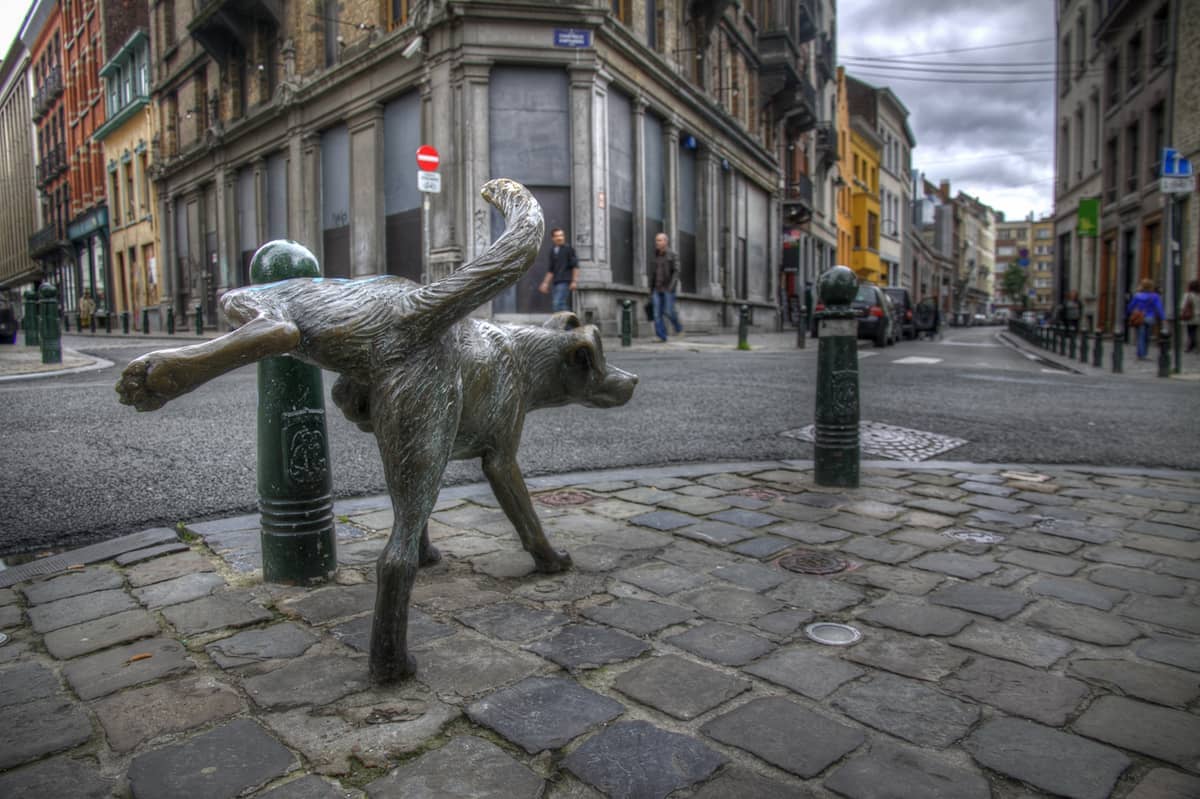
Zinneke Pis is a bronze sculpture of a scruffy mongrel dog lifting its leg against a street bollard, installed in 1999 at the corner of Rue des Chartreux and Rue du Vieux Marché aux Grains. The work was created by Belgian sculptor Tom Frantzen and is the third and least-known entry in Brussels' informal trilogy of peeing statues, joining the famous Manneken Pis and the lesser-visited Jeanneke Pis. Unlike its counterparts, Zinneke Pis never received centuries of royal dressings or tourist infrastructure. It simply stands on a residential street corner in the Dansaert area, doing exactly what a city dog would do.
The name carries more weight than it first appears. 'Zinneke' is a Brusselian dialect word for a mongrel or mixed-breed dog, but it also echoes the Zenne, the river that once flowed through central Brussels before being covered over in the 19th century. Historically, the 'zinneke' was an insult hurled at working-class Brussels residents who lived near the river's banks, the kind of people considered impure or mixed in origin. Over time, Brusselers reclaimed the word as a badge of pride, a symbol of the city's genuinely cosmopolitan and cross-cultural character. The statue, in that context, is less a joke and more a quiet manifesto. You can learn more about the area in our guide to the Dansaert-Saint-Géry neighborhood.
ℹ️ Good to know
Zinneke Pis is accessible 24 hours a day, every day of the year. There is no entry fee, no queue, and no ticket office. It sits on a public pavement like any other street sculpture.
The Sculpture Up Close
Tom Frantzen, the Belgian sculptor behind Zinneke Pis, rendered the dog in cast bronze with a level of detail that rewards a close look. The animal is mid-squat, one hind leg raised with anatomical precision, its tail lifted and its expression suggesting complete indifference to passersby. The patina on the bronze shifts from warm brown at the base to a greener tone toward the bollard, a natural effect of exposure to Brussels' damp Atlantic climate.
The scale is deliberately modest. Zinneke Pis is roughly life-sized for a medium-sized mutt, which means it sits low to the ground and can be easily missed if you walk past without looking down. Children tend to find it immediately, while adults on their phones often walk straight past. This is part of the sculpture's low-key appeal: it rewards attention without demanding it.
Tickets & tours
Hand-picked options from our booking partner. Prices are indicative; availability and final rates are confirmed when you complete your booking.
Brussels self-guided audio tour with Train World ticket
From 28 €Instant confirmationGhent tour from Brussels
From 43 €Instant confirmationFree cancellationTablet Workshop at Choco-Story Brussels
From 45 €Instant confirmationShared tour of Delft and the Keukenhof Estate from Brussels
From 86 €Instant confirmationFree cancellation
How the Experience Changes by Time of Day
Morning is the most atmospheric time to visit. The Rue des Chartreux is a working street used by locals heading to the covered market and independent shops nearby. At 8 or 9 in the morning, the light comes in at a low angle that catches the texture of the bronze clearly, and there are almost no other tourists in sight. The street smells of bread from a nearby bakery and the faint diesel of delivery vehicles. This is when Zinneke Pis feels most like what it is: a neighborhood sculpture, not a tourist attraction.
By midday on weekends, the area picks up foot traffic from people exploring the Dansaert shopping corridor and heading toward the Saint-Géry quarter. The statue still rarely draws crowds the way the Manneken Pis does, but you may find a small cluster of people photographing it. Afternoons in summer bring the strongest light, which can create harsh reflections on the polished bronze, making photos less flattering.
At night, the street is quiet and the immediate corner is lit only by ambient streetlight. The sculpture is visible but the area can feel deserted after shops close. There is nothing to worry about safety-wise on this particular corner, but there is also no particular reason to seek out Zinneke Pis after dark unless you are already passing through.
Getting There and Finding It
The official address is Rue des Chartreux 35, but the statue stands on the corner with Rue du Vieux Marché aux Grains, so you will find it by looking for the corner bollard rather than searching for a number on a door. The walk from Brussels-Central station takes approximately 12–15 minutes on foot through the pedestrianised city centre. From Grand-Place, head northwest along Rue des Chartreux and you will reach it in about 8–10 minutes.
Several tram and bus lines run along nearby streets. The STIB/MIVB network serves this part of central Brussels well, and if you are combining this visit with a walk through the Halles Saint-Géry and the broader Saint-Géry area, the whole route is manageable entirely on foot. No dedicated public transport stop exists directly at the statue.
💡 Local tip
The statue is at street level on a standard pavement. There are no steps to navigate, but the surrounding streets have typical Brussels cobblestones, which can be uneven. Flat-soled shoes are advisable if you are walking the broader Dansaert circuit.
The Trio of Peeing Statues: Brussels' Running Joke with Layers
To fully appreciate Zinneke Pis, it helps to understand its place in a deliberate civic comedy. The Manneken Pis, a small bronze boy urinating into a fountain near the Grand-Place, has been a city symbol since at least the 17th century, though the current statue dates to 1619. It has accumulated hundreds of costumes, a dedicated wardrobe museum, and enough mythology to fill several books. Then came Jeanneke Pis, added in 1987 in the Ilot Sacré district: a girl in the same posture, installed as a feminist counterpoint and a comment on the male-dominated history of public art. Zinneke Pis arrived in 1999 to complete the set with an animal, escalating the absurdity to its logical conclusion.
The three statues form an unofficial pilgrimage circuit that takes a few hours to walk comfortably, and there are printed maps and small souvenir items referencing all three. Completing the circuit is a pleasantly low-stakes way to cover several neighborhoods of central Brussels on foot, and each statue sits in a genuinely different type of urban environment: the crowded tourist core near Grand-Place, the quieter Ilot Sacré alley, and the residential-commercial Dansaert corner.
Photography Tips
The best shots place the dog in the context of the street rather than isolating it as a bronze object. Step back a few meters and include the bollard, the cobblestones, and if possible a passing cyclist or pedestrian for scale. The sculpture's low profile means you will get the cleanest composition by crouching to roughly dog-height, which also avoids the unflattering overhead angle that flattens the detail.
Overcast days are better than direct sun for photographing bronze: the diffuse light captures the patina tones evenly without blown highlights. If you arrive on a bright afternoon and the surface is glaring, simply wait a few minutes for a cloud to pass, which is rarely a long wait in Brussels.
⚠️ What to skip
Avoid touching or climbing on the statue. The bronze surface is treated and repeated handling can accelerate oxidation. The City of Brussels maintains the piece and repeated physical contact damages the finish over time.
Is Zinneke Pis Worth Your Time?
If you are expecting a major attraction, this is not it. The statue is small, there are no facilities, no explanatory panels, no souvenir kiosk. For a visitor with only one or two days in Brussels, Zinneke Pis is best treated as a bonus stop rather than a primary destination. It is not worth a dedicated trip across the city unless you are specifically completing the peeing statues circuit.
Where it earns its place is as part of a longer walk through the Dansaert area. The neighborhood has good independent coffee shops, Belgian design boutiques, and a character that is noticeably different from the tourist density around the Grand-Place. Combining Zinneke Pis with a coffee stop on nearby streets and a look at the architecture around Rue Antoine Dansaert makes for a satisfying 2-hour loop. The statue itself takes five minutes to see and photograph, but the detour to reach it introduces you to a part of Brussels that many visitors miss entirely. If you want to plan that walk properly, the Brussels walking tours guide covers itineraries that pass through this quarter.
People who will not enjoy this: anyone who needs a narrative or educational experience, visitors with very limited time who should prioritize the city's major museums and landmarks, or travelers who find the Manneken Pis concept tired to begin with. There is nothing more here than a clever small sculpture on a quiet corner, and that is precisely its point.
Insider Tips
- Look for the small plaque near the base that identifies the sculptor and the year. Most visitors photograph the dog and leave without reading it, but it at least confirms who created the statue and when.
- If you are walking from Grand-Place, take Rue des Chartreux the entire way rather than cutting through the shopping streets. The street changes character notably as you move northwest: from tourist-facing to genuinely local, and passing several independent food shops worth noting.
- The Zinneke Parade, an arts and multicultural street parade held every two years in Brussels, shares its name with the same mongrel identity celebrated by the statue. If your visit coincides with a parade year, it is worth looking up the schedule before arrival.
- There is a coffee bar within a short walk on the Dansaert axis that opens early and serves one of the better flat whites in central Brussels. It is worth timing your Zinneke visit with a morning coffee rather than treating it as a standalone errand.
- The corner where the statue stands is also a reasonable reference point for finding the covered Marché aux Grains area, which has a small fresh produce market on certain days of the week. Check local market schedules before your visit if you want to combine the two.
Who Is Zinneke Pis For?
- Travelers doing the full Manneken Pis, Jeanneke Pis, and Zinneke Pis circuit
- Families with young children who find the absurdity immediately funny
- Urban art and public sculpture enthusiasts interested in contemporary Belgian work
- Visitors exploring the Dansaert district on foot and looking for an easy waypoint
- Photographers wanting a low-traffic, character-rich Brussels street scene
Nearby Attractions
Other things to see while in Dansaert & Saint-Géry:
- Belgian Beer World
Belgian Beer World opened in September 2023 inside the grand Brussels Stock Exchange on Boulevard Anspach, turning 12,000 square metres of one of the city's most recognisable buildings into an immersive journey through Belgian brewing culture. It combines interactive storytelling, tasting, and a rooftop bar in a setting that no other beer attraction in the country can match.
- The Bourse (Brussels Stock Exchange)
The Brussels Stock Exchange, officially the Bourse de Bruxelles, is a grand 19th-century neoclassical landmark that has reinvented itself as a cultural venue at the heart of the Belgian capital. Today it houses the Belgian Beer World experience, a medieval archaeological site, and free public galleries beneath one of Brussels' most photographed facades.
- Église Saint-Jean-Baptiste au Béguinage
The Église Saint-Jean-Baptiste au Béguinage is a notable surviving example of Flemish Baroque architecture in Brussels, built between 1657 and 1676 on the site of a medieval beguinage. Free to enter and just minutes from the canal district, it rewards visitors who slow down long enough to look up.
- Halles Saint-Géry
Halles Saint-Géry is a landmark 19th-century covered market hall on Place Saint-Géry, at the geographic and cultural heart of Brussels' Dansaert quarter. Free to enter and open daily, it functions as a heritage exhibition centre, event venue, and social gathering space that genuinely earns its place in the city's civic life.