Église Saint-Jean-Baptiste au Béguinage: Brussels' Most Underrated Baroque Church
The Église Saint-Jean-Baptiste au Béguinage is a notable surviving example of Flemish Baroque architecture in Brussels, built between 1657 and 1676 on the site of a medieval beguinage. Free to enter and just minutes from the canal district, it rewards visitors who slow down long enough to look up.
Quick Facts
- Location
- Place du Béguinage / Begijnhofplein, 1000 Brussels (Dansaert–Saint-Géry)
- Getting There
- Sint-Katelijne (metro/tram) – approx. 2 min walk; De Brouckère (metro) – approx. 5 min walk
- Time Needed
- 30–60 minutes
- Cost
- Free admission
- Best for
- Architecture enthusiasts, history lovers, those seeking quiet in the city centre
What You're Actually Looking At
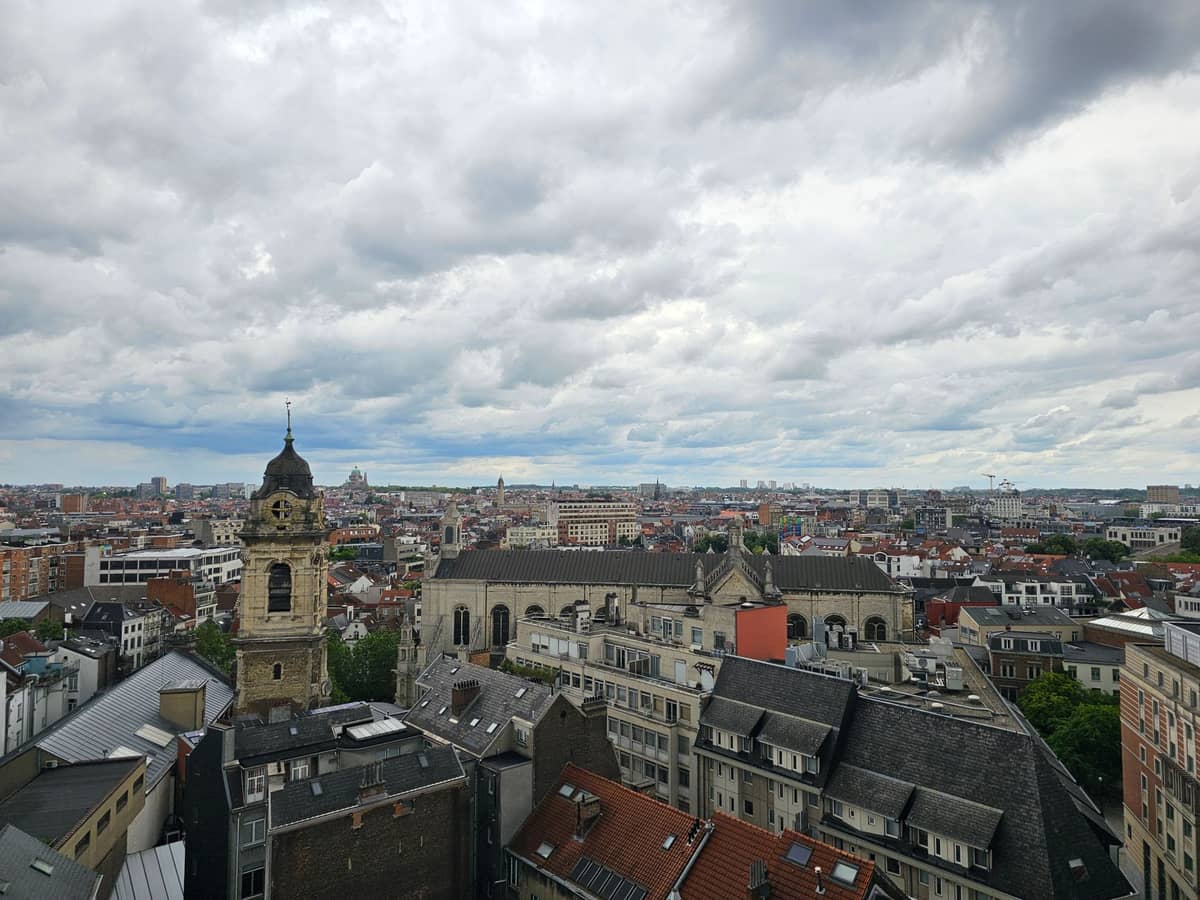
The Église Saint-Jean-Baptiste au Béguinage sits at the edge of a quiet cobbled square just north of the canal, and its facade stops you cold the moment you turn the corner. Three tiers of scrolled pilasters, carved stone saints, and layered cornices rise above a neighbourhood that otherwise runs to sandwich shops and cycle lanes. It is the kind of building that makes you recalibrate what you expected from this part of the city.
Construction ran from 1657 to 1676, placing this church firmly within the Counter-Reformation Baroque architecture of the southern Low Countries. The style is specifically Flemish Baroque: exuberant but controlled, where ornament follows a clear structural logic rather than spilling into excess. The facade is tripartite, with the central bay projecting forward and the flanking bays stepping back in a rhythm that creates genuine depth and shadow, even on overcast days.
Inside, the Latin-cross plan opens into a tall, luminous nave with white-plastered walls, dark wooden confessionals carved with considerable skill, and a pulpit that dates from the late 17th century. The ceiling vaulting is painted in soft tones, and natural light enters through high windows that keep the interior bright without the glare that ruins so many photographs in Southern European churches.
💡 Local tip
Arrive between 11:00 and 13:00 on a weekday for the most favourable interior light and the fewest other visitors. The square outside is largely empty at this hour, giving you a clear view of the facade without tour groups in the frame.
The Beguinage Behind the Church
The church is the last significant remnant of the Béguinage Notre-Dame de la Vigne, a beguinage founded in the 13th century. Beguinages were semi-monastic communities for lay women, primarily widows and unmarried women of modest means, who lived communally and followed a religious rule without taking permanent vows. Brussels once had one of the largest such communities in the Low Countries, housing hundreds of beguines at its peak.
By the time construction of the current church began in the mid-17th century, the beguinage was already in decline. The church itself was built partly as a statement of Catholic confidence during the Counter-Reformation, when the Spanish Habsburg administration in the Low Countries was actively commissioning religious architecture to reassert the faith. The architect is believed to have been Luc Fayd'herbe, a sculptor-turned-architect from Mechelen who studied under Rubens, though attributions from this period can be contested.
Understanding this context helps explain why the church feels slightly oversized for its square. It was not built to serve a small parish quietly; it was built to make a visual argument. For more on how religious architecture shaped Brussels' urban fabric, the Cathedral of St. Michael and St. Gudula offers a useful contrast in Gothic scale and civic ceremony, while the beguinage church represents the Baroque response to that tradition.
Tickets & tours
Hand-picked options from our booking partner. Prices are indicative; availability and final rates are confirmed when you complete your booking.
Ghent tour from Brussels
From 43 €Instant confirmationFree cancellationTablet Workshop at Choco-Story Brussels
From 45 €Instant confirmationShared tour of Delft and the Keukenhof Estate from Brussels
From 86 €Instant confirmationFree cancellationOrigins of Brussels exploration game and tour
From 10 €Instant confirmationFree cancellation
How the Experience Changes by Time of Day
The church is generally open at 11:00 Tuesday through Saturday and at 14:00 on Sundays; it is closed on Mondays. The hours are shorter than many visitors expect, and the gap between Sunday opening and the morning rush means you cannot simply drop in on a whim. Planning matters here.
Early afternoon on a weekday is the optimal visit window. The square outside, Place du Béguinage, is calm at this hour: a few locals cutting through, perhaps a market delivery to one of the surrounding cafes, pigeons working the cobblestones. The church interior at this time carries a particular quality of silence that is distinct from the silence of emptiness. There are usually a handful of other visitors, sometimes a person praying in a side pew, and the wood and stone hold a faint smell of cold incense that has accumulated over centuries.
Later in the afternoon, especially on weekends, foot traffic from the nearby Halles Saint-Géry area and the canal spills toward the square, and visitor numbers pick up noticeably. The church is not crowded by Brussels standards, but the intimate quality of the space is more easily disrupted here than in larger churches. Sunday afternoons in summer can feel rushed; arriving close to 14:00 when doors open is the better strategy.
⚠️ What to skip
Opening hours are reported as Tuesday–Saturday 11:00–17:00 and Sunday 14:00–17:00, but several visitor accounts note occasional unannounced closures for religious services or maintenance. If the church is central to your itinerary, check current status via the Flemish Masters in Situ venue page before visiting.
Getting There and Moving On
The Sint-Katelijne metro and tram stop is approximately three to four minutes on foot from the church, making this one of the easiest major architectural sites in Brussels to reach without navigating the older streets of the city centre. From De Brouckère metro station, the walk takes around five minutes through a straightforward grid of streets. Both stations are served by Brussels' STIB/MIVB public transport network.
The church sits in the Dansaert–Saint-Géry neighbourhood, which positions it naturally within a longer walking circuit. The Halles Saint-Géry are a five-minute walk south, and the canal and its developing cultural institutions lie a short distance to the west. To the east, the Grand-Place is roughly ten minutes on foot through the lower city. This location makes the Béguinage church an ideal first or last stop on a day that covers both the historic core and the canal district.
Accessibility at the church is noted as good, with easy access for visitors with mobility requirements. The square itself is flat cobblestone, which can be uneven in places, but the entrance to the church presents no significant barrier. There are no steps at the main door.
Photography and What to Focus On
The facade is best photographed in morning light (when the sun catches the western-facing stonework) or on bright overcast days, which eliminate harsh shadows and reveal the carved detail more evenly. The square is wide enough to capture the full facade with a standard lens, though a slight wide-angle helps. Watch the foreground: parked bicycles and delivery vehicles can clutter the lower third of the frame, particularly between 09:00 and 11:00 before the church opens.
Inside, photography is generally permitted, but tripods and flash are inappropriate in active places of worship. The nave looking toward the choir, the dark wooden confessionals against white plaster walls, and the detail of the painted vault are the most rewarding subjects. The contrast between the dark woodwork and bright walls is high enough that phone cameras may struggle; a camera with manual exposure control handles it significantly better.
Honest Assessment: Is It Worth Your Time?
The Église Saint-Jean-Baptiste au Béguinage is not Brussels' most famous church, and it lacks the civic spectacle of the Cathedral of St. Michael and St. Gudula or the sheer improbability of the Basilica of the Sacred Heart at Koekelberg. What it offers instead is architectural coherence: a single building in a single style, executed with precision, in a setting that has not been overwhelmed by tourism.
For a traveller with a genuine interest in European Baroque architecture, this church is among the best examples of its type anywhere in Belgium, and the free admission and short visiting time make the calculus easy. For a traveller who is primarily interested in museums, food, or nightlife, it is a pleasant fifteen-minute detour rather than a destination in itself.
Those who are working through Brussels' broader architectural heritage should consider pairing this visit with the Horta Museum in Saint-Gilles, which represents the Art Nouveau counterpoint to the Baroque tradition. The two buildings span roughly two and a half centuries of Belgian architectural ambition and together make a coherent day.
ℹ️ Good to know
The church is an active parish. Masses are held regularly, and visitors during a service should observe discretion, keep movement to the rear of the nave, and avoid using cameras. The church's spiritual function takes precedence over its role as an attraction.
Insider Tips
- The square itself, Place du Béguinage, is worth five minutes of attention before you enter. The proportions of the open space relative to the facade height were deliberate: the Baroque design assumes you approach across open ground, not through a narrow alley. Standing at the far edge of the square gives you the view the architects intended.
- The confessionals along the nave walls are among the finest pieces of 17th-century ecclesiastical woodwork in Brussels. Each cabinet is carved differently, and the craftsmanship in the upper panels is easy to miss if you walk straight toward the choir. Slow down along the side aisles.
- Tuesday mornings are often a quiet visiting window of the week. Sunday afternoons can attract more visitors, partly due to the later opening time concentrating arrivals.
- The neighbourhood around the church is bilingual in daily life, and the church's official name appears in both French (Église Saint-Jean-Baptiste au Béguinage) and Dutch (Sint-Jan-Baptist ten Begijnhofkerk). Street signage uses both; neither version is 'wrong' in a Brussels context.
- If the church is closed unexpectedly, the Flemish Masters in Situ programme occasionally arranges guided access to the interior with expert commentary. Check their events calendar if your visit coincides with one of these sessions.
Who Is Église Saint-Jean-Baptiste au Béguinage For?
- Travellers with a serious interest in Baroque or religious architecture who want quality without crowds
- Photographers looking for a photogenic facade that is not already saturated with tourist imagery
- History-focused visitors exploring the medieval and early modern layers beneath modern Brussels
- Anyone walking between the Grand-Place and the canal district who wants a purposeful stop rather than a random detour
- Visitors on a tight budget for whom free, high-quality cultural experiences are a priority
Nearby Attractions
Other things to see while in Dansaert & Saint-Géry:
- Belgian Beer World
Belgian Beer World opened in September 2023 inside the grand Brussels Stock Exchange on Boulevard Anspach, turning 12,000 square metres of one of the city's most recognisable buildings into an immersive journey through Belgian brewing culture. It combines interactive storytelling, tasting, and a rooftop bar in a setting that no other beer attraction in the country can match.
- The Bourse (Brussels Stock Exchange)
The Brussels Stock Exchange, officially the Bourse de Bruxelles, is a grand 19th-century neoclassical landmark that has reinvented itself as a cultural venue at the heart of the Belgian capital. Today it houses the Belgian Beer World experience, a medieval archaeological site, and free public galleries beneath one of Brussels' most photographed facades.
- Halles Saint-Géry
Halles Saint-Géry is a landmark 19th-century covered market hall on Place Saint-Géry, at the geographic and cultural heart of Brussels' Dansaert quarter. Free to enter and open daily, it functions as a heritage exhibition centre, event venue, and social gathering space that genuinely earns its place in the city's civic life.
- Zinneke Pis
Zinneke Pis is a small bronze dog caught mid-urination on a street corner in Brussels' Dansaert district. Free to visit at any hour, it completes the city's trio of peeing statues and carries a surprisingly meaningful message about Brussels' identity as a cosmopolitan, mixed city.