The Bourse de Bruxelles: From Financial Temple to Beer World
The Brussels Stock Exchange, officially the Bourse de Bruxelles, is a grand 19th-century neoclassical landmark that has reinvented itself as a cultural venue at the heart of the Belgian capital. Today it houses the Belgian Beer World experience, a medieval archaeological site, and free public galleries beneath one of Brussels' most photographed facades.
Quick Facts
- Location
- Place de la Bourse / Beursplein, Boulevard Anspach, 1000 Brussels (Dansaert–Saint-Géry)
- Getting There
- Metro lines 1 & 5 to De Brouckère; Tram lines 4 & 10 at Bourse/Beurs stop; short walk from Brussels Central Station
- Time Needed
- 1.5–3 hours (30 min for the exterior and free halls; 2–3 hours with Belgian Beer World and Bruxella 1238)
- Cost
- Free public access to central hall. Belgian Beer World: €21.50 adults (verify on belgianbeerworld.be) depending on age. Bruxella 1238 archaeological site: around €8 adults. Verify current prices before visiting.
- Best for
- Belgian beer enthusiasts, architecture lovers, history buffs, and families with older children
- Official website
- www.boursebeurs.be/en
What the Bourse Actually Is Today
The Bourse de Bruxelles (French) or Beurs van Brussel (Dutch) sits at one of the most-photographed intersections in the Belgian capital, where Boulevard Anspach meets Place de la Bourse. For over a century, it functioned as the Brussels Stock Exchange, the financial pulse of the country. Since 2023, after a major restoration, it has operated as a multipurpose cultural venue anchored by the Belgian Beer World museum. The financial exchange itself relocated long ago; what remains is the architecture and a new purpose that, by most accounts, suits the building rather well.
This matters for anyone planning a visit: the Bourse is not simply a museum, and it is not simply a landmark to photograph from the pavement. It is three things at once: a freely accessible civic hall and public gathering space, a paid immersive museum dedicated to Belgian beer, and a gateway to the Bruxella 1238 archaeological site hidden in its basement. Knowing which part you are there for will shape how long you stay and what you pay.
ℹ️ Good to know
The central hall is open to the public daily from 09:00 to 22:00 (except 1 January and 25 December) at no charge. The Belgian Beer World museum generally runs 10:30–18:30 Monday–Thursday and Sunday, and 10:30–19:30 on Fridays and Saturdays, with last entry typically one hour before closing. Check the official site before visiting, as seasonal schedules and events can alter times.
The Architecture: What You See From the Street
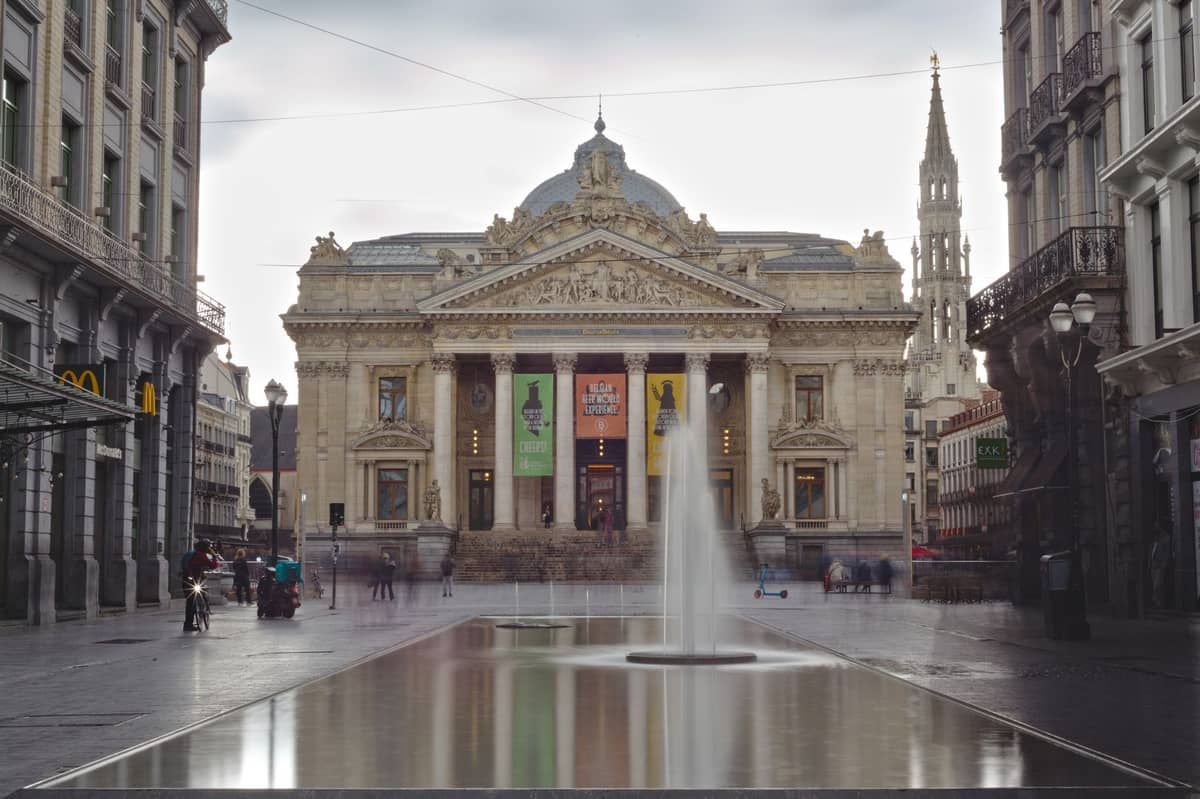
The building was constructed in the 19th century in a neoclassical style, with an imposing columned portico, elaborate allegorical friezes, and a steeply pitched roofline that reads as deliberately monumental from every approach. Architect Léon-Pierre Suys began the project in the 1860s, and it was completed in 1873. The facade faces northwest toward Boulevard Anspach, which was itself cut through the city around the same period as part of a broad Haussmanian reshaping of Brussels's urban core. Stand at the bottom of the steps and look up: the carvings between the columns represent industry, commerce, and the navigable rivers of Belgium, a reminder of what the building was meant to celebrate.
The square in front of the Bourse is pedestrianized, which makes it easy to step back and take in the full elevation. In the morning, before the café terraces fill, the stonework catches a low northern light that brings out the relief detail far better than midday flat sun. Photographers get cleaner shots before 10:00 and again in the golden hour before dusk. The steps themselves serve as an informal gathering place for locals and students throughout the day, and the square becomes a de facto public living room on warm evenings.
For visitors exploring Brussels's broader architectural heritage, the Bourse pairs naturally with a walk through the Dansaert–Saint-Géry neighborhood immediately to the west, where 19th-century commercial streetscapes give way to independent boutiques and weekend markets. The covered Halles Saint-Géry market hall is a five-minute walk away and represents a similar story of industrial repurposing.
Tickets & tours
Hand-picked options from our booking partner. Prices are indicative; availability and final rates are confirmed when you complete your booking.
Ghent tour from Brussels
From 43 €Instant confirmationFree cancellationTablet Workshop at Choco-Story Brussels
From 45 €Instant confirmationShared tour of Delft and the Keukenhof Estate from Brussels
From 86 €Instant confirmationFree cancellationOrigins of Brussels exploration game and tour
From 10 €Instant confirmationFree cancellation
Inside: The Free Central Hall
Walking through the main entrance costs nothing. The restored interior of the former trading floor is genuinely impressive: a high vaulted ceiling with iron and glass elements, columns of polished stone, and gallery levels that allow you to look down into the central space. The renovation has been careful to preserve the bones of the original trading hall while preparing the space for events, exhibitions, and the beer museum that occupies a significant portion of the interior.
The free public galleries offer a decent sense of the building's scale and craftsmanship without requiring a ticket. If you are short on time or budget, spending twenty minutes in the entrance hall and on the steps outside gives a complete architectural impression. For most visitors, though, the building's context becomes far richer once you engage with either of the paid experiences inside.
Belgian Beer World: What the Museum Actually Covers
Belgian Beer World opened in 2023 as the centerpiece of the Bourse's new cultural identity. Admission is typically in the around €21.50 for adults for adults, with reduced prices for seniors, students, and children, and free entry for very young children. These prices were current as of 2025 but should be verified before your visit.
The experience is interactive and designed to move visitors through the story of Belgian brewing: the history of abbey and Trappist traditions, the technical process of fermentation, the geography of Belgium's brewing regions, and the cultural role that beer has played in Belgian civic life. There are tasting elements, sensory stations where you can smell hop varieties and malt profiles, and displays that contextualize Belgium's internationally recognized brewing heritage. The museum is pitched at a broad audience, including families, rather than exclusively at serious beer specialists.
Two honest caveats: visitors who have already spent time at specialist breweries or at dedicated beer museums elsewhere in the city may find the content covers familiar ground. And the experience, while well-produced, leans toward the accessible end of the educational spectrum rather than the deeply technical. If you want laboratory-level depth on brewing science, this is not that. If you want an engaging, well-designed introduction to why Belgian beer matters internationally, it delivers.
For a more hands-on beer experience with actual production context, consider pairing your visit with the Cantillon Brewery in the nearby Anderlecht area, which remains a working lambic brewery open to the public. The two experiences complement rather than duplicate each other.
💡 Local tip
Book Belgian Beer World tickets online in advance, especially on weekends. The museum capacity is managed and walk-up entry can involve a wait during peak season (May–September) and around major events on the adjacent square.
Bruxella 1238: The Archaeological Site in the Basement
Beneath the Bourse lies one of Brussels's less-talked-about attractions. During construction of the original 19th-century building, workers uncovered the remains of a medieval Franciscan convent dating to 1238. Those remains, preserved in situ, are accessible as the Bruxella 1238 archaeological site. Admission is around €8 for adults, with reduced rates available; check current pricing and whether combined tickets with Belgian Beer World offer a saving.
The site includes foundation walls, tile floors, and burial remains from the medieval period. It is compact, not extensive, and will not occupy more than 30–45 minutes even for a careful visitor. But it adds a striking chronological dimension to the Bourse experience: you walk from a 19th-century trading floor above ground level into a 13th-century religious site below it, in one of Europe's most layered capital cities. That contrast alone makes it worth the detour.
Practical Walkthrough: How to Approach the Visit
The Bourse sits roughly midway between the Grand-Place and the Dansaert design quarter, making it a natural stopping point on any walking route through the center. From Brussels Central Station, the walk takes around eight to ten minutes on foot. From the De Brouckère metro station on lines 1 and 5, it is a short walk south of about 4–5 minutes. Tram lines 4 and 10 stop directly adjacent to the building at the Bourse/Beurs stop.
The surrounding area on Boulevard Anspach is pedestrianized and connects directly to the Grand-Place, roughly 300 meters to the southeast. Most visitors include the Bourse as part of a broader central Brussels walk rather than as a standalone destination, which makes sense logistically.
The building is described as fully accessible for visitors with reduced mobility, with elevators, ramps, and adapted restrooms installed during the restoration. Bike parking is available at the Bourse bike park on Boulevard Anspach. There is no dedicated parking lot for cars immediately at the building; the central location means most visitors arrive on foot or by public transport.
Weather affects the exterior experience more than the interior. The square in front of the building is exposed, and in wet or cold conditions the exterior visit becomes a quick one. The interior, however, is entirely climate-controlled and makes the Bourse a reasonable choice for a rainy afternoon in Brussels. The building is open until 22:00, which means the evening facade, lit against the night sky, is accessible without any special planning.
💡 Local tip
The Bourse steps are one of the better foreground elements for a wide-angle photograph of Boulevard Anspach. Position yourself on the second or third step looking back toward the boulevard for a perspective that includes both the streetscape and the building's scale. Avoid midday on summer weekends when the square fills with people and cafe furniture.
Who This Attraction Suits, and Who It Does Not
The Bourse rewards visitors with at least a passing interest in architecture, Belgian history, or beer culture. Families with children aged 8 and up will generally find the Belgian Beer World format engaging, with its interactive elements and sensory stations. Architecture enthusiasts can satisfy themselves with the free exterior and public hall visit without spending on the museum. Anyone following Brussels's museum circuit will find it a useful addition to a day that might also include the Royal Museums or the Magritte Museum.
Those who will likely be underwhelmed: visitors with very limited time who need to prioritize, serious beer academics looking for technical depth rather than a designed experience, and travelers who have already visited dedicated specialty breweries and covered Belgian beer history elsewhere. Young children under about 6 may find the museum content hard to engage with beyond the sensory elements. The building's central location means it is easy to walk past and assess for yourself before committing to a ticket.
If you are on a tight budget, note that the exterior and public hall are free. For a wider view of free experiences in Brussels, the Bourse steps, the adjacent square, and a walk west toward the canal contribute a full afternoon without any admission cost.
Insider Tips
- The Bourse facade is illuminated after dark and the pedestrianized square empties considerably after 21:00 on weeknights, giving you near-unobstructed views and photographs without the daytime crowd. The building stays open until 22:00, so an evening visit to the free public hall requires no special planning.
- Combined tickets for Belgian Beer World and Bruxella 1238 are sometimes available and can reduce the overall cost compared to buying separately. Check the official site before purchasing individual tickets at the door.
- The square in front of the Bourse has been the site of large public gatherings and memorials. The impromptu tribute wall that appeared after the 2016 Brussels attacks began here, and the square retains a civic resonance for local residents that goes beyond tourism.
- If you are visiting in the late afternoon on a Friday or Saturday, Belgian Beer World has extended hours to around 19:00, which means you can arrive after the main midday rush and still complete the full experience before the building closes.
- The tram stop directly at the Bourse currently serves tram lines 4 and 10, which connect you quickly to other central and southern corridors; for Place Flagey and Ixelles, you will usually need to connect to appropriate bus or tram routes rather than relying on a single direct line from Bourse.
Who Is The Bourse (Brussels Stock Exchange) For?
- Belgian beer enthusiasts wanting historical and cultural context before or after brewery visits
- Architecture lovers interested in 19th-century neoclassical civic buildings and Brussels urban history
- Travelers on a half-day in Brussels who want a single location covering exterior sightseeing, a free public interior, and optional paid experiences
- Families with children aged 8 and above who appreciate interactive museum formats
- Visitors curious about medieval Brussels who want to combine above-ground architecture with the Bruxella 1238 underground archaeological site
Nearby Attractions
Other things to see while in Dansaert & Saint-Géry:
- Belgian Beer World
Belgian Beer World opened in September 2023 inside the grand Brussels Stock Exchange on Boulevard Anspach, turning 12,000 square metres of one of the city's most recognisable buildings into an immersive journey through Belgian brewing culture. It combines interactive storytelling, tasting, and a rooftop bar in a setting that no other beer attraction in the country can match.
- Église Saint-Jean-Baptiste au Béguinage
The Église Saint-Jean-Baptiste au Béguinage is a notable surviving example of Flemish Baroque architecture in Brussels, built between 1657 and 1676 on the site of a medieval beguinage. Free to enter and just minutes from the canal district, it rewards visitors who slow down long enough to look up.
- Halles Saint-Géry
Halles Saint-Géry is a landmark 19th-century covered market hall on Place Saint-Géry, at the geographic and cultural heart of Brussels' Dansaert quarter. Free to enter and open daily, it functions as a heritage exhibition centre, event venue, and social gathering space that genuinely earns its place in the city's civic life.
- Zinneke Pis
Zinneke Pis is a small bronze dog caught mid-urination on a street corner in Brussels' Dansaert district. Free to visit at any hour, it completes the city's trio of peeing statues and carries a surprisingly meaningful message about Brussels' identity as a cosmopolitan, mixed city.