Museum of Natural Sciences Brussels: Dinosaurs, Deep Time, and a Lot More Than You Expect
The Museum of Natural Sciences in Brussels is one of Europe's most significant natural history institutions, home to the world's largest display of Iguanodon skeletons and collections spanning billions of years of life on Earth. Located in Leopold Park near the European Quarter, it rewards both families and serious science enthusiasts with far more depth than a single visit can exhaust.
Quick Facts
- Location
- 29 Rue Vautier, 1000 Brussels (Leopold Park, European Quarter)
- Getting There
- Metro: Maelbeek (lines 1/5) or Trône (lines 2/6). Bus: lines 34, 38, 80, 95 to Museum or Luxembourg stops.
- Time Needed
- 2–4 hours; a full day if visiting with children
- Cost
- Adults €13, Seniors €10, Ages 4–17 €5, Under 4 free. Disabled visitors: one accompanying adult admitted free. Entrance to the museum is free for everybody on the first Wednesday of every month after 13:00.
- Best for
- Families with children, science enthusiasts, rainy-day visits, fossil lovers
- Official website
- www.naturalsciences.be/en/museum
What the Museum of Natural Sciences Actually Is
The Museum of Natural Sciences (officially the Institut royal des Sciences naturelles de Belgique / Koninklijk Belgisch Instituut voor Natuurwetenschappen) is not a children's science center dressed up in museum clothing. It is a working federal scientific institution whose research staff publish peer-reviewed paleontology, entomology, and marine biology. The public-facing museum is the visible tip of an iceberg that includes millions of specimens in storage, much of it inaccessible to casual visitors. That context matters: what you see on the gallery floors has genuine scientific weight behind it.
The building itself sits in Leopold Park, a quiet green space squeezed between the European Quarter's glass towers and the older residential streets of Ixelles. The contrast is striking. You walk past EU lobbyists on Rue de la Loi, duck into the park, and suddenly find yourself in front of a 19th-century institutional building that smells faintly of beeswax and old stone. The atmosphere inside is that particular combination of hushed authority and barely contained excitement that good natural history museums always seem to cultivate.
💡 Local tip
The museum is closed on Mondays and on 1 January, 1 May, and 25 December. On 24 and 31 December it closes at 15:00, with last tickets sold at 13:30. Check the official site before planning a holiday visit.
The Dinosaur Gallery: Europe's Largest Iguanodon Display
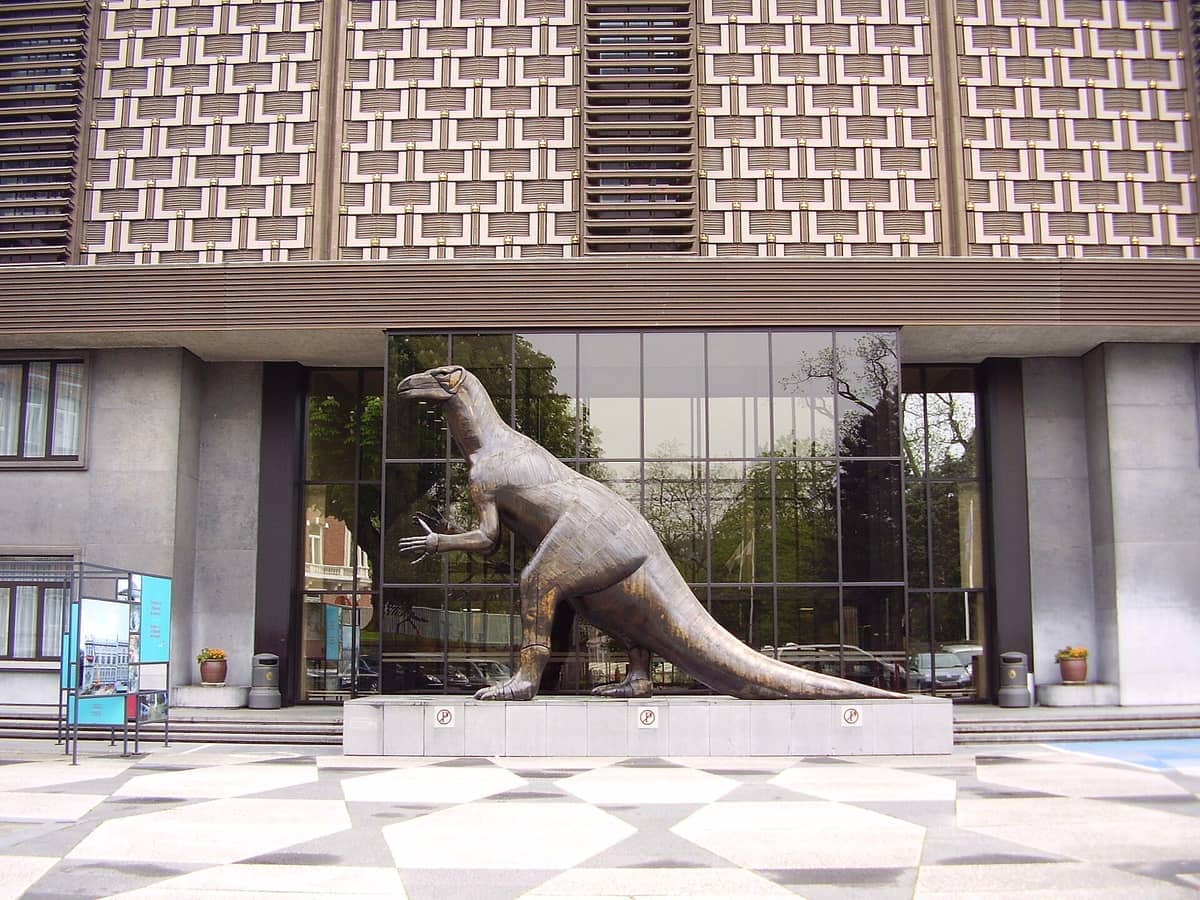
The headline attraction is the Dinosaur Gallery (Galerie des Dinosaures), and for once the hype is proportionate. In 1878, coal miners working near Bernissart in southern Belgium broke through into a sinkhole and discovered about thirty relatively complete Iguanodon skeletons. The find was, and remains, one of the most significant paleontological discoveries in history. Thirty of those skeletons ended up here. The gallery displays around 30 of them, some fully articulated and mounted at full scale, filling a two-story hall in a way that stops adult visitors mid-sentence.
The scale is hard to convey in photographs. At roughly 7 meters long and several meters tall when standing upright, the mounted Iguanodons dwarf the human figures around them. The lighting in the gallery is deliberately dramatic, with warm spots picking out individual skeletons against a darker ceiling. Early morning (opening to about 11:00 on weekdays) is the quietest window: school groups tend to arrive between 10:00 and 11:30, and by midday the hall fills with noise. If fossils are your primary reason for visiting, arrive at 09:30 on a Tuesday or Wednesday.
Beyond the Iguanodons, the gallery includes Cretaceous marine reptiles, flying pterosaurs suspended from the ceiling, and a number of other dinosaur species that would be headline exhibits at smaller institutions. The interpretive panels are available in French, Dutch, and English, and they manage to strike a balance between scientific accuracy and accessibility that many larger museums struggle to achieve.
Tickets & tours
Hand-picked options from our booking partner. Prices are indicative; availability and final rates are confirmed when you complete your booking.
Ghent tour from Brussels
From 43 €Instant confirmationFree cancellationTablet Workshop at Choco-Story Brussels
From 45 €Instant confirmationShared tour of Delft and the Keukenhof Estate from Brussels
From 86 €Instant confirmationFree cancellationOrigins of Brussels exploration game and tour
From 10 €Instant confirmationFree cancellation
The Rest of the Collections: More Depth Than Most Visitors Reach
Most visitors who come for the dinosaurs leave before exploring what the rest of the museum offers, which is a genuine loss. The Evolution Wing traces life on Earth across geological time with a clarity that makes other museum treatments of the same subject feel superficial. Whale skeletons hang from the ceiling of the Marine Gallery, and the adjacent galleries on biodiversity cover everything from tropical beetles to deep-sea organisms. The insect collections alone would justify a separate visit for the entomologically inclined.
The human evolution exhibits have been updated relatively recently and use a combination of fossil casts, reconstructions, and interactive displays to cover hominin development without sensationalizing it. The taxidermy halls in the older wing feel more dated by comparison, with glass cases of mounted mammals in poses that belong to early 20th-century museum conventions, but they retain a certain period authority.
Visitors interested in Brussels's wider museum scene will find that the Natural Sciences Museum complements rather than overlaps with the nearby Art and History Museum in the Cinquantenaire, which focuses on human civilizations rather than natural history. Both are within the broader European Quarter orbit and can be combined on a full museum day.
Visiting with Children: Practical Realities
The museum is genuinely excellent for children, and not in a token way. The dinosaur hall alone will hold most kids between ages 5 and 14 for a solid hour. The interactive zones on the lower floors use hands-on exhibits that avoid the common trap of being flashy but content-free. Children under 4 enter free, and the pricing for ages 4–17 at €5 makes a family visit considerably less expensive than comparable institutions in other European capitals.
Practically speaking, the museum has adapted toilets on multiple floors, lifts connecting all exhibition levels, and a café on site. Prams and strollers are manageable in most galleries, though the older wing has some narrower corridors. The museum can be comfortably navigated in 2 hours with younger children, or stretched to a full day with older ones who want to read the panels and linger over the specimens.
ℹ️ Good to know
Accessibility: The museum has lifts serving all gallery levels, adapted toilets on multiple floors, and a wheelchair available to borrow (reserve in advance via dispatching@naturalsciences.be). A disabled visitor's ticket includes free admission for one accompanying adult.
Getting There and When to Go
The museum's address is 29 Rue Vautier, 1000 Brussels, at the edge of Leopold Park. From the city centre, the easiest approach is metro to Maelbeek (lines 1 and 5) or Trône (lines 2 and 6), both a 5–10 minute walk through the park. Bus lines 34 and 80 stop directly at a Museum stop; lines 38 and 95 stop at Idalie or Luxembourg, a short walk away. The park walk itself is pleasant in dry weather, running past the House of European History and the EU institutions.
The European Quarter is relatively quiet at weekends compared to weekday rush hours when EU staff fill the surrounding streets. If you are combining the museum with the broader area, the House of European History is a short walk away and free to enter, offering a complementary look at the human story rather than the natural one.
Opening hours run Tuesday to Friday 09:30–17:00 and Saturday to Sunday 10:00–18:00. The museum is closed on Mondays; last admissions are between 15:30 and 16:00 on weekdays and between 16:30 and 17:00 on weekends.
Brussels has a temperate maritime climate with rain distributed across most of the year, making the museum a natural candidate for grey-day visits. For a full list of indoor options when the weather turns, see the Brussels rainy day activities guide.
Photography, Shop, and Practical Notes
Photography without flash is generally permitted in the permanent galleries, and the dinosaur hall is one of the more photogenic natural history interiors in Europe. The combination of high ceilings, warm directional lighting, and the sheer drama of the Iguanodon skeletons makes it worth bringing a camera capable of low-light performance. A wide-angle lens helps with the full-hall shots; a longer focal length works better for individual skull and limb detail.
The museum shop near the main entrance stocks a reasonable selection of paleontology books, mineral specimens, and science-themed gifts aimed at children. It is better stocked than many comparable museum shops. The on-site café provides standard light meals and hot drinks; it is not a destination in itself, but adequate for a mid-visit break. Car parking at the museum is very limited and not recommended; the area is well-served by public transit, and driving into this part of Brussels adds stress without saving time.
⚠️ What to skip
Ticket prices and opening hours are verified as of 2025 but may be subject to change. Confirm on the official website (naturalsciences.be) before your visit, particularly for public holiday closures and temporary exhibition surcharges.
Honest Assessment: Who Will Love It and Who Might Not
If you came to Brussels primarily for architecture, food, or the city's political and cultural history, the Museum of Natural Sciences may not be the highest priority on a short trip. The building's exterior is institutional rather than beautiful, the location in the European Quarter is not the most atmospheric part of the city, and the ticket price, while fair, is not negligible. Visitors with one day in Brussels are better served by the Grand-Place area and the Royal Museums of Fine Arts first.
For those with two or more days, or who are traveling with children, or who simply find deep geological time more compelling than Flemish Primitives, this museum is among the best of its kind in northern Europe. Pair it with the Parc du Cinquantenaire, a 10-minute walk west, for a half-day that covers both natural history and the grand neoclassical ambitions of 19th-century Belgium.
Insider Tips
- Arrive at 09:30 on a Tuesday or Wednesday to have the dinosaur gallery almost entirely to yourself before school groups arrive around 10:30.
- The upper mezzanine level of the dinosaur hall gives you a completely different perspective on the Iguanodon skeletons: you look down onto the skulls and spine rather than up at the ribs. Most visitors never go up there.
- The free Leopold Park surrounding the museum is an underused asset: bring a sandwich and eat outside before or after, especially in spring when the park is in bloom.
- If you need a wheelchair, email dispatching@naturalsciences.be in advance. On-site parking is prioritized for visitors with reduced mobility, but security should be contacted ahead of time.
- Temporary exhibitions run in addition to the permanent collection and sometimes carry a surcharge; check the website before buying tickets if you want to include them.
Who Is Museum of Natural Sciences For?
- Families with children aged 5 and up who want something beyond a city walk
- Fossil and paleontology enthusiasts who know what the Bernissart discovery represents
- Travelers visiting Brussels on a rainy day with several hours to fill indoors
- Visitors spending two or more days in Brussels who have already covered the main historic sites
- School-age groups and anyone who wants to understand Belgium's scientific heritage alongside its political and cultural identity
Nearby Attractions
Other things to see while in European Quarter:
- Art & History Museum (Cinquantenaire)
Housed in the grand neoclassical wings of the Parc du Cinquantenaire, the Art & History Museum holds one of Belgium's most important collections, covering ancient civilisations, decorative arts, and non-European cultures across dozens of galleries. It draws far fewer crowds than its scale deserves, making it a rare opportunity to spend hours with world-class artefacts in relative calm.
- Autoworld Brussels
Autoworld Brussels presents more than 250 historic automobiles inside one of Brussels' most spectacular 19th-century exhibition halls, at the heart of the Parc du Cinquantenaire. From brass-era carriages to mid-century American cruisers, the collection spans over a century of automotive history, set beneath soaring iron-and-glass vaulting that is itself worth the visit.
- House of European History
Opened in 2017 and free to enter, the House of European History sits in Brussels's Leopold Park and explores the development of European identity with a particular focus on modern history and the 20th century. It is one of the few major museums in the city that genuinely rewards slow, careful attention rather than a quick walkthrough.
- Parc du Cinquantenaire
Parc du Cinquantenaire is a 34-hectare formal park in Brussels's European Quarter, anchored by a monumental triumphal arch and flanked by three major museums. Laid out in 1880 to mark 50 years of Belgian independence, it draws joggers at dawn, families on weekends, and EU staff at lunch — all for free.