Royal Museum of the Armed Forces and Military History: Brussels' Monument to War and Memory
Housed in the monumental Cinquantenaire complex, the Royal Museum of the Armed Forces and Military History spans Belgian military history from medieval armour to Cold War jets. It is one of the most comprehensive military museums in Europe, and one of Brussels' most underappreciated major attractions.
Quick Facts
- Location
- Parc du Cinquantenaire 3, 1000 Brussels (European Quarter)
- Getting There
- Schuman or Merode (Metro lines 1 & 5), short walk through the park
- Time Needed
- 2.5 to 4 hours; full-day for aviation or armour enthusiasts
- Cost
- €12 adults, €9 ages 6–18, free under 6. Free for all: first Wednesday of the month from 13:00. Combined Cinquantenaire ticket (Army Museum + Autoworld + Art & History): €25
- Best for
- History buffs, families with older children, aviation enthusiasts, WWII researchers
- Official website
- klm-mra.be/en
What Kind of Museum Is This, Exactly?
The Royal Museum of the Armed Forces and Military History is not a single gallery with a few cannons and some faded maps. It is a large, multi-wing institution covering roughly nine centuries of Belgian and European military history, from medieval weaponry through the Napoleonic era, both World Wars, and into the Cold War. The scale is genuinely surprising on first visit.
The museum forms part of the War Heritage Institute and sits within the Cinquantenaire complex, a monumental ensemble of triumphal arches, colonnaded arcades, and exhibition halls that King Leopold II commissioned for Belgium's 1880 National Exhibition. The architectural setting adds real weight to the visit: you are walking through history before you even enter the building.
Three major museums share the Cinquantenaire park: the Armed Forces Museum, Autoworld, and the Royal Museum of Art and History. A combined ticket covering all three costs €30 and is valid for three months, which makes pairing visits on separate days entirely practical.
💡 Local tip
The museum opens Tuesday to Sunday, 09:00–17:00 (ticket office closes at 16:00). It is closed Mondays and on 1 January, 1 May, 1 November, and 25 December. Admission is free for all visitors on the first Wednesday of each month, from 13:00 onward. Visitors with reduced mobility and one accompanying person also enter free.
The Aircraft Hall: The Room That Stops People in Their Tracks
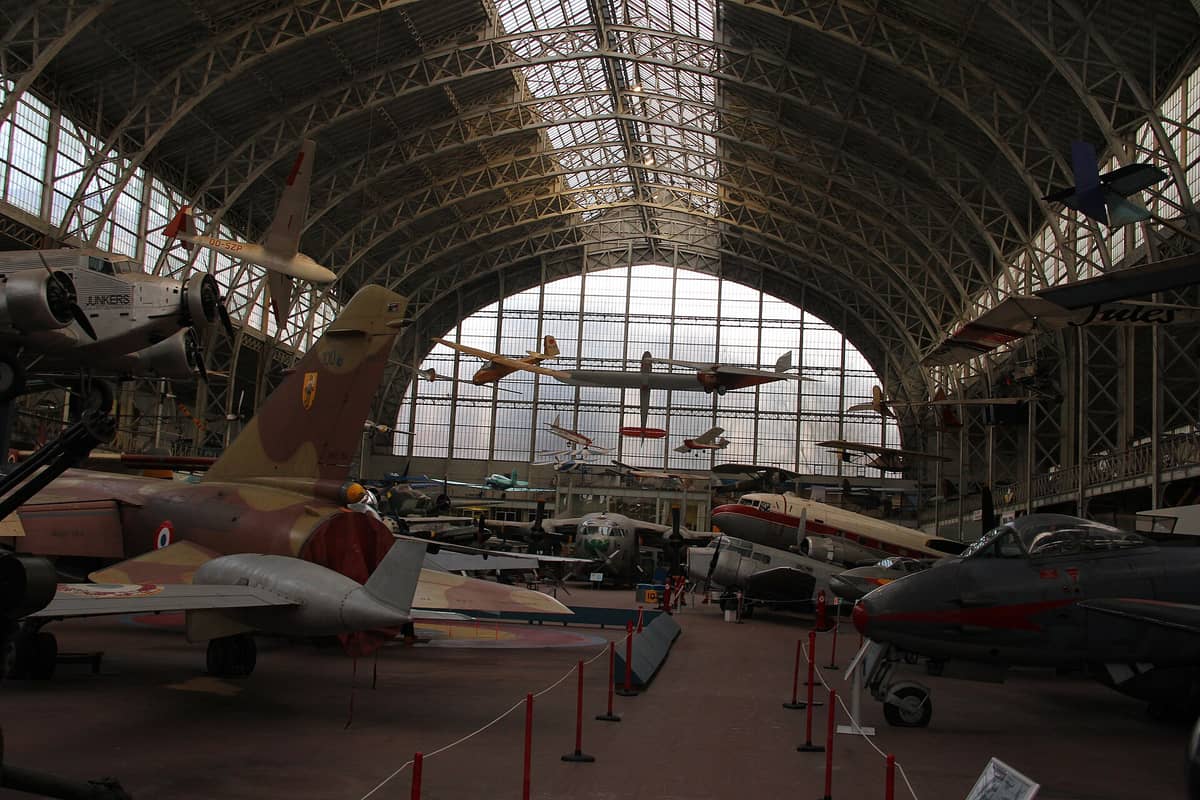
The museum's single most impressive space is the aviation hall. It is a vast, glass-roofed structure housing dozens of aircraft suspended at different heights, from early biplanes to Korean War-era jets. The scale is theatrical. Light pours through the roof on clear mornings, catching propeller blades and fuselages in a way that feels almost cinematic. On overcast days, the same space feels quieter and more contemplative — both atmospheres work.
Aircraft are labelled with their technical specifications and operational histories. You will find Spitfires, Hawker Hurricanes, German Messerschmitts, and later Cold War jets, often positioned close enough to examine the cockpit details and panel wear. The collection communicates the speed at which aviation technology advanced across forty years of war and reconstruction.
Note that the mezzanine level of the aircraft hall is not fully accessible for visitors with reduced mobility. The main floor, however, offers good sightlines to most of the suspended aircraft.
Tickets & tours
Hand-picked options from our booking partner. Prices are indicative; availability and final rates are confirmed when you complete your booking.
Ghent tour from Brussels
From 43 €Instant confirmationFree cancellationTablet Workshop at Choco-Story Brussels
From 45 €Instant confirmationShared tour of Delft and the Keukenhof Estate from Brussels
From 86 €Instant confirmationFree cancellationOrigins of Brussels exploration game and tour
From 10 €Instant confirmationFree cancellation
The World War Galleries: Depth Over Drama
The WWI and WWII sections are the museum's historical core. The First World War galleries are particularly strong, reflecting the fact that Belgium was occupied for most of the war and the Western Front ran through Belgian territory. There are reconstructed trench environments, personal effects, weapons, uniforms, and detailed contextual panels covering the German invasion of 1914, the Battle of the Yser, and Belgian resistance. It is not sensationalist. The tone is archival and precise.
The WWII section extends across several rooms and covers both the German occupation of Belgium and Belgian contributions to Allied operations. It includes military vehicles, propaganda materials, resistance documents, and a reasonably detailed treatment of Belgian forces operating with Allied armies in North Africa and northwest Europe. For visitors with a general knowledge of WWII, there is enough specificity here to fill in chapters they have rarely encountered.
ℹ️ Good to know
The Napoleon section is located in the arcades and is not accessible to visitors with reduced mobility. If this is a priority for your visit, plan accordingly.
Armour, Medieval Collections, and the Earlier Galleries
Fewer visitors make it to the earlier galleries, which is a small loss. The armoury holds a substantial collection of medieval and Renaissance arms and armour: plate armour, halberds, swords, and early firearms, some displayed in full knight configurations on horseback. The collection is not as well-known internationally as equivalents in London or Vienna, but it is serious and well-maintained.
The 18th and early 19th century sections trace the Austrian Netherlands period, the French Revolutionary and Napoleonic Wars, and the formation of Belgium as an independent state in 1830. These rooms tend to be quieter than the aviation hall or the World War sections, which makes them good places to slow down and actually read the context panels.
Be aware that the armoury section is not accessible for visitors with reduced mobility, alongside the mezzanine of the aircraft hall and the Napoleon section in the arcades.
Getting There and Navigating the Cinquantenaire Complex
The museum is located at Parc du Cinquantenaire 3, a ten-minute walk from either Schuman or Merode metro stations on lines 1 and 5. Schuman is the closer exit for visitors coming from the city centre. The park itself is a worthwhile destination: the triumphal arch at its centre is one of Brussels' most photogenic structures. If you are exploring the European Quarter more broadly, the Cinquantenaire complex sits at its eastern edge and combines well with a walk past the EU institutions.
From Brussels Airport, STIB bus line 12 (weekdays) and bus 21 (evenings and weekends) run directly to the European Quarter, stopping near Schuman. The journey takes roughly 30 to 40 minutes depending on traffic. Train connections from Brussels-Central or Brussels-Midi to Schuman station are faster on most days.
The museum entrance is in the south wing of the Cinquantenaire arcade. Signage in the park is adequate but not abundant — walking from Schuman, follow the park's main path east toward the arch and look for museum signage on your left. There is no dedicated parking facility inside the park, but street parking exists on surrounding roads, subject to Brussels' zone regulations.
💡 Local tip
Arrive before 10:00 on weekday mornings and you will often have the aircraft hall almost entirely to yourself. Weekend afternoons draw the largest crowds, particularly families with children. School groups are common on weekday mornings in spring, which can make the narrower gallery corridors feel congested.
Photography, Comfort, and Practical Notes
Photography is generally permitted for personal use throughout the museum. The aircraft hall is the most photogenic space: a wide-angle lens or a phone with a panoramic mode handles the scale better than a standard focal length. Overhead lighting means flash is rarely necessary or useful. The early morning light through the roof glazing between 09:00 and 11:00 produces the most dramatic results.
The museum is large and involves a significant amount of walking, including some uneven surfaces in the older sections of the building. Comfortable, flat shoes are practical. There is a cloakroom facility available, which matters if you are carrying a large bag or winter coat — the galleries can become warm, particularly the aircraft hall in summer.
Audio guides and guided tours are available; check the official website for current language options and pricing. The on-site cafe operates during museum hours and offers basic food and beverages. For a better lunch, the surrounding streets of the Schuman area have several restaurants catering to the EU Quarter office crowd, with reasonable quality at lunchtime prices.
Who This Museum Is For (and Who Might Find It Less Rewarding)
The museum rewards visitors who bring some existing interest in military history or aviation. If you arrive with no prior context, the sheer volume of material can feel overwhelming without a clear route through it. First-time visitors to Brussels who have limited time and want to see the Grand-Place or the Magritte Museum may find this a lower priority — it is not a casual one-hour stop.
Young children under eight or nine may struggle with the volume of text-heavy content and the less obviously interactive displays in the historical galleries. The aircraft hall is an exception: the visual spectacle of suspended planes is immediately engaging for most ages. Families should plan their route to hit the aviation hall early and use it as the centrepiece of their visit.
For visitors with a serious interest in Belgian history, this museum is genuinely essential. Belgium's position at the crossroads of European conflict — occupied in both world wars, home to major battles, and a founding member of NATO and the EU — means the collections carry real historical weight. Pairing a visit here with the BELvue Museum nearby provides a rounded picture of how Belgium emerged as a modern state.
Insider Tips
- The free admission on the first Wednesday of the month (from 13:00) draws noticeably larger crowds than a typical Tuesday morning. If your schedule is flexible, a Tuesday or Thursday morning visit gives you more space, particularly in the aircraft hall.
- The combined Cinquantenaire ticket (€25) covers Autoworld and the Royal Museum of Art and History as well. It is valid for three months, so you do not need to do all three in one day. Autoworld is directly across the park and can make for a logical afternoon pairing.
- The roof terrace of the Cinquantenaire arcade offers one of the better elevated views over Brussels and the park, and is accessible from within the museum complex. Check current access arrangements at the ticket desk when you arrive.
- The museum shop carries a solid selection of specialist military history publications, including works focused on Belgian WWI and WWII history that are difficult to find elsewhere. Worth browsing even if you are not a usual buyer of museum merchandise.
- If you are visiting in winter, the aircraft hall can feel cool despite being indoors. A light layer is useful. In summer, the opposite applies: the glass roof traps heat and the hall becomes noticeably warm by mid-afternoon.
Who Is Royal Museum of the Armed Forces and Military History For?
- Military history enthusiasts who want European conflict covered in depth beyond the standard Anglo-American narrative
- Aviation fans: the aircraft hall is among the most impressive indoor collections of its kind in Belgium
- Families with children aged ten and above who can engage with both the visual spectacle and the historical content
- Visitors combining multiple Cinquantenaire museums on a single day trip
- Researchers and educators focused on WWI, WWII, or Belgian national history
Nearby Attractions
Other things to see while in European Quarter:
- Art & History Museum (Cinquantenaire)
Housed in the grand neoclassical wings of the Parc du Cinquantenaire, the Art & History Museum holds one of Belgium's most important collections, covering ancient civilisations, decorative arts, and non-European cultures across dozens of galleries. It draws far fewer crowds than its scale deserves, making it a rare opportunity to spend hours with world-class artefacts in relative calm.
- Autoworld Brussels
Autoworld Brussels presents more than 250 historic automobiles inside one of Brussels' most spectacular 19th-century exhibition halls, at the heart of the Parc du Cinquantenaire. From brass-era carriages to mid-century American cruisers, the collection spans over a century of automotive history, set beneath soaring iron-and-glass vaulting that is itself worth the visit.
- House of European History
Opened in 2017 and free to enter, the House of European History sits in Brussels's Leopold Park and explores the development of European identity with a particular focus on modern history and the 20th century. It is one of the few major museums in the city that genuinely rewards slow, careful attention rather than a quick walkthrough.
- Museum of Natural Sciences
The Museum of Natural Sciences in Brussels is one of Europe's most significant natural history institutions, home to the world's largest display of Iguanodon skeletons and collections spanning billions of years of life on Earth. Located in Leopold Park near the European Quarter, it rewards both families and serious science enthusiasts with far more depth than a single visit can exhaust.