Hôtel Van Eetvelde: Inside Brussels' Most Refined Art Nouveau Town House
Designed by Victor Horta in 1895 and inscribed on the UNESCO World Heritage List, the Van Eetvelde House on Avenue Palmerston is one of the few Horta interiors in Brussels open to the public. Smaller and less visited than the Horta Museum, it rewards those who seek it out with an extraordinary sequence of glass, iron, and organic ornament in near-original condition.
Quick Facts
- Location
- Avenue Palmerston 2–4, 1000 Brussels (Squares Quarter, European Quarter)
- Getting There
- Metro: Maelbeek (line 1/5) or Schuman (line 1/5), then ~10 min walk north
- Time Needed
- 45–90 minutes
- Cost
- €12 standard; free with Museum Pass; Art Nouveau Pass holders enter free, but the pass itself is a separate purchase
- Best for
- Architecture lovers, Art Nouveau enthusiasts, design historians
- Official website
- www.lab-an.be/en
What Is the Van Eetvelde House?
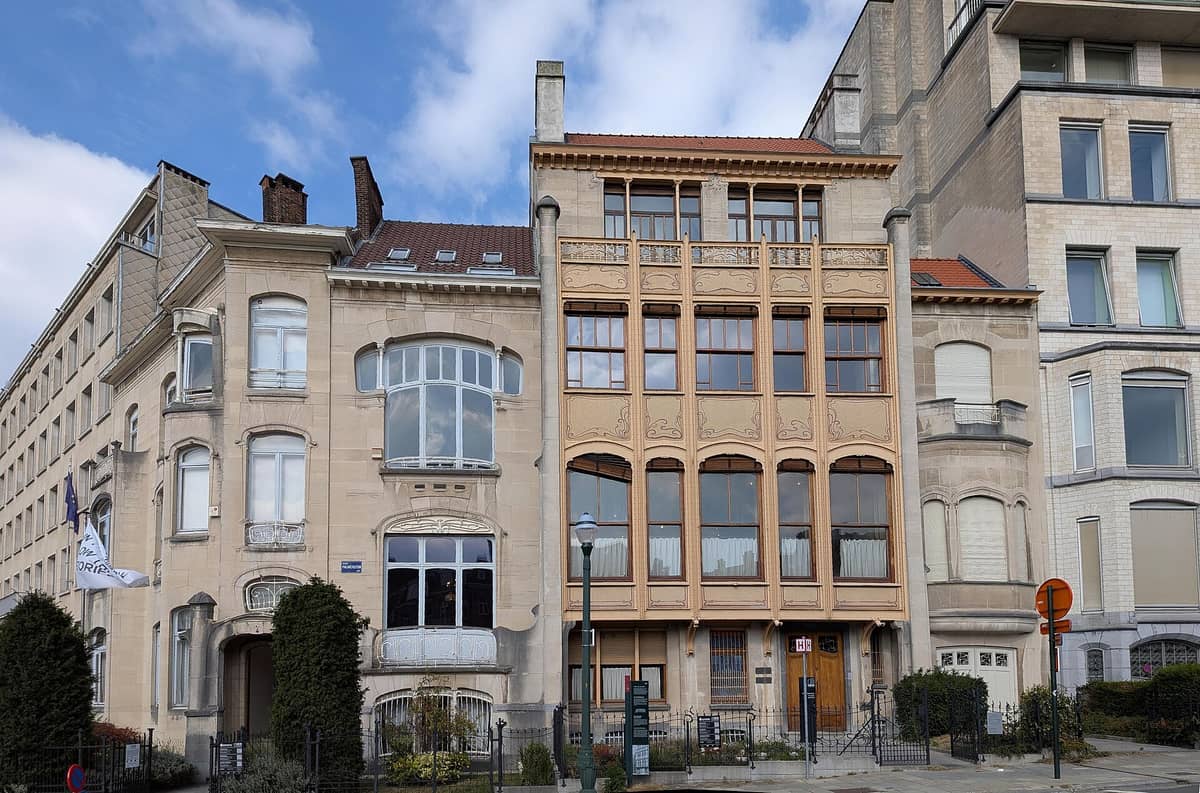
The Hôtel Van Eetvelde, located at Avenue Palmerston 2–4 in Brussels, is one of four major town houses designed by Victor Horta that together form a UNESCO World Heritage Site inscribed in 2000. Horta completed the commission between 1895 and the early 1900s for Edmond van Eetvelde, a senior official in the administration of the Congo Free State under King Leopold II. The building is not a hotel in the lodging sense: in French architectural tradition, an hôtel particulier is a large private urban residence, and this one was purpose-built for a man of considerable means who wanted a home that announced both his status and his taste.
Unlike the Horta Museum in Saint-Gilles, which is dedicated entirely to Horta's life and work, the Van Eetvelde House is managed by LAB·AN (Laboratoire Art Nouveau), a nonprofit that runs public visits while also using the building for cultural programming. This gives the space a lived-in quality that is rare among historic house museums. You are not walking through a reconstruction or a period room staged for effect. You are entering a building that has remained in continuous use.
ℹ️ Good to know
Opening hours: Saturday, Sunday, and Monday, 10:00–17:00 (last entry 16:30). Closed Tuesday through Friday. Verify the current schedule with LAB·AN before visiting, as hours may change and the building is occasionally closed for private events.
The Architecture: What Horta Did Here
Horta's work at Van Eetvelde represents Art Nouveau at its most structurally inventive. The facade on Avenue Palmerston is relatively restrained compared to some of his other commissions, but step inside and the composition changes dramatically. The central hall rises through multiple floors under a large glass-and-iron dome, flooding the interior with diffused natural light. The ironwork is not decorative in a superficial sense: the exposed columns and beams are structural, but Horta shaped them into sinuous forms that echo botanical motifs, particularly the stems and tendrils of plants.
The materials throughout are exceptional. Pale yellow Siena marble lines the lower walls of the hall. Mosaic floors carry interlocking geometric and floral patterns that are clearly related to the ironwork above them, creating a visual coherence across every surface. The stained glass in the dome shifts the quality of light depending on cloud cover and the time of day: on overcast mornings, the interior takes on a soft, even luminosity; in afternoon sun, it becomes warmer and more gold-tinted. Visiting on a day with high, thin cloud cover gives the most balanced conditions for seeing the glasswork clearly.
Horta scholars often describe this building as the moment when he fully mastered the integration of structure and ornament. For the broader context of what he achieved across Brussels, the Horta Museum in Saint-Gilles provides the deepest archival and biographical account of his career, but Van Eetvelde is where the architecture is arguably at its most spatially dramatic.
Tickets & tours
Hand-picked options from our booking partner. Prices are indicative; availability and final rates are confirmed when you complete your booking.
1-hour tour of Antwerp highlights with a local
From 61 €Instant confirmationFree cancellationGhent tour from Brussels
From 43 €Instant confirmationFree cancellationTablet Workshop at Choco-Story Brussels
From 45 €Instant confirmationShared tour of Delft and the Keukenhof Estate from Brussels
From 86 €Instant confirmationFree cancellation
The Visit: What You Actually See
Visits are self-guided, though informational materials are available in several languages. You enter through the original vestibule, where the floor mosaic and the ironwork of the staircase balustrade immediately establish the visual language of the house. The main sequence moves through the ground-floor reception rooms and into the central hall, which is the spatial climax of the building. From here, the staircase leads upward past the dome, giving you changing angles on the glasswork as you ascend.
The upper floors contain rooms of varying scale, some with original paneling, built-in furniture, and decorative details that survive in good condition. The contrast between the intimate proportions of the private rooms and the generosity of the central hall is one of the more interesting spatial experiences the building offers. It is worth slowing down in the upper galleries rather than rushing directly to the dome.
The visit takes most people between 45 minutes and an hour and a half, depending on how closely they examine the detailing. There is no audio guide available at present, so bringing a reference book or downloading background material before you arrive is worthwhile. Groups are kept small, which means the experience rarely feels crowded even on busy weekends.
💡 Local tip
Photography is generally permitted for personal use. The best shots of the dome are taken from the upper landing looking down, or from ground level looking straight up through the ironwork. Bring a wide-angle lens if you have one; the space is too compressed for a standard kit lens to capture the full height of the hall in a single frame.
Getting There and Practical Planning
Avenue Palmerston sits in the Squares Quarter, a neighborhood of late-19th-century town houses just north of Parc du Cinquantenaire and within easy walking distance of the main EU institutions around Schuman. The nearest metro stops are Maelbeek and Schuman, both on lines 1 and 5, which run through the European Quarter. From either stop, the walk to the house is roughly 10 minutes through streets lined with period architecture.
The surrounding neighborhood rewards walking time on arrival or departure. Avenue Palmerston itself has several other notable facades, and the Parc du Cinquantenaire is a short walk south, with its triumphal arch and cluster of museums including the Art and History Museum and Autoworld. Budget at least half a day if you plan to combine Van Eetvelde with any of these.
Brussels has a temperate oceanic climate with reliable rainfall year-round. Because the Van Eetvelde House is an indoor attraction, weather has almost no effect on the quality of the visit, making it one of the better options for a rainy afternoon in the city. The one exception is photography of the dome: diffused natural light from overcast skies can actually be preferable to harsh direct sun, which creates strong contrast and makes the glass harder to expose correctly.
Tickets, Passes, and Booking
Standard admission is €12 per person. Museum Pass holders enter free. The Art Nouveau Pass, currently priced at €27 or €37 depending on the option, covers Van Eetvelde along with a selection of other participating Art Nouveau sites in Brussels and is worth considering if you plan to visit more than two or three buildings during your stay.
For context on how this fits into a broader Art Nouveau itinerary, the Art Nouveau Brussels guide covers the major Horta buildings alongside other significant examples from the period, including facades in Saint-Gilles and Ixelles.
⚠️ What to skip
The building is not accessible to visitors with reduced mobility. Multiple staircases with between 3 and 15 steps are present throughout, and there is no lift. This is clearly stated by Brussels Museums and the venue operator. If this is a concern, the ground-floor vestibule and hall are partially visible from the entrance, but a full visit requires navigating the upper floors.
Who Should Visit and Who Might Not
This is a house that rewards careful attention. Visitors who are genuinely interested in architectural detail, the history of Art Nouveau, or the biography of Victor Horta will find it deeply satisfying. The building is small enough to absorb without fatigue and detailed enough to hold attention for well over an hour. Those visiting Brussels primarily for its food, beer, or street life may find the experience too specialized for the entrance price, particularly if they are not combining it with other nearby attractions.
Families with young children may find the visit challenging: the spaces are fragile and the pace of a thorough visit is slow. There is no children's programming or interactive element. The building is also not suitable for anyone with significant mobility limitations, for the reasons noted above.
Visitors specifically focused on Horta's domestic architecture should also make time for the Hôtel Solvay on Avenue Louise, another UNESCO-listed Horta house that can be seen from the street even when interior visits are limited.
Insider Tips
- Visit on a Monday rather than a weekend: the house is open all three days (Saturday, Sunday, Monday), but Monday sees fewer visitors because most tourists plan weekend activities without checking the full schedule. Groups are visibly smaller and the experience is noticeably quieter.
- Arrive at opening time (10:00) if photography matters to you. The dome light is most even in the morning before the sun has moved to a position that creates harsh angles through the glass panels.
- The Art Nouveau Pass is good value if you plan to visit two or more participating houses. Ask at the door whether the pass can be purchased on-site, or buy it in advance through Brussels Museums at the current price (€27 or €37 depending on the option) to avoid any availability issues on the day.
- Before visiting, read a short overview of Edmond van Eetvelde's background as Congo Free State administrator. Understanding the source of his wealth adds a complicated layer to the experience of a building this beautiful, and it is a context that the standard visit materials touch on only lightly.
- The street outside, Avenue Palmerston, contains several other Art Nouveau and late-19th-century facades worth examining before or after your visit. Allow 15 minutes to walk slowly along the block in both directions.
Who Is Van Eetvelde House (Hôtel van Eetvelde) For?
- Architecture and design enthusiasts who want to see Horta's work beyond the better-known Horta Museum
- Travelers building an Art Nouveau itinerary across Brussels over one or two days
- Photographers interested in interior light, glass, and ironwork
- History-minded visitors interested in the intersection of Belgian colonial wealth and Belle Époque design
- Anyone looking for a genuinely absorbing indoor attraction in the European Quarter on a rainy afternoon
Nearby Attractions
Other things to see while in European Quarter:
- Art & History Museum (Cinquantenaire)
Housed in the grand neoclassical wings of the Parc du Cinquantenaire, the Art & History Museum holds one of Belgium's most important collections, covering ancient civilisations, decorative arts, and non-European cultures across dozens of galleries. It draws far fewer crowds than its scale deserves, making it a rare opportunity to spend hours with world-class artefacts in relative calm.
- Autoworld Brussels
Autoworld Brussels presents more than 250 historic automobiles inside one of Brussels' most spectacular 19th-century exhibition halls, at the heart of the Parc du Cinquantenaire. From brass-era carriages to mid-century American cruisers, the collection spans over a century of automotive history, set beneath soaring iron-and-glass vaulting that is itself worth the visit.
- House of European History
Opened in 2017 and free to enter, the House of European History sits in Brussels's Leopold Park and explores the development of European identity with a particular focus on modern history and the 20th century. It is one of the few major museums in the city that genuinely rewards slow, careful attention rather than a quick walkthrough.
- Museum of Natural Sciences
The Museum of Natural Sciences in Brussels is one of Europe's most significant natural history institutions, home to the world's largest display of Iguanodon skeletons and collections spanning billions of years of life on Earth. Located in Leopold Park near the European Quarter, it rewards both families and serious science enthusiasts with far more depth than a single visit can exhaust.