Hôtel Solvay: Inside Victor Horta's Most Refined Art Nouveau Townhouse
Built for industrialist Armand Solvay and designed by Victor Horta between 1894 and 1898, Hôtel Solvay is one of Brussels' four UNESCO-listed Horta townhouses. Located on Avenue Louise in Ixelles, it opens to individual visitors on limited days each week, offering a rare look at an Art Nouveau interior preserved almost entirely in its original state.
Quick Facts
- Location
- Avenue Louise 224, 1050 Ixelles, Brussels, Belgium
- Getting There
- Metro lines 2 & 6 to Louise/Louiza station; Trams 8, 81, 93 along Avenue Louise
- Time Needed
- 1 to 1.5 hours for a guided visit
- Cost
- Approximately €12–€18 per person; advance booking required via hotelsolvay.be
- Best for
- Architecture enthusiasts, design lovers, Art Nouveau fans, slow travellers
- Official website
- hotelsolvay.be
What Hôtel Solvay Actually Is
Hôtel Solvay is not a hotel in the contemporary sense. In French, the word hôtel historically referred to a grand private residence, and this one was commissioned in 1894 by Armand Solvay, son of the Belgian industrial chemist Ernest Solvay, whose fortune came from the Solvay chemical business. Armand gave architect Victor Horta near-total creative freedom and an open budget, a combination that rarely ends badly in architecture.
The result, completed in 1900, is widely considered the most coherent surviving example of Horta's vision: a building where the architecture, the interior fittings, the furniture, the light fixtures, the door handles, and even the cutlery were all designed as a single unified composition. Nothing was left to chance or delegated to another designer. This is what makes Hôtel Solvay different from even its closest equivalent, the Horta Museum in Saint-Gilles: the Solvay house has been carefully preserved, and the original furnishings have never been dispersed.
The building forms part of the Horta townhousesUNESCO World Heritage inscription covering the Major Town Houses of the Architect Victor HortaMajor Town Houses of the Architect Victor Horta (Brussels) a designation granted in 2000 that also covers the Horta Museum (his former home and studio), Hôtel van Eetvelde, and Maison & Atelier Horta. Of the four, the Solvay house is the largest and the one that remained privately occupied the longest, which partly explains the exceptional state of preservation.
The Architecture: What Horta Did Here
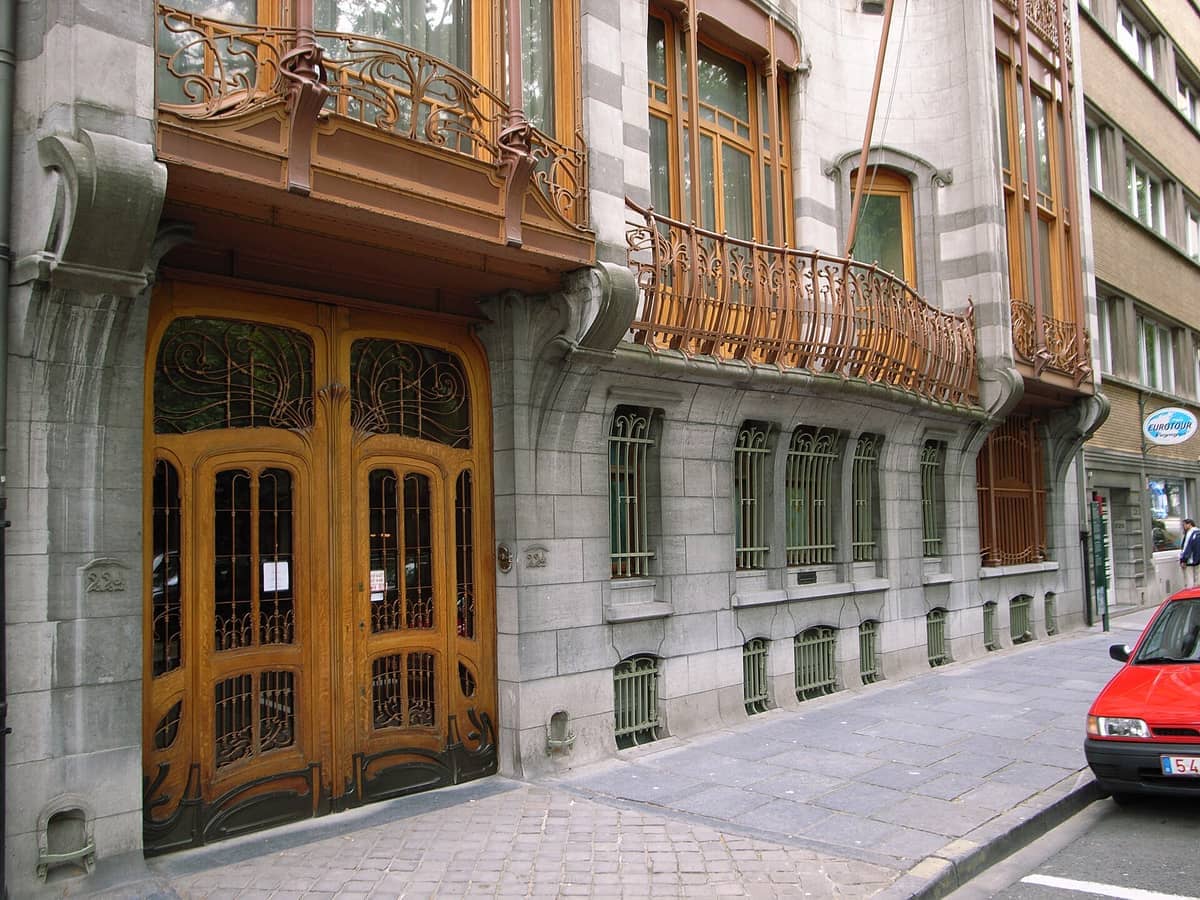
From the street, Hôtel Solvay announces itself through its asymmetrical limestone facade, a rhythm of bays that curves and breathes rather than presenting a flat plane. The ironwork on the balconies flows in organic lines that echo botanical forms, a signature of Horta's work, but here executed with more confidence and budget than almost anywhere else. The facade is proportioned to the plot and opens deep into the block behind.
The defining structural move inside is the central staircase lit by a skylight. Natural light floods down through leaded glass into the heart of the house, reaching rooms that would otherwise be dark in a building of this depth. The ironwork of the stair balustrade curves upward continuously, the handrail sweeping without interruption from ground floor to upper levels. The floors are laid in marquetry patterns that align with the ceiling decorations above them. Every surface carries a decision.
The colour palette is warm rather than cold, amber and ochre tones in the glass and woodwork contrasting with the cooler stone of the structural elements. When morning light enters through the front windows on a clear day, the whole entrance level takes on a golden cast that photographs cannot adequately reproduce. If you visit on a grey Brussels afternoon, the effect is different but not lesser: the interior becomes more intimate, the artificial lighting in the sconces Horta designed doing exactly what it was intended to do.
💡 Local tip
Visit on a Thursday morning (opening from 10:00) for a quieter experience. Saturday hours run until 18:00 but attract significantly more visitors. Advance booking is recommended.
Tickets & tours
Hand-picked options from our booking partner. Prices are indicative; availability and final rates are confirmed when you complete your booking.
Ghent tour from Brussels
From 43 €Instant confirmationFree cancellationTablet Workshop at Choco-Story Brussels
From 45 €Instant confirmationShared tour of Delft and the Keukenhof Estate from Brussels
From 86 €Instant confirmationFree cancellationOrigins of Brussels exploration game and tour
From 10 €Instant confirmationFree cancellation
Opening Hours and How to Book
Individual visits are currently available on Thursdays from 10:00 to 14:00 and Saturdays from 10:00 to 18:00. The house is closed Monday through Wednesday, Friday, and Sunday.
Tickets must be purchased in advance through the official website at hotelsolvay.be. Walk-in entry is not reliably available. Individual admission is €13 to €18 depending on visit type; the official site carries current pricing. Booking well ahead is practical advice rather than a formality: slots fill on popular Saturdays, particularly in spring and autumn.
⚠️ What to skip
The house is a working historic building, not a conventional museum. Photography policies, group sizes, and access to certain rooms can vary by visit. Check the official site for current conditions before booking.
Getting There from Ixelles and the City Centre
Avenue Louise is one of Brussels' main ceremonial avenues, running southeast from the inner ring road through Ixelles toward the Bois de la Cambre. Number 224 sits roughly midway along the avenue, in the stretch where the boulevard becomes wider and the buildings more consistently grand. The neighbourhood is calm and largely residential at street level, with a few boutiques and cafés.
Metro lines 2 and 6 stop at Louise/Louiza, from which the house is a short walk south along the avenue. Trams 8, 81, and 93 also run along Avenue Louise and stop closer to number 224. If you are already exploring the Ixelles neighbourhood, the house is easy to reach on foot from Place Flagey or the Ixelles ponds. From the city centre, allow around 15 to 20 minutes by tram or metro.
Avenue Louise has wide, mostly step-free pavements with curb ramps at crossings. The house itself is described as wheelchair accessible, but visitors with specific mobility requirements should contact the venue directly before booking, as historic buildings of this kind can have practical limitations not immediately apparent from the description.
What a Visit Feels Like in Practice
You enter from Avenue Louise directly into a ground floor that still feels like a private home rather than a public attraction. The scale is domestic: ceilings are high but not institutional, rooms are sized for living rather than display. The furniture Horta designed sits in the rooms it was made for. This is a significant part of the experience. Most Art Nouveau interiors that survive do so as reconstructions or fragmentary displays in museums; here the chairs, tables, and cabinets have not moved.
The guided route typically takes visitors through the principal reception rooms, the staircase hall, and the main living areas. Details accumulate as you move through: the way a door latch fits the palm, the way light from a leaded window falls across a floor inlay, the fact that the radiator covers were designed to the same decorative programme as the wall panels. Visitors who approach Hôtel Solvay as an architecture tour rather than a casual sightseeing stop will get considerably more from it.
Pairing this visit with the nearby Horta Museum in Saint-Gilles makes for an exceptionally focused half-day in Art Nouveau Brussels. The Horta Museum is open more regularly and provides biographical context that enriches what you see at the Solvay house. For a broader orientation to the movement across the city, the Art Nouveau Brussels guide covers the wider landscape of surviving buildings and facades.
Who Will Get the Most from This Visit
Hôtel Solvay rewards patience and prior knowledge. Visitors who have read something about Victor Horta, about the Solvay family's industrial history, or about Art Nouveau as a movement will find the experience significantly richer than those arriving cold. This is not a criticism: it is practical guidance about how to use your time. The official website carries background information, and several Brussels city guides provide good introductory reading.
Visitors looking for a quick landmark tick or a large-scale museum experience will find Hôtel Solvay limited by design. The visit is structured, time-constrained, and focused on a relatively small number of rooms. Children under ten are likely to find little to hold their attention unless they have a specific interest in design. The house does not have a café, a shop, or extensive interpretation panels: it is close to a private home, and the experience is calibrated accordingly.
If your interest is specifically in the grand civic scale of Brussels architecture rather than the domestic scale of Art Nouveau, the Parc du Cinquantenaire complex offers a different register entirely. And if you want to understand the broader neighbourhood context, Avenue Louise runs directly to the Bois de la Cambre, a large public park that makes a natural complement to an afternoon that begins at Hôtel Solvay.
Photography and Practical Notes
Photography policies inside the house vary and should be confirmed when booking. The facade is on a public street and can be photographed freely from the pavement at any time. The best light on the exterior falls in the morning when the sun is on the front elevation. Avenue Louise is wide enough to step back for a full facade view without obstruction, though parked cars along the avenue can complicate foreground composition.
The house is in active use throughout the year. Brussels winters are damp and grey, and Avenue Louise can feel bleak between November and February. The interior experience is not weather-dependent in the way that outdoor attractions are, but pairing the visit with a walk along Avenue Louise or through Ixelles is more comfortable in mild weather. Spring visits, particularly April and May, align with the best conditions for exploring the surrounding neighbourhood on foot.
ℹ️ Good to know
Hôtel Solvay is a UNESCO World Heritage Site as part of the 'Major Town Houses of the Architect Victor Horta' inscription. The other three sites in the group are the Horta Museum, Hôtel van Eetvelde, and Maison & Atelier Horta, all in Brussels.
Insider Tips
- Book your Thursday morning slot at least two to three weeks in advance in April, May, and September, when architecture tourism in Brussels peaks. Saturday slots disappear faster but Thursday visits are often half the crowd size.
- Read about Victor Horta's design philosophy before visiting, specifically his concept of the 'whiplash line' and his rejection of historicist ornament. The visit will make significantly more sense and take on more detail.
- The facade at street level includes ironwork details at eye height that most visitors walk past without stopping. Spend five minutes at the entrance before going in: the transition from pavement to interior is itself a designed sequence.
- If you are combining this with the Horta Museum in Saint-Gilles, visit the Solvay house first. The Horta Museum provides biographical and contextual depth that reframes what you have already seen, making the sequence more coherent.
- The Solvay house can be booked for private events. If you are travelling in a group with a specific interest in Art Nouveau or architectural history, a private guided visit offers more access and more time than an individual ticket.
Who Is Hôtel Solvay For?
- Architecture enthusiasts with an existing interest in Art Nouveau or modernist design movements
- Slow travellers who prefer depth over volume and are happy spending an afternoon on a single building
- Design professionals or students researching the Gesamtkunstwerk approach to interior and furniture design
- Couples looking for a quieter, more considered alternative to the major Brussels museums
- Visitors combining a Brussels trip with a focus on Victor Horta's surviving buildings
Nearby Attractions
Other things to see while in Ixelles:
- Bois de la Cambre
Bois de la Cambre (Ter Kamerenbos in Dutch) is a sprawling public park at the southern end of Avenue Louise in Ixelles, Brussels. Free to enter year-round, it draws joggers, families, and picnickers on weekday mornings and transforms into a lively outdoor gathering place on car-free weekends. Its centrepiece lake, island restaurant, and old-growth tree canopy make it the most atmospheric green space in the Belgian capital.
- Place Flagey
Place Eugène Flagey is the social and architectural anchor of the Ixelles municipality, southeast of central Brussels. A 9,000 m² square built over a drained 19th-century pond, it combines a celebrated Art Deco radio building, a twice-weekly market, and some of the city's most rewarding café terraces into one address that locals rarely leave willingly.