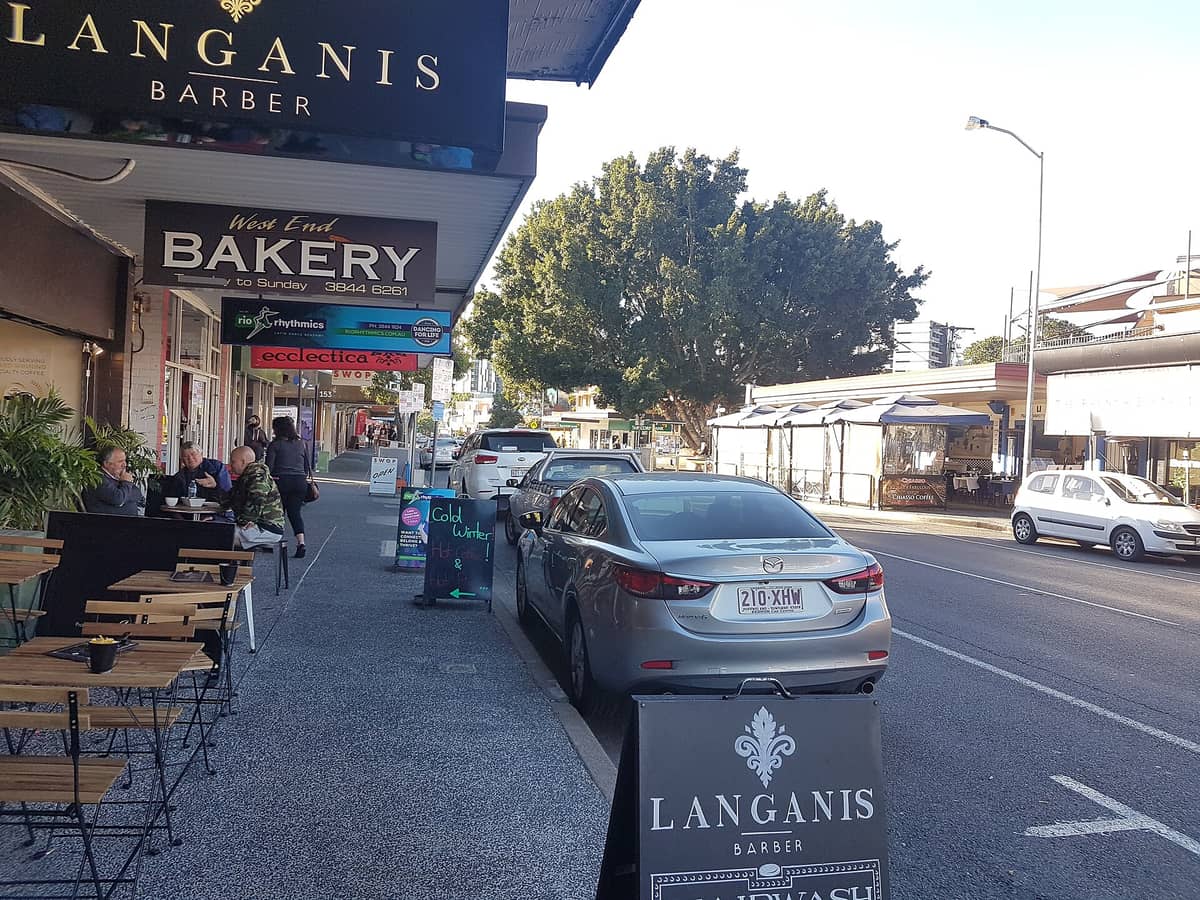
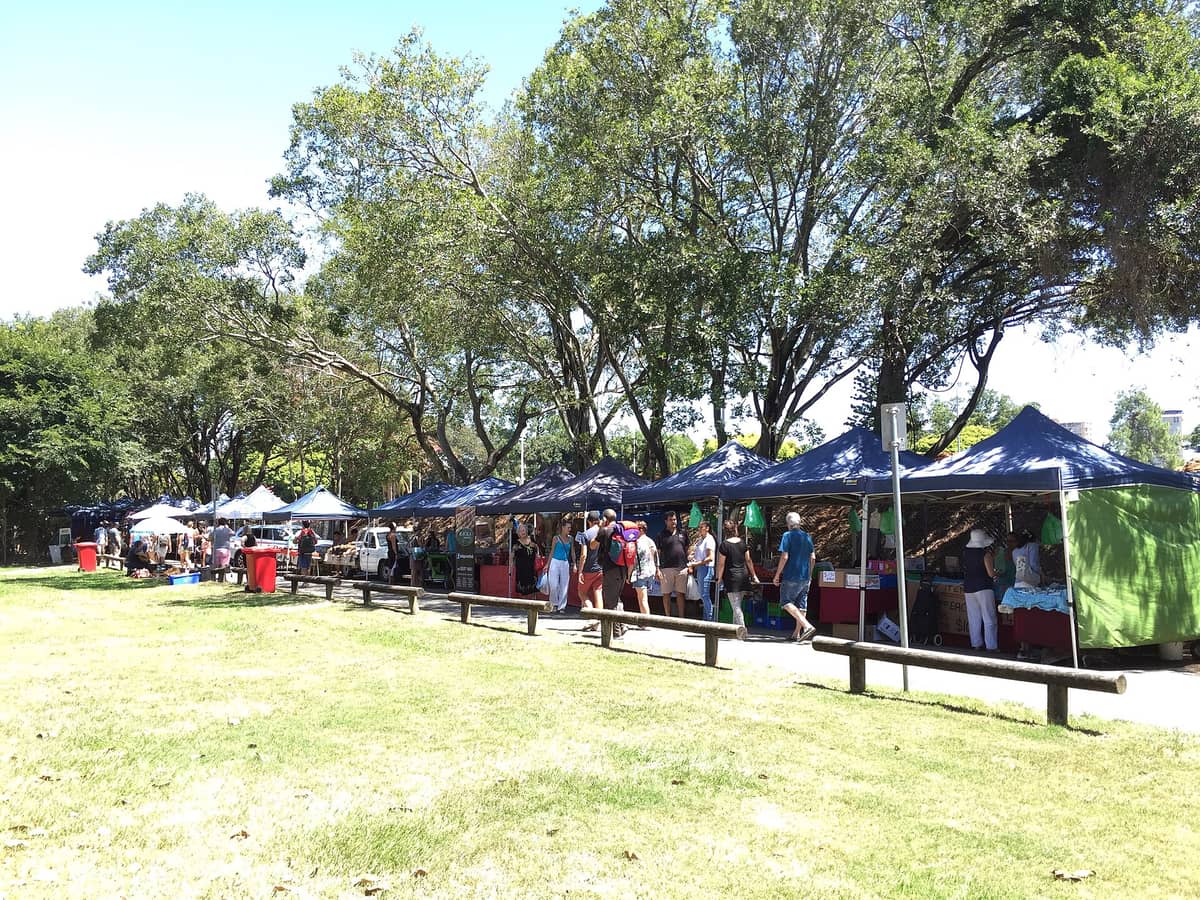
West End sits on a Brisbane River peninsula just southwest of the CBD, combining a long multicultural history with an arts-forward, independent-minded character. Boundary Street is the neighborhood's commercial spine, lined with cafés, bookshops, and restaurants from dozens of culinary traditions. It's an area that rewards slow walking and returning at different times of day.
West End is the kind of neighborhood that feels slightly apart from the rest of Brisbane, not because it's distant, but because it has always done things its own way. On a river-wrapped peninsula just minutes from the CBD, it has absorbed wave after wave of migrant communities, artists, and activists, and the result is a street-level culture that's genuinely layered rather than performed.
Orientation
West End occupies a peninsula formed by a wide westward bend in the Brisbane River, roughly two kilometres southwest of the CBD. The river wraps around its western and southern flanks, giving the suburb a geography that feels more enclosed than most inner-city neighborhoods. Its eastern boundary blends into South Brisbane, where the two suburbs share streets without a clean dividing line. To the southeast, the land lifts gradually toward Highgate Hill.
Boundary Street is the commercial and social backbone of West End, running roughly northwest to southeast through the suburb's core. Most visitors orient themselves to this strip first, then explore outward. Montague Road runs parallel along the river side, connecting the suburb to the South Bank precinct to the east. Davies Park sits near the river at the western end of the peninsula, and the West End ferry terminal at Hoogley Street provides a direct water connection to the CBD and beyond.
Understanding West End's position alongside South Bank is useful for planning. The two precincts feel very different, South Bank is polished, curated, and tourist-ready, while West End is scrappier and more residential, but they share a 10-minute walking connection along Montague Road. The Newstead-Teneriffe precinct is the comparable inner-city alternative for anyone who prefers riverside dining with a more contemporary warehouse aesthetic.
Character & Atmosphere
West End's character is the product of successive communities who made it their own. The suburb absorbed Greek and Italian migrants in the post-war decades, followed by Vietnamese and other Southeast Asian communities from the 1970s onwards. More recently it became a magnet for artists, students, and activists drawn by affordable rents and a tolerance for the unconventional. Rents have risen, but the cultural residue of all these layers remains visible in the mix of grocers, temples, community murals, and restaurants that share the same block.
On a Saturday morning, Davies Park is the place to understand what West End actually is. The markets fill the grassy space beside the river from around 6am, and the crowd is a genuine cross-section: families with strollers, older residents who have shopped here for decades, younger people with dogs, and visitors who have heard about it. The light at this hour falls flat and golden across the water, and the sound is a mix of live folk music, the hiss of coffee machines, and a half-dozen languages.
By midday on a weekend, Boundary Street shifts into a different register. The café tables fill, a queue forms outside the better brunch spots, and the foot traffic gets thick between Vulture Street and Jane Street. Weekday afternoons are quieter and arguably more pleasant for walking. The streets narrow slightly as you move away from Boundary Street toward the river, and the rhythm slows into something more residential. Independent bookshops, record stores, and small galleries are scattered through these blocks, the kind of businesses that open their own hours and don't chase tourist trade.
After dark, West End offers something different from Fortitude Valley's concentrated nightlife scene. The energy here is distributed across wine bars, small live music venues, and restaurants rather than clubs. The strip between Mollison Street and Browning Street on Boundary Street gets genuinely lively on weekend evenings, but it rarely feels threatening or rowdy in the way that some entertainment strips do. That said, the suburb's character does vary street by street, and a few blocks off the main drag can feel very quiet at night.
💡 Local tip
Saturday morning at Davies Park Markets is the single best introduction to West End. Arrive before 8am for the full atmosphere and the best produce selection. The markets run until around 2pm.
What to See & Do
Davies Park and its Saturday markets are the neighborhood's anchor attraction, but the activity list extends well beyond one morning. The West End Markets at Davies Park draw locals who treat them as a weekly ritual: fresh produce, prepared food stalls, handmade goods, and buskers spread across a leafy riverside park. The park itself is worth visiting outside market hours as well, a large grassed area with river views and shade trees that makes an underappreciated picnic spot.
Boundary Street rewards an unstructured walk. The independent retail mix includes specialty food stores, vintage clothing, second-hand bookshops, and a handful of art galleries that show local and emerging work. The street art along the side streets and laneways off Boundary Street is worth seeking out; murals appear and evolve regularly, and some are significant commissions rather than casual tags.
The river is a constant presence. Walking north along Montague Road brings you within easy reach of Kurilpa Bridge, a striking tensegrity structure that connects West End to the CBD's Tank Street, offering a useful pedestrian crossing and good river views. The bridge is also a handy link if you are walking between West End and the Queensland cultural precinct at South Bank.
Arts and community programming are woven into West End's identity. The neighborhood sits close enough to the South Bank cultural corridor that the Gallery of Modern Art and the State Library of Queensland are a 15-minute walk east along Montague Road, or a single ferry stop away. The suburb itself hosts regular community events, film screenings, and live music in its parks and smaller venues.
Davies Park Saturday Markets: 6am to 2pm, riverside park, produce and food stalls
Boundary Street: independent retail, street art, bookshops, and specialty grocers
Kurilpa Bridge: pedestrian crossing to the CBD with river views
West End ferry terminal at Hoogley Street: CityCat access and riverside walks
Local art galleries and community murals scattered through side streets
ℹ️ Good to know
West End is on the traditional lands of the Turrbal and Jagera peoples. Brisbane City Council acknowledges this history, and it's worth knowing as context for an area that has consistently positioned itself as a community-minded, culturally aware neighborhood.
Eating & Drinking
The food culture in West End is the most genuinely diverse of any neighborhood in Brisbane. Boundary Street alone contains Vietnamese, Ethiopian, Greek, Japanese, Indian, Lebanese, Italian, and Mexican restaurants within a few blocks of each other, and the quality across these is more consistent than the low-to-mid price points might suggest. This is not a neighborhood where you need to spend a lot to eat well.
Café culture is strong here. West End was doing specialty coffee before it was a common expectation in other Brisbane neighborhoods, and that culture has deepened rather than diluted over the years. The best spots tend to be small, independently owned, and occasionally stubborn about their hours. Coming in mid-morning on a weekday is the most reliable way to get a seat. Weekend brunch is popular enough that queues form at the most talked-about spots by 9am.
For drinking, West End leans toward wine bars and craft beer venues rather than clubs or cocktail bars. Several well-regarded wine lists are attached to small restaurants where the food is just as serious as the drinks. The pub scene is quieter than Fortitude Valley but warmer, with a few well-established local pubs that serve the residential crowd rather than targeting tourists or nightlife visitors.
The food market element is worth factoring into planning. The Saturday Davies Park markets have strong food stalls across cuisines, and eating breakfast or lunch there is a popular local ritual. For a broader view of Brisbane's food culture and what to seek out in the area, the Brisbane food guide covers the city's culinary landscape in more detail.
Budget: Vietnamese, Ethiopian, and Middle Eastern restaurants on Boundary Street, most mains under A$25
Mid-range: independent bistros and wine bars, expect A$30-60 for food with drinks
Café culture: specialty coffee shops concentrated around Boundary and Vulture Streets
Markets: Davies Park Saturday food stalls, ideal for a casual breakfast or lunch
Pub dining: established local pubs with a residential rather than tourist focus
Getting There & Around
West End is well served by public transport, though the options require a little more navigation than in the CBD. The easiest connection from the city centre is the CityCat ferry, which stops at the West End terminal on Hoogley Street. The journey from North Quay near the CBD takes around 10 minutes and is a pleasant way to arrive, giving you a river-level perspective on the suburb before you even reach the shore. CityCat services run frequently during the day and are part of the Translink network, covered by go card and other standard fare methods.
Bus connections run along Boundary Street and Montague Road, with the West End CityGlider providing a frequent, high-capacity service between the suburb and the CBD via South Brisbane. South Brisbane and South Bank train stations are located on the suburb's eastern boundary, about a 10 to 15-minute walk from the center of Boundary Street. These stations sit on the South East Queensland rail network and offer fast connections to the CBD and further south.
On foot, West End is reachable from South Bank's cultural precinct in around 10 minutes by walking west along Montague Road. The Kurilpa Bridge provides a direct pedestrian and cycle route to the CBD's Tank Street. Cycling is a practical option: the riverside paths connect West End to the broader city cycling network, and the terrain is relatively flat along the river routes.
For a full overview of how Brisbane's public transport network fits together, including go card setup, CityCat routes, and bus rapid transit, the getting around Brisbane guide covers the logistics clearly.
💡 Local tip
If you're combining West End with a visit to South Bank, the most efficient route is Montague Road on foot or bike. The walk takes about 10-12 minutes and passes a number of cafés and murals along the way. Alternatively, the CityCat connects both areas in a single stop.
Where to Stay
West End is a primarily residential suburb and hotel stock is limited compared to the CBD or South Bank. The accommodation that does exist tends toward boutique guesthouses, serviced apartments, and smaller lodges rather than major hotel chains. This suits a particular kind of traveler: someone who wants to stay in a neighborhood rather than a hotel precinct, with access to local cafés and markets as part of the daily routine.
The most practical base position within the suburb is within easy walking distance of Boundary Street and the Hoogley Street ferry terminal, which keeps the main dining strip, the markets, and the CityCat connection all within a few minutes on foot. Staying on or just off Boundary Street puts you at the center of the neighborhood's noise and activity, which is appealing or not depending on the traveler.
For travelers who want more accommodation options without losing proximity to West End, South Bank is the most logical alternative base, offering a wider range of hotels at various price points with a 10-15 minute walk to the West End strip. The Brisbane accommodation guide covers the full range of neighborhood options across the city.
Best for: travelers who prioritize neighborhood immersion over hotel amenities
Accommodation types: boutique guesthouses, serviced apartments, small lodges
Nearest major hotel hub: South Bank, a 10-15 minute walk east along Montague Road
Noise note: rooms on or near Boundary Street can be noisy on weekend evenings
⚠️ What to skip
West End is not the right base if you need conference facilities, a pool, a concierge, or a large hotel loyalty program. The suburb's accommodation is genuinely limited in scale and amenity compared to the CBD or South Bank. Book early if you want the better boutique options, particularly around festival weekends.
Honest Assessment: Who West End Is For
West End is not a neighborhood that tries to appeal to everyone, and that's a significant part of what makes it worth spending time in. If you want a polished tourist experience with guaranteed opening hours and English-language menus, South Bank is more reliably that. If you want a Saturday morning that feels like a genuine neighborhood rather than a curated attraction, West End delivers in a way that few parts of Brisbane do.
The suburb rewards travelers who are curious about how cities actually work. Its history as a working-class and migrant neighborhood, its current tension between gentrification and community identity, its mix of the political and the convivial, all of this is readable in the streets if you're paying attention. Paired with a morning at the Davies Park markets and an afternoon walking the South Bank cultural precinct, it makes for one of the more layered days you can spend in Brisbane.
For first-time visitors trying to fit West End into a broader Brisbane itinerary, the three-day Brisbane itinerary provides a useful structure for balancing neighborhood exploration with the city's main attractions.
TL;DR
West End is Brisbane's most culturally layered inner suburb, shaped by successive waves of migrant communities and a persistent independent streak that has survived rising rents.
Best for: food-curious travelers, market enthusiasts, people who want a residential neighborhood feel rather than a hotel precinct.
Key logistics: CityCat ferry to Hoogley Street terminal, buses along Boundary Street and Montague Road, 10-15 minute walk from South Bank train stations.
Saturday morning at Davies Park Markets is the definitive West End experience and a strong reason to time your visit accordingly.
Not ideal for: travelers who need a wide range of hotel options, want guaranteed tourist infrastructure, or prefer a more curated, polished precinct experience.
Three days is enough time to get a genuine feel for Brisbane, from its riverside precincts and cultural institutions to its inner-city neighbourhoods and wildlife encounters. This itinerary is structured for first-time visitors but specific enough to be useful for repeat travellers who want to go deeper.
Brisbane is not a beach city in the way Sydney or the Gold Coast are, but the ocean is closer than most visitors expect. This guide covers the best beaches near Brisbane, from the patrolled surf beaches of North Stradbroke Island to the pristine sands of Moreton Island, plus practical advice on getting there, staying safe, and timing your visit.
Brisbane delivers more than its size suggests for museums, with major institutions offering free general admission alongside world-class rotating exhibitions. This guide covers the city's best museums across art, natural history, maritime heritage, civic history, and science.
Brisbane's subtropical climate means it's worth visiting year-round, but the best time to go depends on your priorities. This guide breaks down every season by weather, crowds, costs, and events so you can plan smarter.
Brisbane rewards those who look up, out, and across. From the sweeping 180-degree panorama at Mount Coot-tha to the cliff-edge views at Kangaroo Point, this guide covers the city's finest vantage points for sunrise, sunset, and everything in between.
Brisbane is the city that inspired Bluey, and you can experience it two ways: the official Bluey's World immersive attraction at Hamilton, and the real parks, beaches and streets that appear throughout the show. This guide covers both, with practical booking advice, neighbourhood-by-neighbourhood locations, and practical tips for making the most of a Bluey-themed Brisbane day.
Everything you need to navigate Brisbane Airport (BNE) from landing to your hotel. This guide covers terminal layouts, all transport options to the CBD, inter-terminal transfers, parking, and practical tips that save time and money.
Brisbane runs a packed events calendar year-round, from the flagship Brisbane Festival in September to free outdoor markets, sports finals, and cultural celebrations. This guide breaks down the key events by season, what they actually involve, and how to plan around them.
Brisbane rewards couples with a surprisingly rich mix of romantic settings: dramatic river views, heritage precincts, lush gardens, and waterfront bars. Whether you're planning a weekend away or looking for a special evening out, this guide covers the best the city has to offer.
Brisbane's history stretches from Indigenous Country to colonial settlement, two World Wars, and a postwar boom that shaped the city you see today. This guide covers the heritage buildings, war memorials, colonial-era homes, and cultural institutions that tell that story best.
Brisbane delivers more than its size suggests for outdoor walking. Whether you want a quick riverside stroll through the CBD, a serious bushland hike, or a dramatic coastal walk on a nearby island, the city and its surrounds deliver. This guide covers the best hikes and walks near Brisbane, organised by type and difficulty.
Brisbane's live music scene delivers more than its size suggests, from intimate indie rooms in Fortitude Valley to outdoor amphitheatres on the river. This guide covers the best venues by genre and neighbourhood, how to get tickets, what to budget, and how to get home safely after the show.
Brisbane's market scene is more varied than most visitors expect, with options spread across the week, not just weekends. This guide covers the best markets in Brisbane, including what to buy, when to go, and what to skip.
Brisbane's nightlife has matured considerably over the past decade. From the bar-packed streets of Fortitude Valley to riverside cocktail spots and indie live music rooms, this guide covers the best precincts, practical logistics, and practical advice for a great night out in Brisbane.
Brisbane is one of Australia's more affordable capital cities, and with a few smart moves, you can stretch your dollar significantly. This guide covers free attractions, cheap transport, budget-friendly food, and practical advice on where not to waste your money.
The Brisbane River is the city's spine, and knowing how to use it makes a trip here dramatically better. This guide covers the best walks, viewpoints, precincts, and experiences along the river, from the CBD to New Farm and beyond.
Brisbane's shopping scene spans a central mall, design-focused precincts, riverside markets, and neighbourhood strips worth exploring on foot. This guide breaks down where to go, what to expect, and how to avoid wasting time on the wrong options.
Brisbane delivers more than its size suggests as a sports city. From NRL and A-League to cricket and basketball, this guide covers every major team, venue, and match-day logistics you need to plan a great live sports experience in Brisbane.
The Gold Coast is 80 kilometres south of Brisbane and one of the most popular day trips in Queensland. This guide covers every realistic way to get there, what to do once you arrive, how much to budget, and the practical trade-offs between driving, taking the train, and joining a tour.
Brisbane rewards walkers with a compact city centre, riverside paths, and 24 official heritage trails maintained by Brisbane City Council. This guide covers the best self-guided walking routes, how long each takes, what you'll actually see, and when to go.
Brisbane sits at the edge of some of Australia's most accessible wildlife habitat, and you don't need to travel far to encounter koalas, kangaroos, dolphins, and migratory shorebirds. This guide covers the best sanctuaries, nature reserves, wetlands, and island escapes for seeing native animals in and around the city.
Brisbane is one of Australia's most family-friendly cities, with free beaches, world-class wildlife sanctuaries, hands-on museums, and outdoor adventures within easy reach of the CBD. This guide covers the best activities for families visiting Brisbane, from toddler-friendly parks to day trips that will captivate older kids.
Brisbane sits at the centre of one of Australia's most diverse regions for day tripping. Within two hours you can be snorkelling around shipwrecks, watching humpback whales from a headland, or wandering a rainforest. This guide breaks down the top day trips from Brisbane with realistic transport options, costs, and the practical trade-offs most guides skip.
Brisbane rewards budget-conscious travellers more than most Australian cities. From a free inner-city beach and world-class art galleries to riverside walks, koala encounters, and sweeping city lookouts, there's an enormous amount to do here without opening your wallet.
Brisbane has one of Australia's most practical urban transport networks, covering trains, buses, ferries, and the CityCat river service. This guide breaks down fares, payment methods, routes, and practical advice on when to ditch public transit and grab a rideshare instead.
Brisbane divides opinion. Some travelers find it a sunny, walkable city with genuine character and easy access to outstanding day trips. Others pass through and wonder what the fuss is about. This guide cuts through both the hype and the skepticism to give you a clear picture of what Brisbane actually offers, who it suits, and when to go.
Moreton Island sits just 40 kilometres off the Brisbane coast, but it feels worlds away. This guide covers how to get there, what to do with your time, realistic costs, and the practical details that most guides leave out.
North Stradbroke Island (Minjerribah) sits just 30 km from Brisbane but feels like a different world. This guide covers how to get there, how to get around, what to do, and what the glossy tourism brochures leave out.
Brisbane delivers more than its size suggests for a city of its size. This guide covers the best things to do in Brisbane across every budget and interest, from South Bank's cultural precinct and the river's CityCat ferries to day trips, wildlife encounters, and the city's underrated food scene.
Brisbane's food scene delivers more than its size suggests. This guide covers the regional specialties, best neighbourhoods for dining, market food experiences, and practical tips to help you eat well across every budget in Queensland's capital.
Choosing where to stay in Brisbane shapes your entire trip. This guide breaks down every major neighbourhood by budget, vibe, and proximity to attractions, so you can book with confidence rather than guesswork.