State Library of Queensland: Brisbane's Cultural Anchor on South Bank
The State Library of Queensland is a free, publicly accessible cultural institution at the heart of South Bank's arts precinct. Beyond books and archives, it houses gallery spaces, a rooftop terrace, maker spaces, and a strong calendar of public programs that reward repeat visits.
Quick Facts
- Location
- Stanley Place, South Bank, Brisbane QLD
- Getting There
- Cultural Centre Busway Station (approx. 260 m); South Brisbane Station (approx. 500 m); South Bank ferry terminals (approx. 800 m)
- Time Needed
- 1–3 hours depending on programs and exhibitions
- Cost
- Free general entry; some events and programs may require tickets
- Best for
- Curious travellers, rainy-day culture seekers, families with older children, researchers, architecture admirers
- Official website
- www.slq.qld.gov.au
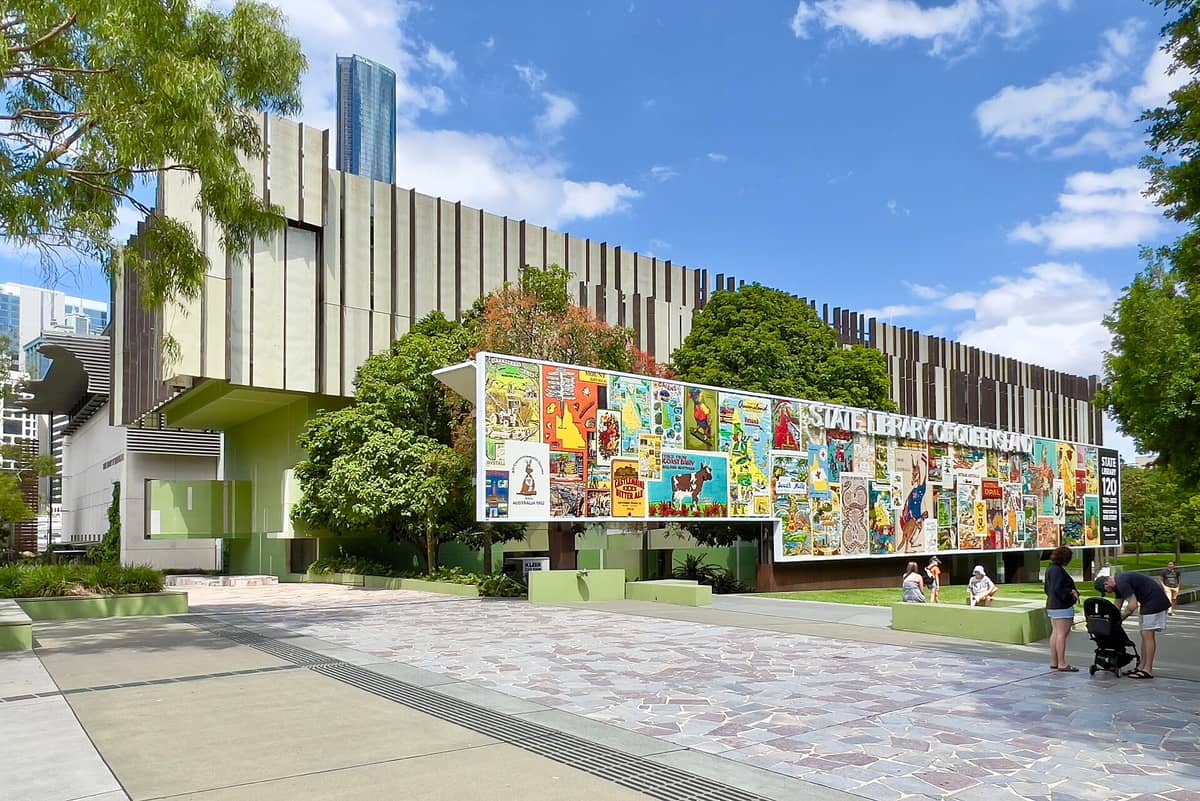
What the State Library of Queensland Actually Is
Most visitors to South Bank walk straight past the State Library of Queensland on their way to the beach pool or the galleries. That's their loss. This is a working public institution, open to anyone, with no ticket barrier at the door and a surprising amount going on inside: rotating exhibitions, a strong photography and film archive, dedicated Indigenous knowledge spaces, digital maker labs, and a rooftop terrace with river views that almost no one talks about.
It sits within South Bank's Cultural Forecourt alongside the Queensland Museum, QAGOMA, and the Queensland Performing Arts Centre. The building itself is a confident piece of late-twentieth-century civic architecture: layered concrete and glass with generous interior volumes that read as serious without feeling intimidating. Inside, the atmosphere is notably calmer than anything else in the precinct.
The library occupies a central position in Brisbane's broader arts corridor. If you're already planning to visit the Gallery of Modern Art or the Queensland Museum, the State Library is a logical extension of the same afternoon — and it stays open until 8pm Monday through Thursday, well past when other institutions close.
💡 Local tip
Check the official hours page before visiting. The State Reference Library is generally open 10am–8pm Monday–Thursday and 10am–5pm Friday–Sunday, but hours vary by space, and some public holidays see reduced hours or full closures. Verify at slq.qld.gov.au/visit/opening-hours.
What You'll Find Inside
The ground floor is the first point of orientation. A main reception desk sits near the entrance, and the layout branches outward from there: reading rooms, computer terminals, and the beginning of the exhibition spaces. The ceilings are high, the lighting is controlled, and the floor surface produces a particular low hum of footsteps and turning pages that you notice within a few minutes. It smells faintly of paper and climate-controlled air, the universal scent of serious archival institutions.
The State Reference Library holds Queensland's most significant collection of published materials, historical records, maps, photographs, and newspapers. For most leisure visitors, the collection rooms are not the main draw, but the gallery exhibitions on the upper levels absolutely are. The library mounts a rotating program of shows that tend to focus on Queensland history, First Nations culture and knowledge, photography, and social history. These are free, well-curated, and occupy spaces with serious natural light. They're frequently overlooked in favour of the larger institutions next door, which means you often have them almost to yourself.
The Kuril Dhagun space is worth particular attention. Named using Yuggera language, it is the library's dedicated First Nations space, providing access to Aboriginal and Torres Strait Islander resources, community programs, and a quieter environment specifically designed for First Nations visitors and researchers. It's not a museum exhibit; it functions as a living community resource, which gives it a different energy from the rest of the building.
Tickets & tours
Live prices and dates from our booking partner. If you book, we may earn a commission at no extra cost to you.
Luggage Storage in Brisbane
From 5 €Instant confirmationFree cancellationBrisbane's dark stories true crime tour
From 21 €Instant confirmationFree cancellationFull-day Mount Tamborine winery tour from Brisbane with lunch
From 140 €Instant confirmationFree cancellationNorth Stradbroke Island small groups day tour
From 79 €Instant confirmationFree cancellation
How the Visit Changes by Time of Day
Morning visits, from opening until around noon, draw a mix of students, researchers, and early-rising tourists. The reading rooms are populated but not crowded, and the natural light through the upper windows is at its best. If you're here to use the collections or attend a program, this is the most productive window.
The mid-afternoon period, roughly 1pm to 4pm, sees school groups on weekdays during term time. The ground floor in particular can become noticeably louder during these hours. If you prefer a quieter experience, arrive before noon or after 4pm.
The evening hours on weekdays are the library's most underrated window. Between 5pm and 8pm Monday through Thursday, the building thins out considerably. The exhibitions are still accessible, the rooftop terrace catches the late afternoon light, and the atmosphere shifts from busy civic institution to something closer to a calm retreat. It's genuinely pleasant to be here after the South Bank afternoon crowds have peaked and before the dinner-hour foot traffic builds on the esplanade.
ℹ️ Good to know
Parking is available beneath the library via Stanley Place at a listed daily rate of A$20 per entry, per day. For most visitors, public transport is the practical choice: Cultural Centre Busway Station is a short walk away, and the South Bank ferry terminals connect to the river network.
The Rooftop Terrace: South Bank's Quietest View
One of the library's least-publicised features is its rooftop terrace. From the upper levels you get clear sightlines across the South Bank precinct and toward the Brisbane River. It's not the highest vantage point in the city, but the combination of the view and the near-silence up there makes it worth seeking out. Most people never make it up.
For comparison, the full city panorama requires going further, either to the Mount Coot-tha Lookout or to elevated viewing points in the CBD. But the library terrace serves a different function: it's a breathing space in the middle of a dense cultural precinct, free of admission and easy to access.
Practical Walkthrough: Getting Here and Getting Around Inside
The Cultural Centre Busway Station is the closest transit stop, approximately 260 metres from the library entrance. Buses from the CBD cross the Victoria Bridge and stop here within a few minutes. South Brisbane Station on the suburban rail network is around 500 metres, and the South Bank ferry terminals are roughly 800 metres along the riverside path — walkable in about ten minutes.
South Bank as a precinct rewards time on foot. If you're arriving via ferry and want to factor in a short walk before entering the library, the South Bank Parklands run parallel to the riverside path and take you past the beach pool and market stalls before you reach the Cultural Forecourt.
Inside the building, all areas are wheelchair accessible. The library features lifts on every level, accessible toilets throughout, tactile and Braille signage, and hearing loops. Certified assistance dogs are welcome. The entrance foyer is level and wide, with no steps between the main entrance and the elevator bank. For visitors with mobility considerations, this is one of the more straightforwardly accessible cultural institutions in Brisbane.
💡 Local tip
Photography rules inside the library vary by space. Exhibition areas often allow photography for personal use but not flash or tripods. Check signage as you enter each area rather than assuming a blanket policy applies throughout the building.
Who This Is and Isn't For
The State Library of Queensland works well for travellers who want cultural substance without paying for it, families with children old enough to engage with exhibitions independently, anyone who needs a calm interior space during Brisbane's hotter months, and visitors with a specific interest in Queensland history, First Nations culture, or archival photography. The library's program calendar rewards planning: check the website before you visit to see what's running.
It's also a natural complement to a broader South Bank afternoon. The Queensland Art Gallery is directly adjacent, and the two institutions share the Cultural Forecourt. You can move between them in minutes, making this the most efficient cultural pairing on the precinct.
Who should skip it or adjust expectations: visitors looking for interactive children's activities aimed at young kids will find the environment a poor fit for toddlers — it is a functioning library, and the noise tolerance is limited. Travellers whose time is tightly compressed around landmark sightseeing may find the library's offerings require more patience than a quick walk-through allows. It rewards slow visitors more than hurried ones.
If your primary focus is outdoor Brisbane, the library probably doesn't make the cut. In that case, the City Botanic Gardens across the river or a walk along the Brisbane Riverwalk are better uses of limited daylight hours.
A Note on Weather and Seasonal Timing
Brisbane's summer months, roughly December through February, bring heat and humidity that make indoor attractions considerably more appealing than usual. The library's climate-controlled interior is a genuine asset during these months, and visitor numbers inside tend to increase while the outdoor South Bank areas thin out during the hottest parts of the day. In winter, from June through August, Brisbane's mild temperatures mean the competition between indoor and outdoor options is more even. The library's evening hours make it a particularly sensible choice on summer days when you want to avoid the midday heat but still want to be active later.
For broader guidance on when to plan your trip, the best time to visit Brisbane guide covers seasonal trade-offs in more detail.
Insider Tips
- The rooftop terrace is not prominently signposted. Take the lift to the upper floors and follow the terrace exit signs. Most visitors never find it, which means you often have the space entirely to yourself.
- The library's weekday evening hours (open until 8pm Monday–Thursday) are the least-trafficked window of the week. If you want the exhibitions to yourself and a calm reading-room atmosphere, this is the time to come.
- Check the events calendar on the official website before visiting. The library runs free public programs, author talks, and workshops on a regular cycle. Attending one turns a browse into a genuine experience.
- The Kuril Dhagun space has its own dedicated resources and is open for community use as well as visitor access. It's not a display — treat it accordingly and you'll find it genuinely informative.
- If you're driving, the underground parking entrance is via Stanley Place. Arrive early on weekends as the precinct parking fills up when both the library and the adjacent cultural venues have major programs running simultaneously.
Who Is State Library of Queensland For?
- Budget-conscious travellers who want genuine cultural depth without admission fees
- History and archive enthusiasts with an interest in Queensland's documentary record
- Visitors seeking an indoor refuge during Brisbane's hot and humid summer afternoons
- Travellers pairing a South Bank cultural precinct day with QAGOMA or the Queensland Museum
- Anyone who wants to understand contemporary First Nations knowledge and culture beyond a museum display context
Nearby Attractions
Other things to see while in South Bank:
- Fish Lane
Fish Lane is a compact but layered laneway in South Brisbane connecting the Cultural Centre precinct with West End. It packs street art, independent cafés, bars, and restaurants into a short stretch that rewards slow exploration at almost any hour.
- Gallery of Modern Art (GOMA)
The Gallery of Modern Art (GOMA) is Australia's largest gallery dedicated to modern and contemporary art, anchoring Brisbane's South Bank cultural precinct. General entry is free, the building itself is architecturally striking, and the rotating program of exhibitions consistently draws international attention.
- Kurilpa Bridge
Kurilpa Bridge is a free pedestrian and bicycle bridge crossing the Brisbane River between Kurilpa Point in South Brisbane and Tank Street in the CBD. Opened in 2009, it is one of the world's largest structures built on tensegrity principles, and it doubles as a solar energy generator. Whether you're crossing to reach the Gallery of Modern Art or simply looking for a river walk with architectural interest, the bridge earns a place in any South Bank itinerary.
- Nepalese Peace Pagoda
Standing three storeys tall in the heart of South Bank Parklands, the Nepalese Peace Pagoda is a remarkable piece of traditional Himalayan craftsmanship built from over 80 tonnes of hand-carved timber. Free to visit and open daily, it rewards curious travelers who slow down enough to take in the detail.
Planning a trip? Discover personalized activities with the Nomado app.