Kurilpa Bridge: Brisbane's Bold River Crossing Explained
Kurilpa Bridge is a free pedestrian and bicycle bridge crossing the Brisbane River between Kurilpa Point in South Brisbane and Tank Street in the CBD. Opened in 2009, it is one of the world's largest structures built on tensegrity principles, and it doubles as a solar energy generator. Whether you're crossing to reach the Gallery of Modern Art or simply looking for a river walk with architectural interest, the bridge earns a place in any South Bank itinerary.
Quick Facts
- Location
- Between Kurilpa Point, South Brisbane and Tank Street, Brisbane CBD
- Getting There
- South Brisbane Station (5 min walk); South Bank Busway stops nearby
- Time Needed
- 15–30 minutes to cross and pause; longer if combining with nearby attractions
- Cost
- Free; open to pedestrians and cyclists at all hours
- Best for
- Architecture lovers, photographers, cyclists, river walkers
What Kurilpa Bridge Actually Is
Kurilpa Bridge is a dedicated pedestrian and bicycle bridge spanning the Brisbane River in Queensland, Australia. Construction began in 2007 and the bridge opened on 4 October 2009, originally referred to in planning documentation as the Tank Street Bridge. Its current name comes from the traditional name for the area: 'kurilpa' is a Turrbal word relating to the water rats that once inhabited the riverbank. Brisbane sits on the Country of the Turrbal and Jagera peoples, and the name choice reflects an effort to embed that history into the city's built form.
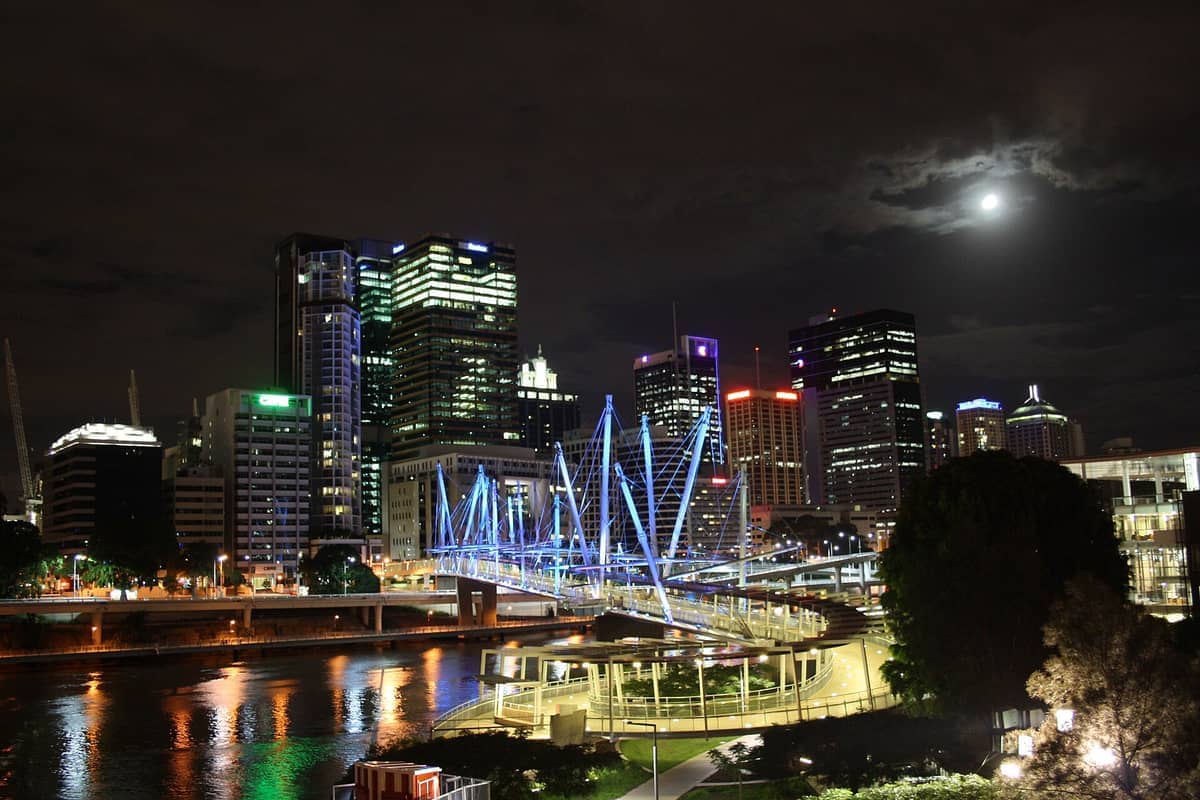
At approximately 470 metres in total length, with a main span reported between 120 and 135 metres, it is not a small structure. What sets it apart from every other bridge in Brisbane is its construction system. Kurilpa Bridge is one of the world's largest built examples of tensegrity engineering, a structural approach in which components are held in stable equilibrium through a balance of continuous tension cables and isolated compression masts, rather than through rigid connections or arches. The result looks almost unfinished to an untrained eye: a forest of white steel masts leaning at competing angles, threaded through with cables that look too delicate to be doing serious work. They are, in fact, doing all of it.
ℹ️ Good to know
The bridge's tensegrity structure was designed by Cox Rayner Architects in collaboration with Arup engineers. The principle was first articulated by inventor and designer Buckminster Fuller, whose geodesic domes operate on similar load-distribution logic.
The Experience of Crossing It
The approach from the South Bank side begins near the Gallery of Modern Art, where a broad ramp leads up onto the deck. The bridge sits noticeably higher than the riverbank, so within a few steps you have clear sightlines up and down the Brisbane River in both directions. To the east, the Story Bridge and the city's tower cluster come into view. To the west, the river bends away toward the inner suburbs.
The deck itself is wide enough for comfortable two-way pedestrian and cycle traffic, with a gentle camber toward the centre. Overhead, the mast and cable array creates a shifting geometric shadow pattern across the walkway throughout the day. In strong morning light, the cables cast thin, precise lines across the pale deck surface. By late afternoon, when the sun drops toward the west, the whole structure glows a warm off-white and the shadows lengthen into long diagonals.
The bridge is also a working power generator. An array of photovoltaic solar panels is integrated into its canopy structure, helping to power the bridge’s lighting. This detail is not always obvious to first-time visitors, but look up at the canopy sections above the main deck and the dark panel surfaces become visible. It was considered an innovative piece of urban infrastructure design at the time of its opening and remains relevant as Brisbane continues to expand its sustainable infrastructure commitments.
At the midpoint, where the main span reaches its highest point above the water, there is a marked change in the ambient sound. The traffic noise from William Jolly Bridge to the west and the general city hum drop away. You are above the river, surrounded by wind and the soft rattle of cable tension. It is briefly, unexpectedly quiet. This midpoint is also the best location to photograph the Story Bridge framed through the mast array, particularly in golden-hour light.
Tickets & tours
Live prices and dates from our booking partner. If you book, we may earn a commission at no extra cost to you.
Self-guided Brisbane exploration tours with downloadable app
From 7 €Instant confirmationNatural Bridge and Springbrook tour
From 61 €Instant confirmationFree cancellationLuggage Storage in Brisbane
From 5 €Instant confirmationFree cancellationBrisbane's dark stories true crime tour
From 21 €Instant confirmationFree cancellation
Best Time to Visit and How Light Changes Everything
Early morning brings joggers and commuter cyclists who use the bridge as a practical CBD link. The river below is often calm at this hour and the light comes in flat and even from the east. This is a useful time if you want the bridge largely to yourself for photography without the midday contrast that bleaches the white masts.
Midday and early afternoon are the bridge's busiest periods on weekends, when visitors moving between South Bank Parklands and the CBD cross in both directions. The structure can feel populated but it is wide enough that it never feels crowded. On weekdays, lunchtime foot traffic from the CBD office precinct is noticeable.
After dark, Kurilpa Bridge is lit from below and along the mast array. The lighting design changes the character of the structure entirely: where daytime is all shadow geometry and cable precision, at night the masts become glowing verticals against a dark sky and the river reflects the light in long, wavering columns. For photographers working with a tripod, the reflection shots looking back toward the South Bank lights are worth the trip alone.
💡 Local tip
Sunset and the first hour after dark offer the most dramatic lighting conditions on the bridge. Position yourself at the midpoint of the main span for the best view of the city skyline reflection in the river below.
Getting There and Practical Logistics
The South Bank end of the bridge is a short walk from South Brisbane Station, which sits on the inner-city rail network. From there, follow the Cultural Forecourt signage west along Stanley Place; the bridge ramp is visible within five minutes. The South Bank bus corridor and nearby ferry terminals also place the bridge within easy reach of the broader Translink network.
From the CBD side, the bridge connects to Tank Street and is a straightforward walk from Roma Street or Central Station via the riverside path. Cyclists using the bridge should be aware that it connects to wider South Brisbane cycling routes heading toward West End and beyond. The bridge is free to use with no barriers or ticketing, and there is no recorded seasonal closure.
Accessibility information beyond general pedestrian access is not detailed in available sources. The ramp-based approach from both ends suggests the designers intended step-free access, but visitors with specific mobility needs should check directly with Brisbane City Council before relying on this.
⚠️ What to skip
Cyclists should give way to pedestrians on the bridge deck, particularly near the midpoint where foot traffic slows. On windy days the cable array creates an audible and physical sensation of movement that some visitors find unexpected.
Cultural and Architectural Context
Brisbane's urban development in the decade around the 2000s and 2010s placed repeated emphasis on the river as a public asset rather than an industrial corridor. Kurilpa Bridge was part of that shift. It was funded as civic infrastructure with an explicit design brief: the bridge had to perform structurally, integrate renewable energy production, and be architecturally distinct enough to contribute to the city's identity.
The bridge lands on the South Bank side adjacent to the Gallery of Modern Art, which itself opened in 2006 as part of the same broader cultural investment in the precinct. Together, GOMA and the bridge form the western anchor of the South Bank cultural corridor, which extends east through the Queensland Museum, State Library, and South Bank Parklands.
The tensegrity approach, while visually experimental, was not arbitrary. The system allows for a lighter deck structure than a conventional cable-stayed or arch bridge of similar span. Given the depth of the Brisbane River at this point and the constraints of the surrounding urban streetscape, the engineering choice had practical justification beyond aesthetics. That said, the visual outcome is genuinely striking, and the bridge has become one of the more photographed pieces of infrastructure in the city.
Who Gets the Most Out of This Bridge
Architecture and engineering enthusiasts will find more to examine here than on any other river crossing in Brisbane. If you have any interest in structural design, give yourself extra time at each end to study the cable geometry from ground level before crossing. The way the masts relate to each other changes entirely depending on your angle of view.
Visitors building a walking itinerary through South Bank can use the bridge as a natural turn-around point. Cross from the CBD, walk through the cultural precinct to the South Bank Parklands and Streets Beach, then return via the Brisbane Riverwalk or William Jolly Bridge for a loop that takes in the river from multiple angles.
It is worth being honest about what the bridge is not. It is not a destination attraction in the way that a museum or a lookout is. There is nothing to do on it beyond walk across. Visitors who expect an observation deck, an interpretive installation, or a café will find only a well-designed path above a river. For that reason, Kurilpa Bridge works best when folded into a broader itinerary rather than treated as a standalone outing. Travellers with very limited time in Brisbane who need to prioritise should understand that clearly.
Insider Tips
- Walk to the midpoint of the main span and look straight down. The gap in the deck railing gives a clear view directly to the river surface below, which is a different experience from any other Brisbane river crossing and useful for a sense of the bridge's height.
- The western side of the deck (facing upriver) gives cleaner photography conditions in the morning because the sun is behind you when shooting toward West End and the inner suburbs.
- If you are crossing by bicycle during peak commuter hours on weekdays, the direction flow can feel compressed near both ramps. Starting your crossing from the South Bank side before 8 am or after 9 am avoids the thickest commuter traffic.
- The lighting scheme changes colour during special events and public holidays. If you are visiting during a festival or event period, check whether the bridge has a scheduled lighting programme for that evening.
- Ground-level views from the South Bank riverbank path looking back up at the bridge structure give a clearer sense of the tensegrity geometry than the view from the deck itself. Spend a few minutes below before crossing.
Who Is Kurilpa Bridge For?
- Architecture and engineering enthusiasts who want to study a real-world tensegrity structure
- Photographers working at sunset or after dark, especially those focused on long-exposure river reflections
- Cyclists and joggers using the river crossing as part of a broader inner-city route
- Visitors building a full South Bank walking loop between the CBD cultural precinct and the Parklands
- Travellers interested in sustainable urban design and solar integration in public infrastructure
Nearby Attractions
Other things to see while in South Bank:
- Fish Lane
Fish Lane is a compact but layered laneway in South Brisbane connecting the Cultural Centre precinct with West End. It packs street art, independent cafés, bars, and restaurants into a short stretch that rewards slow exploration at almost any hour.
- Gallery of Modern Art (GOMA)
The Gallery of Modern Art (GOMA) is Australia's largest gallery dedicated to modern and contemporary art, anchoring Brisbane's South Bank cultural precinct. General entry is free, the building itself is architecturally striking, and the rotating program of exhibitions consistently draws international attention.
- Nepalese Peace Pagoda
Standing three storeys tall in the heart of South Bank Parklands, the Nepalese Peace Pagoda is a remarkable piece of traditional Himalayan craftsmanship built from over 80 tonnes of hand-carved timber. Free to visit and open daily, it rewards curious travelers who slow down enough to take in the detail.
- Queensland Art Gallery (QAGOMA)
Spread across two buildings 150 metres apart on South Bank, the Queensland Art Gallery and Gallery of Modern Art form one of Australia's most significant art institutions. General entry is free, programming runs daily, and the permanent collections alone justify at least half a day.
Planning a trip? Discover personalized activities with the Nomado app.