Gallery of Modern Art (GOMA): Brisbane's World-Class Contemporary Art Space
The Gallery of Modern Art (GOMA) is Australia's largest gallery dedicated to modern and contemporary art, anchoring Brisbane's South Bank cultural precinct. General entry is free, the building itself is architecturally striking, and the rotating program of exhibitions consistently draws international attention.
Quick Facts
- Location
- Stanley Place, South Brisbane (South Bank precinct)
- Getting There
- Cultural Centre Busway station (adjacent); South Brisbane train station (~5 min walk); South Bank CityCat terminal (~10 min walk); or walk across Victoria Bridge or Kurilpa Bridge from the CBD
- Time Needed
- 1.5–3 hours for general collection; up to half a day during major ticketed exhibitions
- Cost
- General entry free; some major exhibitions and events require paid tickets (prices vary)
- Best for
- Contemporary art lovers, architecture enthusiasts, families, and rainy-day visitors
- Official website
- www.qagoma.qld.gov.au
What GOMA Actually Is (and Why It Matters)
The Gallery of Modern Art opened in 2006. It sits at Stanley Place in South Brisbane, directly alongside the Queensland Art Gallery (QAG), and the two institutions are managed together under the QAGOMA umbrella. GOMA is the larger of the two buildings and is widely recognised as Australia's largest gallery of modern and contemporary art.
This is not a quiet, reverent museum where you whisper and shuffle. The scale is generous, the light is calibrated, and the programming oscillates between challenging solo retrospectives, large-scale international touring exhibitions, film, and immersive installations. On any given Saturday morning you might walk past a school group sprawled on the floor sketching a sculpture, a couple debating a video installation, and a solo visitor working through the audio guide at their own pace.
GOMA anchors the broader South Bank cultural precinct, which also includes the Queensland Museum, State Library of Queensland, and the Queensland Performing Arts Centre. Spending a full day across two or three of these institutions is a realistic and rewarding option, particularly in Brisbane's wetter summer months.
💡 Local tip
GOMA's general entry is free, but major blockbuster exhibitions run their own ticketing. Check the QAGOMA website before your visit to see what's currently ticketed — some sell out weeks in advance.
The Building: Architecture Worth Noticing
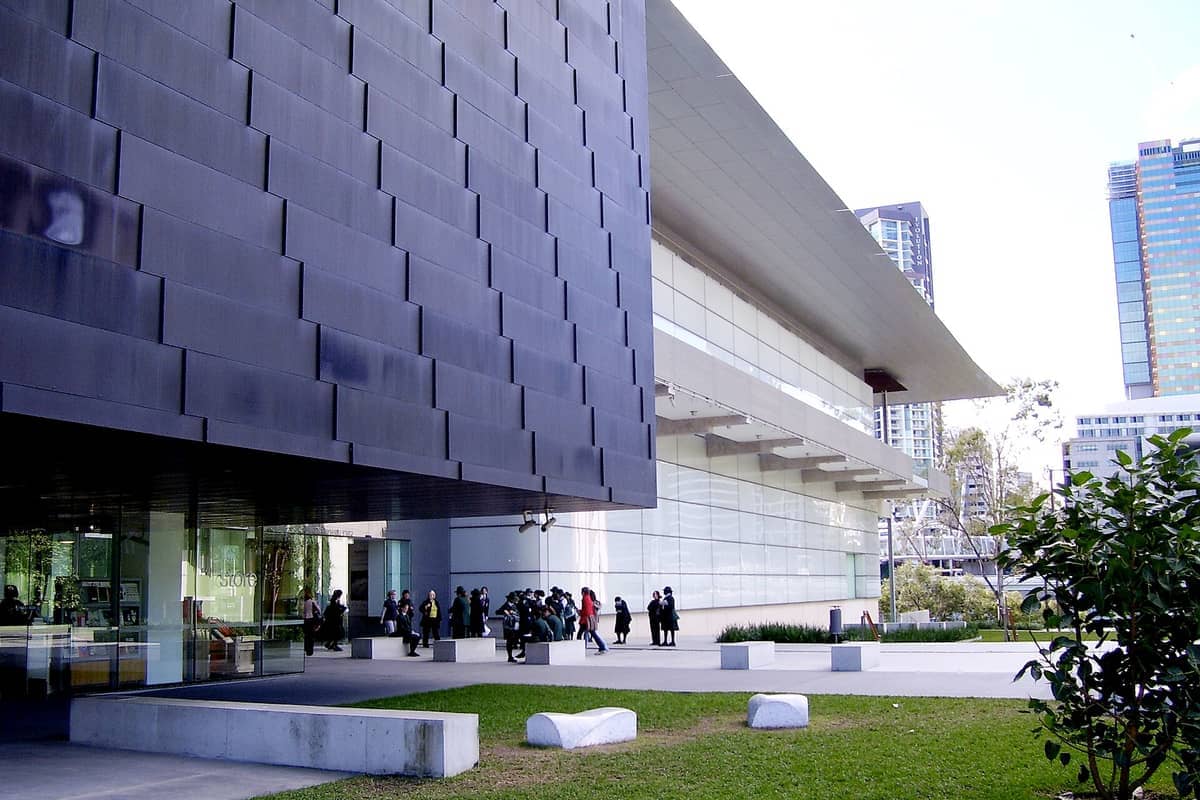
Designed by Architectus with Davenport Campbell, GOMA's building is a deliberate counterpoint to the Victorian-era formality of older Queensland institutions. The exterior uses large planes of concrete and glass, and the building orients itself toward the river, with the main entrance at Stanley Place facing a wide plaza. At ground level, the proportions feel almost civic: broad enough for a crowd, open enough that you're never quite sure where the public space ends and the gallery begins.
Inside, the gallery uses natural light strategically throughout its upper levels, with skylights and high ceilings that make larger works feel properly scaled rather than compressed. The internal circulation is logical but not rigid: you can move through spaces without following a strict sequence, which suits both dedicated art visitors and those who prefer to wander. The Australian Cinémathèque, located within GOMA, is a fully equipped cinematheque with a hearing loop, screening films that complement or contextualise current exhibitions.
Tickets & tours
Live prices and dates from our booking partner. If you book, we may earn a commission at no extra cost to you.
Luggage Storage in Brisbane
From 5 €Instant confirmationFree cancellationBrisbane's dark stories true crime tour
From 21 €Instant confirmationFree cancellationFull-day Mount Tamborine winery tour from Brisbane with lunch
From 140 €Instant confirmationFree cancellationNorth Stradbroke Island small groups day tour
From 79 €Instant confirmationFree cancellation
What You'll See Inside
The permanent collection spans Australian and international art from the 1970s to the present, with particular depth in works from Asia and the Pacific. Queensland's geographic position in the Indo-Pacific region is reflected in the collection's emphases in ways that distinguish GOMA from southern Australian galleries, which tend toward a more Eurocentric frame. Expect painting, sculpture, photography, video, and digital works across multiple floors.
GOMA rotates its permanent collection displays regularly, so returning visitors often find the galleries reconfigured. The ground floor typically hosts the most accessible, high-traffic spaces including the Children's Art Centre, which runs structured programs for younger visitors and is a genuine highlight for families rather than an afterthought. The upper levels tend to carry larger installations and more demanding works.
Temporary exhibitions are where GOMA builds its international reputation. The gallery has hosted major retrospectives for artists ranging from Yayoi Kusama to David Lynch, and the scale of its temporary exhibition halls allows works to be presented at a scale that smaller Australian venues simply cannot accommodate. For current exhibition listings and tickets, check the QAGOMA website directly. If you're planning a broader cultural day, the Queensland Museum and the State Library of Queensland are both within a five-minute walk.
How the Experience Changes by Time of Day
Mornings are the calmest. When GOMA opens at 10:00 am, the galleries fill gradually, and the first hour or so is genuinely quiet by the standards of any major institution. The natural light in the upper galleries is at its best on clear mornings, particularly in Brisbane's winter months (June to August) when the sun angle is lower and the light is more directional.
Midday to early afternoon is when school groups and family visitors peak. The Children's Art Centre in particular fills up around this time, and the ground-floor café sees queues during the lunch window. If you're visiting with children and want access to the Children's Art Centre programs, arrive early or check session times in advance. If you prefer fewer crowds in the main galleries, plan the permanent collection for the morning and leave ticketed exhibitions for mid-afternoon when school groups have largely cycled through.
Late afternoon, particularly from 3:30 pm onward, sees visitor numbers ease. The gallery closes at 5:00 pm daily, which means the final hour is often the most relaxed for those who enjoy taking their time with individual works. Note that GOMA opens at noon on Anzac Day and is closed on Good Friday, Christmas Day, and Boxing Day.
ℹ️ Good to know
Opening hours: Daily 10:00 am – 5:00 pm. Opens noon on Anzac Day. Closed Good Friday, Christmas Day, and Boxing Day.
Getting There and Getting Around
The Cultural Centre Busway station sits immediately adjacent to the QAGOMA complex and is the most direct public transport option. South Brisbane train station is roughly a five-minute walk to the east. The South Bank CityCat and ferry terminal connects to the river network and adds about ten minutes on foot. From the CBD, both Victoria Bridge and Kurilpa Bridge lead directly toward the Stanley Place entrance; the Kurilpa Bridge crossing is the more scenic option and takes less than ten minutes on foot.
If you're walking from the Kurilpa Bridge, GOMA is the first major building you encounter on the South Bank side. From the South Bank Parklands, follow the riverside path south toward the cultural precinct — the building's plaza is visible from the riverbank.
Parking is available in the cultural-precinct car parks under the Queensland Art Gallery and State Library, accessible via Stanley Place. Weekends and during major exhibition openings, the car park fills early. Public transport or walking is genuinely faster and less stressful on busy days.
Accessibility and Practical Details
GOMA has invested meaningfully in accessibility. Wheelchair access is available via Stanley Place and the lift from the Stanley Place car park beneath the State Library. Wheelchairs and sensory kits are available free of charge at the visitor services desk. An adult change facility is on site, and the Australian Cinémathèque is equipped with a hearing loop. These are not token provisions — they reflect a gallery that has thought about different visitor needs at an operational level.
Photography policies vary by exhibition: the permanent collection areas are generally photograph-friendly for personal use without flash, but ticketed temporary exhibitions often restrict photography. Look for signage at exhibition entrances or ask at the desk. The on-site café is a reasonable option for a meal break, with seating inside and out on the plaza facing the river precinct.
⚠️ What to skip
Not every visit will coincide with a major temporary exhibition. If you're travelling specifically for a blockbuster show, check the QAGOMA calendar and book tickets well in advance. The general collection alone, while impressive, is modest in size compared to national institutions in Sydney or Melbourne.
Who Might Not Get Much Out of a Visit
GOMA is a contemporary art gallery, which means the collection skews heavily toward works made after 1970. Visitors primarily interested in classical, Renaissance, or Impressionist art will find limited material here; the Queensland Art Gallery next door has a broader historical range, but even that collection is weighted toward the modern era by international standards. If old masters and decorative arts are your priority, GOMA is not the right institution.
Travellers on very tight itineraries who are not particularly interested in art may find the time investment hard to justify, especially if the current temporary exhibition is not something that appeals to them. In that case, the South Bank Parklands immediately adjacent offers an entirely different kind of experience that suits a shorter stop.
Insider Tips
- GOMA's free entry means there's no cost to spending just 45 minutes on a single floor. Don't feel obligated to see everything — picking two or three rooms and sitting with works you find interesting is a more satisfying approach than rushing through.
- The Children's Art Centre runs structured drop-in programs, but spaces are limited and sessions fill quickly on weekends and school holidays. Check the QAGOMA website for session times and book ahead if possible.
- The gallery plaza facing Stanley Place is a useful landmark for meeting up with others and also catches the river breeze on warm afternoons. It's significantly cooler than the surrounding streets during Brisbane's summer heat.
- If you're visiting during a major ticketed exhibition, buy tickets online before you arrive. Walk-up availability exists but sell-outs are common for headline shows. Evening openings for special events occasionally extend gallery hours — check the events calendar.
- The QAGOMA Members lounge, while restricted, means the café and foyer area can feel quieter if you position yourself upstairs rather than at the main ground-floor entrance during peak times.
Who Is Gallery of Modern Art (GOMA) For?
- Contemporary art enthusiasts seeking serious international-calibre programming without the cost of Sydney or Melbourne gallery visits
- Families with children aged 4–12 who will benefit from the structured Children's Art Centre programs
- Rainy-day visitors needing a full half-day of indoor culture with no admission cost
- Architecture and design-focused travellers who appreciate the building's spatial quality as much as the contents
- Repeat Brisbane visitors looking for something beyond the standard outdoor attractions
Nearby Attractions
Other things to see while in South Bank:
- Fish Lane
Fish Lane is a compact but layered laneway in South Brisbane connecting the Cultural Centre precinct with West End. It packs street art, independent cafés, bars, and restaurants into a short stretch that rewards slow exploration at almost any hour.
- Kurilpa Bridge
Kurilpa Bridge is a free pedestrian and bicycle bridge crossing the Brisbane River between Kurilpa Point in South Brisbane and Tank Street in the CBD. Opened in 2009, it is one of the world's largest structures built on tensegrity principles, and it doubles as a solar energy generator. Whether you're crossing to reach the Gallery of Modern Art or simply looking for a river walk with architectural interest, the bridge earns a place in any South Bank itinerary.
- Nepalese Peace Pagoda
Standing three storeys tall in the heart of South Bank Parklands, the Nepalese Peace Pagoda is a remarkable piece of traditional Himalayan craftsmanship built from over 80 tonnes of hand-carved timber. Free to visit and open daily, it rewards curious travelers who slow down enough to take in the detail.
- Queensland Art Gallery (QAGOMA)
Spread across two buildings 150 metres apart on South Bank, the Queensland Art Gallery and Gallery of Modern Art form one of Australia's most significant art institutions. General entry is free, programming runs daily, and the permanent collections alone justify at least half a day.
Planning a trip? Discover personalized activities with the Nomado app.