Nepalese Peace Pagoda: Brisbane's Most Unexpected Landmark
Standing three storeys tall in the heart of South Bank Parklands, the Nepalese Peace Pagoda is a remarkable piece of traditional Himalayan craftsmanship built from over 80 tonnes of hand-carved timber. Free to visit and open daily, it rewards curious travelers who slow down enough to take in the detail.
Quick Facts
- Location
- Clem Jones Promenade, South Bank Parklands, South Brisbane QLD 4101
- Getting There
- South Bank Busway Station or South Brisbane Railway Station, both a short walk away
- Time Needed
- 20–40 minutes on its own; longer if combined with a South Bank Parklands stroll
- Cost
- Free admission
- Best for
- Architecture enthusiasts, families, culture-curious travelers, photographers
- Official website
- www.visitsouthbank.com.au/places/nepalese-pagoda
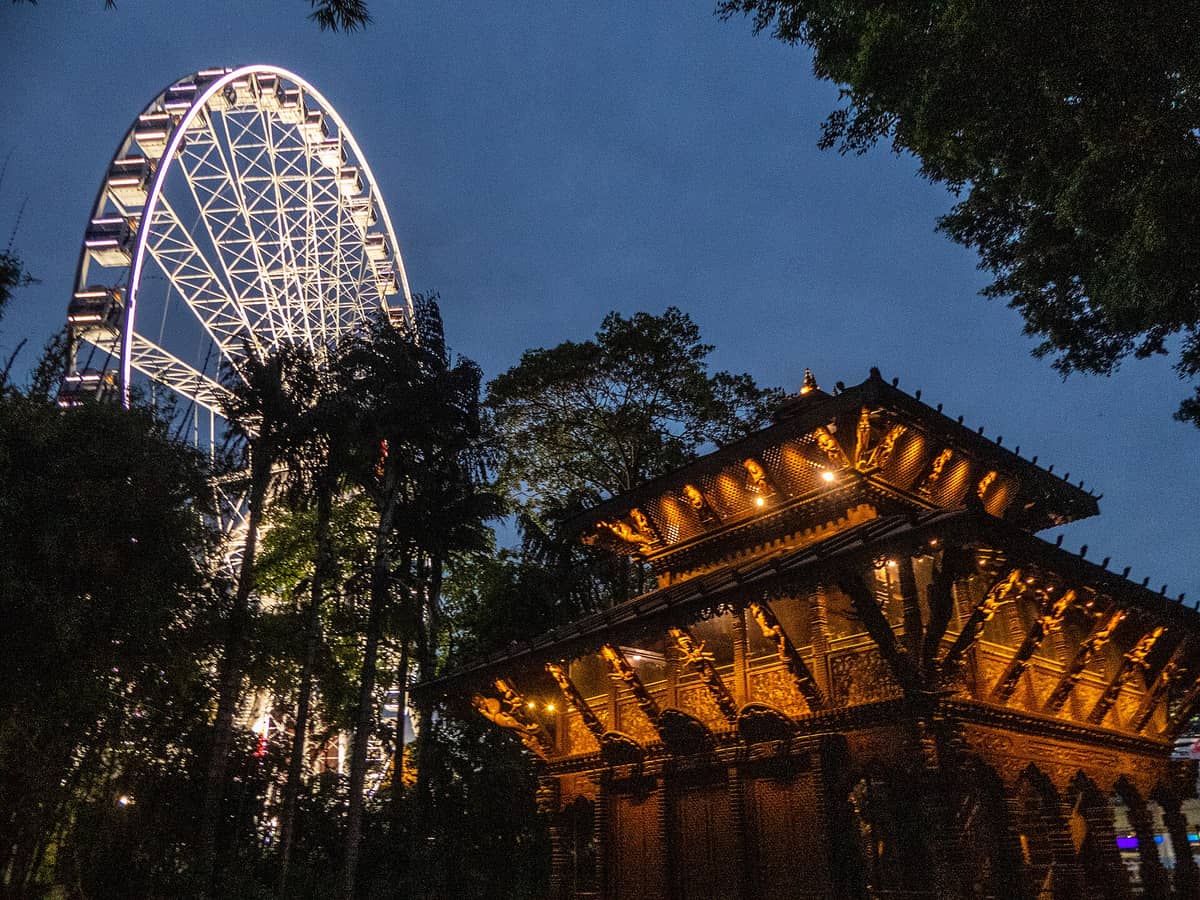
What You're Actually Looking At
The Nepalese Peace Pagoda is a three-storey traditional pagoda built from more than 80 tonnes of hand-carved Nepalese timber. Every bracket, beam, and decorative panel was shaped by Nepalese craftspeople, and the accumulated detail is genuinely staggering up close. From a distance, it reads as an elegant focal point on the Clem Jones Promenade. From two metres away, it becomes something else entirely: a dense catalogue of carved animals, mythological figures, and geometric lattice patterns, each element interlocking with the next in the way that traditional Newari woodcraft demands.
The pagoda sits within South Bank Parklands, surrounded by subtropical garden planting, walking paths, and the low hum of the riverside precinct. It does not announce itself loudly. There are no ticket barriers, no audio guides, no interpretive panels crowding the entrance. You simply walk up and look.
💡 Local tip
The pagoda is open daily from 7:30 a.m. to 5:00 p.m. Arriving close to opening gives you the best light and the quietest atmosphere — the paths around it are often empty before 9 a.m.
History: From Expo '88 to a Permanent Home
The pagoda was built for World Expo '88, the world's fair that Brisbane hosted along the South Bank of the Brisbane River. Nepal was one of the participating nations, and the pagoda served as the centrepiece of the Nepalese pavilion. Nepalese craftspeople constructed it on-site using traditional joinery techniques, most of which rely on interlocking timber rather than nails or adhesives.
When Expo closed in October 1988, the site was redeveloped into what became South Bank Parklands, which opened to the public in 1992. The pagoda was retained and relocated within the new parklands, a decision that preserved one of Expo's most architecturally distinctive contributions. It is now one of the few surviving structures from that event, and it carries a quiet significance that most visitors in a hurry miss entirely.
South Bank Parklands itself is one of Brisbane's most used public spaces, a 17-hectare riverside precinct that includes Streets Beach, lawns, restaurants, and several cultural institutions. The pagoda sits toward the promenade, close to the river end of the parklands. For more on the area's history and layout, the South Bank neighbourhood guide covers it in detail.
Tickets & tours
Live prices and dates from our booking partner. If you book, we may earn a commission at no extra cost to you.
Luggage Storage in Brisbane
From 5 €Instant confirmationFree cancellationBrisbane's dark stories true crime tour
From 21 €Instant confirmationFree cancellationFull-day Mount Tamborine winery tour from Brisbane with lunch
From 140 €Instant confirmationFree cancellationNorth Stradbroke Island small groups day tour
From 79 €Instant confirmationFree cancellation
The Experience at Different Times of Day
Morning light is the pagoda's best light. In the hour after opening, low-angle sun catches the carved timber from the side, throwing the relief work into sharp shadow and making the craftsmanship much easier to read. The surrounding garden beds are often damp with dew, and the noise from the promenade has not yet built up. It is the most peaceful time to visit.
By mid-morning, the promenade fills with joggers, school groups, and families heading toward the parklands. The pagoda attracts a steady stream of visitors through the middle of the day, but it rarely feels overcrowded because there is no queuing system and no single viewpoint everyone competes for. You can circle it, approach from the garden side, or sit on the surrounding area and observe it from a distance.
In the late afternoon, the light shifts to the western face of the structure, and the carved timber takes on a warmer tone. This is also when the promenade gets busier with after-work foot traffic. If you visit in summer, the afternoon heat between December and February can make any extended outdoor time uncomfortable. The pagoda offers some shade from its overhanging eaves, but not enough for a long stay. The cooler months between May and September are considerably more pleasant.
⚠️ What to skip
On weekends, South Bank Parklands can be very busy by 10 a.m. If you want space to photograph the pagoda without foot traffic in every frame, aim for a weekday morning or arrive at or just after 7:30 a.m.
Architecture and Craftsmanship: What to Look For
The pagoda is built in the Newari style, the dominant architectural tradition of Nepal's Kathmandu Valley. Newari pagoda architecture is characterized by tiered sloping roofs, carved timber struts called tunala, and an emphasis on handcraft over machinery. The timber used is hardwood, and the carvings cover not just the decorative panels but the structural elements themselves: roof struts, column capitals, window frames, and door surrounds.
Look at the roof struts before you look at anything else. Each one is carved with a figure, often a deity or mythological creature, and the quality of the work varies in interesting ways as you move around the building. Some faces are rendered with considerable precision; others are more schematic. This is not inconsistency so much as evidence of multiple hands at work over the construction period, which is exactly what you would find in traditional Nepalese temple architecture.
The lower level of the pagoda is accessible to visitors. The interior is relatively simple compared to the external carvings, but stepping inside gives you a different sense of the structure's scale and the thickness of the timber work. Note that the available information does not confirm step-free access, so if mobility is a consideration, it is worth checking with South Bank Parklands staff before visiting.
Getting There and Practical Details
South Bank Busway Station and South Brisbane Railway Station are both a short walk from the pagoda. If you are coming from the Brisbane CBD, the train from Roma Street to South Brisbane takes only a few minutes. The Translink Go Card or a contactless payment card covers the fare. For a broader look at moving around the city, the guide to getting around Brisbane covers all transport options including the CityCat ferry, which stops at South Bank and offers river views on the approach.
Admission is free, and no booking is required. The pagoda is open daily from 7:30 a.m. to 5:00 p.m. There is no entry fee for South Bank Parklands either, so the surrounding area costs nothing to explore. Parking is available near South Bank but fills quickly on weekends and during events; public transport is the more reliable option.
The pagoda sits on flat ground within the parklands, and the surrounding paths are paved. However, accessibility details for the interior have not been confirmed in available sources. If this matters for your visit, contact South Bank Corporation directly before you go.
Photography Notes
The pagoda photographs well in most conditions, but the carved timber detail is the real subject. A standard wide shot will capture the overall form, but you will get more interesting images by moving closer and isolating individual carved panels, roof brackets, or the layered rooflines. A polarising filter helps manage glare from the lacquered surfaces in strong sunlight.
The surrounding garden provides natural framing opportunities. Shooting from below and slightly to the side emphasizes the upward taper of the tiers. In the golden hour before the pagoda closes at 5:00 p.m., the warm light suits the amber and red tones of the timber particularly well.
ℹ️ Good to know
Be respectful of other visitors using the space. The pagoda is also a place of quiet reflection for some people, so keep noise and intrusion minimal, particularly inside the lower level.
Combining This With the Rest of South Bank
The pagoda makes most sense as part of a longer South Bank morning rather than a standalone destination. From here, it is an easy walk along the promenade to South Bank Parklands in full, including the beach, lawns, and riverside walking paths. The Queensland Museum and the Gallery of Modern Art are both within a few minutes' walk, making this a sensible anchor point for a cultural half-day.
If you are looking for a structured way to see South Bank and the surrounding area, the Brisbane walking tours guide includes routes that pass through the precinct. For families, South Bank's combination of the pagoda, the beach, and the parklands lawns works particularly well as a morning plan before the heat of the afternoon sets in.
Insider Tips
- Circle the entire pagoda before stopping anywhere. Each face is different, and the north-facing side often has the most intricate roof strut carvings.
- Visit on a weekday between 7:30 and 9:00 a.m. if you want photographs without people walking through the frame. Weekend mornings fill quickly.
- The surrounding garden beds are worth a slow look. The planting choices complement the pagoda's Himalayan character and are often in bloom during spring and autumn.
- The pagoda closes at 5:00 p.m., which is earlier than most of South Bank's other attractions. If you are planning a late afternoon visit, go here first.
- Bring water and sun protection in summer. The pagoda itself provides limited shade, and the surrounding promenade is fully exposed to the sun.
Who Is Nepalese Peace Pagoda For?
- Architecture and design enthusiasts who want to study traditional Newari woodcraft up close
- Families with children looking for a free, visually engaging stop within South Bank Parklands
- Photographers seeking textural detail and an unusual subject within an otherwise modern precinct
- Travelers interested in Brisbane's Expo '88 history and what remains of that period
- Anyone building a broader South Bank cultural morning that includes the nearby museums
Nearby Attractions
Other things to see while in South Bank:
- Fish Lane
Fish Lane is a compact but layered laneway in South Brisbane connecting the Cultural Centre precinct with West End. It packs street art, independent cafés, bars, and restaurants into a short stretch that rewards slow exploration at almost any hour.
- Gallery of Modern Art (GOMA)
The Gallery of Modern Art (GOMA) is Australia's largest gallery dedicated to modern and contemporary art, anchoring Brisbane's South Bank cultural precinct. General entry is free, the building itself is architecturally striking, and the rotating program of exhibitions consistently draws international attention.
- Kurilpa Bridge
Kurilpa Bridge is a free pedestrian and bicycle bridge crossing the Brisbane River between Kurilpa Point in South Brisbane and Tank Street in the CBD. Opened in 2009, it is one of the world's largest structures built on tensegrity principles, and it doubles as a solar energy generator. Whether you're crossing to reach the Gallery of Modern Art or simply looking for a river walk with architectural interest, the bridge earns a place in any South Bank itinerary.
- Queensland Art Gallery (QAGOMA)
Spread across two buildings 150 metres apart on South Bank, the Queensland Art Gallery and Gallery of Modern Art form one of Australia's most significant art institutions. General entry is free, programming runs daily, and the permanent collections alone justify at least half a day.
Planning a trip? Discover personalized activities with the Nomado app.