South Bank Parklands: Brisbane's Riverside Green Heart
South Bank Parklands is a free, 17-hectare riverside precinct in South Brisbane that combines a real sand beach, lush gardens, world-class cultural institutions, and some of the best views of the city skyline. Open daily from 5:00 a.m. to midnight, it works equally well for a morning run, a family afternoon, or a leisurely evening walk.
Quick Facts
- Location
- South Bank, South Brisbane, Queensland, Australia
- Getting There
- South Bank or South Brisbane train stations; South Bank or Cultural Centre bus/metro stops; South Bank CityCat ferry terminal
- Time Needed
- 1.5–4 hours depending on pace and activities
- Cost
- Free entry to the parklands. Some individual attractions charge separately.
- Best for
- Families, joggers, culture-seekers, weekend picnickers, photography
- Official website
- www.visitsouthbank.com.au
What South Bank Parklands Actually Is
South Bank Parklands occupies 17 hectares of prime riverfront land in South Brisbane, running along the western bank of the Brisbane River directly opposite the CBD. It opened in 1992 on the site of World Expo 88, and that transformation from a temporary international showcase into a permanent public park is part of what makes it unusual. The bones of the precinct — the broad promenades, the shaded pergola walkway, the carefully graded lagoon — were designed to last, and they show it.
The parklands sit at the geographic and social core of the South Bank precinct, which also includes the Queensland Art Gallery, the Gallery of Modern Art, the Queensland Museum, the State Library of Queensland, and the Queensland Performing Arts Centre. You can walk from a swim in Streets Beach to a Picasso exhibition in under ten minutes. That concentration of free or low-cost public amenity in one compact area is genuinely rare.
ℹ️ Good to know
Entry to the parklands is free and open daily from 5:00 a.m. to midnight. Streets Beach, the Boat Pool, and Aquativity have their own seasonal hours that vary, so check the official South Bank FAQ before you plan a swimming visit.
Streets Beach: The Park's Centrepiece
Streets Beach is a constructed lagoon with genuine sand, clear filtered water, and a lifeguarded swimming area in the middle of an urban park — a combination that is not as common as Brisbane residents might assume. The water is calm, shallow at the entry edges, and regularly cleaned. On a weekday morning between 7:00 a.m. and 9:00 a.m. you will find lap swimmers, dog walkers on the surrounding path, and the first of the day's joggers coming through. The sand is still cool, the air smells faintly of sunscreen and eucalyptus from the plantings nearby, and the CBD towers across the river catch the early light.
By 11:00 a.m. on weekends and school holidays the beach fills quickly: families with small children, teenagers with portable speakers, tourists taking the obligatory photo of a sand beach with skyscrapers behind it. The scene is genuinely enjoyable but can feel crowded at peak summer hours. If you want the beach at its most relaxed, arrive before 9:00 a.m. or after 4:00 p.m. on a weekday.
For photography, the beach facing northeast means the best light for skyline-plus-beach shots falls in the morning. Afternoon light is flatter and faces into the sun. For broader South Bank photography tips and context, see our guide to the best viewpoints in Brisbane.
💡 Local tip
Accessible beach and pool wheelchairs can be borrowed free of charge from the South Bank Visitor Information Centre for up to two hours. The car park on Little Stanley Street has eight accessible spaces with lifts at both entrances.
Tickets & tours
Live prices and dates from our booking partner. If you book, we may earn a commission at no extra cost to you.
Luggage Storage in Brisbane
From 5 €Instant confirmationFree cancellationBrisbane's dark stories true crime tour
From 21 €Instant confirmationFree cancellationFull-day Mount Tamborine winery tour from Brisbane with lunch
From 140 €Instant confirmationFree cancellationNorth Stradbroke Island small groups day tour
From 79 €Instant confirmationFree cancellation
The Cultural Corridor Next Door
South Bank Parklands is physically attached to one of Australia's densest concentrations of cultural institutions. The Queensland Art Gallery and the Gallery of Modern Art share a single campus a short walk south of the beach. The State Library of Queensland is within the same walkable loop. The Queensland Museum sits just north. None of them require you to enter the parklands specifically, but the park is the connective tissue that makes visiting two or three in a day feel effortless rather than exhausting.
The Gallery of Modern Art (GOMA) is the largest gallery of modern and contemporary art in Australia and has free general admission. It regularly runs blockbuster temporary exhibitions that do charge entry, so check what is on before you go. If you are traveling with children, the Queensland Museum and the adjacent Sciencentre are worth factoring into your South Bank half-day.
The State Library of Queensland is free, air-conditioned, and often overlooked by visitors. Its top floor reading room has wide river views and is a genuinely good place to sit on a hot afternoon. For a broader look at what the area's institutions offer, the best museums in Brisbane guide covers the full range.
How the Parklands Change Through the Day
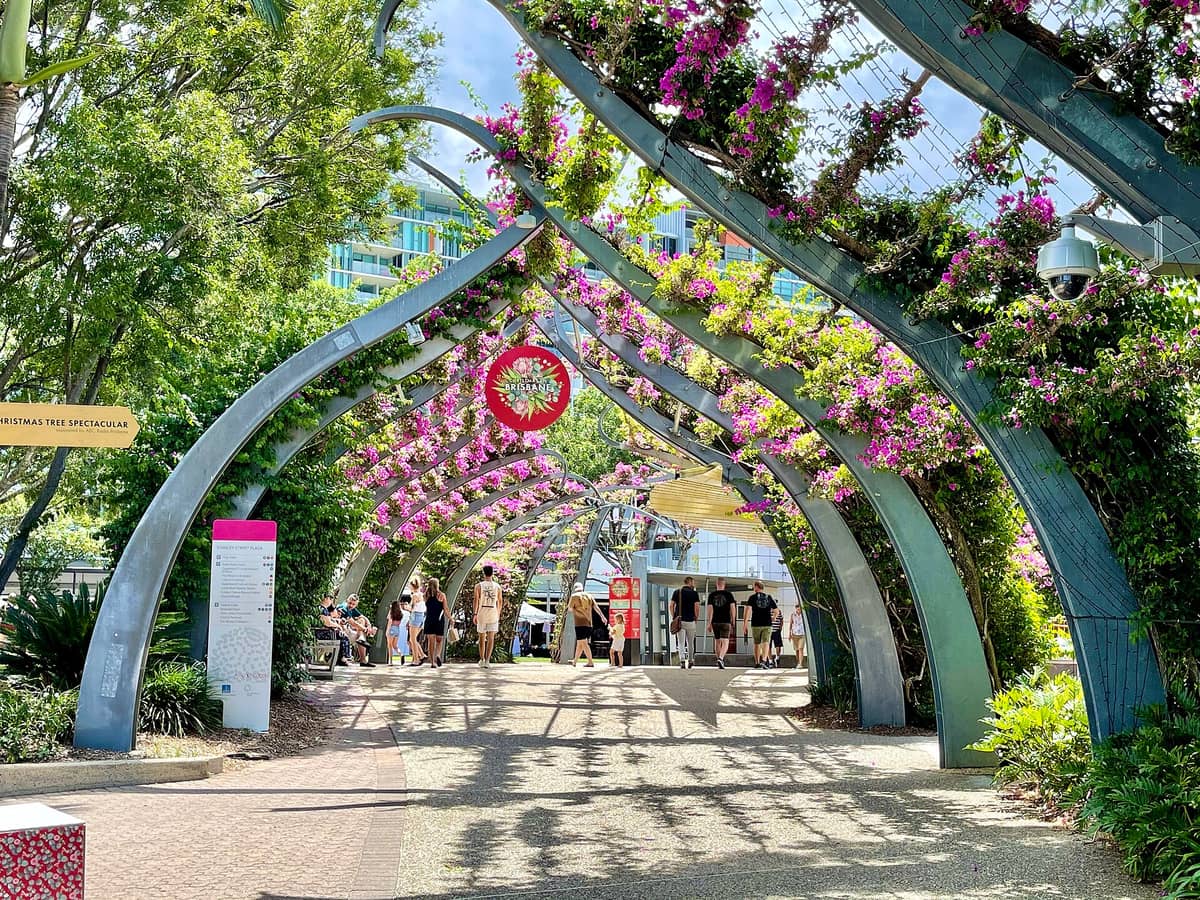
Early morning, roughly 5:30 a.m. to 8:30 a.m., belongs to the regulars. Joggers run the riverside path in both directions, occasionally pausing at the water's edge to look across at the CBD. The Nepalese Peace Pagoda glows softly in the low light and the Grande Arbour pergola, covered in bougainvillea, is almost completely still. The smell of freshly watered garden beds is strongest at this hour. Cafes in the parklands open early and the flat whites arrive quickly.
Midday on a clear winter's day (June through August) is arguably the park's best hour. Temperatures sit around 22°C, the light is sharp, and the lawns fill with office workers from the nearby cultural institutions eating lunch. Summer midday is a different experience: humidity sits high, the sun is direct, and without shade you will be uncomfortable. In December and January it is worth sticking to the shaded sections of the Grand Arbour or the tree-lined paths close to the river.
Evenings are when the parklands feel most alive as a social space. The restaurants and bars along Stanley Street Plaza and Little Stanley Street fill up after 6:00 p.m. The riverside path is busy with couples, small groups, and visitors who have spent the afternoon in the galleries. On Fridays and weekends the Wheel of Brisbane is lit up after dark. If there is an event at the Queensland Performing Arts Centre, the surrounding paths fill and empty quickly around curtain time.
💡 Local tip
The park runs north-south along the river. The northern end near the CBD connection is more open and exposed; the southern end near the cultural institutions is shadier and quieter. If heat is a concern, start from the south.
Getting There and Moving Around
South Bank Parklands has more transit options than almost anywhere else in Brisbane. By train: South Bank station and South Brisbane station sit at opposite ends of the precinct, making a north-to-south walk through the parklands a natural loop with easy exit at either end. By bus or the Brisbane Metro rapid transit service: the South Bank and Cultural Centre stops are both within a short walk of the parklands. By CityCat ferry: the South Bank terminal drops you directly onto the riverside path, which is a particularly good arrival for first-time visitors because the river view of the CBD and the park layout becomes immediately clear.
If you are driving, the underground car park is accessed via Tribune or Glenelg streets, with the entrance on Little Stanley Street. Paid parking is available but can fill on weekends and during events. Public transport is more reliable for timed visits. For full transit planning across the city, see the guide to getting around Brisbane.
The parklands are flat and almost entirely accessible by paved paths. Cycling through the main pedestrian areas is restricted; cyclists should use designated paths. The parklands loop is roughly 1.8 kilometres from the northern pedestrian bridge connection to the southern end near the cultural precinct, so even a slow walk covers the full length in under 30 minutes.
Practical Considerations and Honest Assessment
South Bank Parklands is often described in promotional material in terms that set unrealistic expectations. It is a very good urban park, but it is not a wilderness experience. The gardens are well-maintained but manicured rather than naturalistic. The food and retail options along Stanley Street Plaza are convenient but skew toward mid-range casual dining and tourist-oriented shops. The riverside path can feel crowded on weekend afternoons, particularly the section closest to the beach.
What the parklands do exceptionally well is combine green space, swimming, river access, and cultural institutions in a single walkable area, all at no entry cost. For families visiting Brisbane, the value proposition is hard to argue with. For solo travelers or couples looking for something more atmospheric or architecturally distinctive, the nearby Story Bridge area, Kangaroo Point Cliffs, or the Fortitude Valley and New Farm corridor might offer a more interesting afternoon.
Weather significantly affects the experience. Brisbane's summer (December to February) brings heat and high humidity; the beach and water features become the most useful parts of the park at this time, but comfort elsewhere drops. The cooler months from May to September offer the most pleasant conditions for exploring on foot. For a full seasonal breakdown, see the guide on the best time to visit Brisbane.
⚠️ What to skip
Afternoon thunderstorms are common in summer, typically arriving between 3:00 p.m. and 6:00 p.m. The open river-facing sections of the park offer little shelter. Check the Bureau of Meteorology forecast on the day and note where the covered sections of the Grand Arbour are before you need them.
Insider Tips
- The Nepalese Peace Pagoda on the southern end of the parklands is one of the few genuinely quiet spots during peak hours. It sits slightly off the main path and most visitors walk past it without stopping.
- If you want Streets Beach almost to yourself, arrive at opening on a weekday morning between May and August. The water is cool but manageable, and you will often have entire sections of the sand to yourself.
- The Grand Arbour pergola runs through the middle of the parklands. It is covered in bougainvillea and provides continuous shade. On a hot day, plan your route to use it rather than the open riverside path.
- Free events and outdoor cinema screenings are held regularly in the parklands, particularly over summer. The South Bank Corporation website publishes an events calendar. Check it before your visit to avoid accidentally arriving during a concert setup when sections of the park are restricted.
- The South Bank CityCat terminal gives the best first view of how the park connects to the city. Arriving by ferry rather than by train reorients your mental map of the precinct and makes the layout much easier to navigate.
Who Is South Bank Parklands For?
- Families with children under 12 who want a free, varied morning with swimming and open green space
- Visitors combining a park visit with a half-day in the adjacent galleries and museums
- Joggers and walkers looking for a flat, scenic riverside route with easy transit access at both ends
- Couples wanting an easy evening walk followed by dinner along Stanley Street Plaza
- First-time Brisbane visitors building an overview of the city's layout from its most accessible central green space
Nearby Attractions
Other things to see while in South Bank:
- Fish Lane
Fish Lane is a compact but layered laneway in South Brisbane connecting the Cultural Centre precinct with West End. It packs street art, independent cafés, bars, and restaurants into a short stretch that rewards slow exploration at almost any hour.
- Gallery of Modern Art (GOMA)
The Gallery of Modern Art (GOMA) is Australia's largest gallery dedicated to modern and contemporary art, anchoring Brisbane's South Bank cultural precinct. General entry is free, the building itself is architecturally striking, and the rotating program of exhibitions consistently draws international attention.
- Kurilpa Bridge
Kurilpa Bridge is a free pedestrian and bicycle bridge crossing the Brisbane River between Kurilpa Point in South Brisbane and Tank Street in the CBD. Opened in 2009, it is one of the world's largest structures built on tensegrity principles, and it doubles as a solar energy generator. Whether you're crossing to reach the Gallery of Modern Art or simply looking for a river walk with architectural interest, the bridge earns a place in any South Bank itinerary.
- Nepalese Peace Pagoda
Standing three storeys tall in the heart of South Bank Parklands, the Nepalese Peace Pagoda is a remarkable piece of traditional Himalayan craftsmanship built from over 80 tonnes of hand-carved timber. Free to visit and open daily, it rewards curious travelers who slow down enough to take in the detail.
Planning a trip? Discover personalized activities with the Nomado app.