City Botanic Gardens: Brisbane's Oldest and Most Walkable Green Space
Established in 1855 on the banks of the Brisbane River, the City Botanic Gardens span 18 hectares of manicured lawns, heritage fig trees, and tropical plantings right in the heart of the CBD. Open around the clock and free to enter, this is the kind of park that rewards a slow morning as much as a quick lunchtime escape.
Quick Facts
- Location
- 147 Alice Street, Brisbane City QLD 4000 — southern edge of the CBD, along the Brisbane River
- Getting There
- Walk from the CBD via Alice, Edward, or George Street entrances; cross via Goodwill Bridge from South Bank. Use Translink Journey Planner for bus routes.
- Time Needed
- 45 minutes to 2 hours depending on pace
- Cost
- Free entry, 24 hours a day, 7 days a week
- Best for
- Morning walks, picnics, family outings, riverside scenery, history
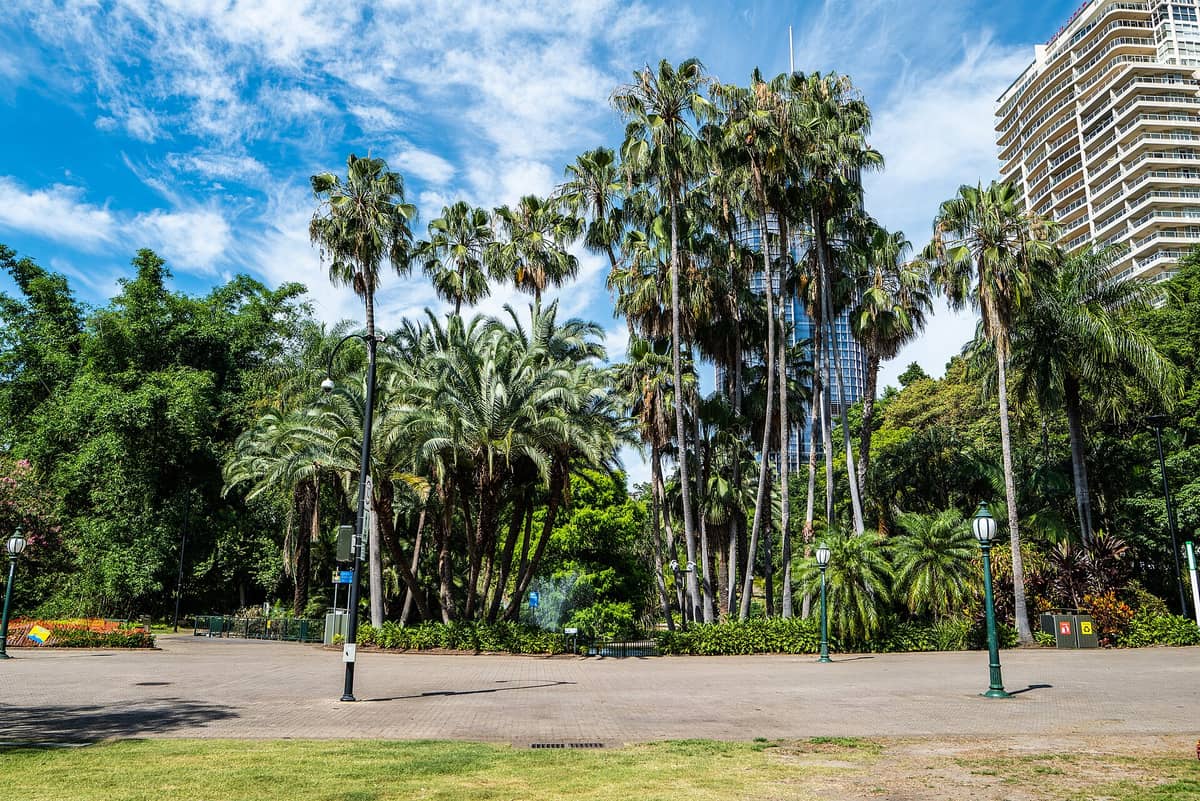
What the City Botanic Gardens Actually Are
The City Botanic Gardens occupy a generous 18-hectare bend of land where the Brisbane River curves south of the CBD. They are Brisbane's oldest park, declared a botanic reserve in 1855 under the care of Walter Hill, the gardens' first curator. More than 160 years later, they remain public, free, and remarkably unencumbered by commercial intrusion.
The gardens were added to the Queensland Heritage Register in 1997, which provides some formal protection for their layout and plantings. That heritage listing is visible in the bones of the place: wide gravel paths, mature Moreton Bay fig trees with roots that buckle the ground around them, and formal garden beds that suggest a Victorian-era sense of order. But the tone today is relaxed rather than stuffy. Office workers eat lunch on the lawns, parents push prams along the river path, and cyclists cut through on the way to work.
One important distinction for first-time visitors: this is not the same as the Brisbane Botanic Gardens at Mount Coot-tha. The City Botanic Gardens are the original, river-front site inside the CBD. Mount Coot-tha holds a separate, larger facility focused more on specialist plant collections.
💡 Local tip
All four main entrances are on Alice Street, Edward Street, George Street (near Parliament House), and Gardens Point Road via Goodwill Bridge. Note that the Parliament House entrance is on George Street — disability parking is available just inside the Edward Street gate and behind The Gardens Club via Gardens Point Road.
How the Gardens Change Through the Day
Early mornings, roughly 6 to 8 am, are when the gardens are at their most atmospheric. The light comes in low across the river, and the lawns hold dew. You'll find joggers, tai chi groups under the fig trees, and the occasional dog walker, but the crowds that arrive later haven't materialized yet. The bird noise at this hour is genuinely striking: rainbow lorikeets and ibis move through the tree canopy while the city hum is still low. This is the window that photographers tend to prefer, and the river frontage facing east catches the morning light directly.
Midday brings a different energy. From around 11:30 am to 1:30 pm on weekdays, office workers fill the lawns and benches, particularly near the central fig grove and the riverside path. It is sociable and lively, but if you are looking for quiet contemplation of the gardens' horticultural features, this window is the least ideal. On weekends, midday is calmer.
Late afternoon, from around 4 pm onward, is arguably the second-best time to visit. The heat drops, golden light hits the river, and the gardens thin out again. The 1.2-kilometre river frontage walk is particularly pleasant at this hour, with views across to Kangaroo Point. After dark, the gardens are open and safe, lit by path lighting, and popular with evening walkers, though the botanical detail is obviously lost.
⚠️ What to skip
Brisbane summers (December to February) bring high humidity and temperatures regularly above 30°C. Midday visits in summer can be uncomfortable — the tree canopy in the fig grove provides relief, but the exposed riverside path offers little shade. Bring water and sun protection regardless of season.
Tickets & tours
Live prices and dates from our booking partner. If you book, we may earn a commission at no extra cost to you.
Luggage Storage in Brisbane
From 5 €Instant confirmationFree cancellationBrisbane's dark stories true crime tour
From 21 €Instant confirmationFree cancellationFull-day Mount Tamborine winery tour from Brisbane with lunch
From 140 €Instant confirmationFree cancellationNorth Stradbroke Island small groups day tour
From 79 €Instant confirmationFree cancellation
What You Will Actually See
The centrepiece of the gardens, the element that most visitors instinctively gravitate toward, is the avenue of mature Moreton Bay fig trees. These are large, spreading specimens with aerial roots and wide buttresses that create natural seating. The central lawn beneath and around them is where picnics happen and where the gardens feel most like a proper city retreat rather than an ornamental display.
Beyond the figs, the plantings include subtropical and tropical species, bamboo groves, a herb garden, and some formal rose beds near the Alice Street end. The gardens contain specimens dating back to Walter Hill's original curation, including some of the oldest cultivated trees in Queensland. The labelling of plants is informative without being overwhelming, and the layout makes it easy to wander without a fixed route.
The river frontage is worth walking in full. At 1.2 kilometres long, it connects the Goodwill Bridge end near South Bank to the Gardens Point end near QUT's campus. Along this stretch you get unobstructed views of the river and the cliffs at Kangaroo Point. The path is flat, paved, and accessible. On the water, you may see CityCats passing, kayakers, and the occasional rowing crew from the Queensland University of Technology boatshed.
History and Cultural Context
Before European settlement, this land was part of the Country of the Turrbal and Jagera peoples. The river bend it occupies has been a significant landscape feature for far longer than European Brisbane has existed. Brisbane City Council acknowledges the traditional custodians of this land, and that context is worth holding in mind while walking through what is now a manicured park.
The colonial history is also layered here. The land was initially used for growing food for the penal colony. Walter Hill's appointment as curator in 1855 transformed it into a more intentional botanical project, and his influence on Queensland's horticultural history extended well beyond these gardens. The site's 1997 listing on the Queensland Heritage Register recognises both its botanical and historical significance.
The gardens sit between two significant Brisbane landmarks. Parliament House borders the George Street entrance to the northwest, and the Goodwill Bridge connects the gardens to South Bank on the southern bank. This positioning means the gardens effectively bridge the civic and cultural precincts of central Brisbane.
Practical Walkthrough: How to Navigate the Gardens
The gardens are compact enough that you cannot really get lost, but they are large enough that a purposeful walk covers meaningful ground. For a first visit, a sensible approach is to enter via Alice Street, walk through the central fig grove, continue to the riverside path, follow it south to the Goodwill Bridge end, and exit back through the gardens. This loop takes around 40 to 50 minutes at a relaxed pace.
There is a café within the gardens, operated separately from the Council, with outdoor seating. Opening hours for the café are independent of the gardens' 24-hour access, so do not assume it will be open for early morning visits. An information kiosk near the main entrance similarly operates on its own schedule.
If you are connecting to other attractions, the Goodwill Bridge makes a natural exit point toward South Bank Parklands and the Gallery of Modern Art, both within easy walking distance on the south bank.
ℹ️ Good to know
Disability parking is located just inside the Edward Street gate and behind The Gardens Club via Gardens Point Road.
Photography Tips
For the river views, position yourself on the lower riverside path in the hour after sunrise. The light comes from the east, crossing the water and catching the Kangaroo Point cliffs. The angle is particularly good from the middle section of the river frontage, away from the Goodwill Bridge infrastructure.
The Moreton Bay fig trees photograph well in soft morning light when the canopy is backlit. Get low to emphasise the root structure, or shoot upward through the branches against the sky. Midday light under the figs is harsh and produces heavy shadows, which flattens the texture that makes these trees interesting.
For a broader perspective on the gardens and their river context, the Kangaroo Point Cliffs lookout across the river provides an elevated view of the gardens' tree canopy stretching along the riverbank.
Who Should Temper Their Expectations
Visitors arriving with the expectations of a major specialist botanical garden may find the City Botanic Gardens underwhelming in terms of plant diversity. The collections are not extensive by comparison with dedicated botanical institutions, and the plant labelling, while present, is not exhaustive. If rare or highly curated plant collections are the priority, the Brisbane Botanic Gardens at Mount Coot-tha is the more appropriate destination.
Similarly, anyone seeking a nature experience away from urban noise will find these gardens firmly embedded in the city. Traffic and construction sounds carry into the Alice Street end in particular. For quieter, wilder green space near the CBD, New Farm Park or the Brisbane Riverwalk offer a different character.
Insider Tips
- The gardens are open 24 hours but the quietest, most photogenic window is the 45 minutes immediately after sunrise. The lawns hold dew, the bird activity peaks, and the riverside light is exceptional.
- The Moreton Bay fig grove near the centre of the gardens provides genuine shade during hot afternoons. If you're visiting in summer and need a cool-down stop between CBD sightseeing, this is one of the few outdoor spots in the city centre that actually delivers it.
- Goodwill Bridge connects the gardens directly to South Bank with no roads to cross. It is a pleasant five-minute walk and makes it easy to combine the gardens with South Bank Parklands or the Gallery of Modern Art in a single morning.
- The gardens are popular during the Brisbane Festival and other events — temporary stages and fencing can block access to sections of the grounds. Check the Brisbane Festival schedule if your visit coincides with September to avoid surprises.
- Parking directly adjacent to the gardens is limited. The most reliable option if you're driving is to use inner-city car parks on Alice or George streets and walk in. The Edward Street gate also has disabled parking inside the grounds.
Who Is City Botanic Gardens For?
- Early risers and joggers who want a scenic riverside route through the city
- Families with young children looking for a free, safe outdoor space with flat paths
- Visitors doing a South Bank to CBD walk who want a riverfront green-space connection
- History and heritage enthusiasts interested in colonial-era Brisbane
- Anyone needing a shaded rest stop between CBD sightseeing
Nearby Attractions
Other things to see while in Brisbane CBD:
- ANZAC Square & Shrine of Remembrance
ANZAC Square and its Shrine of Remembrance sit at the geographic and emotional heart of Brisbane's CBD, offering free access to one of Queensland's most significant commemorative sites. From the flame-lit colonnade to the underground Memorial Galleries, this 1929 landmark rewards both quiet reflection and architectural curiosity.
- Brisbane City Hall
Brisbane City Hall is the Queensland capital's most distinguished civic building, a neoclassical sandstone structure with an 87-metre clock tower and a 31-metre copper-domed auditorium. Free general entry, a central CBD location on King George Square, and genuine architectural grandeur make it a rewarding stop for history-minded travellers and anyone curious about what Brisbane looked like before the glass towers arrived.
- Brisbane Customs House
Perched on the northern bank of the Brisbane River at 399 Queen Street, Customs House is one of Queensland's most celebrated examples of Victorian Free Classical architecture. Built between 1886 and 1889, it has served as a working customs facility, a university function centre, and today operates as a heritage event venue and restaurant that welcomes casual visitors during business hours. Entry to the main spaces costs nothing.
- Brisbane Riverwalk
The Brisbane Riverwalk is a free, 870-metre floating walkway connecting Howard Smith Wharves near the CBD to New Farm, with separated pedestrian and cycling lanes, uninterrupted river views, and easy links to some of the city's best precincts. Whether you walk it at dawn for the quiet or at dusk for the light show on the water, it consistently delivers.
Planning a trip? Discover personalized activities with the Nomado app.