Brisbane Customs House: A Proper Look at One of the CBD's Finest Buildings
Perched on the northern bank of the Brisbane River at 399 Queen Street, Customs House is one of Queensland's most celebrated examples of Victorian Free Classical architecture. Built between 1886 and 1889, it has served as a working customs facility, a university function centre, and today operates as a heritage event venue and restaurant that welcomes casual visitors during business hours. Entry to the main spaces costs nothing.
Quick Facts
- Location
- 399 Queen Street, Brisbane CBD (riverfront end)
- Getting There
- Short walk from Central Station; CityCat to Riverside Centre stop, then 3–4 min on foot
- Time Needed
- 30–60 minutes to explore the exterior, dome interior, and riverside aspect
- Cost
- Free to enter during reception hours (Mon–Fri, 8:30 am–4:30 pm); dining and events are separately priced
- Best for
- Architecture lovers, heritage history enthusiasts, riverside photography, CBD walkers
- Official website
- customshouse.com.au
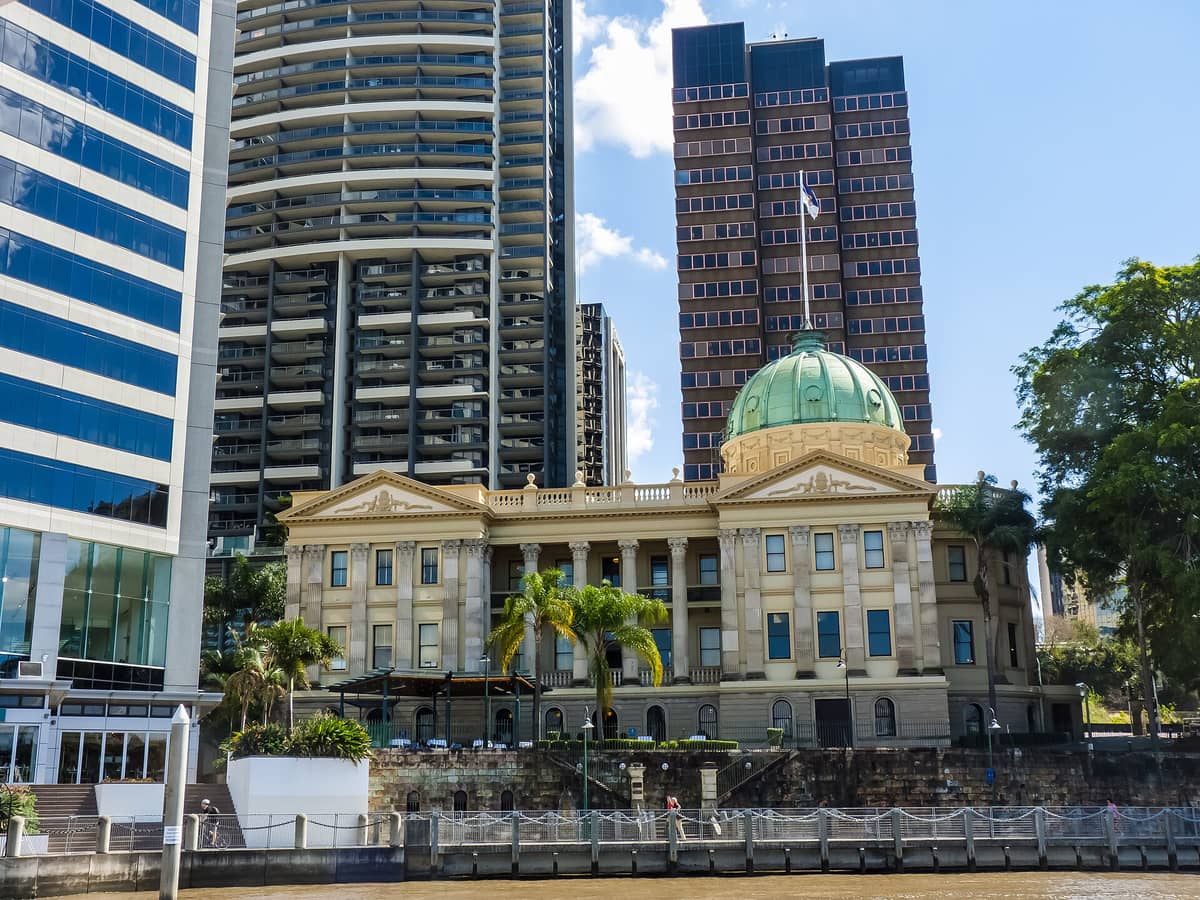
First Impressions: What You See Approaching from Queen Street
Walking down Queen Street toward the river, Customs House announces itself long before you reach it. The copper-green dome sits at the foot of the street like a full stop, framed by the glass towers of the modern CBD on either side. It is a deliberate contrast, and a striking one. The building's sandstone facade, quarried from local sources, gives it a warmth that concrete and steel simply cannot replicate, particularly in the late-afternoon light when the stone takes on a deep ochre tone.
The formal name is Customs House, and construction began in 1886 under Charles McLay of the Colonial Architect’s office, with the building opening in 1889. It rises two storeys on the Queen Street elevation and three on the riverside, where the land drops toward the water. The copper dome above the central rotunda is the defining feature from almost every angle, and it remains structurally intact from the original build.
💡 Local tip
The building is best appreciated from two vantage points: standing at the Queen Street entrance looking up at the dome, and from the riverwalk boardwalk on the southern bank looking back across the water. Both are free and take only minutes to reach.
Inside: The Rotunda, Restoration, and Everyday Atmosphere
The interior is quieter than you might expect. Customs House reopened in October 1994 following a major restoration project, and it now operates primarily as a function and events venue managed in partnership with the University of Queensland. That means the public experience is somewhat curated: the grandest spaces are often prepared for private events, and you may arrive to find a wedding setup underway or corporate signage in the foyer.
When the main hall is open, the rotunda delivers. The interior dome, lined in detailed plasterwork and ringed with tall windows, creates a genuine sense of occasion. Light filters through in soft columns during the morning hours, which is when the space feels most photogenic and least populated. The terrazzo floors and original timber joinery have been sensitively preserved, giving the interior an authenticity that post-1990s restorations often lose.
The restaurant and bar occupy the ground floor and open onto riverside views. Even if you are not dining, the front rooms during off-peak weekday hours give a reasonable sense of the proportions and decoration. Weekday mornings, particularly between 9 am and 11 am, offer the calmest access before corporate lunch bookings fill the space.
⚠️ What to skip
Customs House is closed on public holidays, between Christmas and New Year, and over Easter. General visitor access is limited to weekdays during reception hours (8:30 am–4:30 pm). Visiting on a weekend is not reliable for interior access.
Tickets & tours
Live prices and dates from our booking partner. If you book, we may earn a commission at no extra cost to you.
Luggage Storage in Brisbane
From 5 €Instant confirmationFree cancellationBrisbane's dark stories true crime tour
From 21 €Instant confirmationFree cancellationFull-day Mount Tamborine winery tour from Brisbane with lunch
From 140 €Instant confirmationFree cancellationEscape Tour self-guided, interactive city challenge in Brisbane
From 30 €Instant confirmation
Historical Context: From Colonial Trade Hub to Heritage Landmark
To understand why Customs House matters, it helps to know what the river meant to Brisbane in the 1880s. The Brisbane River was the city's commercial artery. Wool, timber, and agricultural goods moved through the port in significant volumes, and the customs building at the river's edge was the administrative centre of that trade. The building's placement at the foot of Queen Street, Brisbane's main commercial corridor, was deliberate: it projected colonial authority and economic ambition simultaneously.
The decision to build in the Victorian Free Classical style, with its Corinthian pilasters, arched windows, and ceremonial dome, signalled Queensland's aspirations as a prosperous colony. Similar civic buildings of the era appear across the British colonies, but the local sandstone and the dome's copper cladding give this one a character that feels distinctly Queensland.
Brisbane's colonial-era built environment is one of the more underappreciated aspects of the city. Customs House sits naturally within a broader heritage trail that includes Parliament House, Brisbane City Hall, and Newstead House. If this period of architecture interests you, the Brisbane heritage and history guide covers these sites in detail.
The Riverside View: Why the Back of the Building Matters More
Most visitors approach from Queen Street and leave the same way. That is a mistake. The riverside elevation of Customs House is the more interesting facade, and the boardwalk running below it connects to the wider Riverwalk network heading east toward the Story Bridge. From water level, the three-storey river face is imposing in a way the street view does not quite convey, and the relationship between the sandstone building and the steel-and-glass CBD skyline nearby is visually compelling.
Early morning is the best time for photography here. The eastern light catches the sandstone face of the building cleanly, the river is relatively flat before afternoon winds pick up, and the boardwalk is quiet enough to set up a shot without pedestrian interruption. By midday, particularly in summer, the glare off the water makes direct photography of the riverside elevation difficult.
The boardwalk beneath the building connects to the Brisbane Riverwalk, which extends east toward New Farm. It is worth continuing that walk if you have time, as the riverside precinct shifts character significantly within ten minutes of walking.
How Time of Day Changes the Experience
Weekday mornings are the quietest window for interior access. The building functions as an office and event venue, so foot traffic from corporate users is highest around midday and early afternoon. The restaurant draws lunch crowds from surrounding offices on Tuesdays through Thursdays particularly, making the dining room a lively, noisy environment that does not suit quiet architectural appreciation.
By contrast, arriving at 9 am means you may have the foyer and rotunda largely to yourself. Staff are present but unobtrusive, and the quality of natural light through the dome windows is genuinely worth experiencing. Late afternoon on a weekday, as the light shifts and the lunch service clears, is the second-best window.
On a weekend, exterior appreciation is the main activity on offer. The building's Queen Street facade and its riverside elevation are accessible at any time, and the surrounding boardwalk areas remain open. Weekend evenings sometimes see private events in progress, so the building may be illuminated and visually dramatic from outside even if interior access is not available.
Practical Walkthrough: Getting There, Getting In, and What to Bring
The address is 399 Queen Street, Brisbane QLD 4000. Bus and train stations are located nearby. The CityCat ferry stops at Riverside Centre, a few minutes’ walk from the building.
There is no admission charge for general access during business hours. Dining and any events are separately priced. Wear comfortable shoes if you plan to walk the Riverwalk onward; the boardwalk surface is even but can be slippery after rain. Photography with a standard smartphone or camera is unrestricted in public areas.
Accessibility information is not detailed on the official Customs House website. If step-free access is a requirement, contact the venue directly before visiting. For broader context on getting around Brisbane, the getting around Brisbane guide covers public transport options in practical detail.
ℹ️ Good to know
If you are combining this visit with other CBD heritage sites, Customs House works well as a starting point. Walk west along the Riverwalk and you reach Howard Smith Wharves; head south and you can cross to South Bank. The building is genuinely central and easy to fold into a broader walking itinerary.
Insider Tips
- The best exterior photograph of the dome is taken from about 20 metres up Queen Street, with the dome framed between the two nearest office towers. A standard phone camera captures this cleanly.
- The river boardwalk immediately below the building is often empty even during peak lunch hours, making it a calm spot to pause, particularly if you are walking through the CBD heat in summer.
- If you want to see the interior rotunda without navigating around an event setup, call the venue the day before to ask whether the main hall is in use. The reception team is generally helpful with this.
- The building's copper dome has naturally patinated to its current green over decades. The colour changes depending on light conditions: on overcast mornings it reads as grey-green, on sunny afternoons it shifts toward a brighter verdigris that photographs very differently.
- Customs House is closed between Christmas and New Year, over Easter, and on Queensland public holidays. If your trip falls in these windows, plan for exterior-only access.
Who Is Brisbane Customs House For?
- Architecture enthusiasts with an interest in Queensland's colonial building heritage
- Photographers targeting Brisbane's riverfront skyline and heritage contrasts
- CBD walkers looking for a defined destination at the end of the Queen Street corridor
- History-minded visitors building a heritage trail through the central city
- Visitors who want a calm, free stop between the CBD and the Riverwalk
Nearby Attractions
Other things to see while in Brisbane CBD:
- ANZAC Square & Shrine of Remembrance
ANZAC Square and its Shrine of Remembrance sit at the geographic and emotional heart of Brisbane's CBD, offering free access to one of Queensland's most significant commemorative sites. From the flame-lit colonnade to the underground Memorial Galleries, this 1929 landmark rewards both quiet reflection and architectural curiosity.
- Brisbane City Hall
Brisbane City Hall is the Queensland capital's most distinguished civic building, a neoclassical sandstone structure with an 87-metre clock tower and a 31-metre copper-domed auditorium. Free general entry, a central CBD location on King George Square, and genuine architectural grandeur make it a rewarding stop for history-minded travellers and anyone curious about what Brisbane looked like before the glass towers arrived.
- Brisbane Riverwalk
The Brisbane Riverwalk is a free, 870-metre floating walkway connecting Howard Smith Wharves near the CBD to New Farm, with separated pedestrian and cycling lanes, uninterrupted river views, and easy links to some of the city's best precincts. Whether you walk it at dawn for the quiet or at dusk for the light show on the water, it consistently delivers.
- City Botanic Gardens
Established in 1855 on the banks of the Brisbane River, the City Botanic Gardens span 18 hectares of manicured lawns, heritage fig trees, and tropical plantings right in the heart of the CBD. Open around the clock and free to enter, this is the kind of park that rewards a slow morning as much as a quick lunchtime escape.
Planning a trip? Discover personalized activities with the Nomado app.