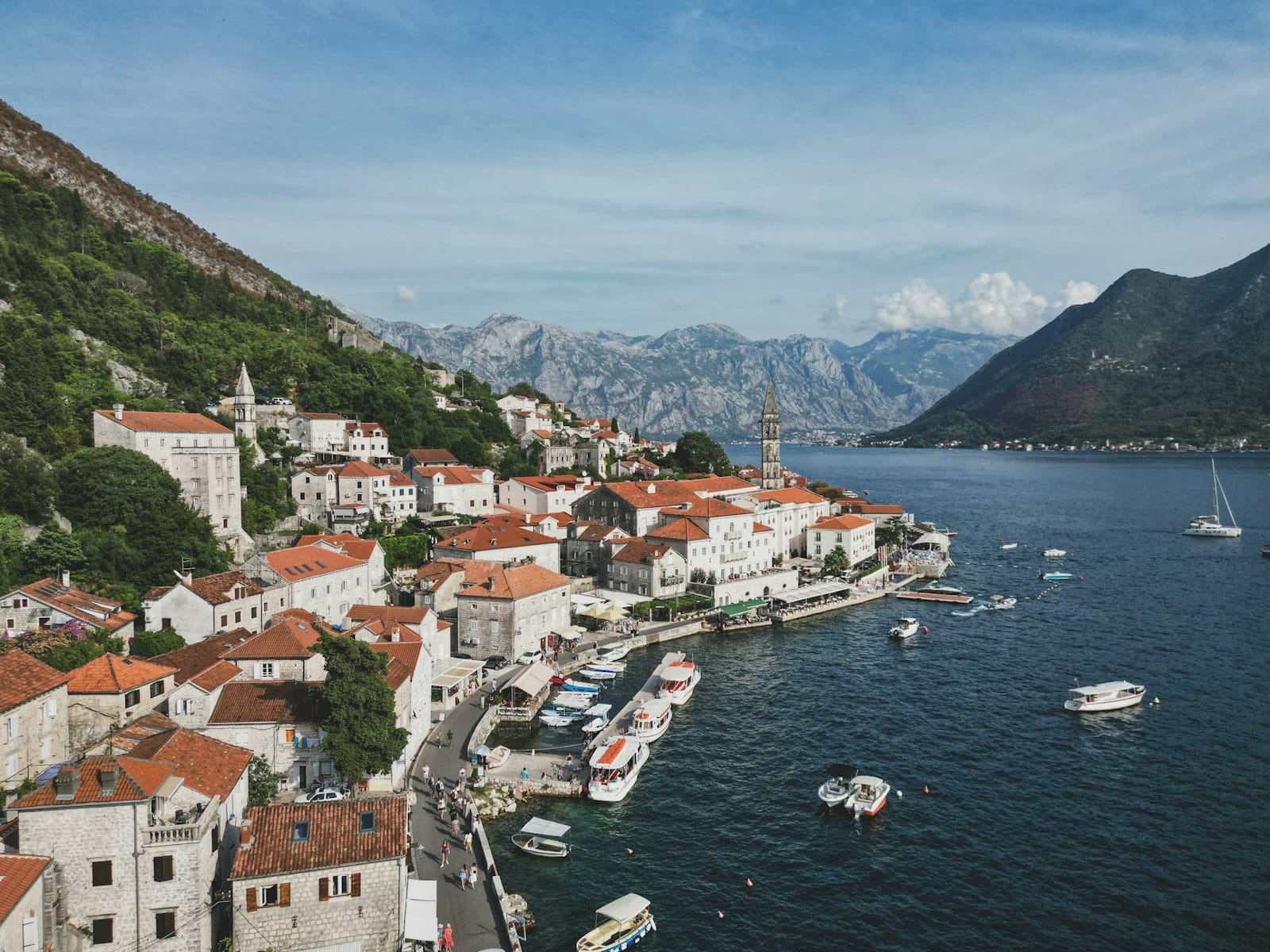
Perast is a compact Baroque village perched on the shore of Kotor Bay, roughly 12 kilometers northwest of Kotor's Old Town. With two island churches visible from its waterfront promenade, a string of weathered stone palaces, and almost no motor traffic, it offers a quieter counterpoint to Kotor's busier streets.
Perast sits at one of the widest points of Kotor Bay, a single curved street of Baroque palaces facing two small islands that seem to float just offshore. It is not a neighborhood in the urban sense but a separate village, small enough to walk end to end in ten minutes, whose stillness and architectural density make it one of the most photogenic places on the Adriatic coast.
Orientation
Perast lies on the northern shore of Kotor Bay, approximately 12 kilometers by road from Kotor's Old Town and about 3 kilometers southeast of the town of Risan. The village occupies a narrow shelf of land between the water and the steep limestone slopes of Mount Orjen. There is essentially one main street, which hugs the shoreline, and a few lanes climbing uphill behind it. The entire settled area is no more than 500 meters long.
The Bay of Kotor road, designated M-2, passes directly through or just above the village, which is how most buses and private vehicles access it. Kotor to the southeast and Herceg Novi to the northwest are the nearest towns of any size. Risan, just a few kilometers along the bay, has a Roman mosaic site worth a short detour but offers little else for visitors. Perast is effectively a destination in itself rather than a transit point.
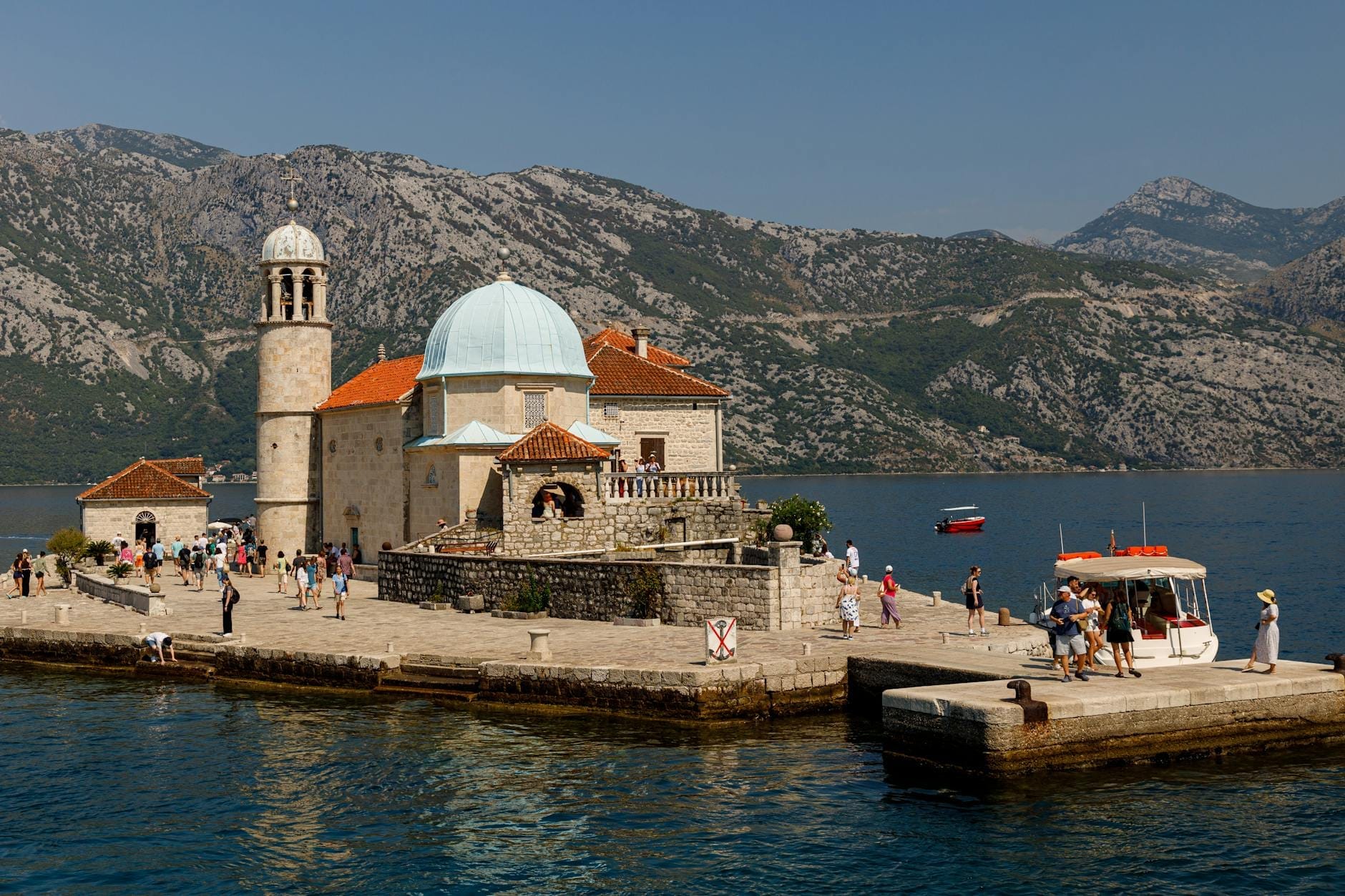
The two small islands visible from the waterfront are Sveti Đorđe (Saint George), a natural islet with a Benedictine monastery, and Gospa od Škrpjela (Our Lady of the Rocks), an artificial island built up over centuries by local sailors. Both sit within rowing distance of the shore. Our Lady of the Rocks is open to visitors and is the more frequently visited of the two.
Character & Atmosphere
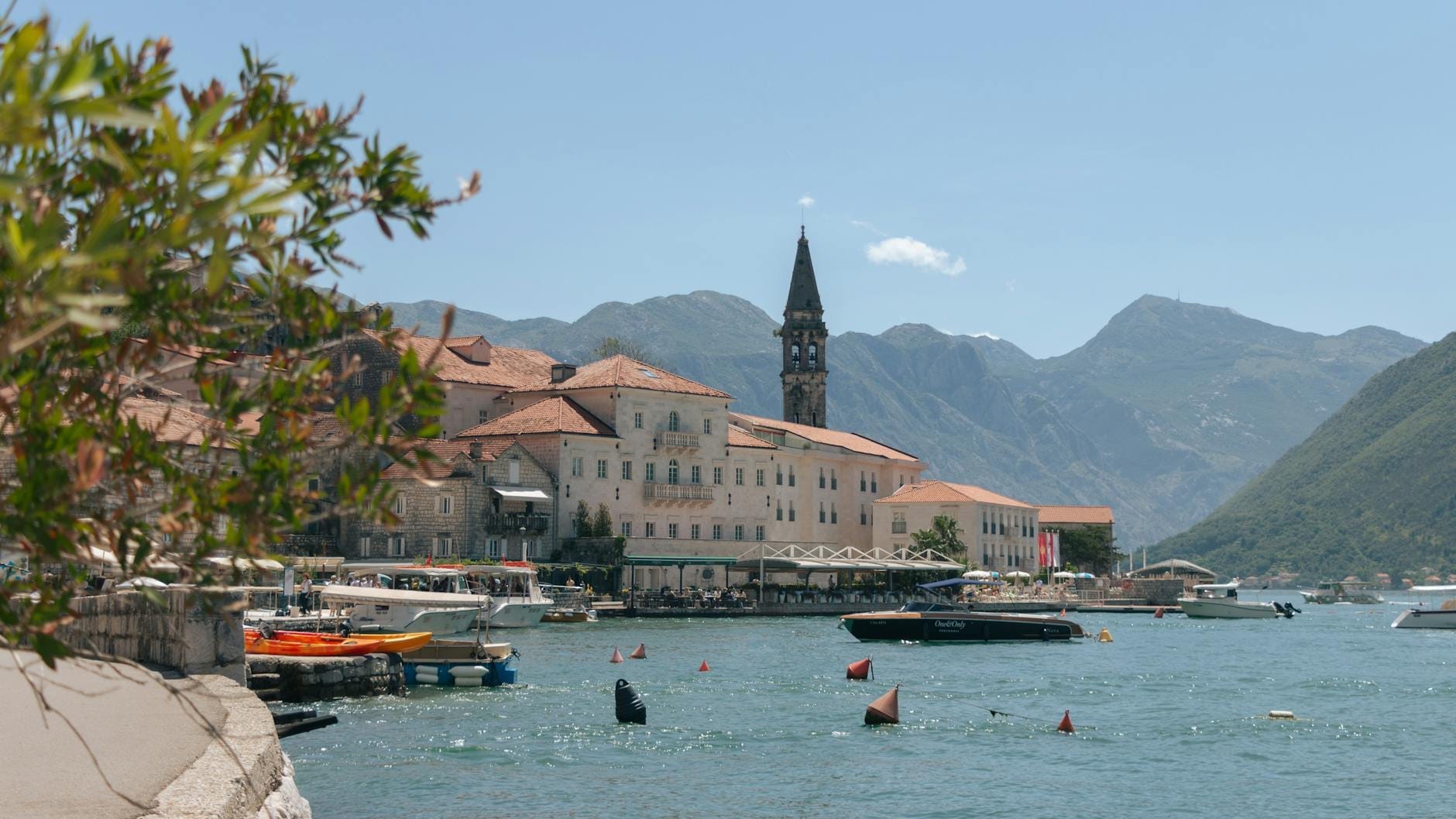
Perast is the kind of place where the loudest sound at seven in the morning is water lapping against stone steps. The main promenade is paved in smooth limestone, worn to a pale shine by centuries of foot traffic, and lined with the facades of 17th and 18th century Venetian-influenced palaces, most of them still used as private residences. Some are in careful repair; others are slowly returning to the hillside, their upper floors open to the sky and colonized by fig trees. The contrast between maintained and crumbling is part of what gives the village its specific texture.
By mid-morning, day-trippers begin arriving from Kotor and from cruise ships docking at the Kotor port. The waterfront fills with people photographing the islands, and the handful of cafe terraces above the water do steady business. But even at peak hours, the village never reaches the compressed density of Kotor's Old Town. The scale simply does not allow it. By four or five in the afternoon, most day visitors have left, and the promenade returns to something close to its morning quiet.
In the evenings, Perast takes on a different quality entirely. The light over the bay turns amber and then deep orange before the mountains cut it off early, since the surrounding ridges block direct sun well before astronomical sunset. Locals sit outside on the stone steps of their houses, the water is glassy, and the illuminated outline of the church on Sveti Đorđe reflects on the surface of the bay. There are very few places to eat or drink after nine, and almost no nightlife, so evenings here are for walking, sitting, and watching the water.
ℹ️ Good to know
Perast is almost entirely pedestrian along its waterfront, but the M-2 highway passes close by and can be noisy in the mornings and evenings when trucks move through. Accommodation on the water-facing side of the main street is quieter than anything on the road side.
What to See & Do
The primary draw is the boat trip out to Our Lady of the Rocks, the artificial island church that local sailors built and expanded over several hundred years beginning in 1452. According to tradition, sailors were required to drop a stone on the reef each time they passed, gradually raising it above the waterline. The interior of the church is covered in votive paintings and silver plaques offered by sailors in thanks for safe passage, creating a dense, layered record of centuries of maritime life.
Sveti Đorđe, the other island, holds a Benedictine monastery and a small cemetery. It is not open to general visitors, but its cypress-fringed profile is one of the most reproduced images of the bay. Back on the mainland, the Perast Old Town itself rewards slow exploration. The palaces of the Zmajević, Bronza, and Bujović families are among the most architecturally significant on the entire Adriatic coast, combining Venetian Gothic and early Baroque styles in a local idiom that developed during the 17th century when Perast was one of the most prosperous towns in the Venetian Republic's eastern territories.
The Bujović Palace now functions as the town museum, housing a collection of maritime instruments, paintings, and artifacts related to Perast's history as a center of naval training. Peter the Great of Russia famously sent officers here in the early 18th century to study seamanship, a fact the village has not forgotten. The bell tower of St. Nicholas Church rises above the waterfront and offers a rare vertical anchor point against the mostly horizontal line of the palaces.
Boat trip to Our Lady of the Rocks island church (boats depart from the waterfront, typically €5 per person)
Bujović Palace Museum covering Perast's maritime history
St. Nicholas Church and its prominent waterfront bell tower
Walking the full length of the promenade from the western to eastern end of the village
Photography of the twin islands from the waterfront at different light conditions
Day-trip extension to Risan for the Roman Hypnos mosaic floor
💡 Local tip
The best light on the islands falls in the late afternoon, when the sun moves to the west and illuminates the church facade on Our Lady of the Rocks directly. If you are arriving from Kotor for the day, aim to reach Perast by 3 PM rather than in the morning.
Eating & Drinking
Perast has a small but reliable food scene anchored almost entirely in the cuisine of the Montenegrin coast: grilled fish, octopus salad, black risotto, and fresh shellfish from the bay. The village is too small to support a diverse restaurant landscape, but what exists is generally of reasonable quality given the tourist traffic. Prices are slightly elevated compared to Kotor, reflecting the location and the captive audience of day-trippers.
Most restaurants cluster along the waterfront promenade, with terraces that extend over the water on wooden platforms. This is where you eat if the view matters to you. A full seafood meal for two with wine typically runs between €40 and €70 depending on the restaurant and your fish selection. For something lighter, several cafes serve coffee and pastries through the morning and afternoon. For broader context on what to order along the bay, the Kotor food guide covers the regional specialties in detail.
There is no significant bar scene in Perast. A few establishments stay open until ten or eleven in summer, but this is not a place to come looking for nightlife. The cafes are best in the morning, when the promenade is uncrowded and a coffee with a view of the bay costs around €2. By midday, the terrace tables fill quickly, particularly on weekends and during cruise ship days.
⚠️ What to skip
Many restaurants in Perast operate seasonally and may be closed or on reduced hours outside the April to October window. If you are visiting in winter or early spring, check ahead, as options may be limited to one or two establishments.
Getting There & Around
From Kotor, Perast is reachable by public bus on the line running toward Herceg Novi. Buses depart from Kotor bus station and take roughly 20 to 25 minutes. The bus stop in Perast is on the main road above the village, requiring a short walk down to the waterfront. Frequency is moderate rather than frequent, so checking the timetable before you leave is advisable. For general transit advice in the region, see the guide to getting around Kotor.
Taxi and ride-share services from Kotor to Perast take 15 to 20 minutes and cost roughly €10 to €15 depending on the operator and time of day. This is often the more practical option for couples or small groups, particularly if you want to arrive at a specific time or return on your own schedule. Several operators in Kotor also run organized day tours that combine Perast with stops in Risan and Herceg Novi.
Bay of Kotor boat tours sometimes include Perast as a stop, which is a pleasant way to approach the village from the water and see the two islands at the same time. Bay of Kotor boat tours typically depart from the Kotor marina and run half-day or full-day circuits of the inner bay. Within Perast itself, no transport is needed: the village is entirely walkable, and the promenade covers the full settled area in about ten minutes at a slow pace.
If you are planning a wider circuit of the region, Perast works well as part of a day trip from Kotor that also takes in Risan or the mountain road up toward Lovćen National Park. The M-2 road continues northwest past Perast toward Herceg Novi, and southeast back to Kotor, making the village easy to combine with other stops along the bay.
Where to Stay
Perast has a limited but genuinely appealing accommodation offer, concentrated in restored stone buildings along or just behind the waterfront. The experience of sleeping here is fundamentally different from staying in Kotor: the village is quiet after dark, there is no Old Town foot traffic, and you wake to the sound of water and boats rather than tour groups. For travelers who want the bay without the noise, it is worth considering seriously.
Most options are small boutique guesthouses or apartments renting rooms within historic buildings. A handful have water-facing terraces, which command premium rates in high season. There are no large hotels in the village. For travelers weighing options across the wider Kotor area, the Kotor accommodation guide covers the full range from Kotor Old Town to the surrounding bay villages.
The main trade-off with staying in Perast rather than Kotor is reduced access to restaurants, shops, and evening activity. If you need more than one dinner option within walking distance, or if you want to explore Kotor's Old Town freely at night, staying in Perast means organizing transport back after dark. For travelers happy to settle into one place and use Kotor as a day trip rather than a base, Perast works extremely well.
Honest Assessment
Perast is not the right choice for every type of traveler. It has almost no urban energy, no shopping, minimal nightlife, and limited dining variety. In shoulder season it can feel close to deserted on weekday evenings, with only the sound of the water and the occasional car on the highway above. Visitors expecting a lively small town will be disappointed.
What it does offer is architectural quality, genuine quiet, and a specific kind of beauty that photographs cannot fully capture: the texture of 400-year-old stone in afternoon light, the visual logic of two islands placed perfectly in the mouth of the bay, the sense that you are looking at a place that has changed very little in the past century. For that, it is worth the trip from Kotor, even for a single afternoon. Paired with a visit to Kotor Old Town, it rounds out a complete picture of what the bay offers at its best.
TL;DR
Perast is a small Baroque village 12 km from Kotor, built on a single waterfront street facing two island churches in the middle of Kotor Bay.
Best suited to travelers who want quiet, architectural beauty, and a break from Kotor's crowds, rather than nightlife or urban convenience.
The boat trip to Our Lady of the Rocks is the main organized activity; the village itself takes less than an hour to walk fully.
Accessible by public bus from Kotor in 20-25 minutes, or by taxi in 15-20 minutes; works well as a half-day or full-day trip.
A small number of boutique guesthouses make it possible to stay overnight, which gives you the village in the evenings and early mornings when day visitors are absent.
Two days in Kotor is enough to cover the essentials without feeling rushed, but only if you plan smartly. This itinerary takes you through the walled Old Town, up to the fortress, out onto the Bay of Kotor, and into the best local restaurants — with honest advice on what to skip and when to go.
The Bay of Kotor is one of the most dramatic stretches of water in the Adriatic, and exploring it by boat is genuinely rewarding. But not all tours are equal. This guide breaks down every major option, from group cruises to private speedboats, so you spend your money on the right one.
Kotor rewards visitors differently depending on when you go. This guide cuts through the hype to tell you exactly which months suit which travel styles, what the weather actually feels like inside those medieval walls, and when to avoid the cruise ship crush.
Kotor is a superb base for exploring the Bay of Kotor and the Montenegrin coast. This guide covers the best day trips from Kotor, with real logistics, honest rankings, and the options that most visitors overlook.
The journey from Dubrovnik to Kotor is one of the most scenic short trips in the Adriatic. Here is a complete breakdown of every transport option, realistic timings, border crossing realities, and how to make the most of the route.
Kotor's medieval old town is walkable in under 20 minutes, but the surrounding Bay of Kotor stretches across 28 kilometres of coastline. This guide covers every transport option, with honest advice on what works, what doesn't, and how to move around Montenegro like someone who's done it before.
Kotor Montenegro gets enormous hype, but the reality is more nuanced than the Instagram photos suggest. This guide cuts through the noise with honest takes on the crowds, costs, highlights, and the cases for and against making the trip.
The Blue Cave near Kotor is one of Montenegro's most photographed natural attractions, but getting there takes planning. This guide covers every practical detail: tour options, pricing, seasonal conditions, and what the experience is actually like.
The Kotor Cable Car climbs from Dub, inland from the Old Town, to Kuk on Mount Lovćen at 1,348 metres in 11 minutes. This guide covers fares, hours, how to reach the lower station, what waits at the top, and how the ride differs from hiking Kotor's fortress walls.
Kotor, Montenegro has one of the most celebrated cat cultures in the world. This guide covers the history behind the city's feline reputation, where to spot cats in the Old Town, the dedicated Cat Museum, how to interact responsibly, and what to buy at cat-themed shops.
Kotor is one of the most rewarding cruise stops in the Adriatic. This guide covers everything from where your ship docks to what to prioritize when time is short, including the Old Town walls, viewpoints, day trip options, and practical logistics for first-time visitors.
The hike up Kotor's medieval fortress walls to the Fortress of San Giovanni is one of the most rewarding climbs in the Adriatic. This guide covers the full route, ticket costs, timing advice, what to bring, and honest tips on what the experience is actually like.
Summer is Kotor's peak season, and it shows. Cruise ships, scorching heat, and packed streets define July and August, but the Bay of Kotor is genuinely spectacular in warm weather. This guide breaks down exactly what to expect and how to plan smart.
A detailed self-guided walking tour through Kotor Old Town, covering the best squares, churches, city walls, and hidden corners of Montenegro's UNESCO-listed medieval town. Includes route logistics, timing tips, and honest advice on what to skip.
Kotor and its surrounding bay offer some of the most dramatic scenery in the Mediterranean. This guide covers every worthwhile viewpoint, from the city walls above the old town to the mountain peaks of Lovćen, so you know exactly where to go and when to get there.
Kotor packs an extraordinary range of experiences into a small area: a UNESCO-listed medieval old town, medieval churches, vertiginous fortress hikes, and boat trips to baroque villages across the bay. This guide covers the 18 best things to do in Kotor, organized by theme so you can plan your time well.
Kotor's food scene is shaped by its geography: Adriatic seafood from the bay, slow-cooked mountain meat from the Montenegrin interior, and centuries of Venetian influence layered into everything. This guide covers what to order, where to eat it, and what to skip.
Kotor's food scene punches well above its size. This guide covers the best restaurants, local dishes worth ordering, bars for evening drinks, and the tourist traps to avoid in the Old Town and beyond.
Choosing where to stay in Kotor shapes your entire trip. This guide breaks down every main area, from the medieval Old Town to the quieter bay villages, with honest advice on who each neighborhood suits, what to expect at different price points, and which options to skip.