Perast Old Town: The Bay of Kotor's Most Perfectly Preserved Baroque Village
Perast is a single-street Baroque village on the Bay of Kotor that once rivaled Venice for maritime wealth. Today it offers stone palaces, waterfront cafes, and direct boat access to two island churches — all within an hour of Kotor.
Quick Facts
- Location
- Perast, Bay of Kotor, Montenegro — approximately 12 km north of Kotor
- Getting There
- Local bus from Kotor (approx. 20-25 min) or taxi. No car park inside the village — park at the entrance and walk in.
- Time Needed
- 2 to 4 hours, including a boat trip to the islands
- Cost
- Free to walk the town. Boat to the islands charged separately by local boatmen (negotiate on the waterfront).
- Best for
- Baroque architecture, slow travel, photography, day trips from Kotor
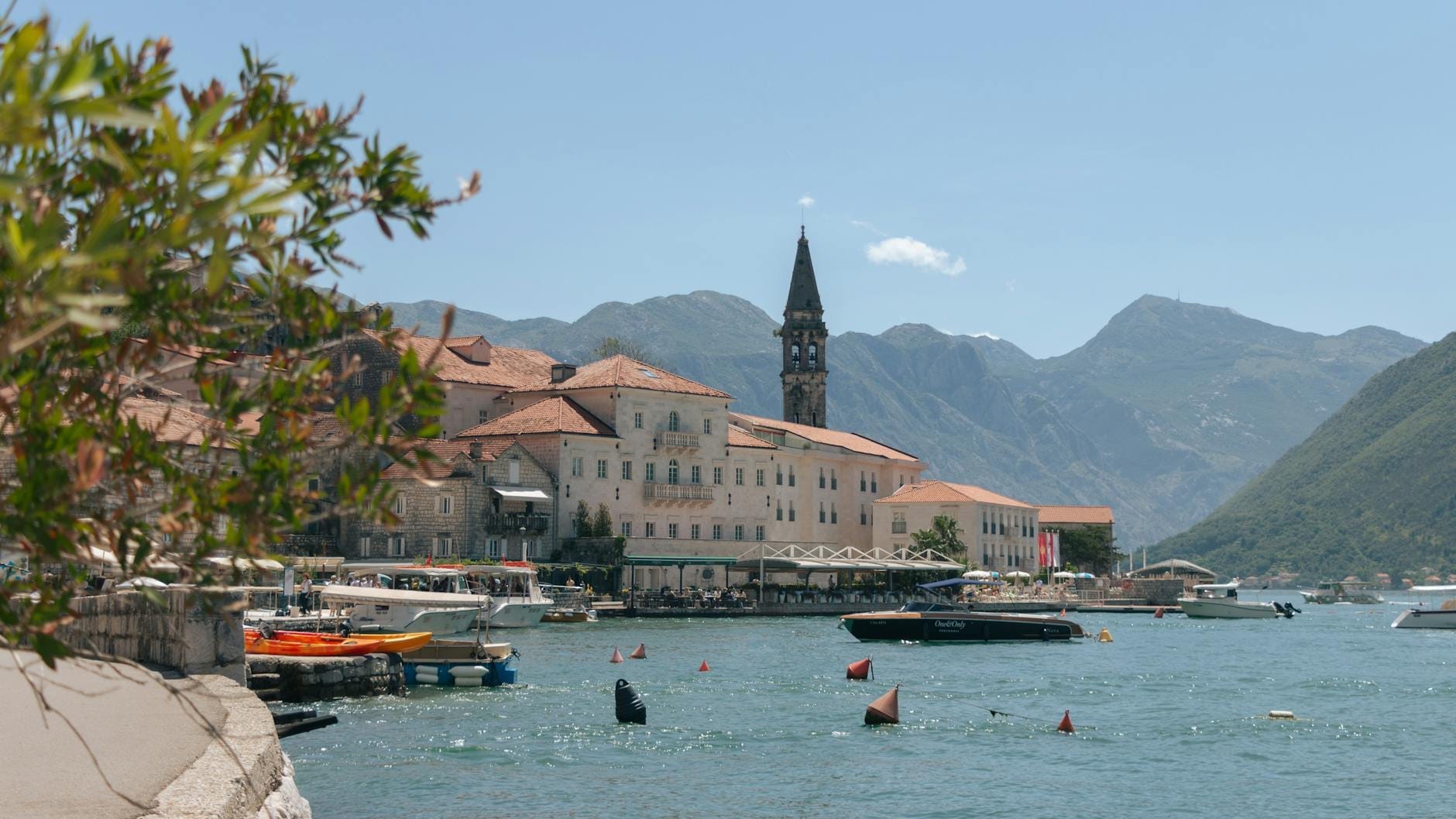
What Perast Actually Is
Perast Old Town is not a tourist reconstruction or a polished heritage site. It is a genuine, inhabited Baroque village that has barely changed structurally since the 17th and 18th centuries, when it was one of the most important maritime towns on the Adriatic. The entire settlement runs along a single curved street — no grid, no side roads of consequence — pressed between the limestone hillside and the calm water of the Bay of Kotor.
At its peak, Perast was home to around 1,600 residents, operated a fleet of trading ships, and maintained 19 Catholic churches and 16 captain's palaces. Today fewer than 350 people live here year-round, and several of those palaces have been converted into hotels or private residences. The result is a place that feels more like a living open-air museum than a functioning town — and that quality, honestly, is both its greatest charm and its main limitation.
ℹ️ Good to know
Perast is best experienced as a day trip from Kotor, ideally combined with a boat ride to Our Lady of the Rocks island. Most visitors spend 2 to 3 hours total. There is nothing wrong with that rhythm — the town is genuinely compact.
Arriving in Perast: The First Impression
Buses from Kotor drop you at the edge of the village, near the small car park where the road narrows. From there, the walk into the old town takes under five minutes on foot, and the shift is immediate. The road surface changes to worn stone, the buildings close in on both sides, and the water appears ahead through gaps between palace walls.
The main promenade runs along the waterfront, lined with stone benches, café terraces, and old wooden boats bobbing against iron rings. In the morning, before 9 a.m., the street is nearly empty. You can hear the water, the occasional bell from St. Nicholas Church (or St. Nikola), and the sound of café staff setting up chairs. This is when Perast looks most like the photographs — glassy water, soft light on pale stone, no tour groups blocking the view.
By midday in peak season (June through August), the atmosphere shifts considerably. Cruise passengers arriving from Kotor and day-trippers from Budva fill the promenade, and the café terraces become crowded. The town handles this better than most places its size because the waterfront is relatively wide and the crowds disperse quickly toward the island boat departures. But if solitude is your goal, arrive early or visit in May or September.
Tickets & tours
Hand-picked options from our booking partner. Prices are indicative; availability and final rates are confirmed when you complete your booking.
Self-guided discovery walk in Kotor - medieval streets of Old Town
From 28 €Free cancellationDiscover scenic Kotor and Perast in Montenegro Private Tour
From 563 €Instant confirmationFree cancellationOld Town Dubrovnik tour with transport from Tivat
From 58 €Instant confirmationFree cancellationOne day private trip from Budva to Perast
From 48 €Instant confirmationFree cancellation
The Architecture: What You're Actually Looking At
The Baroque palaces of Perast were built by sea captains who had made their fortunes trading across the Mediterranean, often under Venetian protection. Under the Republic of Venice, which controlled this coastline from the 15th century to 1797, Perast developed a distinct architectural identity: tall stone palaces with arched ground-floor loggias, exterior staircases, elaborate window surrounds, and family coats of arms carved above doorways.
The Bujović Palace (now housing the Town Museum), the Smekja Palace, and the Bronza Palace are the most photogenic examples on the waterfront. Many are in partial disrepair — cracked facades, shuttered windows, vegetation pushing through stone joints — and this state of genteel decay is actually part of what makes Perast feel authentic rather than sanitized. A fully restored Perast would feel like a stage set.
The most prominent religious building is St. Nicholas Church, whose bell tower rises at the southern end of the main street. — a detail that has become inadvertently characteristic of the town's bittersweet history of interrupted ambition.
💡 Local tip
Look for the carved stone coat-of-arms panels above palace doorways as you walk. Each one represents a different sea captain's family. The density of them on a single street gives you a sense of just how wealthy this tiny town once was.
The Two Islands: The Real Reason Most People Come
The two small islands visible from the Perast waterfront are the spiritual and visual center of the bay. The natural island, Sveti Đorđe (St. George), holds a Benedictine monastery and a historic cemetery for Perast sea captains. It is not open to the general public. The artificial island immediately beside it is the home of Our Lady of the Rocks, a pilgrimage church built on a man-made foundation of submerged rocks and old ships — and this one you can visit.
Boat rides to Our Lady of the Rocks depart from the waterfront in front of the main promenade. Local boatmen offer the crossing informally — you negotiate directly with them rather than booking through an agency. The ride takes around five minutes each way. The church interior contains an extraordinary collection of ex-votos: 2,500 silver votive tablets donated by sailors in thanks for survival at sea, along with a series of naïve oil paintings depicting maritime disasters. It is a genuinely unusual and moving space.
If you are planning to visit Perast as part of a broader day on the water, it fits well into a Bay of Kotor boat tour itinerary, where you can combine it with other stops like the Blue Cave or a pass through the Verige Strait.
The Town Museum and St. Nicholas Church Tower
The Bujović Palace on the waterfront houses the Perast Town Museum, a small but well-organized collection of maritime artifacts, weapons, portraits, and documents relating to the town's history under Venice. The exhibits are modest by international standards but contextually important: the models of historic Perast ships, the naval charts, and the personal effects of sea captains give substance to what otherwise risks becoming a walk through pretty ruins without meaning.
The bell tower of St. Nicholas Church is climbable, and the view from the top is one of the most rewarding in the entire Bay of Kotor. You look directly down at the two islands, across to the forested hillside opposite, and along the curved waterfront of the village. It is not a long climb, but the steps are steep and uneven, so sturdy footwear matters. The tower is occasionally closed for maintenance — check locally on the day.
⚠️ What to skip
Perast has very limited shade on the waterfront promenade. In July and August, the stone reflects heat significantly by late morning. Bring water, wear sun protection, and plan to be finished walking before noon if heat is a concern.
Eating and Spending Time in Perast
The café and restaurant options on the main waterfront are decent rather than exceptional. Most serve grilled fish, local seafood, and Montenegrin wine. Prices are slightly elevated compared to Kotor, which is typical for a location this scenic with limited competition. The waterfront terrace experience itself, with the view of the bay and the islands, justifies sitting down for at least one coffee.
Perast does not have significant shopping, nightlife, or large-scale tourist infrastructure. It is a place for slow walking, looking carefully at old stone, and sitting by the water. Travelers expecting the density of activity available in Kotor Old Town will find it genuinely quiet by comparison. That is its appeal, not a flaw — but it is worth knowing before you allocate your day.
Getting There from Kotor
The most practical way to reach Perast from Kotor is by local bus, which runs along the coastal road and stops at the village entrance. The journey takes roughly 20 to 25 minutes depending on traffic. Taxis are also widely available and make sense for small groups splitting the cost. Some visitors arrive as part of a day trip from Kotor, combining Perast with a stop at Risan or the nearby Roman mosaics.
Driving is straightforward, but note that the old town street is not accessible by car. Parking is available at the village entrance near the main road. In peak summer months, this small car park fills by mid-morning. Arriving before 9 a.m. or after 5 p.m. resolves most parking and crowd issues simultaneously.
Perast also appears as a stop on many organized bay tours by boat, which approach from the water side and offer a completely different arrival experience. Seeing the village from the water first, with its bell tower and island backdrop, provides genuine visual context for the place that you cannot get from the road.
Insider Tips
- Arrive before 9 a.m. in summer. The waterfront is quiet, the light on the stone is at its best, and boatmen are already operating to the islands. You can complete your visit before the midday crowds arrive from Kotor.
- Bring cash for the boat ride to Our Lady of the Rocks. The boatmen are independent operators and do not accept cards. Prices are negotiable, especially outside peak hours.
- Walk to the far southern end of the village beyond St. Nicholas Church. Most visitors turn back at the main cluster of cafes. The quieter residential section at each end of the street shows Perast as a real place where people live, not just a tourist corridor.
- The view from the St. Nicholas bell tower is significantly better than the waterfront ground-level view for photography. The island framing from above is the classic Perast composition. Check whether the tower is open when you arrive.
- If you visit in late July, ask locally about the Fašinada ceremony, an annual tradition in which residents row out and add stones to the artificial island of Our Lady of the Rocks, continuing the centuries-old practice of expanding its foundation. It is one of the most genuine local traditions still practiced in the Bay of Kotor.
Who Is Perast Old Town For?
- Architecture and history enthusiasts who want context for Venetian influence on the Adriatic coast
- Photographers looking for classic Bay of Kotor compositions with the two islands as a backdrop
- Slow travelers who want a half-day of calm waterfront walking without the density of Kotor
- Visitors combining the islands and Perast into a single boat-and-walking itinerary
- Couples and small groups who prefer atmosphere over activity
Nearby Attractions
Other things to see while in Perast:
- Our Lady of the Rocks (Gospa od Škrpjela)
Rising from the still waters of the Bay of Kotor near Perast, Our Lady of the Rocks (Gospa od Škrpjela) is a small Roman Catholic church built on an artificial island over several centuries. It holds an extraordinary collection of votive offerings, silver tablets, and oil paintings, making it far more interesting inside than its modest exterior suggests.